Creality Ender-3 V3 Review
A UK review of the Creality Ender-3 V3: what the CoreXZ gantry changes, the clog owners keep hitting, what it costs to run, and why it is hard to buy.
Independent and reader-funded. We earn a commission if you buy through our links, at no extra cost to you. How this works.
The Creality Ender-3 V3 is a 220 × 220 × 250 mm open-frame printer built on what Creality calls a CoreXZ gantry, and the machine assessed here is the plain Ender-3 V3 — not the SE, the KE or the Plus, which share the name and none of the specification.
What this Creality Ender-3 V3 review adds is the part a product page has no reason to tell you. The headline is a 600 mm/s ceiling; the useful questions are what that figure survives contact with, which component owners of this model keep having to clear, and whether you can still buy one in Britain. That last turned out to be the hard one. Nothing was printed, handled or measured here, and no UK price could be verified from any route reached. If you have not settled on this machine, the best FDM 3d printer uk guide ranks the field.
Which Ender-3 V3 this is, and whether it is still in stock in the UK
Settle the name first: Creality has sold four machines called Ender-3 V3, and they share little but the badge. This is the base model, the CoreXZ-gantry machine with a 220 × 220 × 250 mm plate. The KE is 10 mm shorter in Z and stops at 100 °C on the plate where this one reaches 110 °C, though both take the nozzle to 300 °C. The SE is slower and narrower; the Plus is a size step.
Then the harder question. Checked on 1 October 2026, the UK routes went four ways: Creality's own UK store page showed the machine in stock with UK despatch but rendered its price as an unfilled template; its UK Ender-3 collection page lists the SE instead; the global store showed it sold out; and the authorised UK retailer that used to carry it states it no longer sells the product. The Amazon.co.uk listing returned a server error and was not reached.
Creality names no replacement anywhere reached — not a documented run-out, then, but a supply line that has quietly thinned.
The specification, and what each figure changes
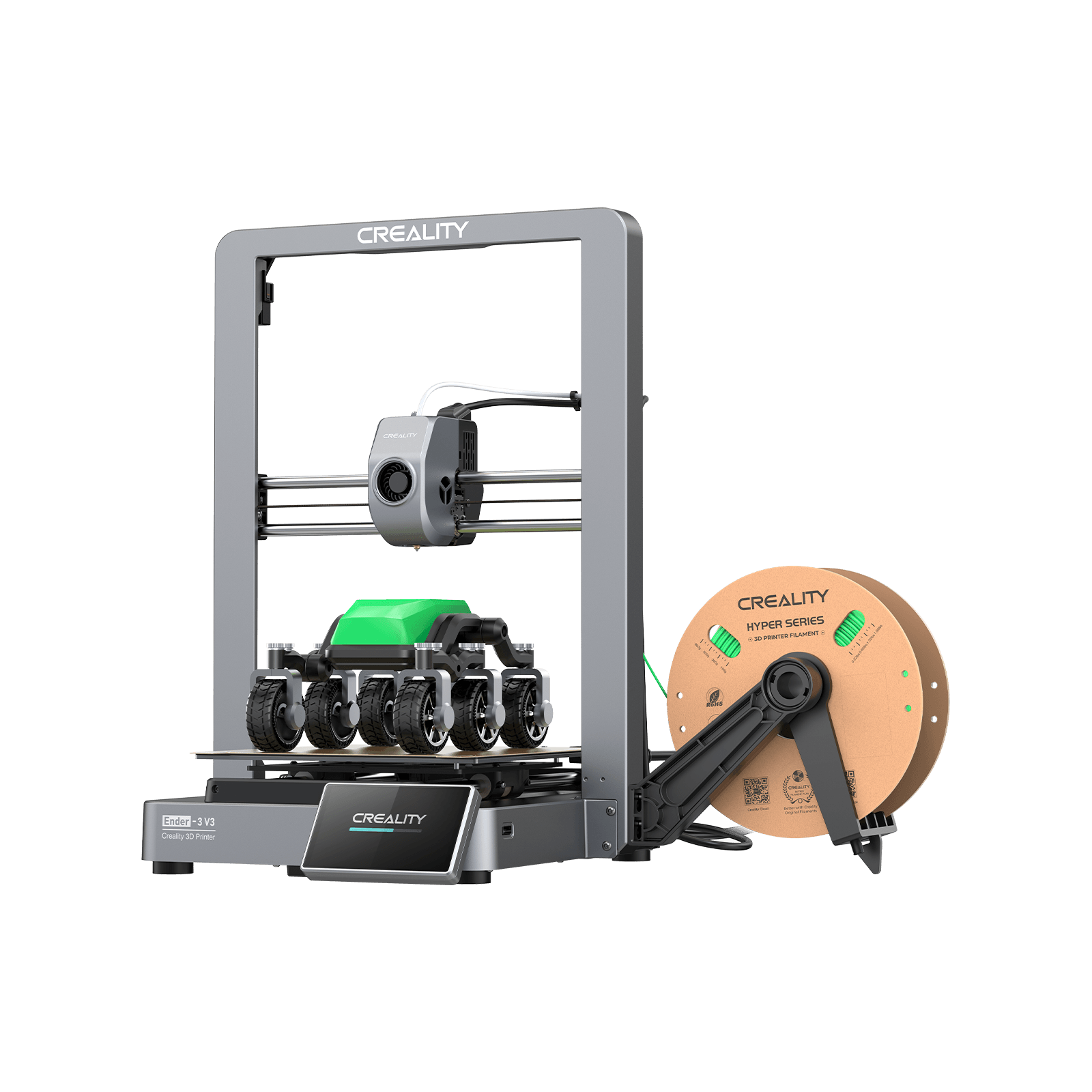
Creality Ender-3 V3
Ender-3 V3 (base CoreXZ model) — not the V3 SE, V3 KE, V3 Plus or Ender-3 V4
A hardened steel nozzle and a 110 °C plate as standard. The most capable Ender-3 V3 on paper, and the hardest to buy.
- Build volume
- 220 × 220 × 250 mm
- Technology
- FDM
- Max speed
- 600 mm/s (20,000 mm/s² acceleration)
- Enclosed
- No
- Multi-colour
- No
- Auto levelling
- Yes (auto-levelling with one-tap calibration and automatic Z offset)
What we like
- A hardened steel nozzle on a metal hotend, fitted as standard, so abrasive filament needs no upgrade part first
- A 110 °C build plate — the hottest in the Ender-3 V3 range, and ten degrees past both rivals compared here
- 600 mm/s and 20,000 mm/s² quoted, on an integrated die-cast aluminium frame with input shaping and a G-sensor
- USB and Wi-Fi transfer, 8 GB of onboard storage and over-the-air firmware updates
- Automatic levelling with one-tap calibration, plus a filament run-out sensor and power-loss recovery
What we don’t
- UK supply has largely gone: one Creality route still shows stock, and no UK price could be verified from any route
- Creality's materials list for this model omits ASA, polycarbonate and nylon — the cheaper V3 KE lists ASA
- ±0.2 mm over 100 mm is an ordinary published accuracy figure for the money
- Owner reports on Creality's own forum repeatedly describe extrusion lost to a clog partway through a print
- The quick-swap nozzle is proprietary, so a generic V6 or MK8 tip will not fit
- No acoustic rating is published for this machine anywhere, and no independent measurement was found
Start with the gantry, which is widely reported wrongly. Creality calls this a CoreXZ gantry: X and Z share a belt path, so two motors drive them together. That is not CoreXY, and it is not a static bed — the plate still slides back and forth carrying the part. What CoreXZ buys is a lighter X carriage, which is what lets a frame be driven hard.
Creality quotes 600 mm/s with 20,000 mm/s² of acceleration, both ceilings under its own conditions. Two things stop figures like that being decoration: an integrated die-cast aluminium frame, because acceleration a machine cannot hold still returns as ringing on a flat surface, and input shaping with a G-sensor, which measures the machine's own resonance and cancels it in the motion planning.
Temperature sets what flows and what stays stuck down: 300 °C at the nozzle, 110 °C at the plate — ten degrees past both machines compared later.
Then the part you keep for the life of the machine: a metal hotend with a 0.4 mm hardened steel nozzle as standard, on a direct drive extruder. Chopped carbon fibre wears brass open, so hardened steel as standard means abrasive filament needs nothing bought first. Two part-cooling fans sit either side of the extrusion, which holds an overhang up at speed.
The rest is quietly complete: a run-out sensor and power-loss recovery, files over USB or Wi-Fi with 8 GB of storage, a 4.3-inch touchscreen, and 350 W of rated power. Wi-Fi matters more than it looks: the SE below takes files by SD card.
What the Ender-3 V3 does well
Three strengths are real, and none is the headline speed.
It arrives ready for abrasive filament. The hardened steel nozzle fitted as standard is the most useful thing on the machine, and the cheaper KE's brass tip makes the point: carbon-filled filament grinds brass open from the inside until extrusion goes thin and dimensions wander. No upgrade to buy, no wear clock running.
The hot plate is worth more than it looks. Ten degrees over both alternatives on this page is the difference between ABS staying down on an open frame and curling off at a corner.
It is solid for the money. The die-cast frame is what the acceleration figure rests on.
A fourth strength Creality does not advertise. Owner reports describe the machine running Klipper underneath, with its configuration editable through the web interface it already serves; the limit they also describe is a custom build they cannot version, with attempts to add adaptive mesh levelling going unrecognised, although this is not consistent across all reports. A higher ceiling if you like tinkering, a warning if you do not.
Where the Ender-3 V3 falls short
Four limitations matter, and the last is why this review reads as it does.
The materials list is narrower than the cheaper sibling's. Creality lists PLA, TPU90A, PLA-CF, PETG-CF, PETG and ABS. Read what is absent: no ASA, no polycarbonate, no nylon. The KE, which costs less, adds ASA — so the hotter plate buys no extra range on paper.
The published accuracy is ordinary. Creality states ±0.2 mm over 100 mm, under its own conditions rather than as a promise — a tolerance to design around on anything that must press-fit into another part.
The speed headline does not survive a real part. A recurring theme among owners is that the usable speed sits far below the quoted ceiling, with contributors converging on roughly a quarter above a normal profile as the point where quality still holds, and reporting skipped axis movement on some machines beyond that. Against the 600 mm/s on the specification sheet, that is a reminder of what a maximum is: achievable on a test coupon, irrelevant on a bracket.
The consumables are proprietary, and the machine is hard to buy. The nozzle is Creality's own Unicorn quick-swap design, shared with the K1C and the Ender-3 V3 Plus, so a generic V6 or MK8 tip will not fit, and abrasive filament means buying replacements at Creality's prices. And one UK route still shows stock while its own maker's collection page has moved on.
What owners consistently report
The basis here is recurring themes researched across Creality's own forum section for this model — and a support forum is where people go when something has gone wrong. Read these as the shape of the machine's problems, not the odds of meeting one.
The dominant pattern is a clog, and it arrives late rather than at the start. Owner reports in Creality's own forum for this model repeatedly describe prints starting cleanly and then losing extrusion to a clog partway through, with contributors tracing it to heat creeping up past the heatbreak and pointing at the hotend cooling fan first; the remedies they settle on are a cold pull, replacing the softened filament tube and easing the extruder tension, although outcomes are not consistent across all reports and one owner described the failure going as far as damaging the board.
The mechanism tells you what to check: above the heatbreak, filament softens in the cold side of the extruder and sets there, and the fan cooling the heatsink is all that holds that heat back — not the part-cooling fans, which cool plastic already laid down.
The second pattern will cost you an evening. A recurring theme among owners of this model is that automatic calibration sets a first-layer height that needs correcting, and that the correction does not survive the next calibration; what contributors settle on is writing the offset into the printer's configuration file through its own web interface, setting it in the slicer, or turning automatic calibration off before a print. Set that beside the specification: levelling is fully automatic. The hardware measures; the software will not remember the answer.
In fairness: one owner described Creality answering inside about two days and agreeing to send replacement parts.
Setup, and the first week with it
Getting it standing up is quick: Creality ships the machine as pre-assembled modules and puts assembly at about ten minutes — an honest estimate for bolting the gantry to the base, and not one for a good first print.
Calibration is the part done for you, on paper. Levelling is fully automatic, with one-tap calibration and an automatic Z offset, so the apprenticeship older Ender machines demanded — a sheet of paper, a nozzle gap and a fortnight of test squares — is not part of this purchase. Budget the first evening for the first layer anyway, for the reason above: the fix lives in a configuration file or in the slicer rather than on the touchscreen.
Software is thin but sufficient: Creality Print and Creality Cloud, with nothing else named for this model. Those profiles will get PLA and PETG printing well by the end of that first evening.
Creality Ender-3 V3 print quality and what it will actually print
No printing was carried out for this review, so Creality Ender-3 V3 print quality is set out as what the machine is specified to do and where its own figures place the limits — not as a verdict on parts nobody here has held.
Layer height runs from 0.1 mm to 0.35 mm: the fine end for display pieces, the coarse end for brackets nobody will inspect, and the coarse end is where real time is saved rather than at the speed slider.
The carbon-filled pair on Creality's materials list is the genuine strength. PLA-CF and PETG-CF are stiffer and less prone to creeping out of shape than their unfilled versions, and the hardened tip lets you run them without watching a brass nozzle wear open.
ABS deserves a narrower answer than the list gives it. The plate and nozzle temperatures are high enough for it. But the frame is open and ABS shrinks as it cools, so a tall or wide part competes with the draught in the room: expect small ones to come out well and large ones to need a box over the printer and patience. For anything structural going outdoors ASA would be better — and this is the machine in the range that does not list it.
Living with a Creality Ender-3 V3: noise, space and what it costs to run
Noise comes with an admission: Creality publishes no acoustic rating anywhere it could be checked, no independent measurement was found, and the third-party decibel figures circulating are not reproduced here, because a number nobody can trace is worse than none. What can be said comes from its own community. Several owners describe the machine's quiet mode as roughly halving speed while reducing fan noise, so the two are traded against each other rather than chosen independently.
Creality publishes no dimensions or weight for this model and the one retailer figure found is uncorroborated, so no footprint is quoted. Reason from the geometry: the plate is 220 mm deep and it moves, because this is a bedslinger — allow roughly double that depth front to back, plus height for the gantry and room behind for a spool. There is no enclosure and no filter either, so print ABS somewhere you can ventilate.
Electricity is the small cost. Creality rates the machine at 350 W — the socket's ceiling, not what the printer draws once going, and no typical figure is published. So, the ceiling rather than an invented average: at the Ofgem price cap of about 26p per kWh, full rated power continuously is roughly 9p an hour, so thirty hours of printing in a month comes to under £2.80. A worked upper bound, not a measurement — the heaters cycle, so the real figure sits well below it.
Filament moves the bill more, and the nozzle is the other line item: a proprietary tip means a single replacement around the £14 mark in the UK, or a four-nozzle kit around the £55 mark. The printer's own price is the gap — no UK listing with a usable figure could be found, so no band appears for it anywhere on this page.
UK warranty, spare parts and support
Creality states up to twelve months of cover on this machine, which agrees with its own after-sales policy: a twelve-month standard term, consumable parts covered for less, and local rules allowed to override it. Creality's UK listings for the SE and KE advertise a longer figure than the policy supports; this model's page does not, so twelve months is the number to plan around, with your statutory rights underneath it.
A warranty is only as good as the queue behind it, and that is the risk with the brand rather than the machine. Creality's own support is the dominant complaint on UK review sites, described as slow to respond and slow to resolve faults, with experiences of the machines themselves sharply split. Buying a Creality Ender-3 V3 in the UK through a seller with its own returns process is a hedge worth having — and exactly what has become hard to find, since the authorised UK retailer that stocked it has delisted the machine.
Spares are the surprise. The Unicorn nozzle is shared with the K1C and the Ender-3 V3 Plus, a wider fitment than one discontinued printer — which is why a UK retailer had both the single nozzle and the four-nozzle kit in stock when this page was checked, despite having stopped selling the printer itself.
The Ender-3 V3 against its two closest alternatives
The Creality Ender-3 V3 alternatives worth your time are its cheaper sibling and the cross-brand machine most buyers are really deciding against.
| Specification | 1 Creality Ender-3 V3 The machine reviewed | 2 Creality Ender-3 V3 KE The sibling that is easier to buy | 3 Bambu Lab A1 The cross-brand rival |
|---|---|---|---|
| Best for | Hardened nozzle, hottest plate | Wider materials for less | A bigger plate and real support |
| Build volume | 220 × 220 × 250 mm | 220 × 220 × 240 mm | 256 × 256 × 256 mm |
| Max speed | 600 mm/s | 500 mm/s | 500 mm/s toolhead |
| Max nozzle temperature | 300 °C | 300 °C | 300 °C |
| Max plate temperature | 110 °C | 100 °C | 100 °C |
| Beyond PLA and PETG | ABS, TPU, PLA-CF, PETG-CF | ABS, ASA, TPU | TPU and PVA only — ABS, ASA, PC and composites not recommended |
| Abrasive filament | Yes — hardened steel nozzle fitted | Nozzle is brass as supplied | Not recommended by Bambu Lab |
| UK warranty | Up to 12 months | 12 months per policy | 2 years |
| Typical UK price | Not verified — no UK listing with a price | Around £220 | Roughly £240 to £320 |
| UK availability | One Creality route only | In stock, Creality UK store | Stocked by UK retailers |
The KE is what most people should buy, and it costs less. It gives up 10 mm of height, a hundred millimetres a second of speed and ten degrees of plate, and its nozzle is brass. In exchange it adds ASA, runs Klipper-based Creality OS with published sources, takes files over USB, LAN and Wi-Fi, sits around the £220 mark and is in stock through Creality's own UK store from a UK warehouse.
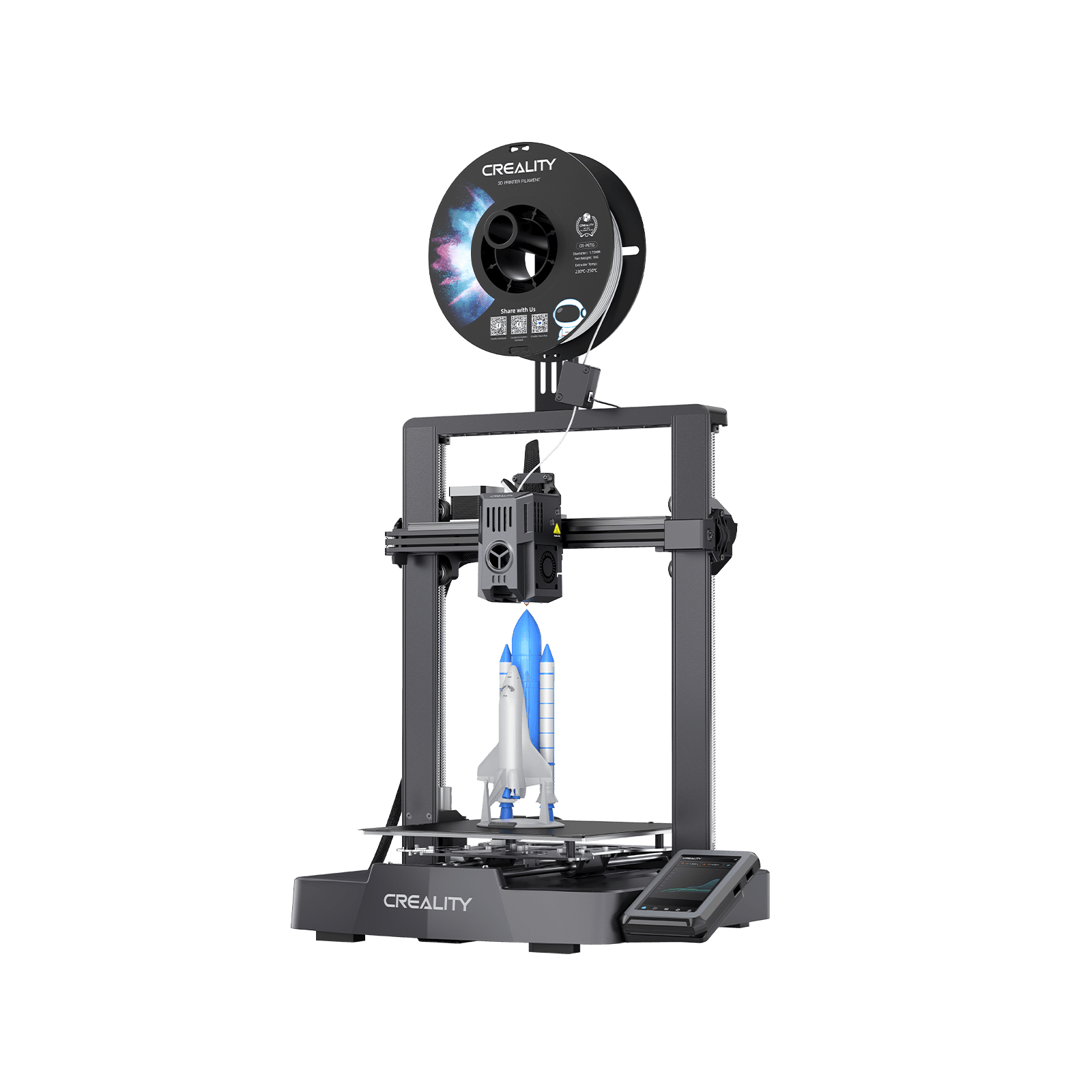
Creality Ender-3 V3 KE
Ender-3 V3 KE - not the Ender-3 V3, V3 SE, V3 Plus or V4
Cheaper, wider on materials and genuinely available — the sensible version of the same purchase.
- Build volume
- 220 × 220 × 240 mm
- Technology
- FDM
- Max speed
- 500 mm/s (≤8,000 mm/s² acceleration)
- Enclosed
- No
- Multi-colour
- No
- Auto levelling
- Yes (hands-free auto levelling)
What we like
- ASA on Creality's own supported-filaments list, which this machine's list does not have
- Klipper-based Creality OS with the sources published on GitHub
- In stock through Creality's own UK store, shipping from a UK warehouse
- Sits around the £220 mark in the UK
- File transfer over USB, LAN and Wi-Fi, with 8 GB of onboard storage
What we don’t
- A 0.4 mm brass nozzle as standard, which abrasive filament wears open
- A 100 °C plate and 500 mm/s, both below the base V3
- 10 mm shorter in Z, the only dimensional difference between the two
- Open frame, so tall ABS and ASA parts will still warp
- One UK supply route: Creality's own store
Buy it instead if you want this class of machine without hunting for stock, or ASA and Klipper matter. Skip it if carbon-filled filament is the plan, because you will be buying a hardened nozzle first.
The A1 is the better machine and a different trade. A 256 mm cube is half again the plate area, multi-colour can be added with the AMS lite, the nozzle matches this Creality at 300 °C, and the UK warranty runs to two years, at roughly £240 to £320. The catch is materials: Bambu Lab lists PLA, PETG, TPU and PVA as ideal and does not recommend ABS, ASA, polycarbonate, nylon or fibre-filled filament. Its own flow test puts the hot end at 28 mm³/s, which matters more than the 500 mm/s toolhead figure on a large solid part.
Bambu Lab A1
A1 (standard, without AMS lite)
More plate, more polish and twice the warranty, at overlapping money. Buy it unless you need abrasive or styrene filament.
- Build volume
- 256 × 256 × 256 mm
- Technology
- FDM
- Max speed
- 500 mm/s toolhead (10,000 mm/s² acceleration)
- Enclosed
- No
- Multi-colour
- Optional (AMS lite sold separately; up to 4 spools)
- Auto levelling
- Yes (fully automatic)
What we like
- A 256 × 256 × 256 mm plate — half again the print area of either Creality here
- Two years of UK warranty cover, against twelve months on this Creality
- Multi-colour can be added later with the AMS lite, up to four spools
- A published hot end flow figure of 28 mm³/s, measured on the maker's own test
- Stocked by UK retailers, so availability is not the problem
What we don’t
- Bambu Lab does not recommend ABS, ASA, polycarbonate, nylon or fibre-filled filament on it
- A 100 °C plate, ten degrees below the machine reviewed here
- An open frame with no enclosure, which is why the styrene plastics are off the list
- No acoustic rating is published in the specification sheet
- A moving plate, the compromise that can show on tall, narrow models
Buy it instead if you print PLA and PETG and would rather have two years of warranty than a hardened nozzle. Skip it if carbon-filled or ABS work is the point.
If both are too much, the SE sits around the £150 mark — but its nozzle stops at 260 °C and Creality lists only PLA, PETG and TPU 95A, a narrower purchase, not a cheaper version of this one.
Who should buy it, who should not, and the verdict
Whether the Creality Ender-3 V3 is worth it comes down to a narrower question than most reviews of it admit. Do you specifically want the hardened steel nozzle and the hottest plate in the range, and will you buy a printer most of the way out of UK retail to get them?
It suits the person who bought carbon-filled filament before they bought a printer, and the owner of an older Ender wanting the same footprint with automatic levelling and a nozzle that will not wear open. It suits nobody who needs ASA, polycarbonate or nylon.
Everyone else has somewhere better to go. This class of machine without a stock hunt? The KE, around the £220 mark and in stock. The biggest plate and longest warranty? The A1 above. Spending as little as possible? The SE. If none of those fits, the best 3D printers UK pillar covers resin and larger formats too.
The best Ender-3 V3 on paper, and the one Creality has quietly stopped putting in front of British buyers. The hardware deserved better; the cheaper KE is what most people should buy instead.
- Buy it if
- A hardened steel nozzle and a 110 °C plate as standard are what you are after, carbon-filled filament is why, and you have found one at a price you are happy with.
- Skip it if
- You need ASA or engineering polymers, you would rather not own a machine whose UK supply has nearly gone, or you want the easiest route to a good first print.
The engineering is sound; the recurring fault is a cooling fan and a config file, not a design that cannot work. What has gone is what a recommendation rests on: a route to buy it, at a price anyone can see.
How this article was researched
No printing, handling, measurement or photography was carried out for this review. Specifications come from Creality's own parameter page for this model, its product page and its user manual, recorded claim by claim with a source URL and an access date; where Creality publishes nothing, corroborating figures come from its own UK store and an authorised UK retailer. UK stock, warranty and spare-part availability were checked on 1 October 2026. The ownership patterns are recurring themes read across Creality's own community forum section for this model and written in our own words — no customer review is quoted and no rating reproduced. Amazon.co.uk returned a server error and was not reached. Three things were left out rather than estimated: a UK price, an acoustic rating, and the external dimensions and weight. Our approach is set out in the review methodology.
Common questions
- Is the Creality Ender-3 V3 worth buying?
- Only for a narrow buyer, and only if you can find one. The hardware is the strongest in the Ender-3 V3 range — a hardened steel nozzle fitted as standard and a 110 °C plate, ten degrees hotter than either machine compared here — so if carbon-filled filament is the reason you are buying, it earns its place. The problem is the shop rather than the printer: Creality's own UK collection page now lists the V3 SE instead, its global store shows the machine sold out, and the authorised UK retailer that stocked it says it no longer sells the product. No UK price could be verified from any route, which is why none appears on this page.
- Who is the Creality Ender-3 V3 best for?
- Someone who bought abrasive filament before they bought a printer. PLA-CF and PETG-CF need a hardened nozzle, and this machine has one out of the box rather than as a paid upgrade. It also suits an owner of an older Ender replacing it in the same desk space, who wants automatic levelling and a stiffer frame without learning a new ecosystem, and anyone happy to read a forum thread and edit a configuration file. It suits nobody who needs ASA, polycarbonate or nylon, because Creality does not list them for this model.
- What are the main alternatives to the Creality Ender-3 V3?
- Two, and for most people one of them is the better buy. The Ender-3 V3 KE costs less, adds ASA to its materials list, runs Klipper-based firmware with published sources and is actually in stock through Creality's UK store — you give up the hardened nozzle, ten degrees of plate and 10 mm of height. The Bambu Lab A1 is the better all-rounder at overlapping money: half again the plate area and two years of UK warranty, but Bambu Lab does not recommend ABS, ASA or fibre-filled filament on it. Below both, the Ender-3 V3 SE is cheaper again and much narrower, stopping at 260 °C with only PLA, PETG and TPU on its list.
- Can you still buy the Creality Ender-3 V3 in the UK?
- Barely, and not at a price anyone can quote. Checked on 1 October 2026, one route — Creality's own UK store product page — still showed the machine in stock with UK despatch, but rendered its price as an unfilled template. Creality's UK Ender-3 series collection page lists the V3 SE instead of it, the global Creality store shows it sold out, and 3DJake UK states it no longer sells the product. The Amazon.co.uk listing returned a server error and was not reached, so nothing is claimed from there. Spare parts are a happier story: the proprietary nozzle is shared with other Creality machines and was still stocked in the UK.
- Is the Ender-3 V3 CoreXY or CoreXZ?
- CoreXZ, which is Creality's own wording on its parameter page for the machine, and the point is often reported wrongly. The X and Z axes share a belt path so two motors drive them together, which keeps the X carriage light and is what allows the quoted acceleration figure. What it does not mean is a static bed: the plate still slides back and forth carrying the weight of the part, exactly as on any other bedslinger, so tall narrow models remain the geometry this layout handles least well.