ELEGOO Centauri 2 vs ELEGOO Centauri Carbon 2
Same 256 mm cube, same speed, same footprint, same rated power. So what does the enclosed Carbon 2 add for about £50 more? ELEGOO's own tables, compared.
Independent and reader-funded. We earn a commission if you buy through our links, at no extra cost to you. How this works.
ELEGOO Centauri 2 vs ELEGOO Centauri Carbon 2 reads like a choice between an entry machine and a serious one. Put ELEGOO's two parameter tables side by side and that framing falls apart.
Both print a 256 mm cube, both are rated to the same top speed and acceleration, and both reach 350 °C at the nozzle over a 110 °C bed. ELEGOO publishes the same external dimensions for the pair, 398 × 404 × 490 mm, and the same rated power. The cheaper machine saves you neither bench space nor electricity.
What it saves is about fifty pounds. What it costs is an enclosure, a camera, chamber filtration and rather more than half of ELEGOO's filament list.
| Specification | 1 ELEGOO Centauri Carbon 2 The default buy | 2 ELEGOO Centauri 2 The budget entry |
|---|---|---|
| Best for | Anyone who may print ABS, ASA, PC or nylon | PLA, PETG and TPU only |
| Frame | Enclosed, thermally regulated | Open — no enclosure listed |
| ELEGOO's 'ideal' filaments | PLA, PETG, TPU, PLA-CF | PLA, PETG, PLA-CF, TPU |
| Engineering filaments | ABS, ASA, PC, PA, PET-CF, PETG-CF rated superior | Rated not recommended |
| High-temp composites | PPS and PPA families rated capable | Not rated |
| Camera | Fitted | Optional add-on |
| Chamber filtration | HEPA and activated carbon, plus smart exhaust grille | Optional add-on |
| Levelling | 121-point, plus partial and full-auto calibration | 121-point, plus partial and full-auto calibration |
| Build volume | 256 × 256 × 256 mm | 256 × 256 × 256 mm |
| Max nozzle / bed | 350 °C / 110 °C | 350 °C / 110 °C |
| Operating sound | 45 dB or less | Not published by ELEGOO |
| Net weight | 17.5 kg | 13.7 kg |
| Footprint | 398 × 404 × 490 mm | 398 × 404 × 490 mm |
| Rated power | 1,100 W at 220 V | 1,100 W at 220 V |
| UK price band | £280–£310 | £230–£260 |
| UK availability | In stock at ELEGOO UK | In stock at ELEGOO UK |
How these two were put side by side
No printing was done for this page. The ELEGOO Centauri 2 compared with the ELEGOO Centauri Carbon 2 is desk research, which matters here, because the conclusion runs against most of what is written about the pair.
Both columns come from one place: the parameter tables ELEGOO renders on its own UK product pages, which use identical row labels, so the figures are like for like rather than stitched from two differently worded marketing pages. Where the tables differ, the difference is the manufacturer's — and where ELEGOO publishes nothing, this page gives nothing. That happens twice, and both gaps are named below.
Three differences that turn out not to be differences
If you have read anything else about these two, you have probably read three things ELEGOO's own tables contradict.
The calibration gap does not exist. The usual claim is that the Carbon 2 self-calibrates while the Centauri 2 falls back on an older 121-point routine. ELEGOO gives both machines 121-point auto-levelling with the same partial-area option, and lists full-auto calibration on both. Either way a first layer repays a glance: some early reports suggest the default Z-offset benefits from a small manual tweak for a clean first layer.
The camera claim is the wrong way round. Several comparisons state both printers ship a camera with AI monitoring. ELEGOO lists one as fitted on the Carbon 2 and marks it an optional expansion on the Centauri 2, along with the LED chamber light. If remote watching matters, that favours the dearer machine rather than being a wash.
The open frame does not buy a smaller printer. ELEGOO gives both machines external dimensions of 398 × 404 × 490 mm. The Centauri 2 is lighter, 13.7 kg against 17.5 kg, so it is easier to lift — but it takes the same rectangle of desk. Plan for the same space either way.
What the two machines share
A comparison is only useful if it is honest about what is not a difference. Here that list is long.
Both are CoreXY machines — the belt layout that leaves the heavy motors on the frame and moves only the print head, which is how a cheap printer accelerates hard without shaking itself out of square. ELEGOO builds both around dual 4260 steppers driving X and Y independently on metal linear guides in a die-cast aluminium frame, rated to 500 mm/s with 250 mm/s recommended and to 20,000 mm/s² at maximum. Acceleration is where one printer normally pulls ahead on real job times; rated the same, neither does.
The parts that touch the plastic are the same parts: a dual-gear direct extruder, a 0.4 mm brass-hardened steel nozzle and a titanium alloy heat break, the same dual-sided spring steel plate with textured PEI on one face and a PLA-specific surface on the other, the same 260 × 260 mm platform, and the same 0.1 to 0.4 mm layer range and ±0.1 mm accuracy claim. That shared hardened nozzle matters: hardness is what stops abrasive filament wearing a nozzle bore oval within a few spools.
The interface is shared too — a 5-inch capacitive touchscreen each, ELEGOO OS underneath, the same USB and Wi-Fi. Owners and reviewers repeatedly praise the Centauri Carbon 2's single-colour print quality for its price, with the caveats concentrated on software and the multi-material unit. Since both move the same head through the same extruder onto the same plate, that is a fair expectation of the cheaper one too.
The difference that decides it: what ELEGOO says each one will print
Centauri 2 or Centauri Carbon 2 comes down to one column in ELEGOO's tables, and it is the filament column.
For the Centauri 2, ELEGOO names four materials as ideal — PLA, PETG, PLA-CF and TPU — then lists ABS, ABS-CF, ASA, ASA-CF, PET, PET-CF, PETG-CF, PA, PA-CF and PC as not recommended. For the Carbon 2 the same column reads in three tiers: those four as ideal, then ABS, ASA, PC, PA, PET-CF and PETG-CF rated superior, then the PPS and PPA families rated capable. That is not a nudge. It is the manufacturer moving a whole class of filament from "don't" to "this is what it is for".
The reason is the box. The Carbon 2 is enclosed and thermally regulated; ELEGOO lists no enclosure for the Centauri 2, and the chamber hardware that goes with one — air filter, smart exhaust grille — appears on its table as an optional expansion, while independent coverage of the launch describes it as open-frame. Styrene-based filaments such as ABS and ASA shrink as they cool, and in a draught they shrink unevenly — which is how a tall part peels off the plate or splits along a layer line. Warm, still air is the fix. Both reach 350 °C at the nozzle, so this was never about heat.
Two qualifications keep it fair. Neither machine heats its chamber deliberately, so polycarbonate and nylon are on the Carbon 2's list rather than its strong suit. And the crude version of this comparison, that the Centauri 2 cannot touch carbon fibre, is wrong: PLA-CF is on its ideal list. If you want stiffer, less stringy PLA, the cheaper machine is rated for it.
One safety point cuts both ways. ELEGOO states the Carbon 2's HEPA and coconut-shell activated carbon filter removes ultrafine particles, VOCs and odours, and peer-reviewed measurements do put the particles a hot nozzle emits in that range, worst with ABS. But the same work puts a plain enclosure well below ducting the exhaust outdoors for particle control. Print ABS or ASA in a ventilated room, enclosure or not.
Noise, bench space and the figure ELEGOO does not publish
Here is the second place this page has to say "not known" rather than guess.
ELEGOO gives the Centauri Carbon 2 an operating sound of 45 dB or less. For the Centauri 2 it publishes no operating-sound figure at all — the row is simply absent from its table. There is no number to compare, and none is borrowed from elsewhere. Nor is there an ownership record to fall back on: the Centauri 2 is new enough that when forums, retailer questions and long-term video reviews were researched for it, no repeating pattern had formed.
The Carbon 2 does have a record. Noise reports are mixed, with some owners finding the machine acceptable at normal speeds and others describing significant vibration at its fastest settings. Read the 45 dB claim accordingly: a figure measured in favourable conditions, not a promise about a machine sprinting.
So noise is a known quantity on one machine and an open question on the other. For a bedroom or a shared office, the one with a published figure and a documented record is the safer buy. Bench space, as above, is identical. Both also want an ambient temperature between 5 and 40 °C, which rules out an unheated garage in a British January — worth knowing before either is exiled there to solve a noise problem.
Colour, Combos and the four boxes ELEGOO sells
This is where an order goes wrong. ELEGOO sells four machines with nearly the same name: Centauri 2, Centauri 2 Combo, Centauri Carbon 2 and Centauri Carbon 2 Combo. A Combo is the same printer with the CANVAS four-colour unit fitted. Neither standard machine includes CANVAS — both are sold upgrade-ready, the unit bought separately or bundled from the start. This page compares the standard units only.
Multicolour is therefore not a reason to pick one tier over the other. It is a separate decision with its own costs. Several owners describe filament-loading errors and occasional colour-change jams with the CANVAS unit, although single-colour printing is consistently reported as reliable. Then the waste, since every colour change flushes the old filament out of the nozzle: owners repeatedly mention high purge waste and scattered purge blobs on multicolour jobs, which is why a printed purge bin is such a common early addition.
One detail is easy to trip over: ELEGOO states TPU is natively supported on the Centauri 2, but that running it on the Combo means fitting the Flexible Filament Adapter and disconnecting the CANVAS cable first.
What each one costs to run in the UK
The running cost is usually the argument for the open machine, and on ELEGOO's figures it does not exist. Both are rated at 1,100 W on 220 V, both from an ordinary 100–240 V socket. Identical ceilings, identical arithmetic.
One caveat before the sums. A rated figure is a ceiling, not a measurement: once the bed and hotend are at temperature they cycle rather than draw continuously, and neither machine publishes a typical figure. What follows is a worked upper bound, labelled as one.
Take the Ofgem price cap unit rate, roughly 26p per kWh for a typical direct debit customer in England, Scotland and Wales. At its rated ceiling either printer would cost about 29p an hour in electricity — roughly £3 over a ten-hour print, or about £29 across a hundred hours of printing in a month. Real figures land below that.
It is the same number twice. Electricity cannot break this tie, which leaves the purchase price as the only cost difference — and that is a one-off. One asterisk: the engineering materials the Carbon 2 unlocks cost more per kilogram, so budget for the filament as well as the enclosure.
UK price, availability, warranty and support
Checked at ELEGOO's own UK storefront on the day of writing, the Centauri 2 sits in the £230–£260 band and the Centauri Carbon 2 in the £280–£310 band. Both prices observed were promotional, so treat the bands as where these machines have been trading rather than as fixed figures. ELEGOO Centauri 2 versus ELEGOO Centauri Carbon 2 in the UK is a gap of roughly fifty pounds — about a fifth of the cheaper machine's price, and the number this decision turns on.
Where to buy, and what was in stock
Both are sold and stocked in GBP by ELEGOO's official UK store. No Amazon.co.uk listing was confirmed for either standard unit when checked, so that route may surface the Combo variants instead; read the exact model name before ordering. Neither is run-out stock: the Carbon 2 arrived in January 2026, and the Centauri 2 is newer still.
Warranty, support and spares
Warranty is identical, because ELEGOO sets it for the Centauri Series rather than per model: twelve months on the printer from the date the original order was received, the extruder and printhead kit limited to six months, and the build plate, PEI platform, nozzle kit, PTFE tube and tools treated as consumables with no cover. Standard for the bracket.
Support is the weaker part, equally for both. Elegoo's support draws mixed reports on UK review sites: prompt replacements for straightforward problems, but slower and more repetitive handling of complex faults. The software carries a similar caveat, and it applies to both because they run the same stack: a recurring theme among Centauri Carbon 2 owners and reviewers is flaky connectivity between the printer, slicer and app, with USB printing the common fallback. Spares are shared across the series, so nozzles, plates and CANVAS itself fit either machine.
Which one to buy
ELEGOO Centauri Carbon 2 vs ELEGOO Centauri 2 stops being difficult once you notice the cheaper machine's savings are mostly imaginary. What is left is a materials list and about fifty pounds.
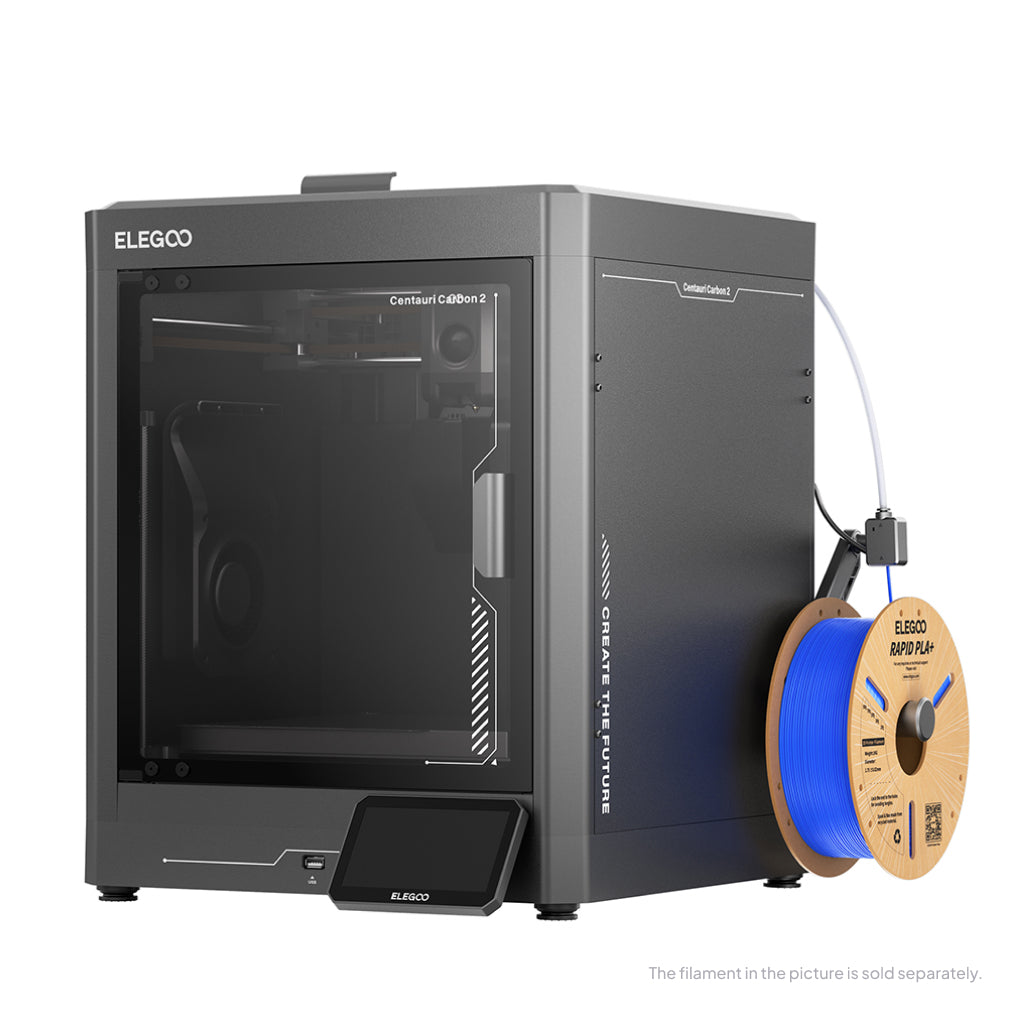
ELEGOO Centauri Carbon 2
Centauri Carbon 2 (standard, without CANVAS - not Combo)
The same printer as the Centauri 2 in every respect that moves plastic, inside a thermally regulated box that shifts a whole class of filament from 'not recommended' to 'what it is for'.
- Build volume
- 256 × 256 × 256 mm
- Technology
- FDM
- Max speed
- 500 mm/s (CoreXY)
- Enclosed
- Yes (thermally regulated enclosure)
- Multi-colour
- Optional (CANVAS 4-colour system; included only in the Combo; standard unit can be upgraded)
- Auto levelling
- Yes — full-auto calibration with 121-point auto-levelling and partial bed-levelling
What we like
- ELEGOO rates it superior with ABS, ASA, polycarbonate, nylon and the fibre-reinforced grades, and capable of the PPS and PPA families — a tier the Centauri 2 is not rated for at all
- Enclosure, camera, LED lighting, HEPA-and-carbon filter and smart exhaust grille are all fitted rather than optional expansions
- Costs no more to run and takes no more bench space than the cheaper machine — ELEGOO publishes the same footprint and the same rated power for both
- An operating sound figure is published for it, which is not true of the open-frame model
What we don’t
- About fifty pounds more, for chamber hardware a PLA-and-PETG owner may never call on
- No actively heated chamber, so polycarbonate and nylon sit on its filament list rather than being its strong suit
- 3.8 kg heavier at 17.5 kg, which makes moving it a deliberate act
- Owner reports on the shared software stack describe unreliable printer-to-app connectivity, with USB the usual fallback
Buy the Carbon 2 if you might ever print ABS, ASA, polycarbonate, nylon or a fibre-reinforced engineering filament; if you want to watch a long print from another room, the camera being fitted rather than optional; or if the printer shares a room with people, where a published 45 dB figure and a closed box both help. Costing no more to run and taking no more desk, this is the default.
Skip the Carbon 2 if fifty pounds is the difference between buying a printer and not buying one. A Centauri 2 printing PLA beats a Carbon 2 you never bought.
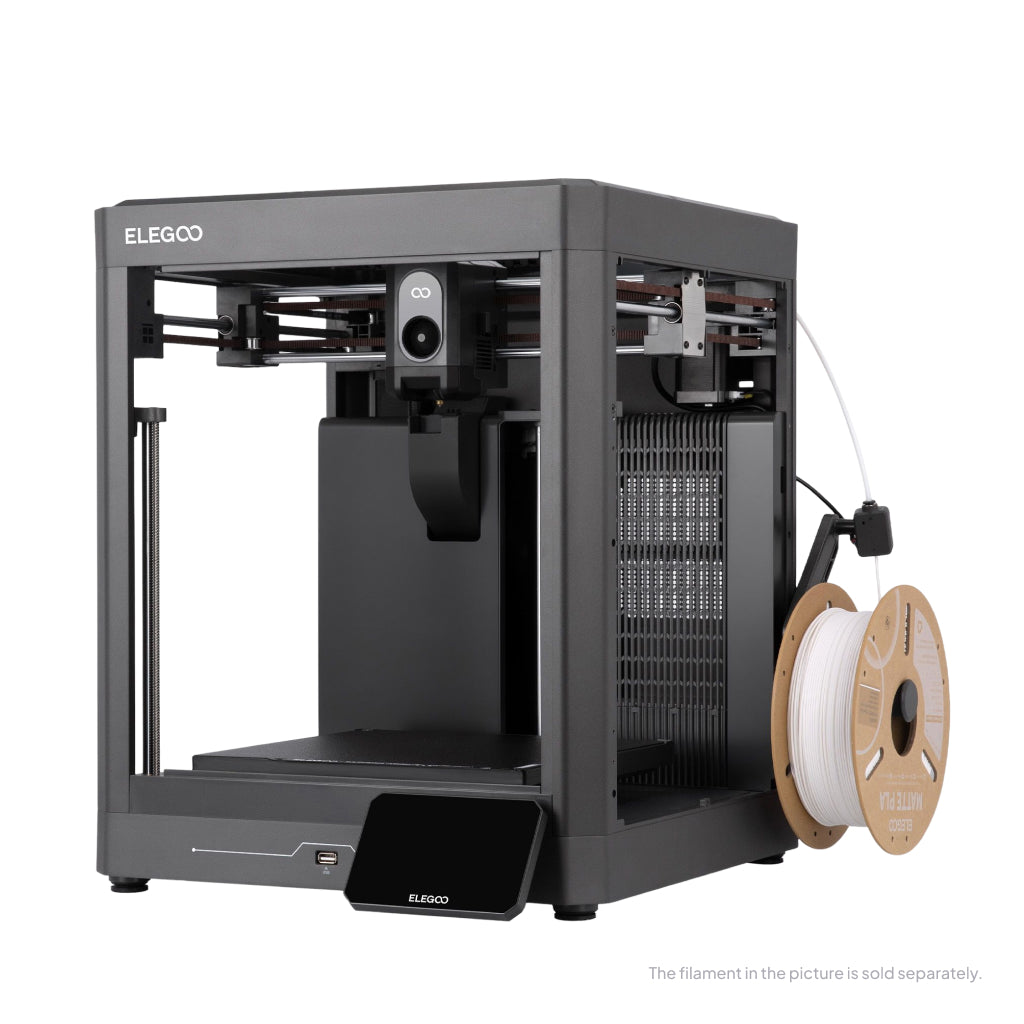
ELEGOO Centauri 2
Centauri 2 (standard open-frame unit, CANVAS not included — not the Centauri 2 Combo, the Centauri Carbon 2 or the Centauri Carbon 2 Combo)
The cheapest way onto a properly specified CoreXY platform: the same motion system, hardened nozzle and 110 °C bed as its enclosed sibling, rated for PLA, PETG, PLA-CF and TPU and no further.
- Build volume
- 256 × 256 × 256 mm
- Technology
- FDM / FFF CoreXY, dual-gear direct extruder, single nozzle
- Max speed
- ≤500 mm/s (ELEGOO recommends 250 mm/s)
- Enclosed
- No — open frame; ELEGOO lists no enclosure, and the chamber camera, air filter, smart exhaust grille and LED lighting are all optional expansions
- Multi-colour
- Not included on the standard unit; upgrade-ready for the CANVAS 4-colour system, which is sold separately or bundled in the Centauri 2 Combo
- Auto levelling
- Yes — full-auto calibration with 121-point auto-levelling and partial bed-levelling
What we like
- The same CoreXY frame, dual-gear direct extruder, hardened steel nozzle, dual-sided plate and 121-point levelling as the enclosed machine
- PLA-CF is on ELEGOO's ideal list, so carbon-filled PLA is not a reason to pay more
- The lighter of the two at 13.7 kg, and TPU is natively supported without an adapter
- Sits a band below the Carbon 2 and is still CANVAS upgrade-ready, so four-colour printing stays open
What we don’t
- ELEGOO lists ABS, ASA, PET, polycarbonate and nylon as not recommended, and the enclosure is the one thing that cannot be added later
- Camera, LED lighting, air filter and smart exhaust grille are all optional expansions rather than fitted parts
- ELEGOO publishes no operating-sound figure for it, so noise cannot be compared before buying
- No saving in space or electricity: ELEGOO publishes the same footprint and the same 1,100 W rating as the Carbon 2
Buy the Centauri 2 if your printing genuinely lives on PLA, PETG, PLA-CF and TPU, as for many it does, or you want the lighter machine at 13.7 kg. It is not a cut-down printer where it counts — the hardened nozzle and CoreXY motion system are the same.
Skip the Centauri 2 if there is an ABS or ASA project anywhere in your plans, because ELEGOO explicitly does not recommend those on it, and the enclosure is the one thing here you cannot add later. Skip it too if the machine must be quiet and you need to know that before buying, since no noise figure is published for it.
If neither is right — if you want an actively heated chamber, a larger plate or a different ecosystem — the best FDM printers roundup covers the brackets either side.
These are not a capable machine and a compromised one. On ELEGOO's own parameter tables they are the same printer twice, down to the frame, the extruder, the nozzle, the plate, the ceilings, the footprint and the rated power.
One of them has a box around it, and that box is the entire difference. It decides whether ABS, ASA, polycarbonate and nylon are recommended or discouraged, it brings the camera and the filtration with it, and it is the one component no upgrade adds later.
So the honest test is one question, and it is not about budget: name the filaments you intend to print. If everything on the list is PLA, PETG, PLA-CF or TPU, buy the Centauri 2 and do not feel short-changed. If anything else is on it, now or plausibly within a year, buy the Centauri Carbon 2.
- Buy it if
- You may ever print ABS, ASA, polycarbonate or nylon, or the printer shares a room: take the Centauri Carbon 2.
- Skip it if
- Your filament list really stops at PLA, PETG, PLA-CF and TPU: take the Centauri 2 and spend the difference on material.
How this article was researched
This comparison is research-based. No printing, measurement or photography was carried out, and nothing here is a test result.
Specifications were researched from ELEGOO's own parameter tables for the two named standard variants — the Centauri 2 without CANVAS and the Centauri Carbon 2 without CANVAS — because those tables use identical row labels, which makes the rows directly comparable. Two gaps are left open rather than filled: ELEGOO publishes no operating-sound figure for the Centauri 2, and it publishes the same external dimensions for an enclosed machine and an unenclosed one.
Owner-reported patterns were researched from forums, community threads, retailer questions and long-term video reviews, summarised in our own words and labelled wherever they appear. Every pattern here concerns the Centauri Carbon 2, because the Centauri 2 is too new for a repeating pattern to have formed. No customer review is quoted and no rating reproduced. UK prices and stock were checked on 29 September 2026 and are given as bands.
Common questions
- Which is better, ELEGOO Centauri 2 or ELEGOO Centauri Carbon 2?
- The Carbon 2, for most buyers, and the reason is narrower than it looks. ELEGOO's own parameter tables give the two machines the same build volume, the same rated speed and acceleration, the same stated accuracy and layer range, the same dual-gear direct extruder, the same hardened steel nozzle, the same dual-sided plate, the same 121-point levelling with full-auto calibration, the same screen, the same connections, the same external dimensions and the same rated power. What the Carbon 2 adds is an enclosure, a fitted camera, chamber filtration and an exhaust grille — and with them an entire tier of filament. What it costs is roughly fifty pounds. So the honest question is not which machine is better built, because they are built the same; it is whether you will ever print a material that needs the box.
- Which has better print quality and reliability?
- On paper there is nothing to choose between them. The two share the motion system, the extruder, the nozzle, the build plate and the accuracy claim, so on PLA and PETG there is no mechanical reason to expect a difference in output. Reliability cannot be called from here, because no first-hand testing was done for this page. What can be said is that the Carbon 2 has an ownership record and the Centauri 2 does not yet — it is too new for a repeating pattern to have formed. For the Carbon 2, that record is consistently positive about single-colour output for the money, with the complaints clustering on the software and the multi-colour unit rather than on the printer's mechanics. Buyers who want a documented track record rather than a specification sheet currently have only one option of the two.
- Which offers better value for UK buyers?
- The Carbon 2, unless your filament list is genuinely fixed. Value usually favours the cheaper machine because it also saves something in ownership, and here it saves nothing: ELEGOO publishes an identical footprint and an identical rated power, so the open-frame model needs the same desk and the same electricity. Warranty is identical too, because ELEGOO sets it for the Centauri Series rather than per model, so there is no protection premium in the higher price. That leaves a one-off gap of roughly a fifth of the cheaper machine's price, against an enclosure, a camera and filtration that cannot be retrofitted. The Centauri 2 is the better value only in the case where the enclosure would never be used — which, if you print PLA and PETG and nothing else, is a real case rather than a hypothetical one.