ELEGOO Neptune 4 Max Review
A UK review of the ELEGOO Neptune 4 Max: what the 420mm bed costs you in bed temperature, acceleration and desk space, and when to buy the Plus.
Independent and reader-funded. We earn a commission if you buy through our links, at no extra cost to you. How this works.
The ELEGOO Neptune 4 Max is a 420 × 420 × 480 mm open-frame bed-slinger, the largest of the four machines ELEGOO has sold under the Neptune 4 name — not the Neptune 4, the 4 Pro or the 4 Plus, which share the badge and little else.
What this ELEGOO Neptune 4 Max review adds is what the product page has no reason to volunteer. ELEGOO's own manual caps the bed at 85 °C on a machine it lists for ABS and ASA, and begins its levelling procedure with a sheet of A4 paper. Nothing was printed, handled or measured here. Still undecided on a large machine? The best FDM 3d printer uk guide ranks the wider field first.
Which Neptune 4 this is, and the ELEGOO Neptune 4 Max UK stock position
Availability is simple; the pricing is not. On 6 October 2026 the machine was in stock on ELEGOO's own UK store as a current product with no successor announced, backed by a UK store in sterling and a spares collection. But three UK routes checked that day ran from under £280 to a little over £400 for the same new machine — roughly a third of the lowest price. So check more than one UK seller.
Be precise about which Neptune 4 a listing sells, too: the Max has the largest bed in the range and the coolest one, while the 4 Plus is hotter and quicker. Measure your bench as well — the bed slides, so the depth this machine needs is not the depth it occupies.
The specification, and what each figure changes
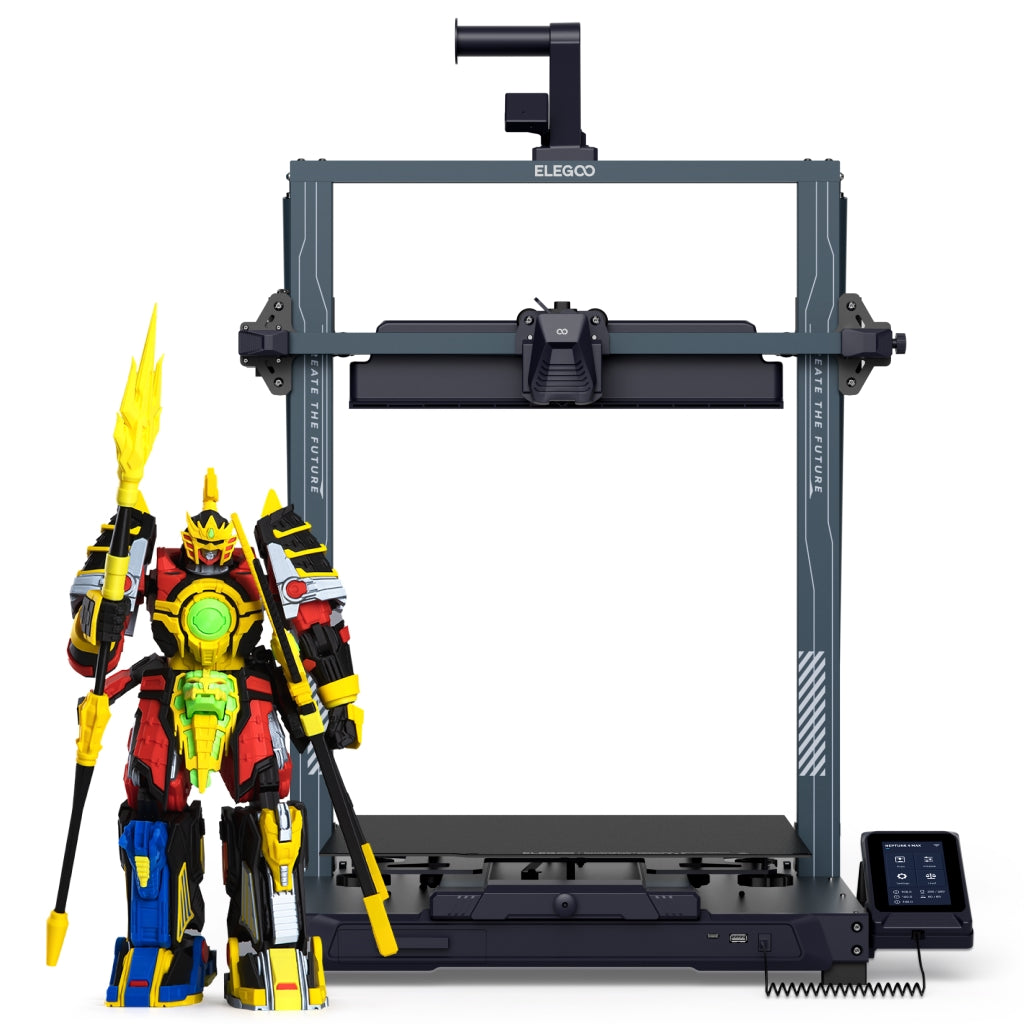
ELEGOO Neptune 4 Max
Neptune 4 Max (420 × 420 × 480 mm model — not the Neptune 4, Neptune 4 Pro, Neptune 4 Plus, Neptune 3 Max, or any refurbished/Grade B SKU)
More build volume per pound than anything else at the price, paid for with a cooler bed and a levelling evening.
- Build volume
- 420 × 420 × 480 mm
- Technology
- FDM
- Max speed
- Up to 500 mm/s (250 mm/s regular; 8,000 mm/s² acceleration)
- Enclosed
- No
- Multi-colour
- No
- Auto levelling
- Yes (121-point, 11 × 11 grid) — but ELEGOO's own manual requires manual A4-paper centre-point calibration and manual auxiliary levelling of six corner points by hand-twist nuts first, and the automatic routine runs 36 points with a 36/121 toggle
What we like
- A 420 × 420 × 480 mm envelope — roughly fifteen times a 180 mm starter cube, and enough to print a full-size helmet or a prop section without splitting it
- Two lead screws, two motors and two tie rods on the 480 mm Z axis, which is the right engineering decision at that height
- Klipper pre-installed with input shaping and pressure advance, plus accelerometers on X and Y that calibrate the resonance compensation themselves
- A browser page at the printer's own IP address that takes dragged-in G-code and exposes a G-code console, so it need not live beside your computer
- A dual-gear direct extruder geared 5.2:1 on a titanium alloy throat, with grip strength you can tune to the filament by hand
- Nozzle kits under £10 in brass or hardened steel, shared across the Neptune 4 series rather than unique to this model
- Listed and in stock on ELEGOO's own UK store with a UK spares collection behind it, and no successor announced
What we don’t
- An 85 °C bed ceiling, quoted at 25 °C ambient, on a machine ELEGOO lists for ABS and ASA — the two filaments that most need a hot plate
- ELEGOO's own cheaper Neptune 4 Plus has a 100 °C bed and 12,000 mm/s² against this machine's 8,000 mm/s²
- "121-point auto bed levelling" begins, in ELEGOO's own manual, with a sheet of A4 paper and six hand-twisted corner nuts, and the automatic pass it then describes is 36 points
- 658 × 632 × 740 mm of machine with a bed that moves, so the working depth is roughly double the bed's own
- No enclosure and no air filter, which on a 420 mm open frame is what limits ABS and ASA further still
- ELEGOO publishes no rated wattage for this model at all, so no honest electricity cost can be worked out
- No acoustic rating published anywhere, so the noise question cannot be answered with a number
- Arrives as a kit — a base unit and a gantry frame to bolt together, with the printhead, screen, spool holder, filament sensor, rear fan and two struts to fit
Start with the figure you are buying. The envelope is around fifteen times the volume of a 180 mm starter cube, which changes what you can make rather than how fast: a full-size helmet unsplit, a prop in two pieces instead of nine. Glued seams are where large prints fail.
Be careful with the speed claim. ELEGOO publishes a 30 to 500 mm/s range and defaults to 250, so 500 is a ceiling. Acceleration says more: 8,000 mm/s² is what the machine manages while flinging a large bed about, and on a part full of corners it governs the clock more than top speed. Stated precision is ±0.1 mm.
The hot end beats the price — a dual-gear direct extruder geared 5.2:1 on a titanium throat, a 60 W ceramic heater with ELEGOO calibrating its own PID values. Direct drive puts the motor immediately above the 0.4 mm nozzle, which makes flexible filament realistic. Then the temperatures that set the materials list: the nozzle reaches 300 °C, which is generous, and the bed stops at 85 °C at 25 °C ambient, which is not.
Two details earn their place at this size. Two lead screws, two motors and a pair of tie rods carry the Z axis, where a single screw would be the part that bends; and Klipper arrives with input shaping and pressure advance, with accelerometers on both axes to calibrate the resonance compensation. Files arrive by USB, Ethernet or Wi-Fi, and a filament sensor stops the job rather than letting it run dry.
What the Neptune 4 Max does well
Three strengths are real, and the first is the whole reason the machine exists.
Nothing else gives you this much volume for this much money. A 420 mm plate starting under £280 on one UK route is not a compromise on the volume question but the answer to it: what beats it on envelope costs several times as much, and what matches its price is a quarter of the size.
ELEGOO specified the frame for its own dimensions. Two lead screws, two motors and two tie rods on the Z axis is precisely where a cheaper large-format machine would have economised and then wandered out of square.
The network side beats the price class. A browser page at the printer's own IP that takes dragged-in G-code and exposes a console means a machine this big need not live within walking distance of wherever you slice.
Owners who have tuned the Neptune 4 Max tend to describe it as unmatched for build volume at its price, provided they accept the set-up effort. Which frames the ELEGOO Neptune 4 Max pros and cons honestly: the strengths are about size, the weaknesses about what size cost.
Where the Neptune 4 Max falls short
Four limitations matter, and the first is the one nobody else puts in writing.
The bed is too cool for two of the six filaments ELEGOO lists for it. That list runs PLA, PETG, TPU, ABS, ASA and nylon. The bed stops at 85 °C, quoted at 25 °C ambient — a warm room, not a British garage in January. ABS and ASA are the filaments that most depend on a hot plate to hold their corners down as the part above contracts, and there is no enclosure to keep the air still. The failure scales with the part: it will print ABS, but not ABS the size of its bed.
The cheaper sibling beats it on two headline numbers. ELEGOO's own manual for the Neptune 4 Plus states a 100 °C bed and 12,000 mm/s² against the Max's 85 °C and 8,000 — same maker, same documents, about £100 less. The Max is the bigger machine, not the better one.
"121-point auto bed levelling" is not what the manual describes. ELEGOO's own manual puts a sheet of A4 paper between nozzle and plate for a centre-point calibration, has you level six corner points by hand with the twist nuts under the bed, and only then runs the automatic pass — 36 points, with a 36/121 toggle on screen. Not a fault, but a different purchase from the one the words suggest, and across this plate an evening rather than a minute.
Two numbers you are entitled to do not exist: ELEGOO publishes no rated wattage for this model and no acoustic rating anywhere. Several owners describe layer shifts on very large or multi-day prints, commonly addressed by belt tension and slower speeds.
What owners consistently report
The basis here is recurring themes researched across community firmware projects, long-term video guides and UK retailer listings, written in our own words. One caveat: Reddit blocked access during the research, so what follows rests on what owners have built rather than posted — good evidence of which problems are worth solving, poor evidence of how many people meet them.
The dominant theme is not in dispute. The single biggest theme in community material for this machine is bed levelling and bed flatness across the large plate, and much of what owners share with each other is aimed at measuring or correcting it, although how often it is bad enough to spoil a print is not something the reports settle. Read that against ELEGOO's own procedure, which already asks for paper and six hand-twisted nuts: most of that effort is the documented job, not a defect. The geometry is unforgiving either way, since a given deviation is spread across 420 mm rather than 220 mm.
First layers follow from it. A recurring theme among Neptune 4 Max owners is that the bed and Z-offset need a few hours of manual tuning before large prints become reliable.
Then software. Owners repeatedly describe ELEGOO's build of Klipper as something they cannot update or fully control themselves, and a well-supported community firmware project exists for those who want to, though plenty of owners never leave the stock build. Worth knowing beforehand, and worth not doing to a machine still inside warranty.
Setup, assembly and the levelling ELEGOO does not advertise
This is a kit, and the box is heavy. It arrives as a base unit and a gantry frame to be bolted together, with the printhead, touchscreen, spool holder, filament detector, rear fan and two struts to fit, at 21.8 kg gross. Owners repeatedly advise that the Neptune 4 Max needs a very sturdy surface and a second pair of hands for assembly. ELEGOO also warns that the Y-axis pulleys may have loosened in transit, and shows the isolation columns to adjust if the platform feels shaky — check that before levelling, or you will level twice.
Then the levelling, which is what to plan the first evening around. The documented sequence: home the axes; slide A4 paper under the nozzle and adjust the height compensation until you feel slight friction; repeat that test at six corner points using the hand-twist nuts under the bed; run the automatic pass; reset the Z-offset. The machine heats to 140 °C at the nozzle and 60 °C at the bed to do it, and ELEGOO asks you to change that bed figure to match your filament. Do that — a mesh measured at 60 °C describes a plate that will not be that shape when you print PETG at 80 °C.
One manual warning is worth repeating because it is expensive: the probe detects only the metal platform plate, so fitting a glass bed — a common large-format upgrade — gives no detection and drives the nozzle into it.
ELEGOO Neptune 4 Max print quality and what it will really print
No printing was carried out for this review, so ELEGOO Neptune 4 Max print quality is set out as what the machine is specified to do — not as a verdict on parts nobody here has held.
The mechanics are sound on paper: a stated ±0.1 mm, pressure advance to keep extrusion even through corners, and input shaping to suppress the ringing a moving bed would leave on vertical walls. Cooling matters more here than on a smaller machine, because overhangs on a large part are long.
Materials split into three groups. PLA and PETG are the natural home, at any size the plate will take — a 300 °C nozzle is far more than either needs and an 85 °C bed is comfortably enough. TPU is realistic rather than theoretical, because the extruder is direct drive with a grip you can tune to the filament by hand. ABS and ASA are the awkward group: ELEGOO lists them, the nozzle is hot enough, and the bed and open frame are what hold them back.
Nylon and carbon-filled filament need one cheap decision. The supplied nozzle is brass, which abrasive filament grinds open from the inside — but ELEGOO sells a hardened steel kit for the same money, making it a purchase under £10 rather than a different printer.
Noise, space, smell and safety in a UK home
Noise comes with an admission: ELEGOO publishes no acoustic rating, and no independent measurement was found. Third-party decibel figures circulate and are not reproduced here: a number nobody can trace is worse than none. What can be said is more useful anyway, because it is a control rather than a rating. The rear cooling fan has three documented modes, Silent at 60 per cent, Normal at 80 and Sport at 100, and in Silent it switches off entirely; print mode separately moves speed, acceleration, stepper quietness and fan percentage together. You can trade speed for quiet deliberately, and nobody has published what either end sounds like.
Space is the bigger constraint. Because the bed travels, you need clearance front and back well past the machine's stated depth — roughly double the bed's own, plus room for a spool. And temperature rules out the obvious location: ELEGOO states an ambient range of 5 °C to 40 °C, and an unheated British garage spends much of the colder half of the year below the bottom of it.
Safety is where the documentation is thinner than it should be. ELEGOO's notes require a stable surface, adult supervision of children using the machine, and — stated emphatically — earthing it, because an improperly grounded device raises the risk of electric shock. What they do not contain is any instruction about ventilation, extraction or filtration, on an open-frame machine with no filter that ELEGOO lists for ABS and ASA. That gap is our observation, not ELEGOO's advice, and it is why we would put this machine in a room you can ventilate rather than one you sleep in.
ELEGOO Neptune 4 Max price uk: running costs, warranty and spares
Electricity has to be left out, for a stated reason: ELEGOO publishes no rated wattage for this model. The manual gives voltages and stops there, and the only wattage published at all is the 60 W nozzle heater — not the part that dominates a bill. One UK retailer states a heated-bed figure no primary source confirms. An invented running cost is worse than an absent one.
Filament is the real cost, and it scales with what you bought the printer for. Ordinary 1 kg PLA runs roughly £14 to £18 a spool in the UK, and a bed-filling print can take several kilograms — so one job can cost more in material than a month on a small machine.
Consumables scale with the bed, and the warranty excludes them. ELEGOO's policy gives the series twelve months on the machine, six on the extruder and printhead kits, and nothing on the plate, nozzle kit or PTFE tube, which it classes as consumables; a longer local statutory period prevails, which matters here, because your statutory rights run against the retailer who sold you the machine rather than against ELEGOO. The size tax shows in ELEGOO's own pricing: a replacement plate is around £20 in the Neptune 4 size and about £40 for the Max.
Support and spares are the quietly excellent part. ELEGOO runs a UK store in sterling with UK stock, and a UK specialist retailer carries the brand too, so a part is a domestic order rather than a five-week wait — and nozzle kits are under £10, with fitment shared across the series. Elegoo support is often reported as willing to send replacement parts, though owners describe the process as slow and scripted.
The ELEGOO Neptune 4 Max alternatives worth your time
Two machines sit close enough to change the decision, and they pull in opposite directions: one is the same printer smaller and better, the other a smaller printer that fixes what this one cannot. Both comparisons are specification against specification, from each maker's own documents.
| Specification | 1 ELEGOO Neptune 4 Max The machine reviewed | 2 ELEGOO Neptune 4 Plus Nearly all the volume, a hotter bed, about £100 less | 3 Creality K1 Max Enclosed and hardened, for engineering plastics |
|---|---|---|---|
| Best for | The largest single-piece prints at the lowest price | Large prints that still need a hot bed | Engineering plastics in a British room |
| Typical UK price | Roughly £275 to £405 | Around £275 to £350 | Roughly £560 to £640 |
| Build volume | 420 × 420 × 480 mm | 320 × 320 × 385 mm | 300 × 300 × 300 mm |
| Motion system | Open-frame bed slinger | Open-frame bed slinger | Enclosed CoreXY |
| Max bed temperature | 85 °C at 25 °C ambient | 100 °C | 100 °C |
| Max nozzle temperature | 300 °C | 300 °C | 300 °C |
| Max acceleration | 8,000 mm/s² | 12,000 mm/s² | 20,000 mm/s² or less |
| Nozzle as supplied | 0.4 mm brass | 0.4 mm brass | 0.4 mm hardened steel, all-metal hot end |
| Enclosure and filtration | No — open frame, no filter | No — open frame, no filter | Yes — enclosed, with an activated carbon filter |
| Materials listed by the maker | PLA, PETG, TPU, ABS, ASA, nylon | PLA, PETG, TPU, ABS, ASA, nylon | PLA, PETG, PET, ABS, ASA, PC, PA, TPU95A and carbon-filled grades |
| Machine footprint | 658 × 632 × 740 mm | 578 × 533 × 640 mm | 435 × 462 × 526 mm |
| Weight | 18.1 kg | 14.4 kg | 18.0 kg |
| Rated power published | No — voltages only | No — voltages only | Yes — 1000 W |
| File transfer | USB drive, LAN and Wi-Fi | USB drive, LAN and Wi-Fi | USB drive, LAN, RJ45 and cloud |
| First-layer aid | 121-point mesh, after manual auxiliary levelling | 121-point mesh, after manual auxiliary levelling | Strain-gauge levelling plus a 1 μm LiDAR first-layer scan |
| Warranty on the machine | 12 months | 12 months | Up to 24 months |
The Neptune 4 Plus is the one that makes this difficult. It is the same design one size down: same extruder, hot end, Klipper build and levelling, same nozzle temperature, tip, speed range and precision claim, same filaments and warranty. Three things differ, two favouring the cheaper machine: a hotter bed, half again the acceleration, and less volume for about £100 less.
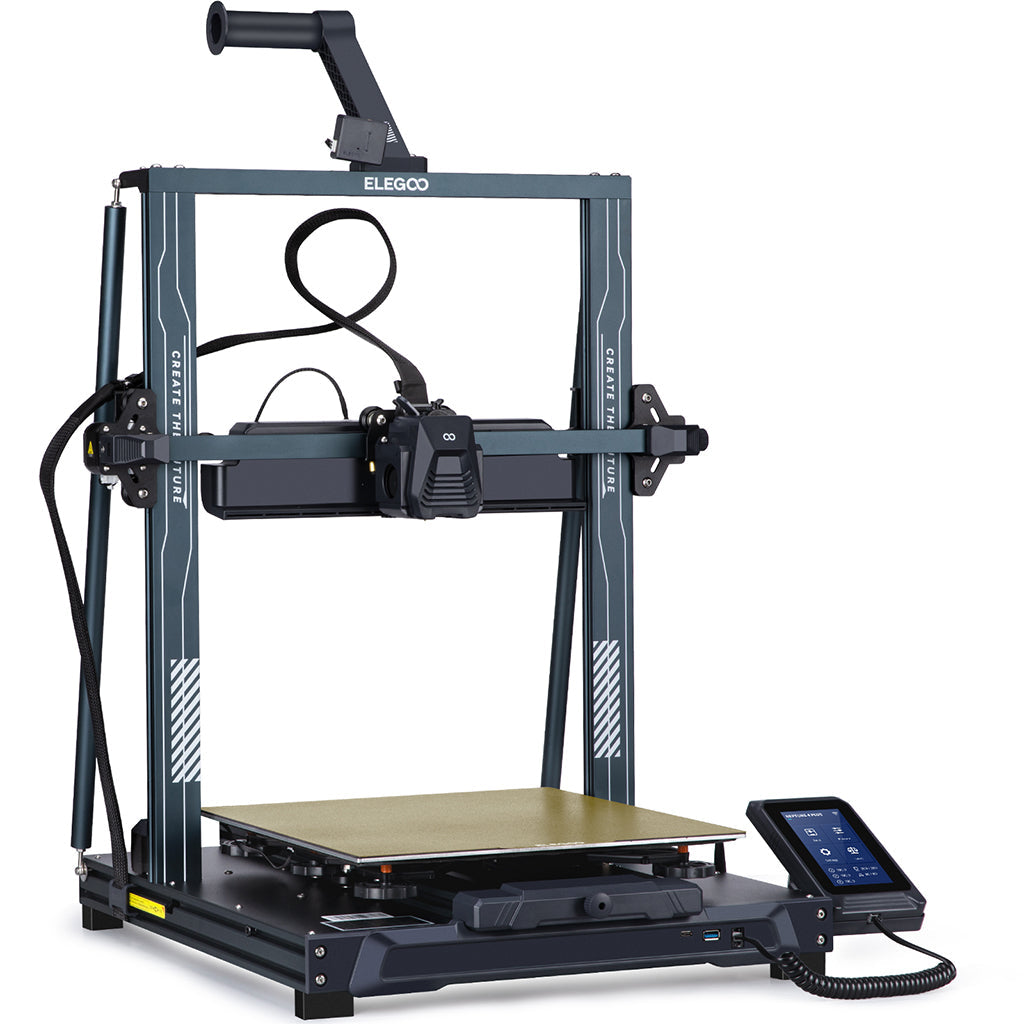
ELEGOO Neptune 4 Plus
Neptune 4 Plus (320 × 320 × 385 mm model — not the Neptune 4, Neptune 4 Pro, Neptune 4 Max, Neptune 3 Plus, or any refurbished/Grade B SKU)
The same machine one size down, with the bed temperature and acceleration the Max gives up. Buy it unless your part genuinely will not fit.
- Build volume
- 320 × 320 × 385 mm
- Technology
- FDM, bed-slinger Cartesian, dual-gear direct-drive extruder (5.2:1), single nozzle, dual Z lead screws
- Max speed
- 30–500 mm/s (ELEGOO's default is 250 mm/s); 12,000 mm/s² maximum acceleration
- Enclosed
- No
- Multi-colour
- No
- Auto levelling
- Yes (121-point, 11 × 11 grid) plus manual auxiliary levelling by hand-twist knobs
What we like
- A 100 °C bed against the Max's 85 °C, which is the figure that decides whether ABS and ASA are realistic
- 12,000 mm/s² of acceleration against the Max's 8,000 — and acceleration, not top speed, governs the clock on a part full of corners
- Still a large machine at 320 × 320 × 385 mm, which covers the great majority of prints people buy a big printer for
- 578 × 533 × 640 mm and 14.4 kg, so it asks for meaningfully less desk and is easier to lift into place
- The same dual-gear direct extruder, 60 W ceramic hot end, Klipper build and levelling arrangement as the Max
- About £100 below the Max on ELEGOO's own UK store, with a replacement build plate several pounds cheaper
What we don’t
- 320 × 320 × 385 mm is a long way short of 420 × 420 × 480 mm, and no setting makes that up
- Still an open frame with no enclosure or filter, so large ABS and ASA parts remain difficult despite the hotter bed
- The same levelling procedure, with the same A4 paper and the same hand-twist corner nuts
- The same brass nozzle as supplied, so abrasive filament needs the hardened steel kit
- ELEGOO publishes no rated wattage for this model either
- No owner-reported research was carried out for this machine, so its comparison here is specification only
Buy it instead if your largest real print fits inside its plate, or you want ABS and ASA to work properly. Skip it if a part needs the full 420 mm.
The K1 Max answers the materials problem rather than the size one. It is the smaller machine at roughly £150 to £200 more, buying what the Neptune lacks: an enclosed chamber with a carbon filter, a hotter bed, a hardened steel nozzle, and a materials list reaching polycarbonate and carbon-filled grades.
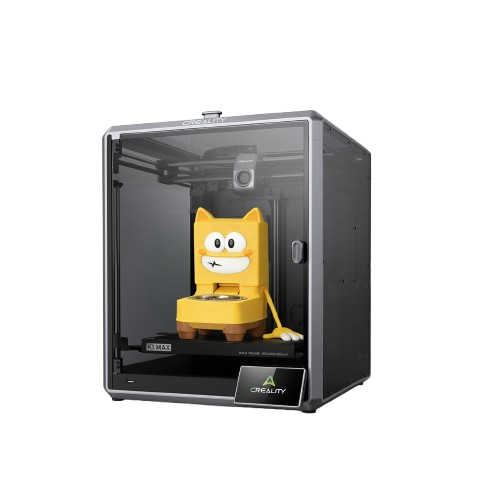
Creality K1 Max
K1 Max (2025 version as shipped; not the K1, K1 SE or K1C)
Two-thirds of the volume for half again the price, and the enclosure and hardened nozzle the Neptune cannot offer at any setting.
- Build volume
- 300 × 300 × 300 mm
- Technology
- FDM
- Max speed
- 600 mm/s (CoreXY, ≤20,000 mm/s² acceleration, max 32 mm³/s flow)
- Enclosed
- Yes (enclosed frame, active cooling — no chamber heating published)
- Multi-colour
- Optional (supports Creality's CFS filament system; the base machine is single-colour)
- Auto levelling
- Yes (nozzle strain gauge levelling, plus a 1 μm AI LiDAR first-layer scan)
What we like
- An enclosed chamber with an activated carbon filter, which is what the Neptune's open frame cannot provide at any price
- A 100 °C bed and a hardened steel nozzle on an all-metal hot end as standard, rather than as an upgrade costing under £10
- A CoreXY frame that moves the head instead of the part, at up to 20,000 mm/s²
- A materials list that reaches polycarbonate, nylon and carbon-filled grades
- A published 1000 W rating, so running costs can actually be worked out
- A 1 μm LiDAR that scans the first layer, plus cloud and RJ45 alongside USB and LAN
- Creality's policy runs to up to twenty-four months against ELEGOO's twelve
What we don’t
- 300 × 300 × 300 mm — two-thirds of the Neptune's footprint in each axis and a fraction of its volume
- Roughly £150 to £200 more than the Max, and more than twice the Max's cheapest UK route
- 1000 W rated, so it is the one machine here whose electricity use is worth thinking about
- Owner reports describe the AI LiDAR failing calibration often enough that switching it off is a common response
- A 300 mm plate is still hard to keep flat, and large flat parts are where it shows
Buy it instead if you want functional parts in ABS, ASA or nylon. Skip it if the reason is size.
Who should buy it, who should not, and the verdict
So is the ELEGOO Neptune 4 Max worth it? It reduces to one question, and not one about quality: have you measured the thing you want to print?
If you have, and it needs more than 320 mm in some direction, this is the machine: nothing else puts a 420 mm plate on a desk from under £280 on the cheapest UK route. Cosplay armour, helmets, large enclosures and architectural models are the purchases it rewards.
If you have not measured it, buy the Neptune 4 Plus — a recommendation from ELEGOO's own documents rather than anyone's opinion: a hotter bed, half again the acceleration and roughly £100 back. Max is a size, not a grade.
It suits nobody who mainly wants ABS or ASA parts, because an 85 °C bed in an open frame is the wrong tool for that job, nobody short of space, and nobody hoping to print tonight. Each has somewhere to go: the K1 Max for engineering plastics, the Plus for a saner footprint, or the best 3D printers UK guide.
The most build volume per pound on the market, with a properly specified machine around it. Just be clear what you are buying: ELEGOO's own figures give the cheaper Plus a hotter bed and more acceleration, so the Max earns its money on size alone.
- Buy it if
- You have a part that will not fit in 320 mm, you want it in one piece in PLA or PETG, and you will spend the first evening on the bed rather than resenting it.
- Skip it if
- Your parts would fit a smaller plate, you mainly want ABS or ASA, or you want the printer working within an hour of the box opening.
How this article was researched
No printing, handling, measurement or photography was carried out. Specifications come from ELEGOO's own Neptune 4 Max manual V1.8 and product pages, recorded claim by claim with a source URL and an access date; comparison figures come from ELEGOO's Neptune 4 Plus manual and Creality's own parameter pages. UK prices were checked across three routes on 6 October 2026 and given only as bands. The ownership patterns are recurring themes from community firmware projects, long-term video guides and UK retailer listings, in our own words — no review quoted, no rating reproduced — and Reddit blocked access during the research, so that section rests on a narrower base than we would like. Four things were left out rather than estimated: electricity cost, since ELEGOO publishes no rated wattage; any noise figure, since no traceable one exists; the screen size, which ELEGOO does not publish; and one retailer's 80 °C bed maximum, set aside for ELEGOO's own 85 °C. Our approach is set out in the review methodology.
Common questions
- Is the ELEGOO Neptune 4 Max worth buying?
- Only if you have measured the thing you want to print and it needs more than 320 mm in some direction. On that test the answer is an easy yes: no other machine puts a 420 × 420 × 480 mm envelope on a desk from under £280 on the cheapest UK route, and the frame, extruder and firmware wrapped around that bed are better than the price suggests. Fail the test and the answer flips, because ELEGOO's own documents show its cheaper Neptune 4 Plus running a 100 °C bed and 12,000 mm/s² of acceleration where the Max manages 85 °C and 8,000. You would be paying roughly £100 more for volume you do not need and accepting a cooler bed to get it. The word Max describes the size of the machine, not its position in the range.
- Who is the ELEGOO Neptune 4 Max best for?
- Someone with a specific large object in mind and the patience to set a big printer up properly. It suits cosplay and prop makers printing armour and helmets in one piece, model makers and architects producing large single-piece pieces, small workshops batching thirty parts in an overnight job, and anyone whose current printer keeps forcing them to split designs and glue them. All of those are PLA and PETG jobs, which is what this machine is genuinely good at. It suits nobody who wants functional ABS, ASA or nylon parts, nobody short of bench space, and nobody who wants to unbox a printer and print the same evening — it arrives as a base and a gantry to be assembled, and the levelling routine asks for an A4 sheet and six hand-twisted nuts before it runs.
- What are the main alternatives to the ELEGOO Neptune 4 Max?
- Two, and they answer opposite questions. The ELEGOO Neptune 4 Plus is the one most buyers should look at first: the same extruder, hot end, firmware and levelling system at 320 × 320 × 385 mm, about £100 cheaper on ELEGOO's own UK store, and better on the two figures that matter most at 100 °C and 12,000 mm/s². The Creality K1 Max goes the other way — down to 300 × 300 × 300 mm and up to roughly £560 to £640, in exchange for an enclosed chamber with a carbon filter, a 100 °C bed, a hardened steel nozzle as standard, a CoreXY frame and a materials list reaching polycarbonate and carbon-filled grades. Choose the Plus if you want volume sensibly priced, the K1 Max if you want engineering plastics, and the Neptune 4 Max only if 420 mm is a requirement rather than an aspiration.
- Can the ELEGOO Neptune 4 Max print ABS and ASA?
- ELEGOO lists both, and the honest answer is that it will print them in small sizes and struggle with them at the size you bought the machine for. The nozzle is not the problem — 300 °C is well beyond what either filament asks. The bed is: it stops at 85 °C, and ELEGOO quotes even that at a 25 °C ambient temperature, so a cool British room erodes it further. There is also no enclosure and no heated chamber, so the air around a tall part moves and cools. ABS and ASA contract as they cool and pull their corners up off the plate, and the force available to do that scales with the length of the part — which is why a 100 mm bracket is usually fine and a 400 mm panel usually is not. If engineering plastics are the point, an enclosed machine with a 100 °C bed is the right purchase, and even ELEGOO's own cheaper Neptune 4 Plus has the hotter bed.
- Is the ELEGOO Neptune 4 Max levelling really automatic?
- Partly, and less than the marketing implies. ELEGOO advertises 121-point auto bed levelling, and its own user manual then sets out a sequence that begins by hand: home the axes, slide a sheet of A4 paper under the nozzle and adjust the height compensation until you feel slight friction, then switch to auxiliary levelling and repeat that paper test at six corner points by turning the nuts under the heated bed. Only then does the automatic pass run, and the manual describes that pass as 36 points, with a 36/121 toggle available on the screen. A UK retailer describes the whole system as semi-automatic, which is fair. None of this is a fault — a mechanical bed does need squaring once — but it is a different purchase from the one the phrase auto levelling suggests, and across a 420 mm plate it is an evening's work rather than a minute's.