How to Choose a 3D Printer in the UK
Which 3D printer suits you, decided before you shop: FDM or resin, the specs that matter, what one costs to run in the UK, and your rights if it fails.
Start with what you want to make
How to choose a 3D printer comes down to one question asked before any other: are you making things that need to be strong, or things that need to be sharp? Answer that and you have picked your technology, which is the decision every other specification hangs off.
Brackets, replacement knobs, tool holders, board-game inserts, cosplay armour — that is filament work, and a fused deposition modelling (FDM) machine is what you want. Miniatures, jewellery patterns, scale-model parts, anything where a fingernail-sized face needs readable detail — that is resin.
Most people asking what 3D printer they should buy are hoping for one machine that does both well. There isn't one, and choosing badly here is not fixed by spending more.
What separates filament from resin
An FDM printer pushes a plastic thread through a hot nozzle and draws your object one line at a time, like a very patient icing bag. A resin printer holds a tank of liquid photopolymer and flashes an ultraviolet image through the bottom of it, hardening a whole layer at once. That difference explains almost everything else.
Detail. Resolution on a resin machine is set by the pixel size of its screen. An ELEGOO Mars 5 Ultra images at 18 × 18 μm and goes down to 0.01 mm layers . A micron is a thousandth of a millimetre, so those pixels are roughly a fifth the width of a hair. Filament machines are limited by the nozzle, laying a line a few tenths of a millimetre wide. For a bracket, invisible. For a face, the whole point.
Size. Filament wins comfortably. The Mars 5 Ultra gives you 153.36 × 77.76 × 165 mm — a tall, narrow column sized for figures. A mainstream FDM machine like the Bambu Lab A1 offers 256 × 256 × 256 mm , enough for most household objects in one piece.
Materials. Filament gives you a menu: Bambu Lab lists PLA, PETG, TPU and PVA as ideal for the A1 , from stiff to rubbery. Resin gives you resin — the Mars 5 Ultra takes most 405 nm formulations — and cured resin is harder but more brittle than a printed filament part.
Effort. Here reputation lags reality. Reviewers repeatedly describe the Mars 5 Ultra as one of the easiest resin printers to start with, needing very little setup before the first print. The hard part of resin has moved: it is no longer the printing but everything after the plate comes out, which is a cost question rather than a skill one.
The five specifications that actually change the decision
Spec sheets are long and mostly irrelevant. Five entries do real work; learning how to pick a 3D printer is largely learning to ignore the rest.
1. Build volume, measured against your actual projects. Buy for what you will print this year. The A1's 256 × 256 × 256 mm swallows most household objects whole; the Mars 5 Ultra's 153.36 × 77.76 × 165 mm sounds small until you realise a resin plate that size holds a squadron of figures at once.
2. Temperature ceilings, which decide your materials. On a filament machine the nozzle and bed maximums are a materials list in disguise. The A1 runs a 300 °C hot end and a bed rated to 100 °C — enough for anything, it sounds like. It is not, because the A1 is open-framed and ABS and ASA crack when a draught cools them mid-print, which is why Bambu Lab does not recommend them here . Those materials need an enclosure: a box that holds warm air in.
3. Automatic bed levelling, the one convenience worth paying for. Prints fail at the first layer, and they fail when the nozzle sits fractionally too far from the plate. Machines that measure this themselves, like the A1 and the Mars 5 Ultra's one-click routine , remove the commonest beginner failure. Long-term owner reports on the Bambu Lab forum repeatedly describe the A1 as reliable and low-maintenance, particularly compared with older budget printers they have moved from.
4. Footprint and weight, the specification people skip. The A1 weighs 8.3 kg ; the Mars 5 Ultra weighs 8.8 kg and takes about 260 × 268 mm of desk . A filament printer flings its bed back and forth, so a flimsy shelf becomes part of the print.
5. Ecosystem: slicer, spares and the people who answer questions. An active forum, a stocked UK spares page and a slicer that gets updates are worth more over three years than a marginally better spec sheet.
What a 3D printer actually costs to run in the UK
Ask almost any 3D printer buying guide UK readers land on what a machine costs to feed and you get the word "low". Here is the arithmetic instead, assumptions on the table. These are worked estimates, not measurements.
Electricity is the part people overestimate. Take the highest number on the A1's spec sheet: a maximum draw of 1,300 W at 220 V . That is the peak while the bed and nozzle heat up, not what the machine settles at. Use it as a ceiling anyway — drawing that continuously for ten hours would consume 13 kWh, which at the roughly 26p per kWh set by the Ofgem price cap comes to about £3.40 . Real consumption is far below it. Treat that as an upper bound, not an estimate of a print.
Plastic is the part people underestimate. Ordinary PLA runs roughly £14 to £18 a kilogram from a UK retailer . A palm-sized object using thirty grams is about 50p of material at the top of that range. Print constantly and filament, not electricity, is your bill.
Resin is a different calculation, and this is the trap. The resin itself is comparable — roughly £16 to £28 a kilogram for the common types . Everything else is not. Prints come off the plate wet and must be washed in isopropyl alcohol then cured under UV, and a combined wash-and-cure station sits around the £79 to £113 mark . Reviewers consistently point out that the printer is only part of the outlay, since washing, curing, alcohol, gloves and ventilation sit outside the box. The release film is a routine consumable on this machine, and owner opinion is divided on whether the tilting vat lengthens or shortens its life, so reports vary.
So: a filament printer costs pennies a print. A resin printer at the same purchase price costs meaningfully more to own, and the gap is in the accessories rather than the resin.
What UK law gives you when it goes wrong
This is the section other guides skip, and it is worth more than any specification. Buying a 3D printer means buying heaters, belts, motors and firmware, and a proportion of them arrive faulty or fail early.
Two rights sit underneath whatever the manufacturer offers, and neither can be signed away. Under the Consumer Rights Act 2015 you have a short-term right to reject faulty goods for 30 days after delivery — a refund rather than a repair, at your choice. Buying online also carries a 14-day cancellation right that does not depend on anything being wrong with the machine , which exists for the buyer who opens the box and realises they bought the wrong thing.
Manufacturer warranties sit on top and vary more than you would expect. Bambu Lab's UK warranty policy states two years from the warranty start date . ELEGOO offers a 12-month warranty on the Mars 5 Ultra, with the LCD covered for three months and the tank and build plate for six . That is the pattern to watch on resin machines: the headline figure covers the chassis while the parts that actually wear are carved out with shorter terms.
A recurring theme among Bambu Lab buyers on UK review sites and the manufacturer's forum is slow warranty support, although delivery and packaging are frequently praised. That is not unique to one brand. When a warranty queue stalls, those statutory rights are the fallback — and they are owed by the retailer who sold you the machine, not the factory that made it.
Noise, smell and where the machine will live
A 3D printer runs for hours, often overnight, in a room you also use. Decide where it goes before you decide what it is.
Noise. Expect fans, stepper motors and, on an open-frame machine, a bed accelerating back and forth. Published decibel figures are patchy and neither example here has one, so treat any headline number as a best case. Owner accounts are more useful and less tidy: owner opinion on A1 noise is mixed, with some who also own an A1 mini finding the larger machine noticeably louder, while others consider it quieter than Bambu Lab's enclosed printers. An open frame is fine in a workshop or spare room and marginal in a bedroom.
Fumes and ventilation. Filament printing melts plastic, and the Health and Safety Executive has published research on emissions from desktop filament 3D printers — report RR1146, from 2019 . Its full text is no longer served on the HSE site, so no finding from it is reproduced here — but that the regulator thought the question worth investigating is reason enough to put a filament machine in a ventilated room rather than a sealed cupboard. The A1 is open-framed , so nothing about it contains anything.
Resin needs more than good intentions. The manual for a machine of this class requires gloves and eye protection, a well-ventilated area, and curing resin under UV before it is disposed of — which is why uncured resin does not go down a drain or into a household bin. If you cannot commit to that routine, it is a reason to choose filament.
Space. Beyond the footprints above, allow clearance overhead, somewhere for spools or a wash-and-cure station, and a surface that does not wobble.
Four things buyers get wrong
Reading maximum speed as print speed. The A1 is rated to a maximum toolhead speed of 500 mm/s , a ceiling rather than a typical print speed — what the motion system can reach, not what it holds while laying a curved wall well. Two machines with identical headline speeds can differ by hours on the same file.
Expecting automatic levelling to mean automatic everything. It removes the commonest failure, not the need to understand the first layer. Several reviewers caution that the auto-levelling on this class of machine does not remove the need to understand levelling, and Elegoo publishes a manual levelling guide alongside the automatic one.
Assuming firmware only improves things. A recurring theme on the Bambu Lab forum is that a firmware update can occasionally unsettle calibration on the A1, with owners often reporting that a recalibration or rollback resolves it. Worth knowing before one lands mid-project.
Blaming the machine for week one. Early prints go wrong in ways that look like faults and are not. Several reviewers report that prints grip the plate more firmly than expected at first and that reducing the bottom-layer exposure a little is the usual fix, although this varies with resin. Give any machine a fortnight before concluding anything about it.
Two worked examples, and the checklist they came from
Run the 3D printer buying checklist in order and the field collapses quickly. Strong or sharp? Then: does it fit my objects, does it reach my materials, does it level itself, will it live somewhere the noise is acceptable, and can I afford to run it? Here is that applied at each end of the fork — neither machine is the better one, because they answer different questions.
If the answer was "strong". You want a filament machine that levels itself and prints the everyday materials without argument.
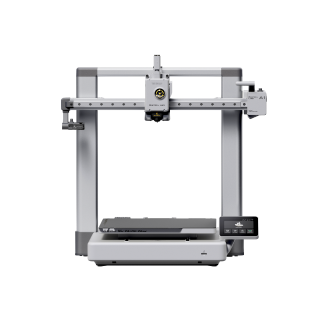
Bambu Lab A1
A1 (standard, without AMS lite)
Auto-levelling and a mainstream slicer and spares route, with an open frame that rules out the high-temperature plastics.
- Build volume
- 256 × 256 × 256 mm
- Technology
- FDM
- Max speed
- 500 mm/s toolhead (10,000 mm/s² acceleration)
- Enclosed
- No
- Multi-colour
- Optional (AMS lite sold separately; up to 4 spools)
- Auto levelling
- Yes (fully automatic)
A 300 °C hot end reads like it will print anything, but the open frame is why Bambu Lab lists PLA, PETG, TPU and PVA as ideal and does not recommend ABS or ASA . In the UK it typically sits between about £240 and £320 . Buy this if your projects are functional and you want the machine to be boring. Skip it if you need ABS or ASA, or it has to live somewhere quiet — look for an enclosed model instead.
If the answer was "sharp". You want resolution, and you accept a post-processing routine in exchange.
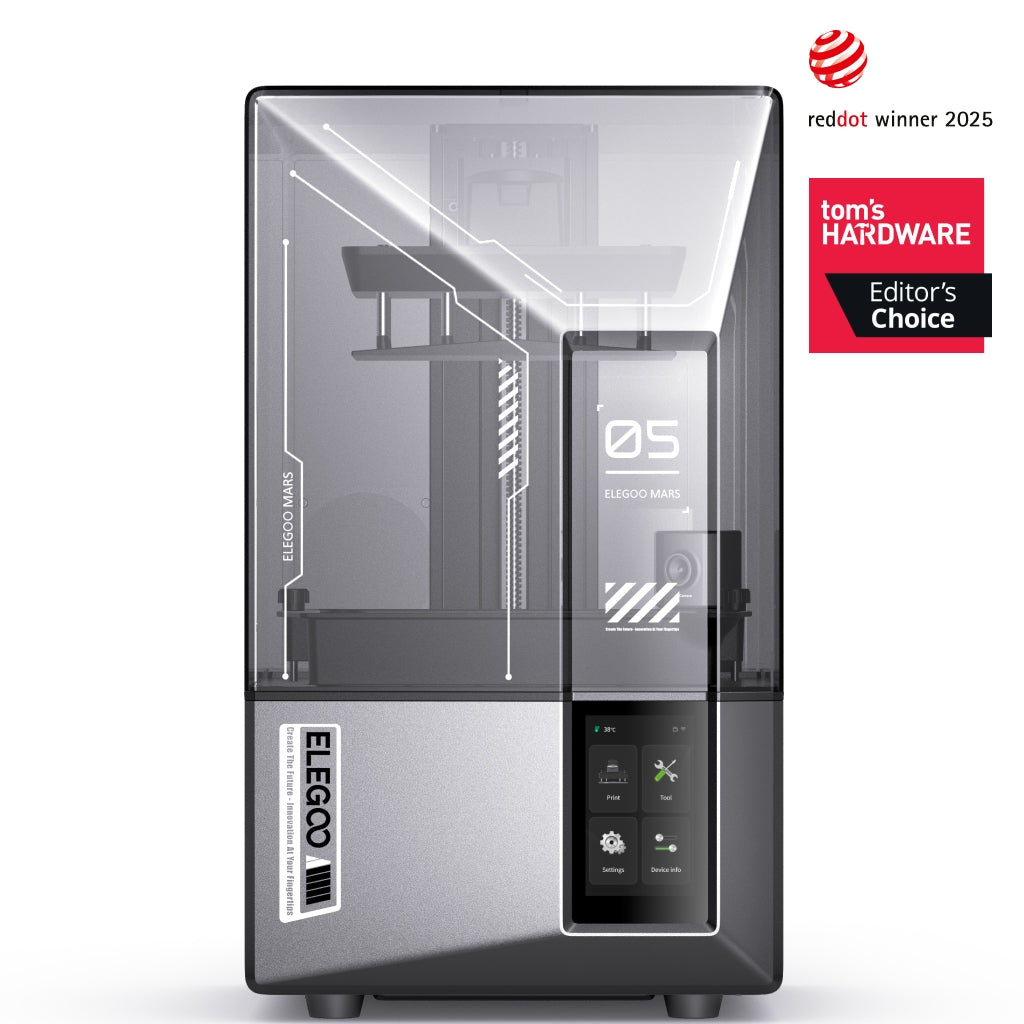
ELEGOO Mars 5 Ultra
Mars 5 Ultra 9K (not the non-Ultra Mars 5)
Fine detail from an 18-micron pixel and a gentle setup, at the price of a washing routine and a warranty that shortens on the wearing parts.
- Build volume
- 153.36 × 77.76 × 165 mm
- Technology
- Resin (MSLA)
- Max speed
- Up to 150 mm/h (manufacturer maximum)
- Enclosed
- Lid (acrylic UV cover)
- Multi-colour
- No
- Auto levelling
- Yes (one-click automatic levelling)
The 18 × 18 μm pixel is the entire reason to be on this side of the fork. The trade is the workflow costed above, and a warranty covering the machine for 12 months but the LCD for three and the tank and plate for six . It usually lands around the £210 to £260 mark . Buy this if you print miniatures or detailed models and have a ventilated space with a sink nearby. Skip it if you want large or load-bearing parts.
Where to go next
You now have the criteria, which is the part that does not change when a new model launches. The machines change constantly, so the shortlists live elsewhere on the site and are kept current there.
Still weighing both technologies? The ranking of the best 3d printer uk options covers filament and resin together. If section one settled it on "strong", go to the best FDM 3d printer uk list; if it settled on "sharp", the best resin printer uk list assumes you have accepted the washing and curing routine.
Take the five questions with you. A ranking tells you what is good; only your own answers tell you which good machine is good for you.
How this article was researched
No first-hand testing, measurement or photography was involved. Every specification figure cites a claim verified against a manufacturer page, official manual, UK regulator or piece of legislation, recorded in the site's claim ledger. Prices are bands, because live figures go stale. Owner-experience statements come from recurring patterns in manufacturer forums, long-term reviews and retailer feedback, are labelled as such, and are never presented as verified specification. Where a source could not be reached — the full text of the HSE's 2019 report on desktop filament printer emissions — nothing beyond the regulator's own index has been claimed.
Common questions
- What should UK buyers know about how to choose a 3d printer in the uk?
- Three things that guides written elsewhere tend to miss. Electricity is cheap here relative to the panic about it — even the absolute ceiling on a mainstream filament machine works out at a few pounds for a very long print at the current Ofgem cap, and the real figure is far lower. Consumables are the actual cost, and on resin the washing and curing kit is a larger line than the resin itself. And UK consumer law sits underneath any manufacturer warranty: a 30-day right to reject faulty goods, plus a 14-day cancellation right on anything bought online, both owed by the retailer rather than the factory.
- Which factors change the answer for FDM and resin users?
- Resolution, size and workflow. Resin resolves detail a filament nozzle cannot approach, which is why miniatures and jewellery patterns go that way; filament gives far more build volume for the money and produces tougher, less brittle parts. The factor people weigh too late is what happens after the print: filament prints come off finished, while resin prints need washing in alcohol and curing under UV, with gloves, ventilation and correct disposal of uncured resin. Materials matter too — an open-frame filament machine cannot reliably run ABS or ASA whatever its nozzle temperature suggests.
- What practical checklist should a buyer follow?
- Five questions in order. One, strong or sharp — which decides filament or resin. Two, does the build volume fit the objects you will genuinely make this year, with a little headroom and no more. Three, do the temperature ceilings and the presence or absence of an enclosure reach the materials you need. Four, does it level itself, which removes the commonest beginner failure. Five, can you house it where the noise, the fumes and the clearance are all acceptable, and afford what it consumes. Anything still standing after those five is a reasonable buy.