Prusa CORE One L Review
A UK review of the Prusa CORE One L: which version actually ships now, what its 60 °C chamber really reaches, and the rival that costs half as much.
Independent and reader-funded. We earn a commission if you buy through our links, at no extra cost to you. How this works.
The Prusa CORE One L is the large one: an enclosed CoreXY machine with 300 × 300 × 330 mm of print space, just under thirty litres, built around a mains-powered cast aluminium heatbed that Prusa says holds temperature to within 2 °C across 99% of the print area. The machine assessed here is the CORE One L+ — the refreshed version Prusa ships now, not the original CORE One L and not the smaller CORE One+.
That distinction is the first thing this Prusa CORE One L review has to settle, because almost nothing else written about the machine does. It sits between the £1,500 and £1,750 mark in the UK, roughly three times an enclosed printer of half the size, so the question is whether the bed, the chamber and the Prague supply chain are worth the difference. No printing or measurement was carried out here; every figure traces to a source. Still choosing between filament machines generally? The best FDM 3d printer uk guide ranks seven.
Which CORE One L you are actually buying
Settle this before you look at a price, because two machines wear this name. Prusa announced the CORE One L at the end of October 2025 and sells it assembled only, with no kit version planned. In August 2026 the line was refreshed: the CORE One L+ adds GT1.5 belts and an integrated nozzle wiper, is ready for the INDX tool-changer, and is offered to existing owners as an upgrade kit.
So the L+ is the same machine a revision on, aimed at surface finish and at the small failures that follow a dirty nozzle. Prusa has not called the original discontinued, which is the tell: a running change, not a replacement.
That matters when shopping. A UK retailer may list both on one page, and a discounted L with the upgrade kit available is a rational buy. What you should not do is pay L+ money for an L, or assume a review written before August 2026 describes the machine in the box.
The specification, and what each figure changes
Prusa CORE One L+
CORE One L+ (assembled; the refreshed CORE One L — not the original CORE One L, not the CORE One+)
A thirty-litre enclosed CoreXY printer whose real advance is the bed underneath it. Engineering materials at scale, at a price that demands you need the scale.
- Build volume
- 300 × 300 × 330 mm (29.7 litres)
- Technology
- FDM
- Max speed
- Travel speed up to 500 mm/s (Prusa publishes travel speed, not a maximum print speed)
- Enclosed
- Yes (fully enclosed CoreXY; Active Convection Chamber up to 60 °C, heated from the underside of the AC heatbed by two fans)
- Multi-colour
- Optional (INDX tool-changer conversion kit, sold separately; the L+ is INDX-ready)
- Auto levelling
- Yes (automatic mesh levelling via load-cell sensor; ships pre-calibrated from the factory)
What we like
- A mains-powered cast aluminium bed Prusa says holds temperature to within 2 °C across 99% of the print area
- 300 × 300 × 330 mm of print space, just under thirty litres, in an actively heated chamber rated to 60 °C
- An abrasive-resistant nozzle supplied alongside the brass one, so filled filament is a day-one capability
- Wi-Fi on a physically removable module — it runs genuinely offline, with no cloud account required
- Aluminium panels leave it half a kilo lighter than the smaller CORE One despite roughly double the volume
- Open-source toolchain, component-level spare parts, and an L-to-L+ upgrade sold as a kit
What we don’t
- ABS, ASA, HIPS and PA are listed only with the Advanced Filtration unit, which is sold separately
- One year of UK manufacturer warranty against two years for consumers in the EU, Norway, Iceland, Switzerland and Liechtenstein
- No acoustic rating published for either the L or the L+, on a machine that runs long jobs
- Owner reports describe the 60 °C chamber as a figure to work towards rather than one it holds unaided
- Owner reports describe belts arriving under-tensioned and bed fasteners working loose on pre-assembled machines
- Roughly double the price of a rival with a larger plate and a hotter nozzle
Start with the bed, the part Prusa redesigned rather than enlarged. It is mains-powered cast aluminium with dual-loop heating, holding temperature to within 2 °C across 99% of the print area. On a small printer that uniformity is a nicety; on a 300 mm plate it is the argument, because the corners of a large ABS part lift when the plate is cooler there than the middle. The same bed heats the box: two fans underneath push chamber air across its hot underside, reaching an actively heated chamber rated to 60 °C with no separate heater. Warm, still air holds a tall part at an even temperature all the way up, so its layers shrink together.
The build volume is 300 × 300 × 330 mm, in a machine measuring 469 × 521 × 635 mm and weighing 21.9 kg. The hot end runs to 290 °C, or 400 °C with the optional HT hotend, over a 120 °C heatbed, fed by a Nextruder direct-drive extruder with 10:1 planetary gearing. The nozzle swaps without tools, and both a brass high-flow 0.4 mm and an abrasive-resistant 0.4 mm nozzle are supplied — the second is usually sold separately, and it lets you run filled filament without shredding brass.
Prints come off removable dual-sided PEI spring steel sheets, levelled automatically by a load-cell sensor, with Input Shaper and Phase Stepping keeping ringing off vertical faces. Layers run 0.05 to 0.30 mm on 1.75 mm filament. One figure needs care: the 500 mm/s Prusa quotes is travel speed, and no maximum print speed is published at all.
What the CORE One L does well
The bed is the headline and deserves to be. Flat, even heat across a large plate removes the commonest reason big parts fail, and does it passively — no profile to tune, no over-specified brim, no glue stick. With automatic load-cell levelling, the first layer stops being something you manage.
The second strength is less visible and, for some buyers, decisive. The Wi-Fi module is physically removable, alongside Ethernet and NFC. Not disabled in a menu — removable. If you work somewhere that will not have an unmanaged radio on the network, or object to a printer needing a cloud account, this one runs without either.
Third, aluminium panels leave the L half a kilo lighter than the smaller CORE One despite roughly double the volume — which you notice the day it goes up a staircase.
Where it falls short
Four things, and the first catches people out. Prusa's material list covers PLA, PETG, Flex, PVA, PC, PP, CPE and PVB as standard, and lists ABS, ASA, HIPS and PA only with the Advanced Filtration unit fitted — sold separately. The chamber exists to make styrenics behave, and the styrenics carry a condition. Budget for the unit if ABS or ASA is why you are buying.
Second, the warranty. Prusa gives one year in the UK against two for consumers in the EU, the EEA and Switzerland — half the cover a German buyer gets on the same machine, and no other review of this printer appears to mention it.
Third, there is no published acoustic rating at all, for either variant — a real gap on a machine likely to run twelve-hour jobs near people.
Fourth, a build-quality question a pre-assembled premium printer should not raise. Owners describe bed and frame fasteners arriving or working loose on machines sold pre-assembled, and recommend periodic checks of the bed mounts, though reports differ on how much it affects the prints themselves. The frustration there is less about the fasteners than about the absence of published assembly diagrams or torque figures.
What owners consistently report
Prusa runs a public forum with a section for this machine, which makes the ownership record unusually legible. Three patterns come out of it.
A recurring theme in Prusa's CORE One L forum is belt tension arriving low from the factory, which owners describe surfacing as resonance at certain speeds, repeated homing or nozzle-cleaning cycles and erratic bed probing, and which re-tensioning to the published frequency range resolves in most of the cases that report back. Those complaints arrive looking like four separate faults. If something feels wrong in the first week, check the belts first — Prusa's own app will measure their frequency.
The second pattern concerns the number on the box. Prusa rates the chamber to 60 °C. Owner reports in Prusa's own CORE One L forum describe the 60 °C chamber figure as something owners work towards rather than a temperature the machine holds unaided, with added insulation and a hotter bed the usual remedies, though at least one owner describes reaching it without either. The reasons given concern heat escaping rather than heat production. Treat it as a ceiling the machine can be coaxed to rather than a setting it maintains.
The third runs the other way. Some owners report the opposite difficulty with low-temperature materials, describing the chamber drifting warmer than they want for PLA and PETG and connecting it to stringing and weaker bridging, although this comes from a much smaller group than the reports about reaching 60 °C. A handful of people rather than a chorus — but it follows from heating the chamber with the bed.
Setup and the first week
There is no kit version and none is planned; the machine arrives assembled and pre-calibrated. For most buyers that means unboxing, levelling handled automatically by the load-cell sensor, and a first print the same evening. Two filament sensors mean a jam or a run-out pauses the job rather than quietly ruining it overnight.
The learning curve is not in the hardware but in the slicer. PrusaSlicer ships with profiles tuned for this machine, and for PLA and PETG you can print what the profile gives you. The materials that justify the purchase need thought, because chamber temperature, bed temperature and cooling all interact where the bed heats the box. Set aside an evening for belt tension and a filament profile first.
Prusa CORE One L print quality and what it will actually print
For everyday work — PLA, PETG, PVB, flexibles — the relevant figures are the 0.05 to 0.30 mm layer range and the vibration correction keeping ringing off vertical faces. A thirty-litre printer prints a small bracket exactly as well as a desktop one, and no better.
It earns its money at the awkward end of the list: PC, PP and CPE as standard, with ABS, ASA, HIPS and PA available once the Advanced Filtration unit is fitted. These polymers fail for thermal reasons — cooling unevenly, shrinking hard, pulling off the plate — and the even bed plus the heated chamber address exactly that. A 290 °C nozzle covers all of them, with the optional HT hotend reaching 400 °C.
There is one large-format tax nobody mentions until you hit it. Owners who measure large calibration parts describe them landing slightly under nominal and settle on filament shrinkage rather than the machine as the cause, reporting that slicer-side shrinkage compensation brings them back in line. Shrinkage scales with length: a rate you would never notice on a palm-sized bracket becomes visible across the full 300 mm width of this plate. If your parts must fit other parts, budget an afternoon for compensation first.
Noise, space and siting it in a British home
Deal with the noise question honestly: Prusa publishes no acoustic rating for the CORE One L or the L+. Anyone quoting a decibel figure did not get it from the manufacturer, and this review will not invent one.
What can be said is structural. It is fully enclosed, and an enclosure is a sound barrier first. Against that, the chamber is heated by two fans driving air across the underside of the bed, so air moves whenever the chamber is at temperature — and fan noise carries further through a house than motion noise. Owners report resonance at particular speeds traced to belt tension, which re-tensioning resolves in most of the cases that report back.
On space, the machine is 469 × 521 × 635 mm and 21.9 kg. Plan for more than the footprint: the door swings out at the front, a spool sits at the side, and the chamber needs air around it that is not its own warm exhaust.
The last siting question is fumes rather than sound. ABS, ASA, HIPS and PA appear on Prusa's list only with the Advanced Filtration unit fitted — the configuration Prusa considers right for those materials, not a claim that any configuration makes a room safe. If styrenics are the plan, treat ventilation as part of the purchase.
What a Prusa CORE One L costs to run in the UK
Electricity first, because it is the number people overestimate. Prusa publishes 16 W on standby, around 630 W while preheating, and roughly 90 W printing PLA or 215 W printing ASA. The preheat figure is a short peak, not a running average.
At a unit rate of 25p per kWh, a reasonable mid-2026 British domestic figure but not necessarily yours, a ten-hour PLA job draws about 0.9 kWh of electricity, or roughly 23p. The same job in ASA draws about 2.2 kWh — near 55p. Forty hours a week on PLA comes in under £5 a month. These are estimates from the manufacturer's figures and a stated tariff, not measurements.
So electricity is not what this machine costs you. Filament is, and the materials this printer exists for cost several times what PLA does by weight. Two other costs belong in the purchase price rather than the monthly one: the Advanced Filtration unit is sold separately, and PEI sheets are consumable — double-sided, which stretches their life, but a plate this size is not cheap to replace.
UK price, availability, warranty and spare parts
On price, the Prusa CORE One L sits between the £1,500 and £1,750 mark in the UK, depending on the route and whether a discount is running. That band comes from UK retailer listings, and one route adds a bulky-goods charge on top.
Availability is better than for much premium hardware here: the machine was in stock through more than one UK retailer, with British delivery and VAT-inclusive pricing. Prusa's own shop dispatches from the Czech Republic and notes that customs charges may apply outside the EU — so buying direct means an import step, while a UK retailer means a domestic returns address.
The warranty is the UK-specific fact worth reading twice. Prusa gives one year in the UK, against two for consumers in the EU, Liechtenstein, Switzerland, Norway and Iceland, and buying from a UK retailer does not extend it. That does not touch your statutory rights against the retailer, which run longer — but on the manufacturer's warranty alone, a British buyer gets half what a German one does.
Spare parts are the compensating strength. Prusa sells parts down to component level and a UK reseller carries them too, so a breakage is an order rather than an argument — and the L+ upgrade is sold as a kit, which is what keeps the older machine defensible.
The CORE One L against its two closest alternatives
The Prusa CORE One L alternatives worth your time answer two objections: do I need the big one? and do I need the Prusa?
| Specification | 1 Prusa CORE One L+ The machine reviewed | 2 Prusa CORE One+ (Gen 2) The same machine, smaller | 3 QIDI Plus5 Most of it, roughly half the money |
|---|---|---|---|
| Best for | Large parts in engineering plastics | The same workflow, less of it | Capability per pound |
| Build volume | 300 × 300 × 330 mm | 250 × 220 × 270 mm | 320 × 320 × 300 mm |
| Heated chamber | Yes — to 60 °C | Yes — to 55 °C | Yes — to 65 °C |
| Max nozzle temperature | 290 °C (400 °C with HT hotend) | 290 °C (400 °C with HT hotend) | 370 °C |
| Max bed temperature | 120 °C | 120 °C | 120 °C |
| ABS and ASA | Listed with Advanced Filtration | Listed with Advanced Filtration | Listed as standard |
| Air filtration | Sold separately | Sold separately | Three-stage, fitted |
| Weight | 21.9 kg | 22.5 kg | 29 kg |
| Published noise rating | None published | None published | None published |
| UK warranty | 1 year | 1 year | 1 year |
| Typical UK price | £1,500–£1,750 | £1,200–£1,500 | £650–£750 |
The CORE One+ is the one to check yourself against first. Same ecosystem, the same 290 °C nozzle over a 120 °C bed, a 250 × 220 × 270 mm volume, a chamber rated to 55 °C rather than 60 °C, the same materials on the same filtration condition, the same one-year UK term and a band of £1,200 to £1,500. It takes the MMU3 or INDX too. The gap is a few hundred pounds and about half the print volume — so if you do not regularly print things the smaller plate will not take, the L is the worse buy.
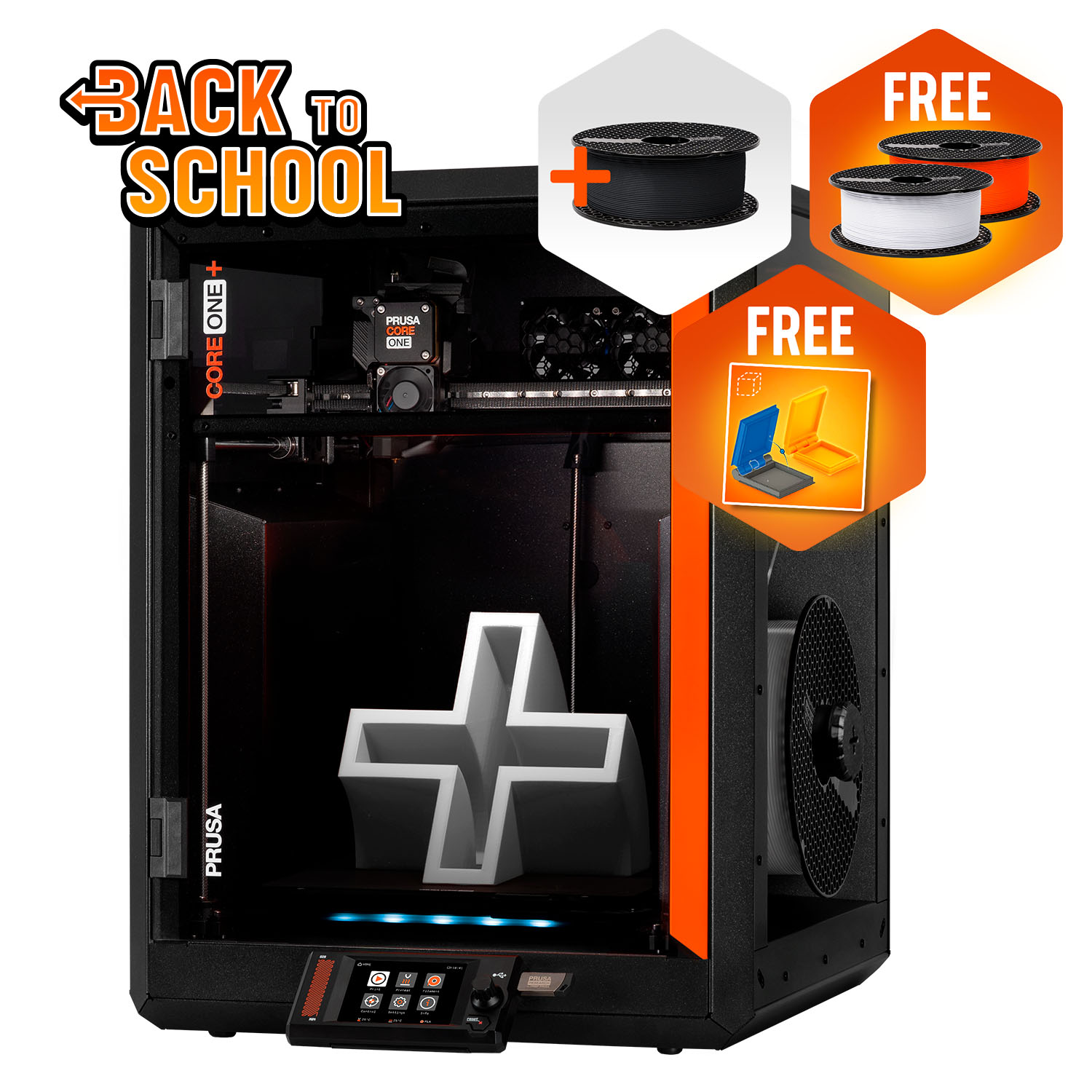
Prusa CORE One+ (Gen 2)
CORE One+ (Gen 2), assembled
Everything the L does, in a smaller box for less. The right Prusa for most people, and the one to rule out before you size up.
- Build volume
- 250 × 220 × 270 mm
- Technology
- FDM
- Max speed
- Not stated on manufacturer product page - Unverified
- Enclosed
- Yes (fully enclosed CoreXY; active chamber heating up to 55 °C)
- Multi-colour
- Optional (MMU3 5-filament unit or INDX tool-changer up to 8 tools, sold separately)
- Auto levelling
- Yes (fully automatic load-cell first-layer calibration)
What we like
- The same 290 °C nozzle, 120 °C bed and material list in a smaller, cheaper box
- Sits in a band of £1,200 to £1,500 against £1,500 to £1,750 for the L
- Takes the MMU3 or the INDX tool-changer for multi-material work
- Lower power draw: 90 W on PLA and 110 W on ABS
What we don’t
- 250 × 220 × 270 mm — a little over half the L's print volume
- Chamber rated to 55 °C rather than 60 °C
- The same Advanced Filtration condition on ABS, ASA, HIPS and PA
- The same one-year UK warranty term
Buy it instead if your parts fit the smaller plate and you want the Prusa ecosystem for less. Skip it if size is the reason you are here.
The QIDI Plus5 is the uncomfortable comparison, and it belongs on this page. A 320 × 320 × 300 mm build volume — larger in two axes than the L — a 370 °C nozzle, chamber heating to 65 °C, ABS, ASA, PC, PA and fibre-reinforced grades on the standard list with a three-stage filter fitted, in a band of £650 to £750. More plate, hotter nozzle, hotter chamber, filtration included, roughly half the money — though it draws more power at 190 W on PLA and 500 W on ABS.
What the Prusa gives you for the difference is not specification. It is the bed, a toolchain you can run entirely offline, parts down to component level, and a community record you can read before buying. For some buyers those justify the gap; for others they do not.
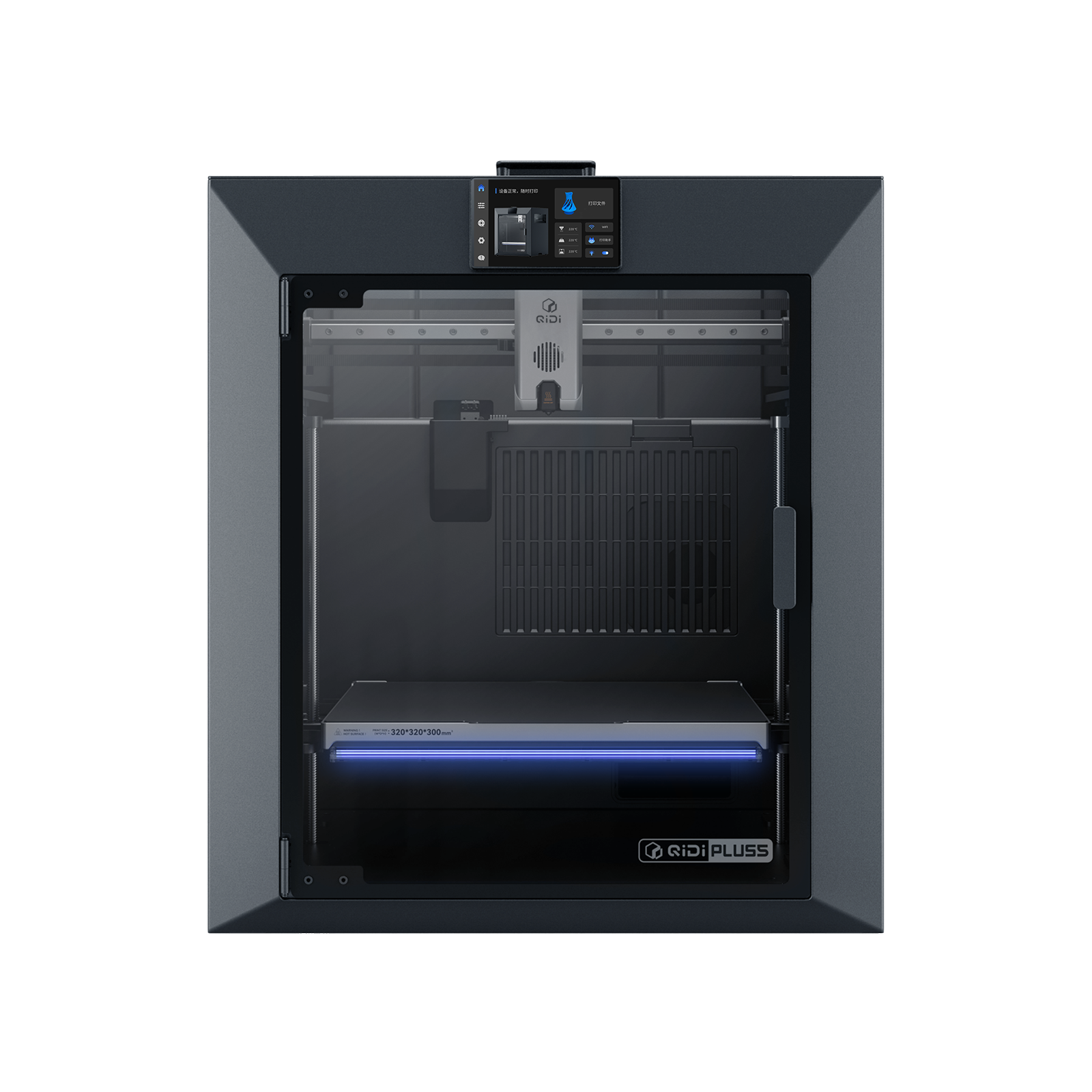
QIDI Plus5
QIDI Plus5 (standard, not the Plus5 Combo with QIDI Box, and not the Plus4)
More plate, hotter nozzle, hotter chamber, filtration fitted, half the price. The machine the CORE One L has to justify itself against.
- Build volume
- 320 × 320 × 300 mm
- Technology
- FDM
- Max speed
- 600 mm/s toolhead (≤20,000 mm/s² acceleration)
- Enclosed
- Yes, with independent active chamber heating up to 65 °C (3rd generation)
- Multi-colour
- Optional (compatible with QIDI Box; the Combo bundles it for 16 colours)
- Auto levelling
- Yes (hands-free, loadcell sensor integrated into the hotend)
What we like
- 320 × 320 × 300 mm — larger in two axes than the CORE One L, for a band of £650 to £750
- 370 °C nozzle and chamber heating to 65 °C, both above the Prusa
- ABS, ASA, PC, PA and fibre-reinforced grades on the standard list, with a three-stage filter already fitted
- Quotes 600 mm/s with 20,000 mm/s² of acceleration
What we don’t
- Draws far more power: 190 W on PLA and 500 W on ABS
- 29 kg, heavier than either Prusa
- No published bed-uniformity figure to set against the Prusa's AC convection bed
- Outside the open-source Prusa ecosystem, with a shorter parts and community record
Buy it instead if capability per pound decides it. Skip it if offline operation, open-source firmware or long-term parts supply are why you were looking at a Prusa at all. If neither fits, the best 3D printers UK pillar covers the tier below.
Who should buy the Prusa CORE One L, and the verdict
Whether the Prusa CORE One L is worth it turns on one question: are you regularly printing parts a smaller plate will not take? Everything the L does well, the CORE One+ also does for several hundred pounds less. Size is the thing you are buying, so size has to be the reason.
Answer yes and it suits a workshop or small business printing functional parts in ASA, PC or filled nylon at sizes that rule out a desktop machine. Answer no and two exits are better: if your parts fit a smaller plate, buy the smaller Prusa; if capability per pound decides it, the QIDI Plus5 gives you more plate and filtration fitted for roughly half the band.
The CORE One L is the most convincing large-format machine Prusa has made, and the reason is underneath it rather than around it: a mains-powered bed flat and even enough that large parts stop having a reason to lift.
- Buy it if
- You regularly print parts too big for a desktop plate, you want them in ABS, ASA, PC or filled nylon, and long-term parts supply and offline operation are worth paying for.
- Skip it if
- Your parts fit a smaller plate, you are optimising for capability per pound, or you expect a premium price to mean nothing needs checking.
Between the £1,500 and £1,750 mark that is defensible engineering, but not an easy recommendation. The chamber figure is a ceiling rather than a setting, the belts want checking on arrival, ABS and ASA need a unit costing extra, and a British buyer gets half the cover an EU one does. Buy it because you need the volume and want the machine still repairable in five years.
How this article was researched
No first-hand testing, printing, measurement or photography was carried out for this review. Specifications come from Prusa's own CORE One L+ product page and its announcement posts for the CORE One L and the August 2026 refresh, recorded claim by claim with a source URL on 22 September 2026; every figure above carries one. Warranty terms and the dispatch country come from Prusa's knowledge base, and UK price bands and stock were checked against two UK retailers on the same date. Ownership patterns were researched as recurring themes in the CORE One L sections of Prusa's community forum, with threads about the smaller CORE One deliberately excluded; no customer review is quoted and no rating reproduced. Three things could not be verified and were left out rather than estimated: any acoustic rating, a direct-from-Prusa price in sterling, and how UK VAT and duty are collected on direct orders. Our approach is set out in the review methodology.
Common questions
- Is the Prusa CORE One L worth buying?
- Only if you genuinely need the size. It sits between the £1,500 and £1,750 mark, and the smaller CORE One+ shares its nozzle, bed and material list for several hundred pounds less — so a 300 × 300 × 330 mm plate has to be the reason, not a bonus. If it is, the case is strong: an unusually even bed, a heated chamber, an abrasive-resistant nozzle included and parts you can still buy years from now.
- Who is the Prusa CORE One L best for?
- A workshop or small business printing functional parts in ASA, PC or filled nylon at sizes a desktop machine cannot take — enclosures, jigs, fixtures, housings. It also suits anyone who needs a printer that works with no cloud account and no radio on the network, since the Wi-Fi module physically unplugs. It suits nobody who wants an appliance that never asks anything of them.
- What are the main alternatives to the Prusa CORE One L?
- Two. The Prusa CORE One+ is the same machine smaller and cheaper, and is the one to rule out first — if your parts fit a 250 mm plate, buy it instead. The QIDI Plus5 is the harder comparison: a larger plate, a 370 °C nozzle, a 65 °C chamber and filtration already fitted, in a band of £650 to £750. What the Prusa adds is the bed, offline operation, open-source firmware and long-term parts supply.
- What is the difference between the CORE One L and the CORE One L+?
- The L+ is a running change rather than a new machine. Announced in August 2026, it adds GT1.5 belts and an integrated nozzle wiper, and is ready for Prusa's INDX tool-changer. Existing CORE One L owners can buy the change as an upgrade kit, and Prusa has not described the original L as discontinued — so a genuinely discounted L is a sensible buy. What you should not do is pay L+ money for an L.
- Can the Prusa CORE One L print ABS and ASA?
- Yes, but with a condition worth budgeting for. Prusa lists ABS, ASA, HIPS and PA only when the Advanced Filtration unit is fitted, and that unit is sold separately from the printer. The heated chamber and the even bed are exactly what those materials need to stop warping, so the machine is well suited to them — you simply have not finished buying it until the filtration is on the order.