Anycubic Photon Mono M7 vs Anycubic Photon Mono M7 Pro
Same panel, same envelope, same warranty. Three things really separate these two Anycubic resin printers, and one of them decides it in a cold British room.
Independent and reader-funded. We earn a commission if you buy through our links, at no extra cost to you. How this works.
Anycubic sells three machines with M7 on the badge. The Anycubic Photon Mono M7 vs Anycubic Photon Mono M7 Pro question reads like a resolution question. It is not: both carry the same panel and the same 223 × 126 × 230 mm envelope, about 6.5 litres.
What separates them is what happens to the resin before it cures — how warm it is, and who pours it.
These are the exact variants, neither of them the M7 Max, which has a different panel entirely. Nothing here was printed in-house.
| Specification | 1 Anycubic Photon Mono M7 Pro Best if the room is cold, or you want the resin handled | 2 Anycubic Photon Mono M7 Best if the room is warm, and for fewest things to fault |
|---|---|---|
| Best for | Cold rooms, long runs on one resin | Warm rooms, simplest ownership |
| Panel | 10.1-inch 14K mono | 10.1-inch 14K mono — identical |
| XY pixel size | 16.8 × 24.8 μm | 16.8 × 24.8 μm — identical |
| Build volume | 223 × 126 × 230 mm (6.5 L) | 223 × 126 × 230 mm (6.5 L) — identical |
| Layer range | 0.01–0.15 mm | 0.01–0.15 mm — identical |
| Heated vat | Yes — dynamic temperature control | No — the room is the thermostat |
| Resin fill and drain | Yes — automatic, pumped | No — you pour and drain it |
| Max speed (maker's maximum) | 130 mm/h standard, 170 mm/h high-speed resin | 90 mm/h standard, 150 mm/h high-speed resin |
| Light intensity | 5500 ±10% μW/cm² | 4500 ±10% μW/cm² |
| Z axis | Dual linear rails, 10 μm | Dual linear rails, 10 μm — identical |
| Release film | Improved ACF | Improved ACF — identical |
| Power-loss resume | No — listed as not supported | No — listed as not supported |
| Power supply | 240 W | 135 W |
| Weight | 12.8 kg | 12 kg |
| Footprint | 312 × 315 × 520 mm | 312 × 315 × 520 mm — identical |
| UK warranty | 12 months, LCD 6 months | 12 months, LCD 6 months — identical |
| UK price band | Around £410–£470 | Around £390–£470 |
| UK availability | Anycubic UK store and 3DJake UK | Anycubic UK store only |
How these two were compared
No printing was carried out for this page. The basis is research, and here that matters more than usual.
Anycubic sells an M7, an M7 Pro and an M7 Max, and the three get written about interchangeably. Every figure below was read from Anycubic's own page for the variant it belongs to, then checked row by row against the other machine's page — the only way to discover that most rows match. Having the Anycubic Photon Mono M7 compared with the Anycubic Photon Mono M7 Pro that way yields a short list of real differences and a longer list other comparisons assert and the manufacturer does not support.
Patterns in what owners report were researched from reviews and manufacturer documentation, are labelled wherever they appear, and are never lent from one machine to the other.
The three things the Pro badge actually buys
Set the Anycubic Photon Mono M7 Pro vs Anycubic Photon Mono M7 sheets side by side and the real differences fit in a sentence: a heated vat, a resin pump, and a brighter lamp.
A heated vat. Anycubic lists a dynamic temperature-control vat on the Pro and the same feature as not supported on the M7. This is the difference that earns the money, for reasons more British than technical. The integrated resin heating is widely regarded as a genuine improvement over the previous bolt-on version, though it is not intended for the thickest resins.
A resin pump. The Pro fills and drains its own vat; the M7 has no auto-fill unit, so you pour and tip the leftovers back. On paper the more attractive feature; in practice the one with the worse record. Owner and reviewer reports repeatedly describe the automatic resin feed as inconsistent, particularly as the bottle empties, and the manufacturer publishes its own troubleshooting for it.
A brighter lamp, which is really the speed. The Pro's lamp is rated at 5500 ±10% μW/cm² against the M7's 4500. More ultraviolet cures each layer in less time, and that is where the speed gap comes from: up to 130 mm/h on standard resin and 170 mm/h on high-speed, against 90 and 150. Both are manufacturer maxima at 0.1 mm layers, not throughput on a full plate. The lamp and heater are also why the Pro needs 240 W where the M7 takes 135 W.
And the differences that are not real
This is the half the SERP leaves out, and it is worth more to you than the half above.
The panel is the same. Both carry a 10.1-inch 14K monochrome LCD, both put a pixel of 16.8 × 24.8 μm on the resin, and both cut layers from 0.01 to 0.15 mm. The figure being identical, so is the finest detail either resolves.
The build volume is the same, 223 × 126 × 230 mm each, and so is the bench space, 312 × 315 × 520 mm. Several comparisons imply the Pro is a size upgrade. It is not.
The motion hardware is the same — dual linear rails quoted at 10 μm, and the same improved ACF release film. The warranty is the same too: twelve months on the machine, six on the masking LCD, with the M7 named in the same bracket as the Pro.
Neither survives a power cut. Power-loss resume is listed as not supported on the Pro and on the M7. More than one comparison presents this as an M7-only shortcoming. It is shared, and for overnight work the most important line on either sheet.
Levelling deserves a warning rather than a figure: Anycubic's own M7 page contradicts itself, the specification table and the feature copy describing two different arrangements. A recurring difficulty owners run into with this machine is that advice about the M7 family rarely names the variant, so troubleshooting steps that assume a heated vat or an automatic resin feed are handed to owners of the base machine, which has neither.
Resin temperature, and why it decides this in a British room
If one section settles this for you, it is this one, and it has nothing to do with print quality.
Resin thickens as it cools. Cold resin flows back under the plate more slowly between layers and cures less completely for a given exposure, producing the symptoms people blame on a faulty machine: models lifting off the plate, supports going soft, walls that look under-exposed. Anycubic is explicit about it — its own guidance is that below 20 °C you should increase exposure time by 30% and reduce the Z lift speed by 30%. That is a recommendation, not a measured result — and slowing the lift by a third partly cancels the speed you paid for.
Now set it against a British house. A garage, a utility room, a loft, an unheated spare room — the places a resin printer usually ends up, because of the smell — sit under that threshold for much of the year. The Pro's vat holds resin in range regardless. The M7 has none, so the room is the thermostat.
Guidance written for resin printers without a heated vat consistently identifies resin temperature as the thing that decides whether a print succeeds in a cold room, with warming the room or standing the bottle in warm water the remedies most often repeated — although none of these sources tested this machine in particular.That does not make the M7 a bad machine. It makes it one with a condition attached, and the condition costs nothing if your circumstances already meet it.
Anycubic Photon Mono M7 Pro: who it suits
The machine to buy when you cannot control the temperature of the room it lives in.
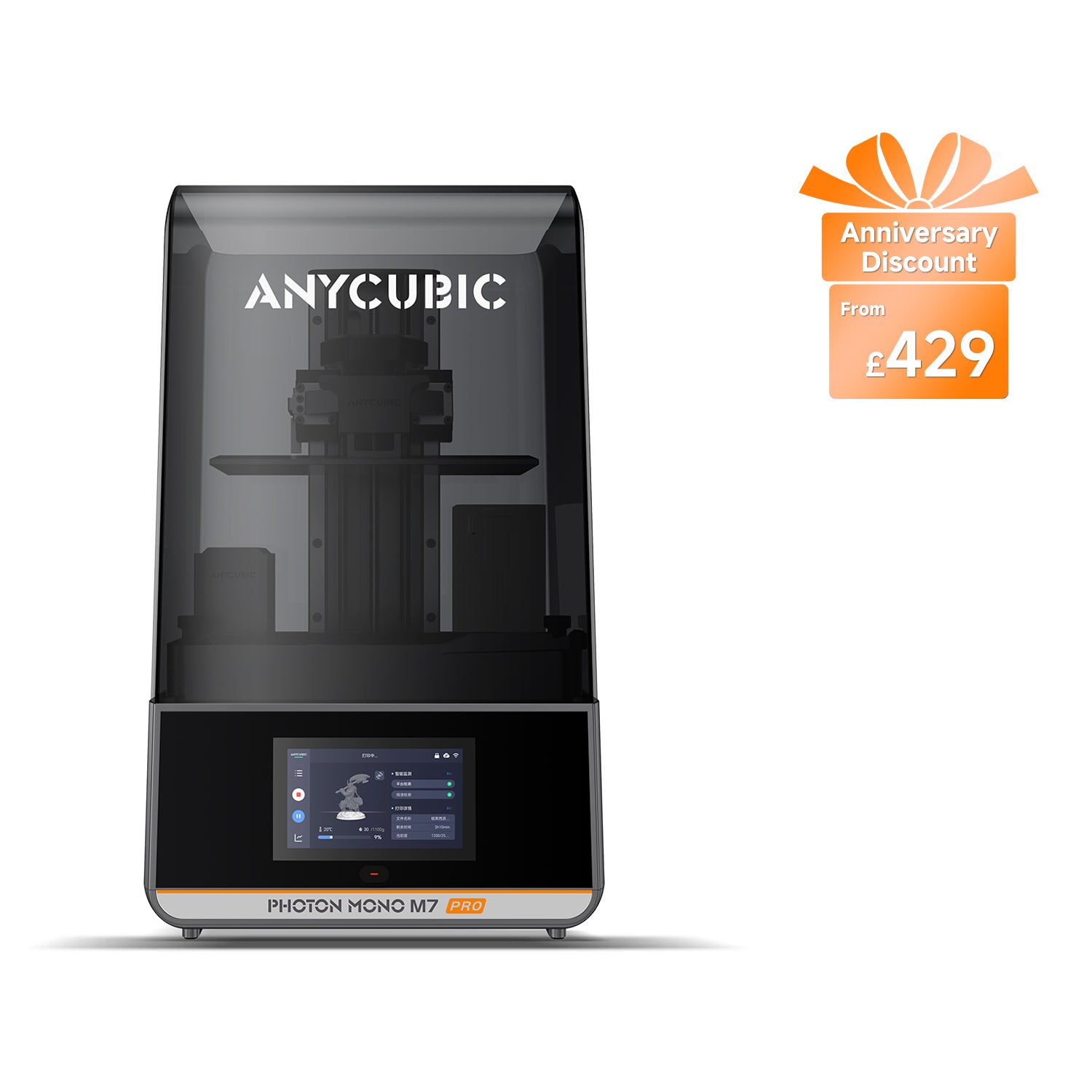
Anycubic Photon Mono M7 Pro
Photon Mono M7 Pro (not the Photon Mono M7 or M7 Max)
The heated vat is the real purchase, and in an unheated British room it justifies the premium on its own. Treat the resin pump as a bonus.
- Build volume
- 223 × 126 × 230 mm (6.5 L)
- Technology
- Resin (MSLA)
- Max speed
- Max ≤130 mm/h; standard resin at 0.1 mm ≤130 mm/h, high-speed resin at 0.1 mm ≤170 mm/h (manufacturer maxima)
- Enclosed
- Lid (removable UV cover; Anycubic lists no hinged cover)
- Multi-colour
- No
- Auto levelling
- Yes (levelling-free)
What we like
- Temperature-controlled vat holds resin in range in a cold room
- Brighter lamp, and the higher speed figures that follow
- Automatic fill and drain, when it behaves
- Reviewed independently several times
What we don’t
- Power-loss resume not supported, on the machine built for long runs
- The resin pump is widely reported as inconsistent
- The pump tube is a consumable Anycubic does not warrant
- A heavier vat that cannot be left to soak
Two things temper the case the section above makes. Power-loss resume is not supported, and this is the machine sold for long unattended work, so a cut in the small hours ends a job rather than pausing it. Budget for a small UPS.
The other is the pump. Reviewers repeatedly note that the heated, pump-fed vat cannot simply be left to soak in IPA because of the electronics attached to it, and that it is heavier and more awkward to pour out than a plain tank, though they treat this as the cost of the feature rather than a fault.
Buy this if the printer will live somewhere cold, or you run long jobs on one resin.
Skip this if the room stays warm, or you would rather not own a heater and a pump that can fault.
Anycubic Photon Mono M7: who it suits
The same printer with two optional systems removed — which, if your room is warm, is a feature.
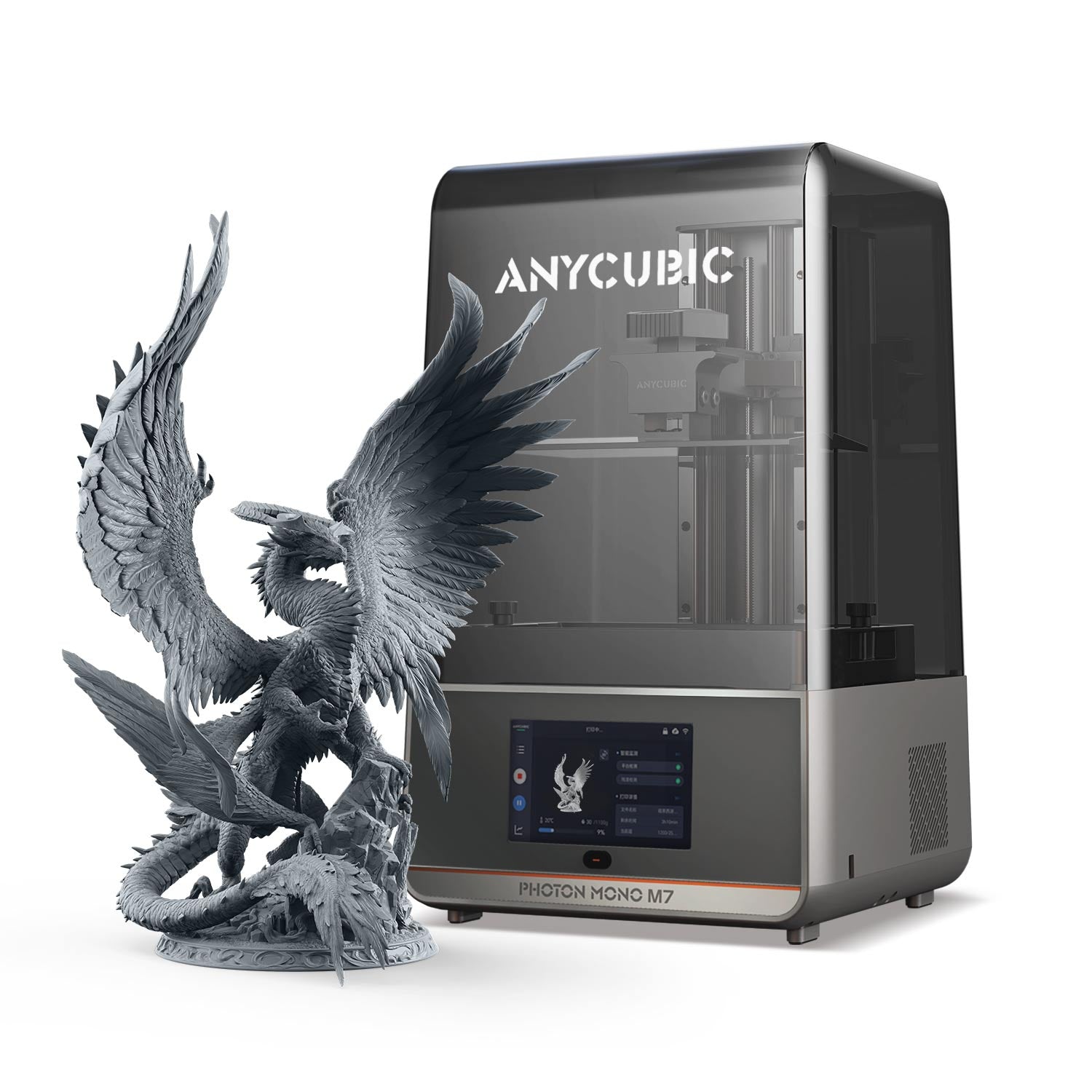
Anycubic Photon Mono M7
Photon Mono M7 (not the Photon Mono M7 Pro or M7 Max)
Identical panel, envelope, rails, film and warranty for less money. You give up the heated vat and the resin pump — and with them the heater fault and the pump tube.
- Build volume
- 223 × 126 × 230 mm (6.5 L)
- Technology
- Resin (MSLA)
- Max speed
- Max ≤90 mm/h; standard resin at 0.1 mm ≤90 mm/h, high-speed resin at 0.1 mm ≤150 mm/h (manufacturer maxima)
- Enclosed
- Lid (removable UV cover; Anycubic lists no hinged cover)
- Multi-colour
- No
- Auto levelling
- Conflict — Anycubic's own page lists 'Leveling-free' in the specification table and 'Enhanced 4-point leveling' in the prose. Not resolvable; do not publish a figure.
What we like
- The same panel and the same pixel size as the Pro
- The same build envelope and bench footprint
- No pump to flush at a colour change, and no tube to replace
- Lighter, and thriftier on electricity
What we don’t
- No heated vat, so a cold room is your problem to solve
- You pour and drain the vat by hand
- Power-loss resume not supported here either
- One UK stock route, where the Pro has two
- Very little independent coverage
Beyond the shared panel and envelope you keep the same resin range, the same slicers, USB, Wi-Fi or LAN and a 4.3-inch touch panel. At 12 kg it is the lighter of the two.
What you give up is the heater and the pump, and with them two things that can go wrong.
The less obvious caveat: this machine has barely been reviewed independently, so far less is known about how it behaves over a year. Not a fault, but a risk worth weighing.
Buy this if the printer will live in a room you already keep warm, and you are happy pouring resin yourself.
Skip this if the room is cold for months at a time, or you would rather buy the machine more people have written about.
Fumes, space and where either one can live
Neither machine filters its own air, and on this question the Pro badge buys nothing.
An air purifier is an optional accessory on the Pro and on the M7. Both have a UV cover over the vat, and on both it lifts off entirely rather than hinging. A cover keeps daylight off the resin; it does not contain what comes off it.
Siting is a decision about the room. Uncured resin and the alcohol used to wash it need ventilation, gloves and eye protection, and resin-contaminated alcohol should be treated as hazardous waste rather than poured away. In a British house that points at a garage or a room with a window that opens — which is how the heated vat and the cold room turn out to be the same conversation.
Reviewers of this machine consistently treat the optional carbon purifier as something that helps rather than something that settles the question, and several report that it and the automatic resin-fill system share a single port, so fitting both is not an option — which is why the rear hose connector tends to be the route they recommend, although none of them measured what any of it achieved. That applies only to the Pro. Neither manufacturer publishes a noise figure, so none is offered here.
What each costs to run in the UK
Electricity is the smallest part of ownership, and the only part where the two differ much.
The Pro has a 240 W supply and the M7 a 135 W one — ratings, not measured draw, so what follows is a labelled estimate and an upper bound. At a unit rate around 25p per kWh, a ten-hour print costs at most roughly 60p on the Pro and 35p on the M7. Over a year the gap is a few pounds, and the Pro's extra watts are mostly the heater doing its job.
Resin is the real cost, and it scales with how much you print rather than which machine you own. Both take ordinary 405 nm bottles, though the Pro's headline speed needs high-speed resin, at the dearer end of the shelf.
Films and the panel are shared. The same improved ACF release film and the same replaceable screen film fit both. The masking LCD is the expensive one, degrading under ultraviolet and likely to need replacing within a couple of years: Anycubic's UK store lists a replacement around the £120 mark, a spare vat around the £65 mark and a build plate around the £50 mark. Budget alike for either machine.
One consumable exists only on the Pro: the peristaltic pump tube, which Anycubic lists as a consumable with no cover.
UK price, availability, warranty and support
The Anycubic Photon Mono M7 versus Anycubic Photon Mono M7 Pro decision in the UK comes down to a smaller gap than most expect, and one difference nobody mentions.
Read from Anycubic's own UK store on the same day, the Pro sat about £60 above the M7 for the bare machine, against roughly £150 between the two stated regular prices. Both are discounted often and independently: at list prices the Pro looks like a different class of machine, and at the prices shown it is a couple of litres of resin dearer. The M7 sits around the £390–£470 mark, the Pro around the £410–£470 mark.
Availability is the difference nobody mentions. The Pro is sold by Anycubic's UK store and by 3DJake UK, though 3DJake's stock has come and gone. The M7 has one route: Anycubic's own store, with 3DJake listing it as no longer sold. A single supplier means your return, your warranty claim and your spares all go through the same door — which deserves more weight than a saving of roughly £60.
Warranty is identical, whatever the comparisons imply: twelve months on the machine, six on the masking LCD, tools and release film excluded. The Pro is not the better-supported machine; it is the better-stocked one.
Three ways buyers get this choice wrong
Paying the premium for detail that does not change. The specification does not support it: the pixel is 16.8 × 24.8 μm on both. Spend the difference on resin.
Assuming the faster machine is the safer one overnight. It reads the opposite way round. Power-loss resume is listed as not supported on the Pro, exactly as on the M7, so a cut in the night costs the whole print either way.
Treating the resin pump as time saved. Even when it behaves it moves work rather than removing it, since the tubing has to be flushed at a colour change.
If neither suits — if you want a finer panel, a larger plate or a tilting vat — the field is wider than these two, and the best resin printers guide is a better starting point than stretching one of these to a job it was not built for.
The verdict
Whether it is the Photon Mono M7 or Photon Mono M7 Pro is settled by a thermometer, not a specification sheet.
Put the printer in a garage and you will be meeting Anycubic's cold-room instruction — a 30% longer exposure and a 30% slower lift below 20 °C — for most of the year. In a room you already heat, the Pro's vat solves a problem you do not have.
The Pro ranks first because more buyers have a cold room than a warm one — not because it prints better. It does not print better.
There is no universal winner here, because these are very nearly the same machine. One of them heats its resin. Work out how cold the room is, and the comparison answers itself.
- Buy it if
- The printer will live somewhere cold, or you run long unattended jobs on one resin — take the Anycubic Photon Mono M7 Pro, and treat the resin pump as a bonus rather than the reason.
- Skip it if
- The room is one you already keep warm and you do not mind pouring resin — take the Anycubic Photon Mono M7, the same printer on every figure that decides print quality.
How this article was researched
This comparison is research-based. No first-hand printing, measurement or photography was carried out.
Every specification was researched from Anycubic's own page for the exact variant named, then compared row by row against the other machine's page, and each figure carries a citation to its ledger entry. Owner-reported patterns come from reviews and manufacturer documentation; no customer review is quoted and no rating reproduced. UK prices, stock routes and warranty terms were checked on 7 October 2026.
Three things were left out as unverifiable: Anycubic's M7 page describes its levelling two different ways, so no levelling figure is given; the two pages list panel pixel counts eight pixels apart on identically sized panels, so the shared 14K designation is used instead; and no launch date was confirmed for either machine.
Common questions
- Which is better, Anycubic Photon Mono M7 or Anycubic Photon Mono M7 Pro?
- Neither is better in general, because on every figure that decides print quality they are the same machine — same 14K panel, same pixel size, same build volume, same layer range, same rails, same warranty. The Pro adds a heated resin vat, an automatic resin pump and a brighter lamp. Which is better between the Anycubic Photon Mono M7 or Anycubic Photon Mono M7 Pro therefore depends on one thing you can check yourself: how cold the room is. Below about 20 °C the heated vat stops being a convenience and starts deciding whether prints succeed, which makes the Pro the sensible buy. In a heated room it solves a problem you do not have.
- Which has better print quality and reliability?
- On print quality there is nothing between them. Both use a 10.1-inch 14K monochrome panel with a 16.8 × 24.8 μm pixel and a layer range of 0.01 to 0.15 mm, so the finest detail either can resolve is the same. The Pro's brighter lamp buys speed, not sharpness. On reliability no honest ranking is possible: there is no independent failure data for either machine, and the base M7 has barely been reviewed at all. What can be said is that the Pro has two systems the M7 does not — a vat heater and a resin pump — and the pump is the component most often reported as unreliable, while cold resin is the most common cause of failed prints on a machine without a heater.
- Which offers better value for UK buyers?
- It depends entirely on the room. Read from Anycubic's own UK store on the same day, the Pro sat about £60 above the M7, so the premium is roughly a couple of litres of resin rather than a different class of machine. If the printer will live somewhere unheated, that is comfortably the best £60 in the comparison, because the alternative is heating the room. If it will live somewhere warm, the M7 is the better value and the difference is better spent on resin or a wash-and-cure station. One point against the M7 that has nothing to do with price: it has a single UK stock route where the Pro has two, so returns, warranty claims and spares all go through one door.