Bambu Lab P1S vs Bambu Lab X1 Carbon
Same build volume, same 500mm/s, same flow rate. One is discontinued. What the X1 Carbon's end of life means for UK buyers and which to choose now.
Independent and reader-funded. We earn a commission if you buy through our links, at no extra cost to you. How this works.
The Bambu Lab P1S vs Bambu Lab X1 Carbon question used to be about money. Since the end of March 2026 it is mostly about supply, because only one of these two is still being made — the part almost nothing written on this comparison mentions, and the part that changes how everything else should be read.
Variants first, because Bambu Lab's range punishes vagueness: this page compares the standard P1S against the X1-Carbon, neither with an AMS. Not the X1, not the X1E, not either Combo, not the X2D. Nothing here was printed in-house.
| Specification | 1 Bambu Lab P1S Still in production — the default choice | 2 Bambu Lab X1 Carbon Discontinued — for routine abrasive work only |
|---|---|---|
| Status | In production | End of life since 31 March 2026 |
| Build volume | 256 × 256 × 256 mm | 256 × 256 × 256 mm |
| Max speed / acceleration | 500 mm/s, 20 m/s² | 500 mm/s, 20 m/s² |
| Max hot end flow | 32 mm³/s | 32 mm³/s |
| Max nozzle temperature | 300 °C | 300 °C |
| Max bed temperature | 100 °C | 110 °C at 220 V |
| Nozzle and extruder gears | Stainless steel nozzle | Hardened steel nozzle and hardened extruder gears |
| Carbon or glass fibre | Not recommended without an extruder and hotend upgrade | Listed as ideal |
| PA and PC | Capable | Ideal |
| Calibration sensor | Automatic bed levelling sensor | Bambu Micro Lidar |
| Screen and control | 2.7-inch 192 × 64 screen, button control | 5-inch 1280 × 720 touchscreen |
| Chamber camera | 1280 × 720 at 0.5 fps | 1920 × 1080 |
| Door sensor | Not listed | Fitted |
| Shell | Plastic and glass | Steel chassis, aluminium and glass shell |
| Net weight | 12.95 kg | 14.13 kg |
| Dimensions | 389 × 389 × 458 mm | 389 × 389 × 457 mm |
| Max power | 1000 W at 220 V | 1000 W at 220 V |
| Air filtration | Activated carbon filter | Activated carbon filter |
| UK price band | Around £330–£400 | Not sold new — no published band |
| UK availability | Bambu Lab UK store and 3DJake UK | Clearance, refurbished or used stock only |
How these two were compared
No printing was carried out for this page. Every figure quoted when the Bambu Lab P1S is compared with the Bambu Lab X1 Carbon comes from Bambu Lab's own specification sheet for the exact variant named, read directly rather than assembled from retailer listings — the usual source of the contradictory numbers in circulation.
Model status comes from Bambu Lab's end-of-life announcement, published on its blog and repeated by staff on the company forum; the two agree on every date. Owner experience is separate evidence, marked wherever it appears, and describes patterns across many reports rather than one machine. Prices are bands, checked in September 2026.
The end of the X1 Carbon changes the question
Bambu Lab stopped manufacturing and actively selling the X1, X1 Carbon and X1E on 31 March 2026. A comparison that treats these two as equally available is describing a market that no longer exists.
It does not mean an X1 Carbon is a dead end. Bambu Lab published a specific support horizon alongside the announcement: firmware fixes and feature updates until 31 May 2027, security patches until 31 May 2029, and spare parts and technical support until 31 March 2031. Those dates answer different questions. The 2031 one matters if you are worried about a snapped belt — a long parts commitment by the standards of consumer hardware. The 2027 one matters if you expect the machine to keep gaining capability.
There is also a distinction almost no comparison draws. Bambu Lab's own post notes that authorised distributors may still hold units carrying full warranty and support. In the UK the X1 Carbon is no longer sold new through the usual channels, with at least one established retailer listing it as no longer available. What is left is clearance, refurbished or used — and those are not the same purchase.
What the two machines actually share
Put the Bambu Lab X1 Carbon vs Bambu Lab P1S specifications side by side and the surprise is how much of the sheet is identical.
Both build to a 256 × 256 × 256 mm cube, quote 500 mm/s maximum toolhead speed and 20 m/s² acceleration, and reach 300 °C at the nozzle. Both are enclosed with an activated carbon filter and a closed-loop chamber temperature regulator fan, and neither has an actively heated chamber. They take the same desk space to within a millimetre, 389 × 389 × 458 mm against 389 × 389 × 457 mm, with the X1 Carbon heavier by a kilogram or so.
The figure worth pausing on is flow rate. Top speed says little alone, because a toolhead can only move as fast as the hot end can melt plastic to fill the path behind it. Both are rated 32 mm³/s on the same manufacturer test — a 150 × 150 mm single-wall model in Bambu ABS at 280 °C. Same number, same test: the X1 Carbon is not the faster machine, and pages describing it that way contradict Bambu Lab's own documents.
Owners agree. Owners who have used both machines repeatedly describe the printed results as hard to tell apart on ordinary filament, and tend to trace any difference they do see to calibration or filament rather than the printer. Choosing between these two hoping one makes visibly better parts in PLA or PETG is choosing on the wrong axis.
Where the extra money went
One difference is a capability. The rest are conveniences, and it is worth keeping them apart.
Abrasive and engineering materials. Bambu Lab lists carbon- and glass-fibre reinforced polymer, along with PA and PC, as ideal on the X1 Carbon. On the P1S the same company states that fibre-reinforced filament is not recommended before an extruder and hotend upgrade, and lists PA and PC only as capable. That is the manufacturer describing two different tolerances for the same material.
The hardware behind it is specific: an all-metal hot end with a hardened steel nozzle and hardened steel extruder gears as standard, against a stainless nozzle on the P1S. Chopped carbon fibre is mildly abrasive; run enough through soft steel and the bore opens up, showing first as extrusion that no longer matches what the slicer asked for. The bed helps too, reaching 110 °C against 100 °C — ten degrees sounds trivial, but ABS and ASA are the materials most inclined to lift a corner part-way through a tall print.
Everything else is the interface. Lidar in place of a bed levelling sensor. A 5-inch 1280 × 720 touchscreen instead of a 2.7-inch 192 × 64 screen driven by a button. A 1920 × 1080 chamber camera, a door sensor, and a steel chassis with aluminium and glass where the P1S uses plastic and glass.
Real improvements, though not the ones the marketing implies. The lidar is the contested one. Owner opinion on the lidar is genuinely divided: several describe it as the feature that makes an unfamiliar filament painless to set up, while others treat it as a convenience they seldom call on, although this is not consistent across all reports. Run two or three filaments you already have dialled in and the case is thin. Buy whatever is cheap and expect it to work, and it is the feature you would miss.
Bambu Lab P1S — the one still in production
Availability is not a glamorous reason to prefer a machine, but it decides most of these purchases. This is the model Bambu Lab still makes, still ships through its UK store and still sells spares for.
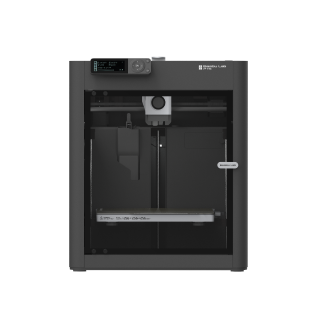
Bambu Lab P1S
P1S (standard, without AMS - not the P1P, P1S Combo or P2S)
Matches the X1 Carbon on build volume, speed, acceleration and hot end flow, in the same enclosure with the same filter — and it is the one you can still order. Gives up the abrasive-materials licence, the hardened nozzle and the good screen.
- Build volume
- 256 × 256 × 256 mm (Bambu Studio defaults to 250 mm height)
- Technology
- FDM
- Max speed
- 500 mm/s toolhead (20 m/s² acceleration)
- Enclosed
- Yes (plastic and glass; chamber temperature regulator fan and activated-carbon filter)
- Multi-colour
- Optional (AMS or AMS 2 Pro sold separately or as a Combo)
- Auto levelling
- Yes (automatic bed levelling sensor)
What we like
- Still in production and still stocked in the UK — the X1 Carbon is neither
- Identical 256 mm cube, 500 mm/s and 32 mm³/s hot end flow to the X1 Carbon
- ABS, ASA and PET on the ideal-materials list, inside an enclosure with a carbon filter
- Owners describe getting from box to a successful first print inside an hour
- The lower band, around £330–£400, with a two-year consumer warranty
- 1.18 kg lighter than the X1 Carbon in the same desk footprint
What we don’t
- Fibre-reinforced filament not recommended without an extruder and hotend upgrade
- A stainless steel nozzle rather than hardened steel
- Bed stops at 100 °C, ten degrees short of the X1 Carbon
- A 2.7-inch 192 × 64 screen driven by a button, not a touchscreen
- Owners name running noise as the main drawback and trace it to the fans
- An oversize delivery surcharge of around £45 applies at the UK retailer
The lower band buys the whole of the shared specification above, and ABS, ASA and PET sit on its ideal-materials list alongside PLA, PETG and TPU — most of what home and small-workshop printers are actually asked to do.
What owners are most consistent about is the noise. Owners repeatedly trace the noise to the fans rather than the motion system, and a recurring theme is that the chamber fan is the loudest part of the machine when it is running PLA. An enclosure does not make a printer quiet; it gives the fans something to work against.
The one trap is materials. Buyers regularly expect an enclosed machine to take carbon fibre, which is where the P1S trips people up.
Buy this if you want an enclosed Bambu Lab machine you can order today, your materials list stops at ABS and ASA, and you would rather spend the difference on filament or an AMS.
Skip this if carbon-fibre-filled filament is routine work, or you know you will resent driving a printer through a two-line screen and a button.
Bambu Lab X1 Carbon — the abrasive-materials machine
Ranked second for one reason, and it is not capability. This is the better-equipped machine — and the one that stopped being manufactured in March 2026. A machine you cannot reliably buy cannot be the default recommendation.
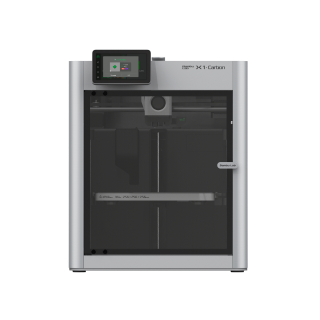
Bambu Lab X1 Carbon
X1-Carbon (X1C) — not the X1, the X1E, the X1 Carbon Combo or the X2D
The only one whose own specification sheet lists carbon and glass fibre as ideal, with the hardened nozzle and extruder gears to back it up, plus a 110 °C bed, lidar and a touchscreen. End of life since March 2026, parts and support to 2031.
- Build volume
- 256 × 256 × 256 mm
- Technology
- FDM
- Max speed
- 500 mm/s toolhead (20 m/s² acceleration)
- Enclosed
- Yes (steel chassis, aluminium and glass shell; closed-loop chamber temperature regulator fan and activated-carbon filter)
- Multi-colour
- Optional (AMS sold separately or as the X1 Carbon Combo — a different SKU)
- Auto levelling
- Yes (Bambu Micro Lidar)
What we like
- Carbon and glass fibre listed as ideal, with PA and PC ideal as well
- Hardened steel nozzle and hardened steel extruder gears as standard
- Bed reaches 110 °C on UK mains, ten degrees above the P1S
- Bambu Micro Lidar handles bed levelling and calibration
- A 5-inch 1280 × 720 touchscreen and a 1920 × 1080 chamber camera
- Spare parts and technical support committed until 31 March 2031
What we don’t
- End of life since 31 March 2026 — no longer manufactured or sold new
- Firmware feature updates stop on 31 May 2027
- No published UK price and no new stock through the usual channels
- No faster than the P1S — the same 500 mm/s and the same 32 mm³/s flow
- Owners running carbon fibre describe nozzle and extruder wear as routine
- A private second-hand sale carries no manufacturer warranty
If your work genuinely involves fibre-filled filament — jigs, brackets, drone frames, anything where stiffness matters more than finish — this is the machine built for it, and the P1S is not a substitute without buying parts first. PA and PC listed as ideal rather than capable points the same way.
No independent reliability statistics exist for either machine, so neither is ranked on it here. What owner reports do establish is that the abrasive licence is not a licence to ignore maintenance. A recurring theme among owners running carbon-fibre filament regularly is that wear shows up on consumable parts — the nozzle and extruder — long before anything else, and that fibre-filled nylon is the material most likely to jam in an AMS, although this is not consistent across all reports. Budget for nozzles the way you budget for filament.
Buy this if abrasive filament is part of your normal week and you can find one from an authorised distributor's remaining stock, with a warranty, at a price reflecting a discontinued machine.
Skip this if you print PLA, PETG, ABS and ASA — you would be paying a premium and taking on a support horizon for a screen upgrade. Take the P1S, or the generation that replaced the X1 series.
What to check before buying either
Two things decide whether either suits a particular house, and neither is on a specification sheet.
Space and ventilation. Both are around 389 mm square and roughly 457 mm tall, so they want shelf headroom as well as desk area, and you cannot lift the lid for clearance. Both carry the same activated carbon filter — a filter, not an extraction system. If ABS and ASA are the plan, a room you can air out matters more than the filter specification.
Condition, if it is second-hand — which applies only to the X1 Carbon, after the March 2026 cut-off. Since the end-of-life announcement a recurring line of advice among owners is to judge a second-hand X1 Carbon on its condition and hours run rather than on its specification, and to price it against a current machine rather than against what it originally cost.
What each costs to run in the UK
Electricity does not separate these two: they carry the same rating, 1000 W at 220 V. Choosing between them on running cost is choosing on a difference that does not exist.
Here is the worked ceiling, an estimate with the assumptions on the table. The Ofgem price cap puts the average domestic unit rate at 26.11 pence per kWh for July to September 2026, rising to 26.32 pence from October. A 1000 W appliance drawing its full rating for an hour uses 1 kWh, so the ceiling is a shade over 26p per hour of printing — a six-hour print cannot cost more than about £1.60 in electricity.
The real figure sits well below that, because the rating is a maximum rather than a draw. Almost all of it is the heated bed, which pulls hard while it climbs to 100 or 110 °C and then cycles to hold temperature. Treat 26p an hour as the ceiling, not the bill. The standing charge of 54.83 pence per day is paid whether the printer runs or not.
Consumables cost more and vary more anyway, and they are where the two genuinely differ: hardened nozzles outlast stainless ones against abrasive filament, and cost more to replace.
UK availability, warranty and support
This is where Bambu Lab P1S versus Bambu Lab X1 Carbon in the UK stops being a close-run thing.
The P1S is stocked through Bambu Lab's own UK store and through 3DJake UK, in pounds, with domestic shipping and no import charges, in the £330–£400 band. Budget for the line that catches people out: an oversize delivery surcharge of around £45 per item on goods of this size. Warranty is two years for consumers in the covered regions, some components carrying a shorter limited period.
The X1 Carbon has no equivalent paragraph, and that is the finding. It is no longer sold new, with at least one established UK retailer listing it as no longer available. No price band is published for it and none is offered here — the figures circulating in price-comparison listings and second-hand guides are not manufacturer or retailer prices and should not be read as one.
It does have a support commitment: spare parts and technical support to 31 March 2031, security patches to 31 May 2029, feature updates to 31 May 2027. Bambu Lab also states that units still held by authorised distributors may carry full warranty and support.
So for anyone set on one: distributor clearance stock and a private sale look alike in a listing and are not the same purchase. One carries a manufacturer warranty; the other carries whatever the previous owner did to it.
Mistakes buyers make with these two
Assuming enclosed means carbon-fibre capable. The most common and most expensive. An enclosure holds heat so ABS and ASA do not warp; abrasion resistance belongs to the nozzle and extruder gears, which are separate parts. Bambu Lab says plainly that fibre-reinforced filament is not recommended on the P1S before an extruder and hotend upgrade.
Paying the X1 Carbon premium for print quality. The specification does not support it — identical flow rate, speed and build volume — and neither does owner experience. The money buys materials tolerance and an interface, and lidar is a tiebreaker rather than a reason.
Buying a discontinued machine at an in-production price. Remaining X1 Carbon stock is worth what a machine with a fixed feature horizon is worth, not what it cost when current. Feature updates stop in May 2027.
Forgetting to cost the P1S upgrade path. If carbon fibre is a maybe rather than a no, price the extruder and hotend upgrade in at the start — it may close the gap you thought you were saving.
The verdict
Asking whether to pick the P1S or X1 Carbon in September 2026 is two questions wearing one coat. On capability the X1 Carbon wins in one place: abrasive and engineering materials. On everything buyers usually think they are choosing between — speed, flow rate, build volume, print quality — the two are level on Bambu Lab's own figures.
On availability the P1S wins outright, because it is still made. That is why it ranks first despite being the less capable machine: the recommendation turns on supply, not specification.
So print abrasives regularly and you should be hunting distributor stock with warranty left on it. Everyone else should buy the P1S. If neither fits, widen the search rather than compromise — our roundup of the best FDM printers is the place to start.
- Buy it if
- You want an enclosed Bambu Lab machine you can actually order, and your materials list runs from PLA and PETG through ABS and ASA — buy the P1S.
- Skip it if
- Carbon-fibre-filled filament is routine work, in which case hold out for authorised-distributor X1 Carbon stock with a warranty, or look at the generation that replaced it.
How this article was researched
This comparison is research-based. Neither machine was bought, printed with or measured here.
Every specification is traceable to Bambu Lab's own specification sheet for the exact variant named, and each figure carries a citation to its ledger entry. Model status and support dates come from Bambu Lab's end-of-life announcement, published on its blog and confirmed by staff on the company forum.
Owner experience is drawn from recurring patterns across forums and long-term reviews, in our own words and never quoted. Where owners disagree, as they do about the lidar, the page says so. Where a figure could not be verified it has been left out and named: neither machine has a published noise rating, and the X1 Carbon has no published price.
Common questions
- Which is better, Bambu Lab P1S or Bambu Lab X1 Carbon?
- It depends entirely on one question: do you print carbon- or glass-fibre-filled filament as routine work? If yes, the X1 Carbon is the better machine and it is not close — Bambu Lab lists those materials as ideal on it and states they are not recommended on the P1S without an extruder and hotend upgrade first. If no, the P1S is the better buy, because everything else the X1 Carbon adds is interface rather than capability, and because it is the only one of the two Bambu Lab still manufactures. The X1 series reached end of life on 31 March 2026. That does not make an X1 Carbon a bad machine — parts and support are committed to 2031 — but it does mean buying one is a hunt through clearance, refurbished or used stock rather than an order, and that the warranty position depends on which of those you end up with.
- Which has better print quality and reliability?
- On quality, neither, and the specifications explain why: the same 256 mm build volume, the same 500 mm/s toolhead, the same 20 m/s² acceleration and the same 32 mm³/s maximum hot end flow, measured by Bambu Lab on the same test. There is no mechanism by which one would lay down a visibly better part in PLA or PETG, and owners who have run both describe the output as hard to tell apart. Where the X1 Carbon does pull ahead is consistency of setup rather than of output — the lidar takes the guesswork out of an unfamiliar filament, though owners are divided on how much that is worth. On reliability, no independent failure-rate data exists for either machine, so this page offers no ranking. Long-term owner reports lean positive for the X1 Carbon and are mixed for the P1S, and the caveat worth carrying is that running abrasive filament wears nozzles and extruder parts on any printer, including the one built for it.
- Which offers better value for UK buyers?
- The P1S, and the reason is availability rather than specification. Value needs a price, and the X1 Carbon no longer has one: it is not sold new in the UK, no band is published for it, and the figures circulating in price-comparison listings and second-hand guides are not manufacturer or retailer prices. The P1S sits around the £330–£400 mark through Bambu Lab's UK store and 3DJake UK, in pounds, with a two-year warranty and no import charges — though budget for the oversize delivery surcharge of roughly £45 that applies to a machine this size. If you are set on an X1 Carbon, the value question becomes a warranty question: stock still held by an authorised distributor may carry full manufacturer warranty and support, while a private sale carries none. Those two are easy to confuse in a search listing and worth separating before you pay.