Creality K1 Max Review
A UK review of the Creality K1 Max: what the 300 mm plate is really for, where its enclosure works against it, what it costs to run, and the cheaper rival.
Independent and reader-funded. We earn a commission if you buy through our links, at no extra cost to you. How this works.
The Creality K1 Max is a 300 × 300 × 300 mm enclosed CoreXY printer, and the machine assessed here is the K1 Max as Creality currently ships it — not the K1, the K1 SE or the K1C, which carry different specifications. In the UK it sits in the £560 to £640 band.
What this Creality K1 Max review adds is what a product page leaves out: where the enclosure works against you, what a 1000 W rating costs on a British tariff, and the awkward fact that Creality now sells a 300 mm machine of its own for less. Nothing was printed or measured for this page. If the field is still open, the best FDM 3d printer uk guide ranks it against six rivals.
Which K1 Max this is, and whether it is still current
Settle this first, because the K1 range is easy to buy the wrong end of. Creality has sold a K1, a K1 SE, a K1C and this machine, and only the Max has the 300 mm cube that is the reason to choose it. Specifications do not carry across the four.
The obsolescence question is fairer, and it has an answer. Creality's storefront now leads with the K2 series, which makes the K1 line look retired. It is not: the K1 Max is still listed and sold, Creality names no successor, and the page's own data marks it in stock rather than discontinued. Re-checked at the end of September 2026, it remained in stock at Creality's UK store at an unchanged price and warranty. This is an older design still in production, then, rather than a run-out.
The specification, and what each figure changes
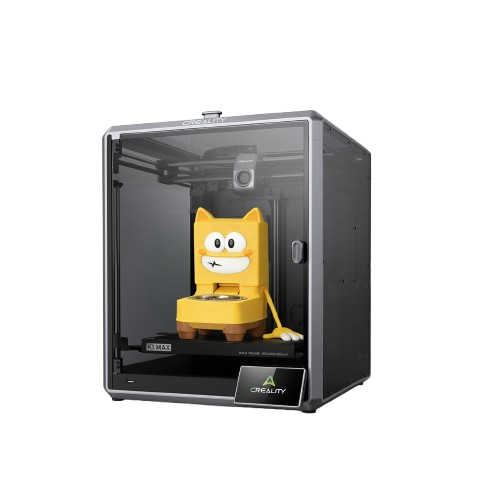
Creality K1 Max
K1 Max (2025 version as shipped; not the K1, K1 SE or K1C)
A quick, well-equipped 300 mm enclosed CoreXY machine. The plate is the reason to buy it; Creality's own newer machine is the reason to hesitate.
- Build volume
- 300 × 300 × 300 mm
- Technology
- FDM
- Max speed
- 600 mm/s (CoreXY, ≤20,000 mm/s² acceleration, max 32 mm³/s flow)
- Enclosed
- Yes (enclosed frame, active cooling — no chamber heating published)
- Multi-colour
- Optional (supports Creality's CFS filament system; the base machine is single-colour)
- Auto levelling
- Yes (nozzle strain gauge levelling, plus a 1 μm AI LiDAR first-layer scan)
What we like
- A 300 × 300 × 300 mm cube — roughly two and a half times the volume of the 220 mm class
- Hardened steel nozzle and all-metal hotend fitted as standard, so composites need nothing bought first
- CoreXY with input shaping, quoted to 600 mm/s and 20,000 mm/s² of acceleration
- AI LiDAR first-layer scan plus a camera with spaghetti and foreign-object detection
- Up to 24 months of UK warranty, still in production, with K1-series spares on a UK shelf
What we don’t
- Enclosed but not chamber-heated, which makes the polycarbonate and nylon on Creality's own filament list optimistic
- Creality's newer K2 Pro gives the same build volume, a hotter plate and a heated chamber for less
- Rated at 1000 W against the K1C's 350 W
- Keeping a 300 mm plate flat is the most repeated complaint in Creality's own forum
- No wireless connection is named in Creality's parameter table
Start with the number that justifies the machine. A 300 × 300 × 300 mm envelope is not a modest step up from the 220 mm class — it is roughly two and a half times the volume, the difference between splitting a helmet shell into glued sections and printing it whole. Every glue line avoided is a weak point you do not have.
The motion system is CoreXY, where two motors drive the toolhead through a shared belt path and stay bolted to the frame instead of dragging a heavy bed about. That is what makes the quoted 600 mm/s and 20,000 mm/s² of acceleration structurally plausible rather than marketing, and input shaping cancels the ringing such speeds would otherwise leave behind.
The hot end is the part most third-party comparisons get wrong. Creality fits a hardened steel nozzle as standard, 0.4 mm, on an all-metal hotend with a titanium alloy heatbreak, fed by a dual-gear direct extruder, running to 300 °C over a plate that reaches 100 °C. Hardened steel is the detail that counts: carbon and glass fibre chew through brass, so composites need nothing bought first.
One omission is worth naming. For getting files onto it, Creality's parameter table lists only a USB drive, LAN, cloud printing and RJ45 Ethernet — wireless is not named there, so confirm it rather than assume it if a cable would be awkward. Otherwise the furniture is as expected: a 4.3-inch touchscreen, a flexible build plate, power-loss recovery and a run-out sensor.
What the K1 Max does well
It removes a constraint rather than improving a number. Most of what this machine does, cheaper enclosed CoreXY printers also do; what they cannot give you is a 300 mm cube. For anyone who has spent a year slicing models into chunks and gluing them back together, that is not a specification but the end of a chore.
The speed is real in the way that matters. The headline 600 mm/s is a ceiling nobody finishes parts at, but the maximum flow of 32 mm³/s is the honest figure of the two: it caps how much plastic the hot end can melt per second, and on a part this size that is the wall you hit.
Abrasive filament needs nothing bought first, because the hardened steel nozzle and all-metal hotend are fitted as standard. Plenty of machines at this money want an upgrade kit before they will tolerate carbon-filled nylon.
The monitoring is unusually complete for the bracket. An AI LiDAR scans the first layer at 1 μm resolution and will pause a job rather than let a fault run on, and a camera adds remote viewing, time-lapse and detection of spaghetti failures and foreign objects. On a machine bought for overnight jobs, catching a failure at layer three instead of hour nine is worth more than any speed figure.
Where the K1 Max falls short
The enclosure promises more than it delivers. The K1 Max is enclosed with active cooling, and Creality publishes no chamber-heating parameter for it at all. That matters more than anything else on this page, because Creality's own supported-filament list includes polycarbonate, unfilled nylon, PET and PET-CF — and unfilled PC and PA are precisely the polymers that need hot, still air to stop them curling off the plate. With a plate ceiling of 100 °C and no chamber heater, listing them is optimistic.
What makes that awkward rather than merely disappointing is that Creality has since fixed it. The K2 Pro is the same 300 × 300 × 300 mm cube with its chamber heated to 60 °C and its plate to 110 °C, in a lower price band. Of the three machines compared further down, the K1 Max is the only one charging enclosure money without chamber control.
The power rating is the second surprise, and it is widely misreported. Creality rates this machine at 1000 W, nearly three times the K1C's 350 W — the cost of holding a much larger plate at temperature — yet more than one review circulating online quotes the smaller printer's figure for it.
What owners consistently report
Three patterns recur often enough in Creality's own community forum to plan around. A support forum collects faults rather than a representative sample, so read these as known failure modes rather than as odds.
The plate is the first, and the most awkward, because flatness is what a 300 mm machine is bought for. A recurring theme among K1 Max owners is that a plate this size is hard to keep flat, and that large flat parts are where it shows; the responses they describe are a denser levelling mesh, a long bed soak and, for several, a thicker replacement plate — though this is not consistent across all reports. That is a problem of scale rather than of brand: a wider heated plate has more room to move as it expands. Budget an afternoon of levelling work into what the machine costs you.
The LiDAR is second, and it is the K1 Max's one exclusive feature. Owner reports in Creality's own forum repeatedly describe the AI LiDAR failing its calibration, and a common response — including from forum staff — is to switch the LiDAR off and print without it, which owners describe as working normally; this is not consistent across all reports. Worth knowing if that first-layer scan is part of why you are paying the difference over a smaller printer.
The third is the other half of the enclosure story. Several K1 Max owners describe the hotend clogging on PLA, and the responses they reach for are more airflow through the machine or an aftermarket extruder or hotend; Creality publishes a filament-feed and clog procedure for this model of its own, although this is not consistent across all reports and one owner found opening the machine up did not settle it. The mechanism is not mysterious: a sealed box with no chamber control traps heat, PLA softens at a low temperature, and softened filament jams on the cold side of the hot end. It is an effect Creality acknowledges elsewhere in its own range.
Setup, and the first week with it
Getting it running is the easy part; getting it printing reliably takes longer. Levelling is automatic, using a strain gauge in the nozzle rather than a separate probe, so there is no manual bed dance to learn. Put it on something solid before you start, though: a flexing desk will undo the levelling you are about to do.
Budget the first week for the plate and for LiDAR calibration, which are the two things most likely to interrupt you early. Software, at least, is unrestrictive: Creality Print is the default, but Cura and Simplify3D are supported, so an existing profile can come with you.
Creality K1 Max print quality and what it will actually print
Creality quotes a layer range of 0.1 to 0.35 mm and dimensional accuracy of ±0.1 mm over 100 mm. The second figure is the useful one — the difference between a bracket that bolts straight on and one you file — but it comes from manufacturer conditions, so treat it as capability rather than a promise. No independent print-quality testing was carried out for this page, and none of these figures should be read as a measured result.
Materials are where the honest answer is narrower than the box. Creality's list runs PLA, PETG, PET, ABS, ASA, TPU95A, PC, PA, PLA-CF, PA-CF and PET-CF, and with a 300 °C nozzle and a hardened tip the filled materials are well within it — PA-CF and PET-CF are a genuine strength, and this is a good machine for functional parts in carbon-filled nylon. Be sceptical about the unfilled two: polycarbonate and nylon on a 100 °C plate in an unheated chamber will fight you on anything large, whatever the list says. ABS and ASA sit in between — fine for modest parts, less happy as they grow.
Noise, space and fumes in a UK home
Space first, because it is the constraint people underestimate. The machine is 435 × 462 × 526 mm and weighs 18 kg, so it wants roughly half a metre square of solid surface, plus clearance for the lid and room behind for a spool — and it is a two-person lift onto whatever you choose.
On noise, the honest position is that nobody has published a number. Creality gives no acoustic rating for the K1 Max, and no independent measurement was found for this page. Its smaller sibling is rated and the comparison is tempting, but a different machine's figure is not evidence about this one, so this review makes no claim either way. Assume a fast CoreXY machine with active cooling is audible, and plan on a room with a door.
Fumes deserve more thought than they usually get. An activated carbon filter is fitted, which helps with the odour of styrene plastics but is not extraction, and does not turn a sealed box into a ventilated one. PLA and PETG are undemanding; ABS and ASA are the ones to site carefully, in a room you can air rather than a bedroom.
What a Creality K1 Max costs to run in the UK
A rated figure is a ceiling, not a measurement of consumption: the printer draws near 1000 W while the plate and hot end come up to temperature, then cycles well below it for most of a job, and Creality publishes no typical draw. What follows is a worked upper bound, labelled as one.
Take the Ofgem price cap unit rate for electricity, 26.32 pence per kWh for a typical direct debit customer in England, Scotland and Wales from October to December 2026. At its rated ceiling the K1 Max would cost about 26p an hour — roughly £2.60 over a ten-hour print, or about £26 across a hundred hours of printing in a month. Real figures land below that, and the longer the job the further below, because a machine at temperature is mostly idling its heaters.
A few evenings a month and you will not notice it on a bill; most nights, printing large parts, and it becomes a real if modest line item — though filament is still the cost that moves. And while that ceiling is comfortably within what a UK socket delivers, it is not a load for a daisy-chained extension lead.
UK warranty, spares and where the K1 Max is in stock
Warranty is the strongest part of buying this machine in Britain: up to 24 months through Creality's own UK store, where twelve is the norm at this money. That is an argument for buying direct rather than chasing a grey import.
Availability is more mixed than it looks. Creality's UK store had it in stock in the £560 to £640 band, with delivery quoted inside about a week. A major UK specialist listed it materially cheaper but had none in the warehouse, with a restock stated and no date attached, and no Amazon.co.uk listing was found. Both prices seen were promotional, so treat the band as where the machine has been trading rather than as fixed.
Support is the weak point, and it is a brand-level problem rather than a K1 Max one. Creality's own support is the dominant complaint on UK review sites, described as slow to respond and slow to resolve faults, with experiences of the machines themselves sharply split. Set expectations accordingly: this is a printer for someone willing to diagnose a fault themselves.
Spares compensate. The K1 Max shares nozzles, hotend parts, cameras, LiDAR modules and build plates with the rest of the K1 range, all stocked in the UK — including the thicker replacement plate a good few buyers end up fitting. A machine still in production is one you can get parts for.
The K1 Max against its two closest alternatives
The Creality K1 Max alternatives that matter are the two enclosed machines either side of it that solve the problem it does not — and the cheaper one is made by Creality.
| Specification | 1 Creality K1 Max The machine reviewed | 2 Creality K2 Pro Same size, newer, cheaper | 3 QIDI Plus5 Spend more, get the temperature ceiling |
|---|---|---|---|
| Best for | Large parts in an enclosure | The same, with chamber control | Engineering polymers |
| Build volume | 300 × 300 × 300 mm | 300 × 300 × 300 mm | 320 × 320 × 300 mm |
| Heated chamber | No — enclosed, actively cooled | Yes — to 60 °C | Yes — to 65 °C |
| Max plate temperature | 100 °C | 110 °C | 120 °C |
| Max nozzle temperature | 300 °C | 300 °C | 370 °C |
| Machine footprint | 435 × 462 × 526 mm | 445 × 477 × 573 mm | 500 × 488 × 558 mm |
| UK warranty | Up to 24 months | 12 months | 12 months |
| Typical UK price | £560–£640 | £500–£560 | £650–£750 |
The K2 Pro is the problem. The same cube, the same 600 mm/s and the same hardened steel nozzle to 300 °C — then a plate to 110 °C and a chamber actively heated to 60 °C, in a band of £500 to £560. That is the K1 Max's central weakness fixed, for less. The counterweights are real but smaller: warranty halves to twelve months, it is a bigger, heavier box at 23.7 kg, and Creality itself cautions that running the chamber heater long-term may affect service life, and that low-temperature filaments want it turned down rather than up.
Creality K2 Pro
K2 Pro (base printer, without the CFS; not the K2, K2 SE, K2 Plus or K2 Pro Combo)
The same build volume as the K1 Max with the chamber heating it lacks, in a lower band. Half the warranty, and a shorter record.
- Build volume
- 300 × 300 × 300 mm
- Technology
- FDM
- Max speed
- ≤600 mm/s (CoreXY, ≤20,000 mm/s² acceleration)
- Enclosed
- Yes — with active chamber heating to 60 °C
- Multi-colour
- Optional — up to 16 colours with four CFS units; the base machine is single-colour
- Auto levelling
- Yes — smart auto levelling, with a nozzle AI camera for auto flow-rate calibration
What we like
- The same 300 × 300 × 300 mm build volume as the K1 Max, in a lower price band
- An actively heated chamber to 60 °C and a plate to 110 °C
- Hardened steel nozzle on an all-metal hotend, to 300 °C
- The same 600 mm/s ceiling and 20,000 mm/s² of acceleration
What we don’t
- UK warranty is 12 months, against up to 24 on the K1 Max
- A bigger, heavier machine at 23.7 kg
- Creality cautions that running the chamber heater long-term may affect service life
- Low-temperature filaments need the chamber turned down rather than up
Buy it instead if you want the 300 mm cube and intend to print ABS, ASA or engineering polymers. Skip it if the longer warranty matters more than the chamber.
The Plus5 is for when materials, not size, are the reason for the enclosure. A slightly larger envelope, a 370 °C nozzle over a 120 °C plate, chamber heating to 65 °C, and a materials list naming PA and PC outright. It costs more, in the £650 to £750 band, gives up warranty at one year, and is the biggest of the three at 29 kg.
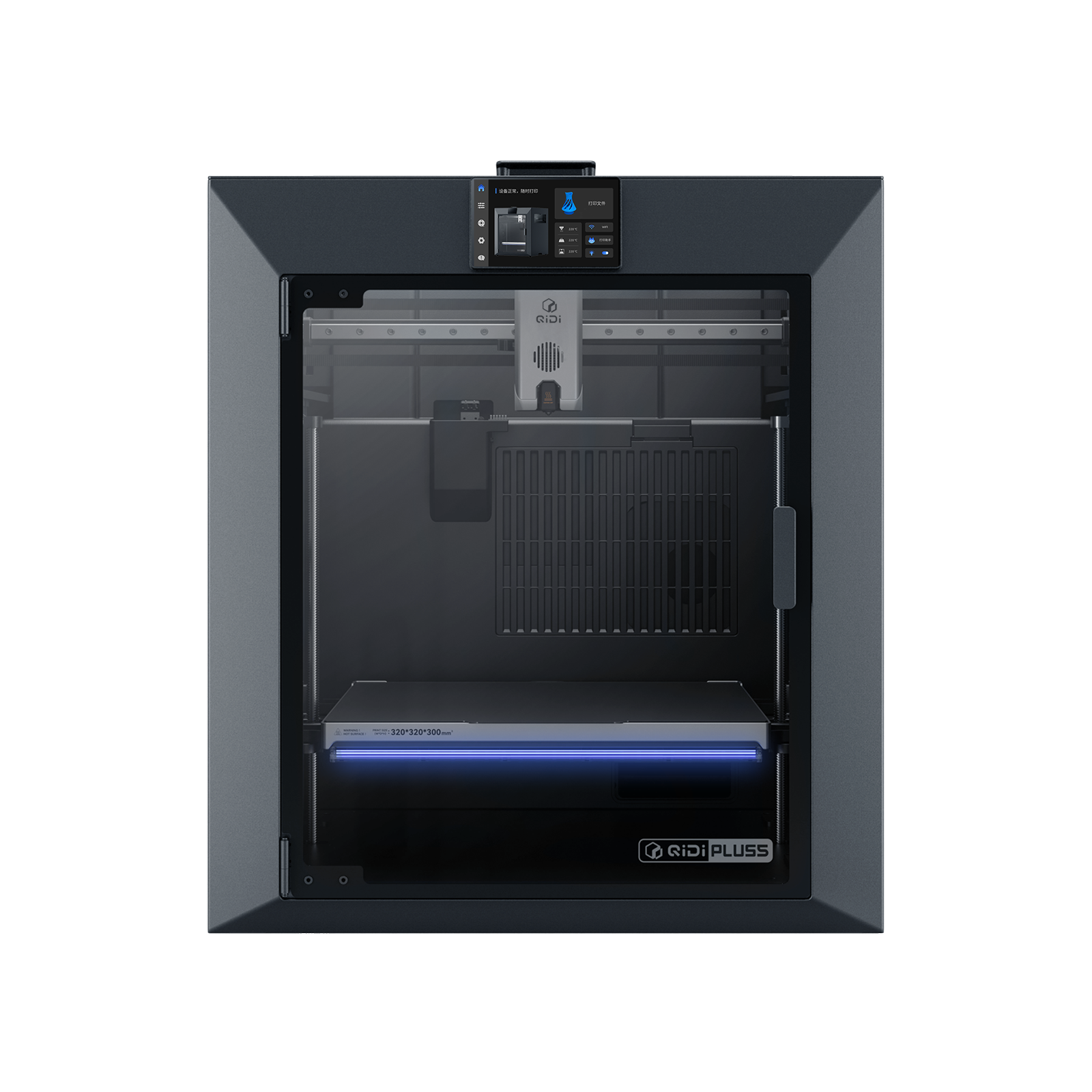
QIDI Plus5
QIDI Plus5 (standard, not the Plus5 Combo with QIDI Box, and not the Plus4)
The only one of the three that will genuinely take unfilled nylon and polycarbonate at size. More money, more bench, less warranty.
- Build volume
- 320 × 320 × 300 mm
- Technology
- FDM
- Max speed
- 600 mm/s toolhead (≤20,000 mm/s² acceleration)
- Enclosed
- Yes, with independent active chamber heating up to 65 °C (3rd generation)
- Multi-colour
- Optional (compatible with QIDI Box; the Combo bundles it for 16 colours)
- Auto levelling
- Yes (hands-free, loadcell sensor integrated into the hotend)
What we like
- A 370 °C nozzle and a 120 °C plate — the highest ceilings of the three
- Independent active chamber heating to 65 °C
- QIDI names PA and PC outright on its materials list
- A slightly larger envelope at 320 × 320 × 300 mm
What we don’t
- Costs more, in the £650 to £750 band
- A one-year warranty, the shortest of the three
- The biggest and heaviest machine here at 29 kg
- More headroom than a mostly-PLA user will ever reach
Buy it instead if polycarbonate or unfilled nylon is the actual job and you have the bench space. Skip it if you mostly print PLA and PETG, where you would pay for headroom you never reach.
If all three are more machine than you need, the K1C is the same family at 220 × 220 × 250 mm for £350 to £420.
Who should buy it, who should not, and the verdict
Whether the Creality K1 Max is worth it turns on one question: is the 300 mm cube what you are buying, and is PLA, PETG or filled filament what you will put in it? Both yes, and this is a well-equipped machine at a fair price.
It suits the person whose models keep needing to be cut in half — cosplay shells, props, enclosures, drone frames, large jigs in carbon-filled nylon. It does not suit someone whose real target is polycarbonate or unfilled nylon at size; nor anyone who needs a supplier to solve their problems; nor a buyer who simply wants the most capable machine for the money, because the K2 Pro is that machine at £500 to £560. If you are not committed to this size or brand, the best 3D printers UK pillar covers the field, resin included.
The K1 Max buys you one thing cheaper enclosed CoreXY printers cannot sell you at all — room — and surrounds it with speed, a hardened nozzle and genuinely useful monitoring.
- Buy it if
- You want a 300 mm enclosed machine for large single-piece parts in PLA, PETG or filled filament, the longer UK warranty matters to you, and you are happy to level a big plate properly.
- Skip it if
- You want unfilled nylon or polycarbonate at size, you want the most machine for the money, or you need support that answers quickly.
In the £560 to £640 band that was a strong machine, and for a PLA and PETG user who needs the space it still is. What stops it being an easy recommendation is that Creality has since built the machine this one should have been, at the same size, for less. Buy it for the plate — but check the K2 Pro's price first.
How this article was researched
Nothing was printed or measured for this review, and the machine was not handled. Every specification comes from Creality's own K1 Max parameter table and product page, or the equivalent primary sources for the two comparison machines, and each figure ties to a dated entry in this site's claim ledger. UK price, stock, warranty and model status were checked at Creality's UK storefront in late September 2026. The ownership patterns come from recurring threads in the manufacturer's community forum and from UK review sites, summarised in our own words and never quoted. Where a figure could not be verified from a primary source — an acoustic rating for this machine, most notably — it has been left out and said so.
Common questions
- Is the Creality K1 Max worth buying?
- It depends entirely on whether you need the size. If a 300 mm cube is what you are buying and you print PLA, PETG or carbon-filled filament, it is a well-equipped machine in the £560 to £640 band with an unusually good warranty for the money. The difficulty is that Creality's own K2 Pro now offers the same build volume with a heated chamber and a hotter plate in a lower band, so the K1 Max has become the more expensive way to buy 300 mm from the same company.
- Who is the Creality K1 Max best for?
- Someone whose models keep having to be cut in half and glued back together — cosplay shells, props, enclosures, drone frames, large functional jigs in carbon-filled nylon. It also suits anyone who wants long jobs supervised by a camera and a first-layer scanner rather than by themselves. It suits nobody whose real target is unfilled polycarbonate or nylon at size, because the chamber is not heated.
- What are the main alternatives to the Creality K1 Max?
- Two are worth real consideration. The Creality K2 Pro is the same 300 mm cube with an actively heated chamber to 60 °C and a 110 °C plate, in a lower price band — the K1 Max's main weakness solved for less, though warranty halves to twelve months. The QIDI Plus5 goes further for more money, with a 370 °C nozzle, a 120 °C plate and chamber heating to 65 °C, which is what unfilled nylon and polycarbonate actually need.
- Can the Creality K1 Max print nylon and polycarbonate?
- Creality's published filament list for the machine does include PC and unfilled PA, alongside PET and PET-CF. Be sceptical about the unfilled pair. Both want hot, still air to stop them curling, and the K1 Max has a plate ceiling of 100 °C with no chamber heater published at all — it is enclosed with active cooling, which is a different thing. Carbon-filled nylon is a genuine strength; unfilled nylon and polycarbonate will fight you on anything large.
- Is the Creality K1 Max still worth it now the K2 range exists?
- The K1 Max is not discontinued — Creality still lists and sells it, names no successor, and had UK stock when this page was checked. But the K2 Pro matches its build volume, beats it on plate and chamber temperature, and sits in a lower band, so the honest answer is that the K1 Max is now hard to recommend over its own replacement unless the longer warranty or the more mature troubleshooting record tips it for you.