ELEGOO Neptune 4 vs ELEGOO Neptune 4 Pro
ELEGOO publishes the same parameter table twice for the Neptune 4 and Neptune 4 Pro, bar one weight row. Here is what the extra twenty pounds buys.
Independent and reader-funded. We earn a commission if you buy through our links, at no extra cost to you. How this works.
ELEGOO Neptune 4 vs ELEGOO Neptune 4 Pro looks like the simplest twenty pounds a first-time buyer ever spends. Then you set ELEGOO's two parameter tables side by side and find they are, very nearly, the same table.
Both print a 225 × 225 × 265 mm volume onto a 235 × 235 mm PEI plate, both reach 300 °C at the nozzle over a bed that goes to 110 °C, both are rated from 30 to 500 mm/s at up to 20,000 mm/s², and both occupy the same 475 × 445 × 515 mm of desk. Across every row ELEGOO publishes, one number differs: net weight, 8.3 kg against 8.9 kg.
The real difference is not on the sheet. It is a bed divided into two independently controlled heating zones — and, far less advertised, a printhead the dearer machine expects you to fit yourself.
| Specification | 1 ELEGOO Neptune 4 Pro The default buy | 2 ELEGOO Neptune 4 The budget entry |
|---|---|---|
| Best for | Most buyers, and anyone printing small parts | A fixed budget, and a simpler first evening |
| Key strength | Segmented bed: a 100 W centre zone heats alone for small models | Cheapest route onto the platform, printhead already fitted |
| Main limitation | Printhead arrives detached; manual adds a lubrication duty | Whole bed heats whatever the model size |
| Segmented heatbed | Yes — 100 W centre plus 150 W outer, 120 × 120 mm centre zone | Not offered |
| Printhead in the box | Listed separately — you fit it | Arrives fitted |
| Motion guidance (ELEGOO's wording) | Wear-resistant POM V-guide wheels | Wear-resistant POM V-guide wheels |
| Build volume | 225 × 225 × 265 mm | 225 × 225 × 265 mm |
| Max nozzle / bed | 300 °C / 110 °C | 300 °C / 110 °C |
| Speed / acceleration | 30–500 mm/s, 20,000 mm/s² | 30–500 mm/s, 20,000 mm/s² |
| Levelling | 121-point mesh, or 36, plus knobs under the bed | 121-point mesh, or 36, plus knobs under the bed |
| Extruder | Dual-gear direct drive, 5.2:1 | Dual-gear direct drive, 5.2:1 |
| Connections | USB drive and LAN — no Wi-Fi listed | USB drive and LAN — no Wi-Fi listed |
| Net weight | 8.9 kg | 8.3 kg |
| Footprint | 475 × 445 × 515 mm | 475 × 445 × 515 mm |
| Noise | ELEGOO claims below 50 dB — identical wording for both | ELEGOO claims below 50 dB — identical wording for both |
| UK warranty | 12 months, set for the Neptune 4 family | 12 months, set for the Neptune 4 family |
| UK price band | £180–£215 | £165–£215 |
| UK availability | ELEGOO UK and one authorised UK stockist | ELEGOO UK |
How this comparison was put together
No printing was done for this page. The ELEGOO Neptune 4 compared with the ELEGOO Neptune 4 Pro is desk research, and saying so matters, because the conclusion contradicts most of what is written about the pair.
Four ELEGOO documents carry it: the two user manuals shipped with the machines, which print their specifications under identical headings so the figures line up row for row, and the two parameter tables on ELEGOO's own UK store. Where ELEGOO publishes nothing, this page gives nothing, and competitor pages were read only to find what buyers are not being told.
The three differences that are real
Three rows separate these machines in ELEGOO's documents. One favours the Pro. Two favour the cheaper printer, which is not how this comparison is usually told.
The segmented heatbed. The Pro's reason to exist. Rather than one element under the whole plate, the bed splits into a 120 × 120 mm centre zone rated at 100 W and an outer zone rated at 150 W; ELEGOO's slicer measures the model and leaves the outer zone off if the part fits the centre square. The zones can also be toggled by hand.
Against the 235 × 235 mm plate that centre zone is roughly a quarter of the usable area — where a bracket, a phone stand or a set of miniatures all land. For those jobs the Pro heats less aluminium: a shorter wait before the first layer, less electricity held at 110 °C after it. Modest, real, and the single thing the extra money buys.
The weight. 8.9 kg against 8.3 kg — nobody's deciding factor, but proof the chassis is the same casting, since ELEGOO publishes identical dimensions for both.
The printhead. Here the cheaper machine wins outright, and almost nobody mentions it. ELEGOO's box list for the Pro includes the printhead as a separate item, fitted with two PM3 × 16 screws through the strain-relief bracket and four PM3 × 8 screws. The standard machine's list has no printhead on it — it arrives attached. The model sold as better-finished asks more of you before it prints.
The specification table ELEGOO publishes twice
A comparison earns its keep by being honest about what is not a difference. Here, that is almost everything.
Every part that touches the plastic is shared: a dual-gear direct-drive extruder at 5.2:1 — motor riding on the moving head, which is what makes flexible filament practical this cheap — a copper-titanium bi-metal throat and an extended hot end behind a 0.4 mm nozzle, cooled by the same two 4015 fans flanking the head and four 4020 behind it. Both claim ±0.1 mm accuracy — a manufacturer figure, not a measured tolerance.
So is everything around it: a pre-installed ELEGOO build of Klipper on an ARM 64-bit quad-core processor with pressure advance and input shaping, the latter being what the 500 mm/s rating rests on; a 121-point mesh over hand-twist knobs; files by USB stick or wired LAN, with no Wi-Fi in ELEGOO's row; and the same filament list, PLA through nylon, with the same advice to pair ABS and ASA with an enclosure neither machine has.
One correction while the tables are open. A bed figure of 100 °C for the Pro is in wide circulation and traces to a duplicate ELEGOO product page. ELEGOO's Pro manual, its main product page and its UK store all say 110 °C, the same as the standard machine.
The upgrade that is not in ELEGOO's specification
Research Neptune 4 or Neptune 4 Pro anywhere else and you meet a confident claim: the standard machine runs on plastic rails, the Pro on all-metal linear rails with ball bearings. It is repeated across comparison sites, the most-cited of which admits it has no manufacturer source.
ELEGOO's own pages do not say it. Both carry the same sentence, word for word: silent drivers on every axis, which the company says brings noise below 50 dB, moving on wear-resistant POM V-guide wheels. POM is a self-lubricating engineering plastic, so that describes plastic wheels on extrusion — on both machines. No ELEGOO page reached mentions a metal rail, and this page claims none.
What ELEGOO does document is a pair of asymmetric footnotes. The Pro's manual adds a maintenance instruction the standard machine's lacks: its X and Y moving parts are described as optical axes needing regular lubrication. The Neptune 4's manual carries a note the Pro's omits, telling owners to slacken the hexagonal isolation columns under the platform if the bed feels shaky, and mentioning the pulleys either side of the gantry.
That is more useful than the rail story: ELEGOO writes about the cheaper machine as a thing with pulleys to adjust and the Pro as a thing with shafts to oil. Suggestive of some hardware difference in X and Y, and as far as the evidence goes — and note which way the burden falls, since a lubrication schedule is a chore, not a benefit. Do not pay the premium expecting a mechanically better printer. Pay it for the bed.
Living with either one, according to owners
The two share the controller, firmware, extruder, fans, levelling and bed hardware, so the ownership record barely distinguishes them. Everything below was researched from community threads, forums and owner write-ups, and none of it is a test result.
Software draws the loudest complaint, and it belongs to both equally. Owners repeatedly describe ELEGOO's own build of Klipper as lagging behind the open-source project and not something they can update themselves, which is why a community firmware project exists for the whole Neptune 4 series — though several owners also report the stock software doing everything they need. That project covers every Neptune 4 variant, and its existence is the point rather than a recommendation.
Noise sits awkwardly against the brochure, where ELEGOO claims below 50 dB for both in identical wording — a claim about stepper drivers, not a working printer. A recurring theme among owners is that the cooling fans, not the motors, are the loudest part of these printers, and quieter replacement fans and printed shrouds are among the commonest early modifications. With the same six fans on both, neither is the quieter buy.
First layers come third, because the mesh assumes a bed that stays where it was put. Several owners describe the hand-twist levelling knobs under the bed working loose over time, and printed knob locks are a common fix, although plenty of owners never run into it. Both use the same knobs.
On output the evidence refuses to settle. Accounts of print quality straight out of the box split in two directions: some owners report months of dependable printing on the supplied profiles, while others describe having to retune stringing and layer-consistency settings before results became reliable. That split runs through both models rather than separating them. And no repeating pattern emerged about the segmented heatbed itself, for or against — the case for it rests on published figures, not experience.
What each one costs to run in the UK
Start with what cannot be done. ELEGOO publishes no total wattage for either machine: neither manual states a rated power, giving only the mains input and the 24 V output, and neither UK table carries a power row. Any site comparing them on total consumption is estimating without saying so.
What ELEGOO does publish is the Pro's bed — a 100 W centre zone and a 150 W outer zone, 250 W together. On a bed-slinger the heated bed is the largest sustained load, so it is the right number to reason from.
The sums, as an estimate rather than a measurement. Take the Ofgem price cap unit rate, about 26p per kWh for a typical direct debit customer in England, Scotland and Wales. Held continuously, both zones would draw 2.5 kWh over a ten-hour print, roughly 66p of electricity; the centre zone alone 1 kWh, about 26p. Across a hundred hours of printing in a month, the difference between something like £6.60 and £2.60.
Three caveats. A heater wattage is a ceiling, not a draw — once the plate reaches 110 °C the element cycles rather than running flat out, so real figures land well under both. The motors, board, fans and hot end are extra and unquantified. And the saving only appears on models that fit the 120 × 120 mm centre square; print plate-filling parts and the Pro heats everything too.
So the bed is worth a few pounds a month on small parts and nothing on large ones, plausibly repaying the premium over a couple of years. Filament, the real running cost, is identical.
Four Neptune 4 boxes, and the one you did not mean to order
ELEGOO sells four machines in this family — Neptune 4, 4 Pro, 4 Plus and 4 Max — all current, in stock and priced in sterling on its own UK store. Only the first two are here; the Plus and Max are bigger printers at bigger prices, different machines rather than trim levels, since the pair on this page both stop at 225 × 225 × 265 mm.
Two traps sit alongside them. Bundles come first: ELEGOO lists filament starter and all-in-one kits under names that read almost identically to the bare printers, at prices between the two machines here — so it is possible to pay Pro money for a standard Neptune 4 with filament attached. Pre-owned stock is the second: ELEGOO sells refurbished Neptune units through the same store, and its own warranty table gives them no warranty at all. On a machine whose nozzle kit, plate and hot end are already excluded when new, that is a real gamble.
If none of the four suits, the best FDM printers roundup covers the brackets either side.
UK price, availability, warranty and support
ELEGOO Neptune 4 versus ELEGOO Neptune 4 Pro in the UK has a different shape from the comparison Americans are reading. On the day of writing the standard machine sat in the £165–£215 band and the Pro in the £180–£215 band — overlapping, because both prices observed were promotional.
One observation matters more than the bands: that day, the Pro at an authorised UK stockist was cheaper than the standard Neptune 4 was at ELEGOO's own UK store. The premium this comparison is supposed to be about had inverted.
Where to buy, and what was in stock
Both were in stock and priced in sterling on ELEGOO's own UK store, which ships across the UK and the Isle of Man. The Pro has a second route, in stock at an authorised UK retailer; for the standard machine no listing was confirmed there, so it has one UK source. Amazon.co.uk was not checked, as automated access is blocked. Neither machine is run-out stock.
Warranty, support and spares
Warranty is identical, and not by coincidence: ELEGOO sets it for the Neptune 4 family rather than per model. Twelve months on the machine from the date the original order was received, the extruder and printhead kit limited to six, and the PEI platform, build plate, nozzle kit, PTFE tube, heater, thermistor and hot end treated as consumables with no cover at all — a list worth reading twice, since it makes the hot end a wear part rather than a warranted component.
Support is the same route either way. Reports on ELEGOO's support run both ways: many owners describe replacement parts arriving quickly and without much argument, while others describe slow first replies and difficulty reaching a person. Spares are shared across the series, so nozzle kits and plates bought for one fit the other. If both machines land above your budget, the best budget 3D printers roundup covers the tier below.
Which one to buy
ELEGOO Neptune 4 Pro vs ELEGOO Neptune 4 turns on one question, and it is not budget: how big are the things you print?
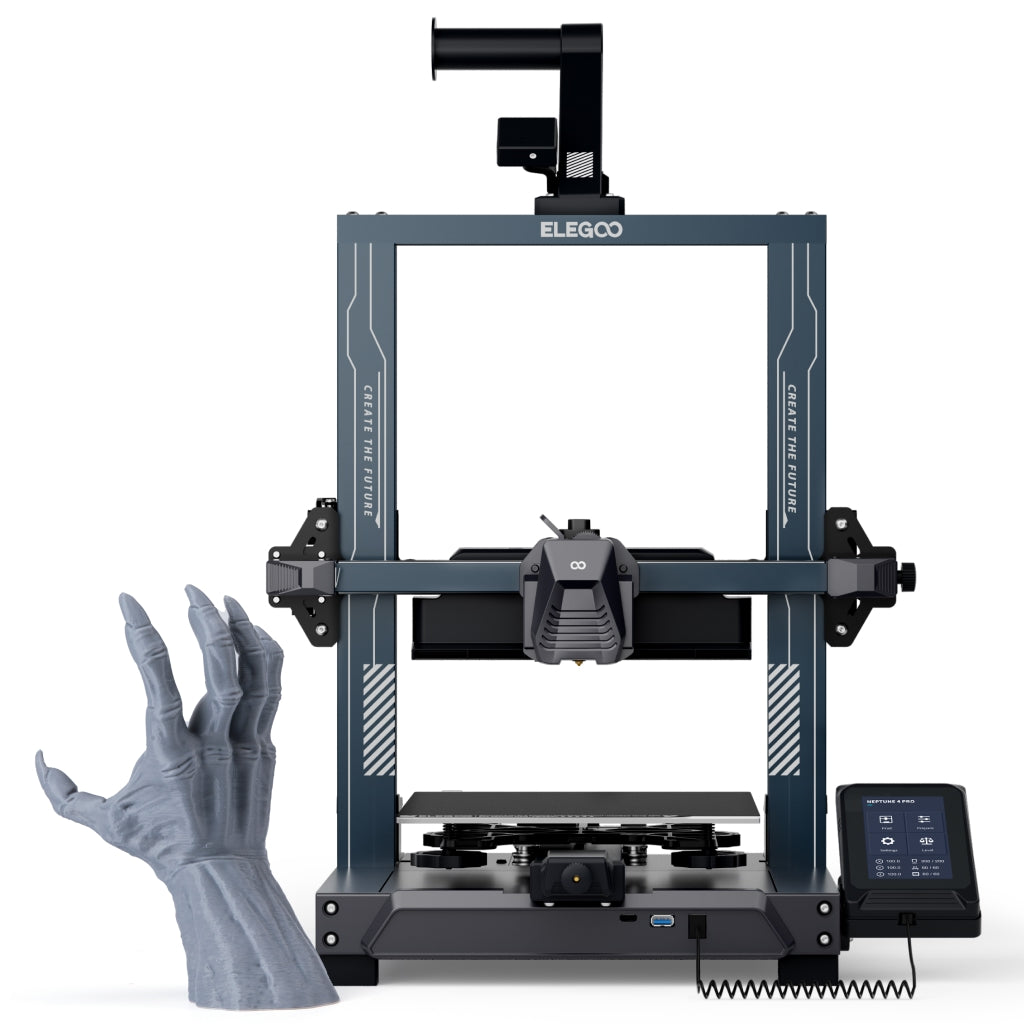
ELEGOO Neptune 4 Pro
Neptune 4 Pro (standard 225 × 225 × 265 mm model — not the Neptune 4, Neptune 4 Plus, Neptune 4 Max, or any bundle/pre-owned SKU)
The same printer as the Neptune 4 wherever plastic moves, with a bed split into two zones so small models do not pay to warm a full-size plate.
- Build volume
- 225 × 225 × 265 mm
- Technology
- FDM, bed-slinger Cartesian, dual-gear direct-drive extruder, single nozzle, segmented heatbed
- Max speed
- 30–500 mm/s (ELEGOO recommends 250 mm/s); 20,000 mm/s² max tool-head acceleration
- Enclosed
- No — open frame, no enclosure offered
- Multi-colour
- No — single extruder, no multi-material unit offered for this platform
- Auto levelling
- Yes — 121-point (11 × 11) auto bed levelling, toggleable to 36 points, plus auxiliary hand-twist knob levelling under the bed
What we like
- Carries the only functional difference ELEGOO documents: a bed split into a 100 W centre zone and a 150 W outer zone, so a small model does not pay to heat a full-size plate
- ELEGOO's slicer switches the outer zone off by itself for anything inside the 120 × 120 mm centre square, and both zones can be toggled by hand
- Identical to the cheaper machine on every other published row — volume, both temperature ceilings, speed, acceleration, levelling, extruder, footprint and warranty
- Two UK buying routes rather than one, and on the day checked it was the cheaper of the two machines in Britain
What we don’t
- The printhead is a separate item in the box and you fit it yourself with six screws; the standard Neptune 4 arrives with it attached
- ELEGOO's manual adds a maintenance duty the cheaper machine's does not, describing the X and Y moving parts as optical axes needing regular lubrication
- The segmented bed does nothing for plate-filling prints, and no repeating owner pattern about it has formed yet
- No enclosure, no Wi-Fi in ELEGOO's transfer row and no total wattage published — exactly as on the standard machine
Buy the Pro if most of what you print would fit a 120 × 120 mm square — brackets, fittings, miniatures, spare parts — and you would rather heat a quarter of the bed than all of it, or if it is quoted within a few pounds of the standard machine, as it was on the day of writing.
Skip the Pro if you print large, plate-filling parts, where the segmented bed does nothing, or would rather not begin ownership by bolting a printhead onto a gantry.
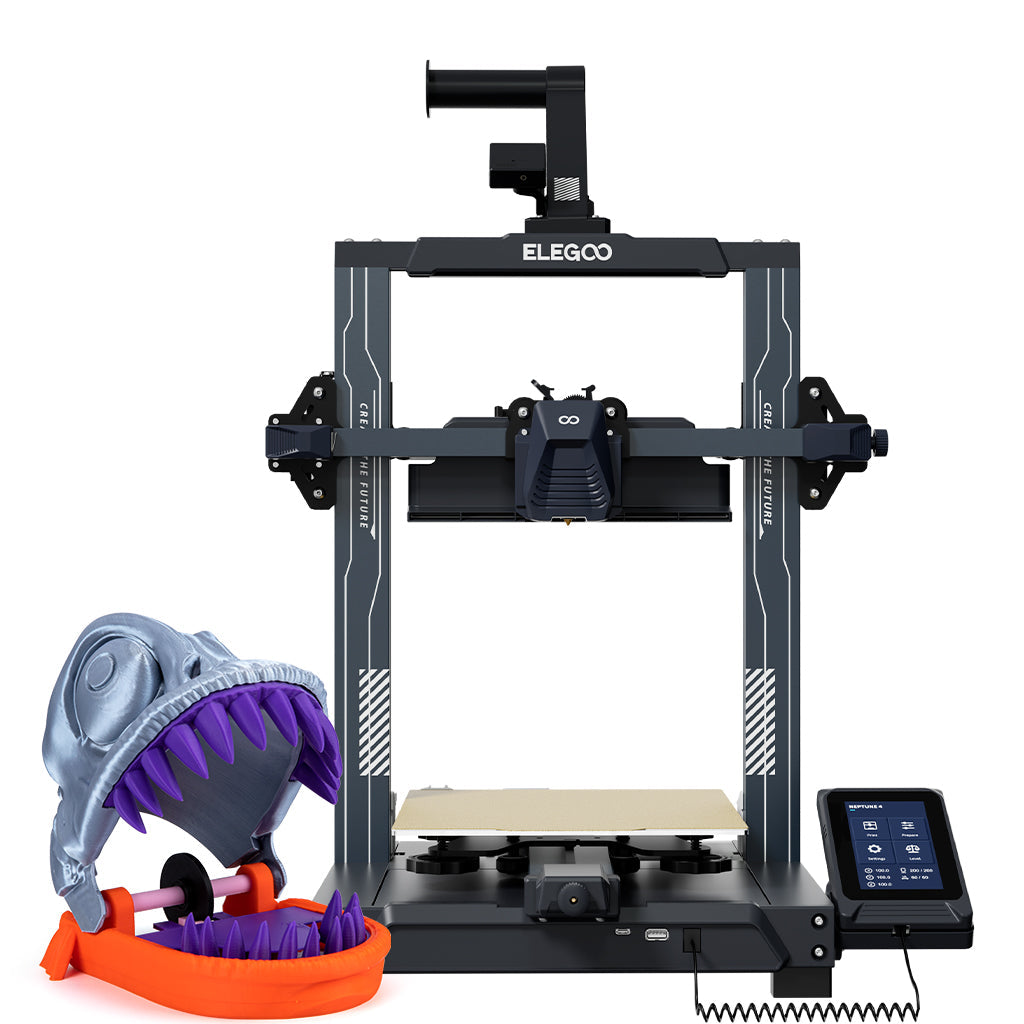
ELEGOO Neptune 4
Neptune 4 (standard 225 × 225 × 265 mm model — not the Neptune 4 Pro, Neptune 4 Plus, Neptune 4 Max, Neptune 3 Pro, or any bundle/pre-owned SKU)
The cheapest way onto this platform and not a cut-down version of it: same extruder, nozzle, levelling, firmware, ceilings and footprint, printhead already fitted.
- Build volume
- 225 × 225 × 265 mm
- Technology
- FDM, bed-slinger Cartesian, dual-gear direct-drive extruder, single nozzle
- Max speed
- 30–500 mm/s (ELEGOO recommends 250 mm/s); 20,000 mm/s² max tool-head acceleration
- Enclosed
- No — open frame, no enclosure offered
- Multi-colour
- No — single extruder, no multi-material unit offered for this platform
- Auto levelling
- Yes — 121-point (11 × 11) auto bed levelling, toggleable to 36 points, plus auxiliary hand-twist knob levelling under the bed
What we like
- The same printer where it counts — same dual-gear direct extruder, same 0.4 mm nozzle, same 121-point levelling, same 300 °C nozzle and 110 °C bed ceilings
- Arrives with the printhead already attached, which the Neptune 4 Pro does not
- The lighter of the two at 8.3 kg against 8.9 kg, on an identical 475 × 445 × 515 mm footprint
- Listed by ELEGOO as current and in stock in sterling, with exactly the same 12-month warranty as the Pro
What we don’t
- The whole bed heats whatever the model size, so small prints wait longer to start and cost marginally more to run
- ELEGOO publishes no bed wattage for it at all, so its bed cannot be compared numerically with the Pro's
- One confirmed UK route against the Pro's two, and the Pro has been seen selling for less
- Ships the same pinned ELEGOO build of Klipper as the Pro, which owner accounts describe as hard to keep current
Buy the Neptune 4 if the budget is genuinely fixed, or you want it printing with the least assembly — it arrives with the printhead attached, which the Pro does not. Nothing about it is second-rate where it counts: the extruder, hot end, mesh levelling and 300 °C ceiling are the Pro's.
Skip the Neptune 4 if the Pro sits in the same price band, which in Britain it often does — you would be declining a free upgrade. If neither suits, the best FDM printers roundup is a better starting point.
These are not a capable printer and a compromised one. On ELEGOO's own documents they are one printer listed twice — same volume, ceilings, extruder, nozzle, levelling, firmware, footprint and warranty, and by the company's own description the same guide wheels. One number differs, and it is the weight.
What separates them is a bed cut into two heating zones: worth a few pounds a month on small parts, nothing on large ones. The widely repeated story that the Pro brings metal linear rails is not something ELEGOO claims anywhere, and nor does this page. So price both on the day. If the gap is small, take the Pro for the bed; if it is wide, take the Neptune 4 without feeling you have settled.
- Buy it if
- Most prints would fit a 120 mm square, or the two are quoted within a few pounds: take the Neptune 4 Pro.
- Skip it if
- You print large parts, or want it printing with the least assembly: take the standard Neptune 4.
How this article was researched
This comparison is research-based: no printing, measurement or photography was carried out, and nothing here is a test result. Specifications come from ELEGOO's own documents for the two named standard variants — neither the Plus, the Max, a bundle nor a pre-owned unit. The Pro's manual was read through a mirror after ELEGOO's own download path for it could not be resolved; every value it shares with ELEGOO's UK table matched exactly, which is what confirms it. Owner-reported patterns were researched from community threads, forums and owner write-ups, summarised in our own words and labelled wherever they appear; no review is quoted and no rating reproduced.
Three gaps are left open rather than filled: no total wattage is published for either printer, no bed wattage at all for the standard machine, and no statement of what the X and Y axes ride on beyond one guide-wheel sentence applied to both. Prices and stock were checked on 2 October 2026 and given as bands.
Common questions
- Which is better, ELEGOO Neptune 4 or ELEGOO Neptune 4 Pro?
- Better at what, is the honest reply, because ELEGOO's own documents make these one printer listed twice. Its two user manuals and its two UK parameter tables agree on build volume, print precision, nozzle diameter, speed range, acceleration, both temperature ceilings, levelling, extruder, frame, Z drive, fan set, connections, slicer and external dimensions. Exactly one number differs between them, and it is net weight. So the question reduces to the one thing that is genuinely different: the Pro's heated bed is divided into a separately controlled 120 mm centre zone and an outer ring, and ELEGOO's slicer leaves the outer ring cold when the model fits inside the middle. If most of what you print is small, that is a real if modest advantage and the Pro is the better buy — particularly in Britain, where the two have been trading within a few pounds of each other. If you print large, plate-filling parts, the feature never activates and the cheaper machine is the better buy. There is no universal winner here, only that criterion.
- Which has better print quality and reliability?
- Neither, as far as anything verifiable goes. No printing was done for this page, so no first-hand quality judgement is offered. What can be said is that every component in the filament path is shared: the same dual-gear direct-drive extruder at the same reduction ratio, the same bi-metal throat, the same extended hot end, the same 0.4 mm nozzle, the same six cooling fans, the same ±0.1 mm accuracy claim and the same slicer profiles. There is no mechanical reason to expect different output from the two, and ELEGOO claims none. On reliability the owner evidence refuses to take a side: accounts divide between owners who print steadily for months on the supplied profiles and owners who had to retune before results settled, and that division runs through both models rather than separating them. Anyone promising you that the Pro prints better is going beyond what the manufacturer says and beyond what owners report.
- Which offers better value for UK buyers?
- The Pro, on current British pricing, and the reason is that the premium has largely disappeared. Both were in stock in sterling at ELEGOO's own UK store when checked, inside overlapping price bands, and the Pro was cheaper at an authorised UK retailer than the standard machine was at ELEGOO UK on the same day. Value normally favours the cheaper model because it also saves something in ownership, and here it saves almost nothing: the footprint is identical, the warranty is identical because ELEGOO sets it for the whole Neptune 4 family rather than per model, the spares are shared, and the segmented bed means the dearer machine is marginally cheaper to run on small parts rather than dearer. The standard Neptune 4 is the better value in two real cases — a genuinely fixed budget, and a preference for a printer that arrives with its printhead fitted. Outside those, price both on the day and take whichever is cheaper, because on the specification there is nothing else to choose.