FlashForge Adventurer 5M Review
A UK review of the FlashForge Adventurer 5M: what its 600 mm/s headline really measures, the noise the open frame brings, and what it costs to run.
Independent and reader-funded. We earn a commission if you buy through our links, at no extra cost to you. How this works.
The FlashForge Adventurer 5M is a 220 × 220 × 220 mm open-frame printer on CoreXY motion: belts drag the toolhead around above a bed that only moves down. This is the standard 5M — not the enclosed 5M Pro, not the multi-colour AD5X.
What this FlashForge Adventurer 5M review adds is what a product page has no reason to volunteer. The headline is 600 mm/s, and FlashForge's own global table calls that a maximum travel speed — how fast the toolhead moves, not how fast plastic leaves the nozzle. Nothing was printed, handled or measured here. If you have not narrowed the field this far, the best FDM 3d printer uk guide ranks it.
Which Adventurer 5M this is, and the FlashForge Adventurer 5M UK position
FlashForge sells three machines in this family and they are not trim levels of one printer. The AD5X adds a four-filament system for colour; the 5M Pro adds a closed shell with HEPA and activated-carbon filtration; the plain 5M has neither. All three are still in FlashForge's current range, the 5M still presented as its best-value entry-level machine with no successor named.
Availability has moved the wrong way. Checked on 9 October 2026, the manufacturer's own UK store was the only authorised consumer route that could be confirmed — 3DJake UK, which used to stock the machine, now states the FlashForge brand is no longer available at all. Import and marketplace listings exist, are not authorised routes, and are not quoted here as prices or as support. One route is no reason to avoid the machine, but it is why the warranty matters.
Price has moved the buyer's way: that store showed the 5M under the £210 mark against a list price of around £360 — a promotional position rather than a permanent one.
The specification, and what each figure changes
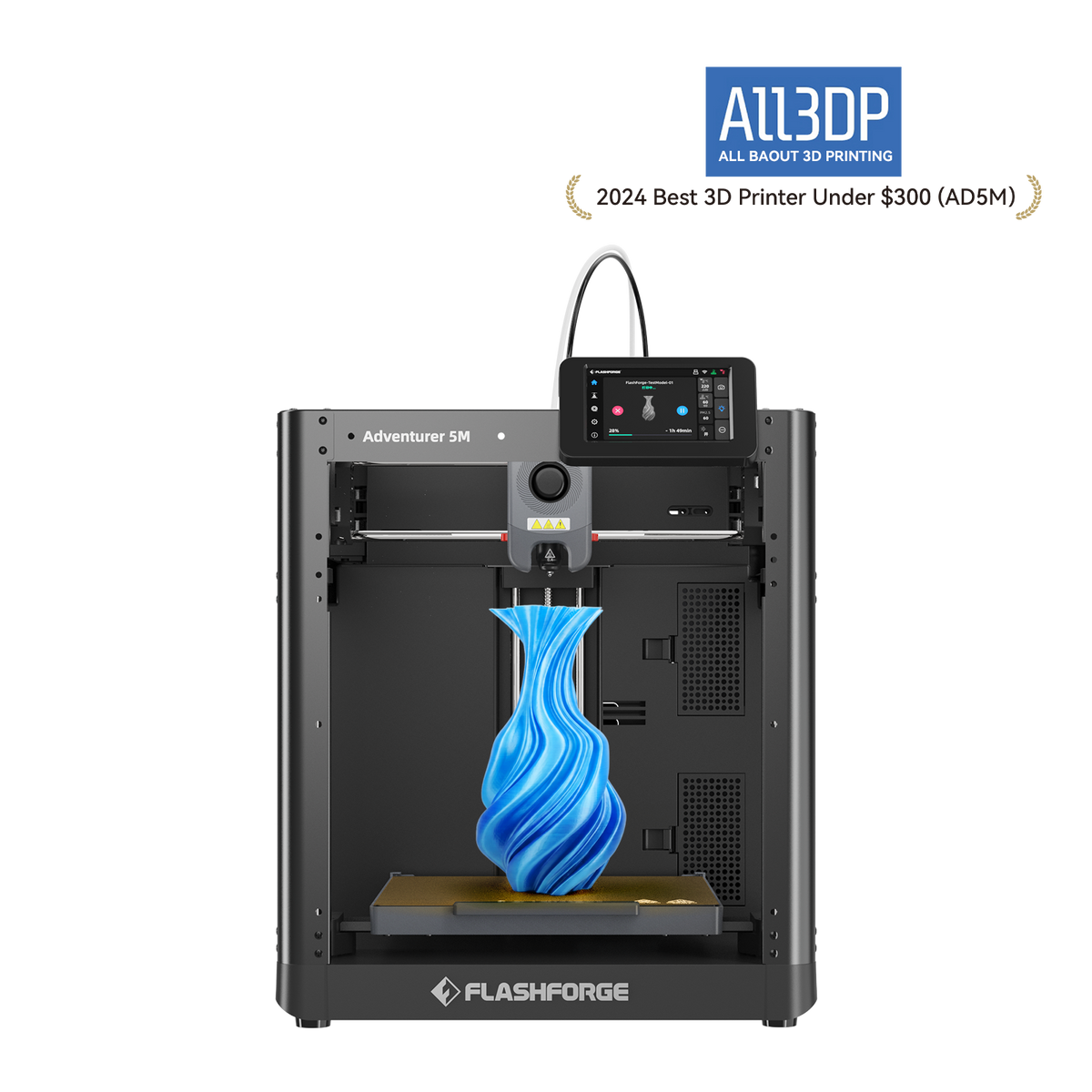
FlashForge Adventurer 5M
Adventurer 5M (open-frame standard model; not the enclosed 5M Pro)
CoreXY motion and an open toolchain for less than anything else offers both. You pay in noise and in materials.
- Build volume
- 220 × 220 × 220 mm
- Technology
- FDM / FFF CoreXY, direct drive, single extruder
- Max speed
- 600 mm/s (20,000 mm/s² acceleration)
- Enclosed
- No (open frame; a DIY enclosure kit is sold separately)
- Multi-colour
- No
- Auto levelling
- Yes — FlashForge's Automatic Datum Management (ADM) auto-levelling
What we like
- CoreXY motion at a price where almost everything else moves the bed, so only the toolhead travels fast
- Quick-detach nozzles in 0.25, 0.4, 0.6 and 0.8 mm with the 0.4 mm fitted — a designed-for swap, not a repair
- An open toolchain: FlashForge's own OrcaSlicer fork, plus standard OrcaSlicer, PrusaSlicer and Cura
- Wired Ethernet as well as Wi-Fi, which is rare this cheaply and survives a weak signal
- A published 32 mm³/s hotend flow figure, and a nozzle that reaches 200 °C in around 35 seconds
- Wear parts sold direct in sterling, from nozzle assemblies around £35 to build plates about £22
What we don’t
- No enclosure and no filtration, so ABS and ASA are on FlashForge's list rather than within its reach
- No noise rating published at all — the UK specification table prints a slash where the figure belongs
- FlashForge's own enclosure kit implies the open machine runs at 65 dB, and the kit needs parts you print yourself
- The 600 mm/s headline is labelled a maximum travel speed on FlashForge's own global table
- One filament at a time and no camera fitted; the camera is a separate kit
- Twelve months on the printer and three on extruder parts, against two years from Bambu Lab
- One authorised UK route confirmed, after 3DJake UK dropped the FlashForge brand
Travel, the 600 mm/s figure, is the dry move between one printed feature and the next: it shortens a plate of small parts and does nothing for a long wall. What governs how fast plastic goes down is on the same listing and gets a fraction of the attention — 32 mm³/s of hotend flow, the volume the hot end can melt each second. No gantry outruns the nozzle.
CoreXY is what makes 20,000 mm/s² of acceleration plausible at all. FlashForge describes a CoreXY all-metal structure while listing the shell as open on the same table: belts move the toolhead, the bed only descends, and no heavy plate reverses direction several times a second. A vibration-suppression algorithm handles the rest.
Temperature sets the materials list, and here the price shows: 280 °C at the nozzle and 100 °C on the plate are comfortable for PLA, PETG and TPU, and the low end of what ABS wants. The nozzle hits 200 °C in around 35 seconds.
Nozzles are the quiet strength — quick-detach units in 0.25, 0.4, 0.6 and 0.8 mm with the 0.4 mm fitted, a designed-for swap rather than a repair. Levelling is hands-off, FlashForge's Automatic Datum Management system adjusting in real time onto flexible PEI-coated spring steel.
Then the surroundings: Wi-Fi, Ethernet and USB — a wired port is rare this cheaply and is the fix for a connection dropping mid-print — a 4.3-inch touchscreen and 350 W rated.
What the Adventurer 5M does well
Three strengths are real, and the headline speed is not quite one of them.
It arrives working. FlashForge says its Automatic Datum Management system eliminates manual calibration. A maker's ease claim is worth little alone, so here is the corroboration: a recurring theme among owners is that the machine prints acceptably from the box without changing slicer settings, with several describing no first-layer trouble, although this is not consistent across all reports.
The toolchain is open. FlashForge's slicer for this generation is a fork of the open-source OrcaSlicer carrying tuned profiles, and the printer is equally at home with standard OrcaSlicer, PrusaSlicer or Cura. Set that beside the closed ecosystems around it: nothing here depends on FlashForge continuing to care, which for a brand whose UK retail presence has just narrowed is worth more than a feature.
Changing nozzle is a decision, not a project. Four quick-detach sizes put the 0.6 mm for chunkier parts and the 0.25 mm for fine detail a minute away, and the wider nozzle is what FlashForge requires for its fibre-filled filaments. Which is where the FlashForge Adventurer 5M pros and cons settle: the strengths get out of your way, the weaknesses are about four walls it has not got.
Where the Adventurer 5M falls short
Three limitations matter, and the first two are the purchase decision.
The open frame decides the materials, whatever the list says. No enclosure and no filtration. ABS, ASA and the fibre-filled grades are on FlashForge's list, but it is split by nozzle — PLA and PETG on the 0.4 mm, TPU and carbon-filled on the 0.6 mm — and a 100 °C plate in open air is the low end of what ABS needs to stay down. Tall ABS parts lift at the corners here, and no setting fixes a draught.
It is loud, and FlashForge will not say how loud. The specification table on its UK listing prints a slash where a rating belongs, and the only figure the company publishes sits on the page for its own enclosure kit: printing noise down from 65 dB to 55 dB with it fitted. By FlashForge's own account, then, you are buying the 65 dB machine.
One filament at a time, and nothing watching it. The camera has a priced answer: FlashForge sells a kit for this model under £40. Colour does not — that means the AD5X, or something else.
What owners consistently report
The basis here is recurring themes researched across owner threads, brand forums, long-term video reviews and UK retailer questions, in our own words — the shape of the machine's problems rather than the odds of meeting one.
Trouble, where it lands, tends to be software rather than hardware. Owner discussion repeatedly turns to which slicer to run, with FlashForge's Orca fork the usual recommendation over the bundled one; where owners describe first-layer problems, the advice that recurs is to clean the nozzle and plate and re-run the calibration before adjusting the Z-offset by hand. That order matters: a dirty PEI plate defeats a perfect measurement.
On clogging, the complaint that circulates most widely, FlashForge's own documentation beats sentiment. It gives two causes for under-extrusion mid-print: the wrong temperature for the filament, or carbonised build-up on the nozzle, for which the stated fix is to replace the nozzle, identified by hand-feeding filament and checking it emerges around 0.5 mm across. The maker treats the nozzle as a wear item, which fits selling it as a quick-detach part: budget for nozzles and this is maintenance, not a fault.
The community has also filled the gaps itself: a recurring theme is that owners print their own toolhead and fan covers for it, with the caution that PLA parts near the hotend soften once the machine runs hotter materials. Print those in PETG.
Setup, slicers, and FlashForge Adventurer 5M print quality in practice
Ten minutes is FlashForge's setup figure and it is honest about what it covers: unbox, plug in, run the levelling routine, start the sample print. It does not cover learning anything, and the thing to learn is not the printer. It is the slicer. The machine ships expecting Orca-FlashForge, a fork of OrcaSlicer with profiles tuned for it, while FlashPrint stays supported and standard OrcaSlicer, PrusaSlicer and Cura all drive it too. Start on FlashForge's Orca build with the profile it supplies, change nothing, and print something small before touching a setting.
Nothing was printed for this review, so FlashForge Adventurer 5M print quality is what the machine is specified to do, not a verdict on parts nobody here has held. The equipment beats the price: CoreXY keeps the bed's mass out of the fast axes, vibration suppression cleans up the ringing high acceleration leaves on vertical faces, and a PEI-coated flexible plate ended the glue-stick era.
Nozzle choice then does more for the result than any slider. The 0.4 mm fitted as standard is the general-purpose compromise, the 0.25 mm suits text and fine mechanisms, and the 0.6 and 0.8 mm move far more plastic for functional parts — which, with flow capped at 32 mm³/s, is also the only real way to use the speed the frame has.
Of the seven filaments FlashForge lists, PLA, PETG and TPU are the natural range and the fibre-filled grades are reachable with the right nozzle. ABS and ASA are on the list and off the table in practice: an open frame is not a warm chamber.
Noise, space, smell and safety in a UK home
What can be said about the noise comes from FlashForge sideways, because no rating for the printer exists and the third-party decibel figures in circulation state no method. The enclosure-kit figure — 65 dB down to 55 dB — makes the before figure the machine as sold: conversation rather than appliance, fine in a workshop, wearing in a bedroom. Owner reports on the open-frame version of this machine repeatedly name the fans as the loud part and describe adding an enclosure as the fix, which is consistent with the figure the manufacturer publishes for its own enclosure kit, although the severity people describe varies a good deal.
The fix is cheap, with a catch. The kit starts under £40 and ships from a UK warehouse, but FlashForge states some of its parts require self-printing — the quiet version of this printer is a project you complete on the noisy one.
Space is the easy part: 363 × 376 × 413 mm before the display and spool holder, and nothing moves outside that footprint, since CoreXY keeps the bed inside the frame — unlike a bed-slinger, it needs no clearance front and back.
Air is the open frame's other consequence. No enclosure and no filter of any kind, so whatever the hot end gives off goes into the room. The Health and Safety Executive has published research on emissions from desktop filament 3D printers; the sensible reading for a home is to ventilate and not to sleep beside a printing machine. Sticking to PLA and PETG keeps that mild.
What a FlashForge Adventurer 5M costs to run in the UK
Electricity is the least of it, and FlashForge publishes no typical draw — only a 350 W rating, which is what the supply must deliver, not what the printer pulls at temperature. So, the ceiling rather than an invented average. Ofgem's cap puts domestic electricity at 26.32 pence per kWh from October to December 2026, plus about 55 pence a day in standing charge regardless. At full rated power that is a shade over 9p an hour, so thirty hours of printing in a month comes in under £3 of electricity. A worked upper bound, not a measurement — the heaters cycle once at temperature.
Filament is the cost that shows up: ordinary PLA runs roughly £14 to £18 a kilogram from a UK retailer, outspending the electricity several times over in any month of real use.
Then the wear parts, sold direct in sterling from FlashForge's UK store — nozzle assemblies from around £35, build plates from about £22, a touchscreen under £50, and the extruder assembly, the dear one, around the £95 mark, which was showing unavailable the day it was checked. Nozzles are not optional spending: FlashForge's own documentation treats a carbonised nozzle as a cause of under-extrusion and replacing it as the remedy.
Against a purchase price under the £210 mark, the FlashForge Adventurer 5M price uk picture is a cheap machine that stays cheap — provided you change the nozzles yourself.
UK warranty, support and spare parts
The warranty is short and clearly stated, which beats ambiguous: one year on the printer, three months on extruder parts. Three months on the part most likely to need attention is the term to notice. There is no hours cap on this route — a 400-hour limit exists for the Pro through a UK education supplier and belongs to neither this machine nor this way of buying it.
Underneath the warranty sit your statutory rights, and in the UK those run against whoever sold you the machine rather than against FlashForge. Which is why the narrowed availability above is the real support story: buy from the manufacturer's own UK store and the manufacturer is also the retailer, so there is no third party to escalate to when the two disagree.
Reports on FlashForge's support are divided: several buyers describe prompt and knowledgeable replies, while others describe slow or unhelpful after-sales handling. A reason to prefer self-service to the support queue — and the machine is built for it. The UK store lists the full parts set in sterling, the nozzles are quick-detach by design, the slicers are open, and the documentation names the part to buy when the machine misbehaves. The weak link is stock rather than price: two items were unavailable on the day, and a single-route brand has no second shelf.
The FlashForge Adventurer 5M alternatives worth your time
Two machines sit close enough to change the decision, and they pull opposite ways: one is this printer with the walls it lacks, the other bigger and better covered for less.
| Specification | 1 FlashForge Adventurer 5M The machine reviewed | 2 FlashForge Adventurer 5M Pro The same machine with the shell | 3 Bambu Lab A1 The cross-shop at the price |
|---|---|---|---|
| Best for | CoreXY speed and open software for the least money | ABS, quiet running and a room you share | A bigger plate, longer cover and a colour path |
| Typical UK price | Around £200 to £360 | Roughly £340 to £490 | Roughly £240 to £320 |
| Build volume | 220 × 220 × 220 mm | 220 × 220 × 220 mm | 256 × 256 × 256 mm |
| Enclosure | No — open frame, DIY kit sold separately | Yes — closed shell as standard | No — open frame |
| Air filtration | None | HEPA and activated carbon, internal and external | None |
| Headline speed, as the maker labels it | 600 mm/s, its own table says max travel speed | 600 mm/s at 20,000 mm/s² | 500 mm/s toolhead at 10,000 mm/s² |
| Max hotend flow | 32 mm³/s | Not published | 28 mm³/s |
| Max nozzle temperature | 280 °C | 280 °C | 300 °C |
| Max bed temperature | 100 °C | 100 °C | 100 °C |
| Published noise rating | None published | 50 dB low-noise, 55 dB standard | None published |
| Multi-colour | No | No | Optional AMS lite, up to four spools |
| Connectivity | Wi-Fi, Ethernet, USB | Wi-Fi, Ethernet, USB, camera built in | Wi-Fi, Bambu-Bus, micro SD |
| Slicer position | Orca-FlashForge, plus standard Orca, PrusaSlicer, Cura | Orca-FlashForge and FlashPrint 5 | Bambu Studio; others with reduced features |
| Warranty on the machine | 12 months, 3 on extruder parts | 12 months, 3 on extruder parts | 2 years |
The 5M Pro is the honest upgrade. Identical on plate, speed, acceleration and both temperatures — then a closed shell with HEPA and activated-carbon filtration, a camera built in, and what the open machine cannot offer at any price: a published noise rating, 50 dB in low-noise mode and 55 dB standard. Bigger at 380 × 400 × 453 mm, identical warranty, roughly £340 to £490 here, filters a two-pack under £20 with no replacement interval published.
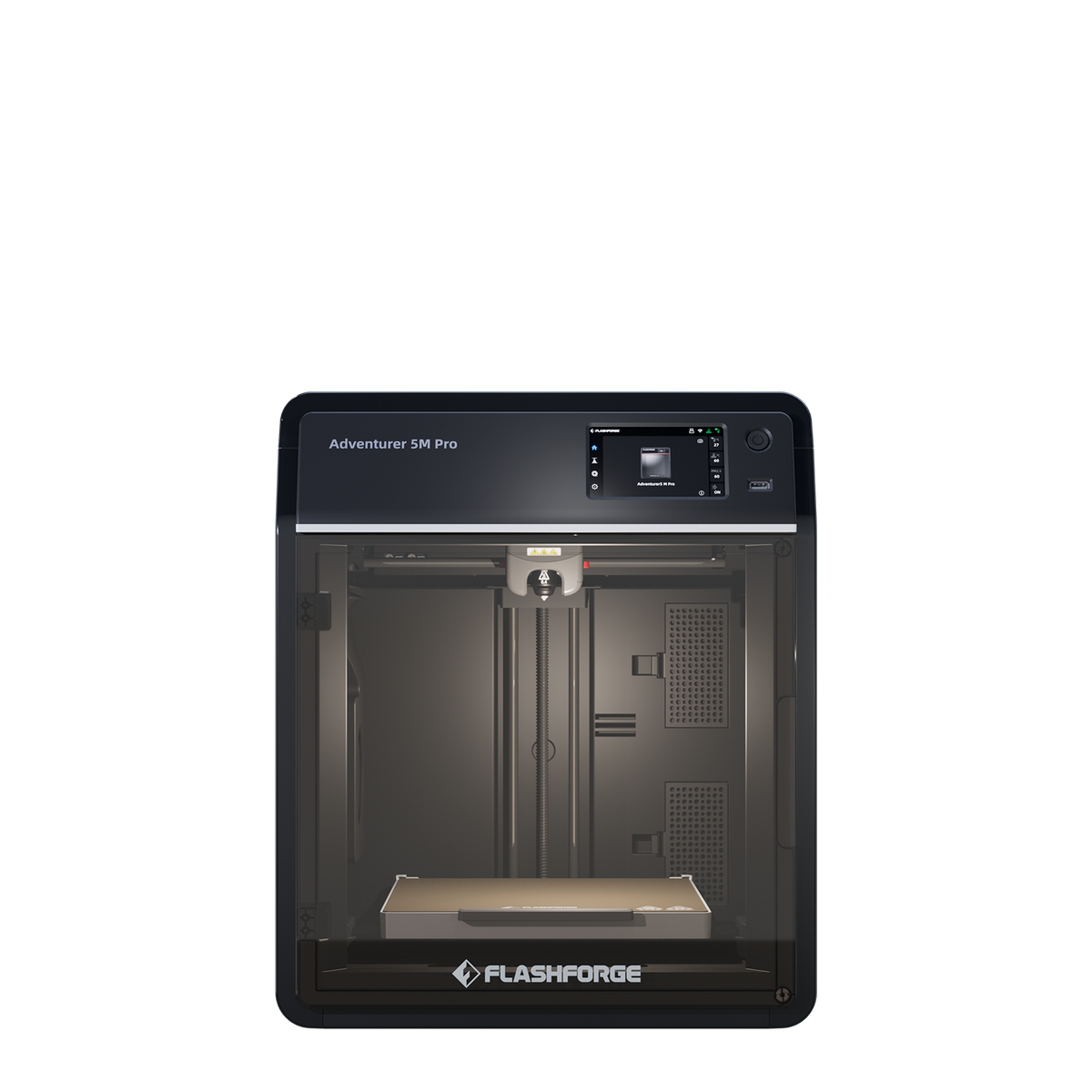
FlashForge Adventurer 5M Pro
Adventurer 5M Pro (enclosed, with dual HEPA and carbon filtration) — not the open-frame Adventurer 5M
Everything the 5M is, plus the enclosure, filtration, camera and a noise figure. Buy it if the printer shares your room.
- Build volume
- 220 × 220 × 220 mm
- Technology
- FDM / FFF CoreXY, direct drive, single extruder
- Max speed
- 600 mm/s (20,000 mm/s² acceleration)
- Enclosed
- Yes — enclosed shell with internal and external air circulation through a HEPA and activated-carbon filter
- Multi-colour
- No
- Auto levelling
- Yes — one-click fully automatic bed levelling
What we like
- Identical to the 5M on plate size, speed, acceleration and both temperature ceilings
- A closed shell with HEPA and activated-carbon filtration on internal and external circulation, fitted as standard
- The only machine here whose maker publishes a noise rating: 50 dB in low-noise mode, 55 dB standard
- A camera built in, where the open 5M needs an accessory kit
- Replacement filters are a two-pack under £20 from FlashForge's own UK store
What we don’t
- Sits a band above the open 5M, roughly £340 to £490 in the UK
- Bigger on the desk at 380 × 400 × 453 mm
- The same short warranty as the 5M: twelve months, and three on extruder parts
- No filter replacement interval is published, so servicing it is a judgement call
- Still one extruder and one colour at a time
Buy it instead if the machine lives where people are, or ABS and ASA are the point. Skip it if you would rather spend the difference on filament.
The A1 is what you are really choosing against. Roughly £240 to £320 on a 256 mm cube rather than 220, a 300 °C nozzle, two years of UK warranty against FlashForge's one, and an optional four-spool AMS lite if colour matters. The trade: a bed-slinger at 500 mm/s and 10,000 mm/s² where the FlashForge is CoreXY, lower published flow at 28 mm³/s, and no ABS, ASA, polycarbonate or composites recommended at all.
Bambu Lab A1
A1 (standard, without AMS lite)
More plate, twice the warranty and a route to colour, for less. You give up CoreXY motion and the open toolchain.
- Build volume
- 256 × 256 × 256 mm
- Technology
- FDM
- Max speed
- 500 mm/s toolhead (10,000 mm/s² acceleration)
- Enclosed
- No
- Multi-colour
- Optional (AMS lite sold separately; up to 4 spools)
- Auto levelling
- Yes (fully automatic)
What we like
- A 256 mm cube against the FlashForge's 220, usually for less money
- Two years of UK warranty, against FlashForge's twelve months
- A 300 °C nozzle, hotter than the 5M's 280 °C
- An optional four-spool AMS lite — the colour path the 5M has not got
- Bambu Lab's own UK store and UK resellers, so more than one route if something goes wrong
What we don’t
- A bed-slinger at 500 mm/s and 10,000 mm/s², where the FlashForge is CoreXY at 600 and 20,000
- Lower published hotend flow at 28 mm³/s
- Bambu Lab does not recommend ABS, ASA, polycarbonate or composites at all
- Bambu Studio first: other slicers work with reduced features
- No acoustic rating published for it either
- A 2024 heatbed cable recall sits in its history, settled by a revised cable but worth knowing
Buy it instead if volume, warranty or colour matter more than motion and software freedom. Skip it if you want a printer no ecosystem can strand.
Two more, without cards. FlashForge's own answer to the colour limit is the AD5X, around the £300 mark on its UK store: a four-filament system on the same 220 mm plate, a 110 °C bed, and a sheet that calls 300 mm/s a maximum print speed where the 5M's 600 mm/s is travel — so the two figures are not comparable. ELEGOO's Centauri Carbon 2 is stronger on paper at £280 to £310 — enclosed, a 350 °C hardened steel nozzle, a published 45 dB or under — but closed software for open. The best budget 3D printers UK guide covers that band.
Who should buy it, who should not, and the verdict
So is the FlashForge Adventurer 5M worth it? It turns on one question, and not about speed: can this machine live somewhere you do not sit?
If it can — garage, spare room, workshop — then yes, comfortably. Under the £210 mark when checked this is the cheapest way to own CoreXY motion, four quick-change nozzles, wired networking and software nobody can take away from you. If it cannot, weigh the noise first: the machine FlashForge sells is the 65 dB one by its own account, and the fix asks you to print part of it.
It suits nobody needing ABS or ASA to work rather than to be listed, nobody wanting more than one colour at a time, and nobody who would rather have a bigger plate and longer cover for less. Each has somewhere to go: the Pro for the shell, the AD5X for colour, the A1 for size, and failing all three, the best 3D printers UK pillar starts from the top.
A genuinely fast, genuinely open machine at a price that keeps falling, let down in one place — it has no walls, and FlashForge charges you to build them. Buy it for the workshop, not the living room.
- Buy it if
- You want CoreXY speed and open software for the least money, you print mostly PLA and PETG, and the printer can live somewhere you are not sitting.
- Skip it if
- You need ABS or ASA to work rather than to be listed, you want colour or a camera out of the box, or a bigger plate and two years of cover for less appeals more.
How this article was researched
No printing, handling, measurement or photography was carried out for this review. The specification comes from FlashForge's own global and UK product pages, accessory listings and published troubleshooting documentation, recorded claim by claim with a source URL and an access date; comparison figures come from FlashForge's and Bambu Lab's own pages and warranty policies. UK price, stock, warranty and model status were re-checked on 9 October 2026, and the price band held for this machine was corrected downwards as a result.
The basis for the ownership patterns is recurring themes researched across owner threads, brand forums, long-term video reviews and UK retailer questions, in our own words: no review is quoted and no rating or review count reproduced.
Three things were left out rather than estimated: the machine's weight and any noise rating for the printer itself, because FlashForge publishes neither, which is why the enclosure-kit figure is used and labelled; a typical power draw, which is why the running cost is a declared upper bound; and a second authorised UK retailer, because none could be confirmed. Our approach is set out in the review methodology.
Common questions
- Is the FlashForge Adventurer 5M worth buying?
- Yes, with one condition attached: somewhere to put it. Under the £210 mark on FlashForge's own UK store when checked on 9 October 2026, nothing else gives you CoreXY motion, four quick-change nozzle sizes, wired Ethernet and a slicer you are not locked into. The condition is the open frame. FlashForge publishes no noise rating for the machine, and the figure on its own enclosure kit implies the printer you receive runs at 65 dB. So either add roughly £40 for that kit plus an afternoon printing the parts it does not include, or put the machine in a room you do not sit in. Settle that before you think about speed at all.
- Who is the FlashForge Adventurer 5M best for?
- Someone with a garage, a workshop or a spare room, who prints PLA and PETG and would rather not be told which software to use. It suits a second machine for an owner who already has something quiet indoors, a maker who swaps nozzle sizes often, and anyone who dislikes closed ecosystems on principle — FlashForge's own slicer is an OrcaSlicer fork, and PrusaSlicer and Cura drive the machine as well. It suits nobody printing ABS or ASA seriously, nobody who needs more than one colour, and nobody whose only free surface is in a bedroom or a shared office.
- What are the main alternatives to the FlashForge Adventurer 5M?
- Three, depending on which limitation bothers you. FlashForge's own 5M Pro is the same machine inside a closed shell, with HEPA and carbon filtration, a camera and a published rating of 50 dB in low-noise mode, at roughly £340 to £490. The Bambu Lab A1, roughly £240 to £320, is the real cross-shop: a 256 mm cube instead of 220, a 300 °C nozzle, two years of warranty instead of one and an AMS lite if colour matters — at the cost of CoreXY motion and an open toolchain. For colour inside the family there is the AD5X, around the £300 mark, which puts a four-filament system on the same 220 mm plate.
- How fast is the Adventurer 5M really?
- Slower than 600 mm/s, and FlashForge has documented that itself. Its global specification table labels the 600 mm/s figure a maximum travel speed — the dry move between printed features, not the rate plastic is laid down. What limits the latter is published on the UK listing: 32 mm³/s of hotend flow, the volume the hot end can melt each second. A 0.4 mm nozzle at an ordinary layer height cannot consume anything close to the gantry's top speed, which is why fitting the 0.6 mm nozzle shortens a print more than any slider will. On a part full of corners the 20,000 mm/s² acceleration figure matters more again than either.
- How loud is the Adventurer 5M, and can it be made quieter?
- FlashForge publishes no rating: its UK specification table prints a slash where the noise figure belongs, and the third-party decibel numbers circulating for this model state no measurement method, so none is repeated here. The one traceable figure is FlashForge's own, on the page for its Adventurer 5M enclosure kit, which states that the kit lowers printing noise from 65 dB to 55 dB — which makes 65 dB the company's implicit figure for the machine as sold. The kit starts under £40 and ships from a UK warehouse, with a condition FlashForge states plainly: some of its parts have to be printed by the owner. Owner reports consistently point at the fans rather than the motion system as the loud part, which is also what an enclosure helps least with if it has no fan of its own.