Is a 3D Printer Worth It?
Is a 3D printer worth buying in the UK? What the payback really depends on, the costs that never reach the receipt, and who should not bother at all.
The short answer
For some people, comfortably. For others it is a few hundred pounds spent on a machine that is in a cupboard within the year, and the difference has remarkably little to do with which printer was bought.
Asking whether a 3D printer is worth it is really asking what it displaces. The plastic is cheap: ordinary PLA runs roughly £14 to £18 a kilogram , so a palm-sized part costs something like thirty to fifty pence. An entry-level machine starts at between about £170 and £270 . Everything turns on how many things you print that you would otherwise have paid for, and on whether you are still printing them next summer.
The answer is therefore conditional, and this page is about the conditions: whether the money comes back, what it costs in time and space, how the sum changes for resin, and what you can recover if you were wrong.
The question is really three questions
Most unsatisfying answers come from running three decisions together. Pulled apart, they are answerable.
Does the money come back? The only one with an arithmetic answer, which is why it attracts the most attention and deserves the least.
What does it cost that is not money? Time, mostly, plus a surface to stand on and some thought about the air in the room.
Will it still be in use in a year? The one that actually settles it, and the one no guide can answer on your behalf.
Does the money come back?
Yes, slowly, and only on things you would otherwise have bought.
Pages asking whether 3D printers are worth buying tend to take this question alone, and usually in dollars. Here is the sterling version.
The saving is not what the plastic cost — it is the gap between that and what the thing would have cost you. A drawer divider, a bracket, a replacement knob for an appliance nobody sells parts for: each is a few tens of pence of PLA at roughly £14 to £18 a kilogram , standing in for something that would have run to several pounds, if it could be bought at all. The benefits of owning a 3D printer that reach a bank statement all have this shape: they accumulate at the rate you use it, not the rate you own it.
This has been studied properly. A peer-reviewed analysis from 2013 assumed twenty household products printed a year and put the payback between four months and two years . A 2017 follow-up printed twenty-six ordinary objects and found the saving depended almost entirely on what each was compared against: very large against premium equivalents, far smaller against the cheapest on the shelf . Both are American, both use prices approaching a decade old, and both used self-built machines, so the figures do not transfer. The shape does: payback follows how often you print and what you replace, not which machine you chose.
The sums also assume prints succeed, and material lost to a job that failed at hour nine is the running cost nobody budgets for.
The costs that are not money
Lists of 3D printer pros and cons rarely include the two things that decide most outcomes: your time, and where the machine is going to live.
Time is the real price. A print is not a print button. It is finding a model that fits, satisfying yourself it will stand up, slicing it and — often enough to matter — working out why the last one peeled off the plate. Owners and long-term reviewers repeatedly name a willingness to learn basic model editing, rather than only downloading finished files, as what keeps a printer in regular use, although this is not consistent across all reports. If opening a free CAD tool to widen a hole by a couple of millimetres reads as a chore rather than a pleasant Saturday, the answer moves.
Space is the second, and it includes the air. A printer wants a surface that does not flex, somewhere dry for filament, and a room you are willing to hear it in. The Health and Safety Executive has published research on emissions from desktop filament printers , and peer-reviewed measurements put the mean emitted particle diameter at 50 to 60 nm — ultrafine, which is why the question arises. The same literature found a rigid enclosure controlling between 67.3% and 80.2% of particulate, against 98.35% to 99.95% for ducting outdoors . None of that settles what is safe. What it does settle is that moving air is worth more than a box, and that "put it in the spare bedroom and shut the door" is the wrong instinct.
Third, the one with no number attached: whether it stays in use. No published figure exists for how often that happens, and this page will not invent one — but it is the risk the price tag does not show.
The sum on a real machine
What follows is a worked example, not a recommendation: it sets the lowest honest bar for the question — roughly what it costs to find out whether 3D printing is worth it at home.
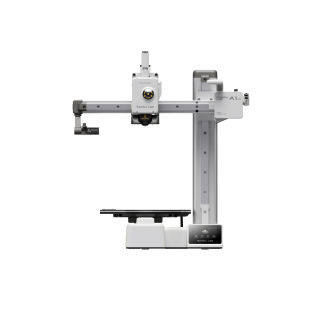
Bambu Lab A1 mini
A1 mini (standard, without AMS lite)
A worked example rather than a pick. It sits where the decision stops being financial and starts being about whether you will use the thing.
- Build volume
- 180 × 180 × 180 mm
- Technology
- FDM
- Max speed
- 500 mm/s toolhead (10 m/s² acceleration)
- Enclosed
- No
- Multi-colour
- Optional (AMS lite sold separately; up to 4 spools)
- Auto levelling
- Yes (fully automatic)
At between about £170 and £270 , the purchase is recoverable in a way a four-figure machine is not. The build volume is 180 × 180 × 180 mm , which covers most household printing and quietly rules out anything large in one piece. It draws at most 150 W , so even a long print at the price-cap unit rate is loose change; the footprint is 347 × 315 × 365 mm and the UK warranty runs to two years .
The limits are where the honesty is. It is not enclosed , and the maker's own material list is candid about the consequence: PLA, PETG, TPU and PVA are what it is built for, while ABS, ASA, polycarbonate, nylon and the filled filaments sit outside its range . For household objects that costs nothing. For parts that must take heat or load it is the whole ballgame, and it is why a cheap machine can be entirely worth it for one buyer and pointless for the next.
Owner reports repeatedly describe the A1 mini as reliable and low-effort, which is why it is so frequently suggested as a first printer. Which is the useful finding here: at this end of the market, the machine is rarely what makes the purchase a mistake.
Where the answer changes: resin
Everything above assumes filament. Resin is a different question with a different answer, and running the two together is the commonest fault in guides to this subject. Resin buys detail a nozzle cannot reach; it also moves several costs from optional to compulsory.
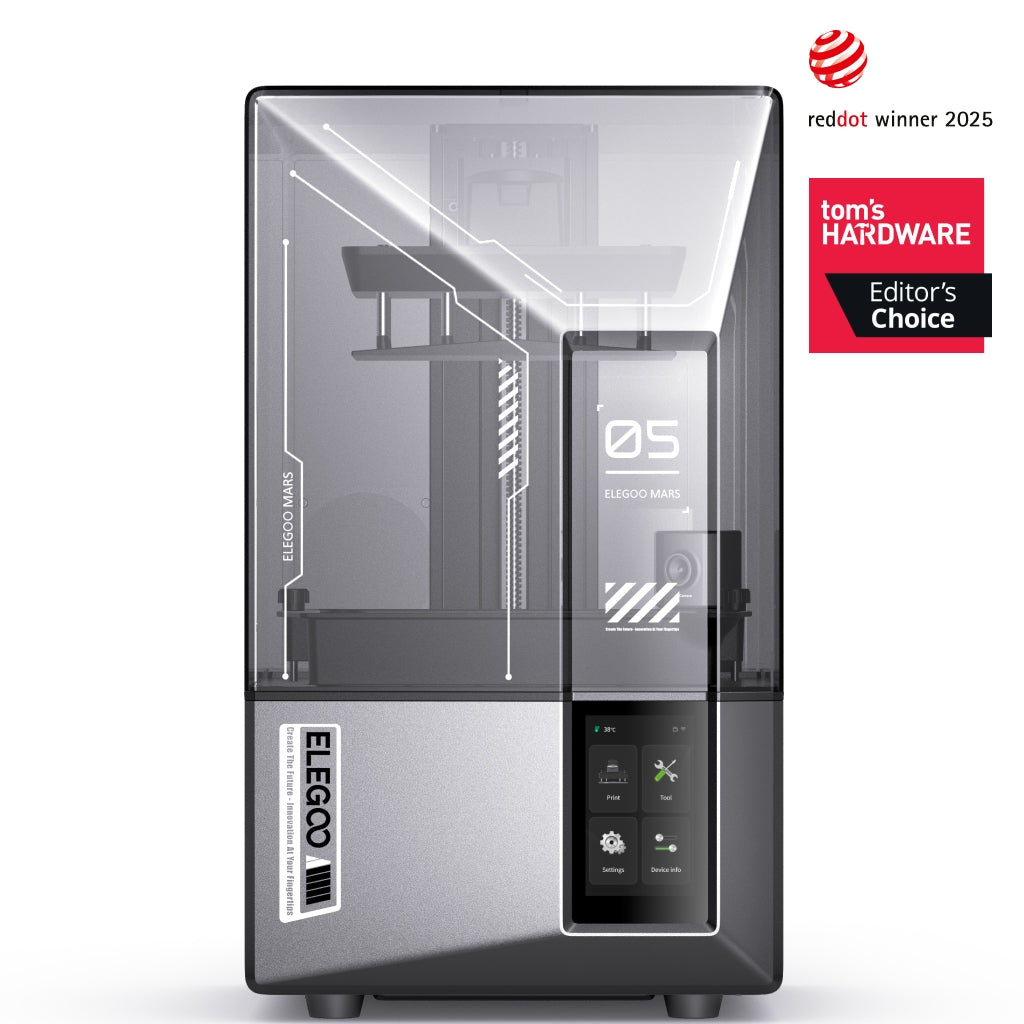
ELEGOO Mars 5 Ultra
Mars 5 Ultra 9K (not the non-Ultra Mars 5)
A worked example rather than a pick, chosen because ELEGOO publishes UK prices for the parts this machine consumes and warrants them in wear order.
- Build volume
- 153.36 × 77.76 × 165 mm
- Technology
- Resin (MSLA)
- Max speed
- Up to 150 mm/h (manufacturer maximum)
- Enclosed
- Lid (acrylic UV cover)
- Multi-colour
- No
- Auto levelling
- Yes (one-click automatic levelling)
The machine is not the expensive part: at between about £210 and £260 it is priced much like the filament machine above, and a build volume of 153.36 × 77.76 × 165 mm tells you what it is for — small, detailed things.
What follows the purchase is the point. Reviewers consistently point out that the printer is only part of the outlay, since washing, curing, alcohol, gloves and ventilation sit outside the box. A wash-and-cure station runs around the £79 to £113 mark , resin is about £16 to £28 a kilogram for the common types , there is no built-in air filtration , and the maker's own purifier is around the £150 mark . The warranty reads as a wear list: twelve months on the machine, six on the tank and build plate, three on the LCD screen . A replacement screen is around the £110 mark — certain in kind, unknown in timing, since nobody publishes how long one lasts.
Then the part that is not about money. The manual requires gloves and eye protection, a well-ventilated area, no skin contact, and curing resin under UV before disposal . That is not boilerplate: the Health and Safety Executive lists resins and acrylates among the agents that cause occupational skin disease , and notes that sensitisation is generally lifelong once it has happened . Followed as the manual sets them out, in a room with air moving through it, these are ordinary precautions. Skipped, this is the one part of 3D printing where the mistake is not fixed by buying a new part.
| Specification | Bambu Lab A1 mini | ELEGOO Mars 5 Ultra |
|---|---|---|
| What the purchase includes | Everything needed for the first print | The printer; washing and curing bought separately |
| What gets consumed | Filament, and eventually a nozzle | Resin, gloves, release film and eventually the screen |
| Warranted for less than the machine | Nothing — the cover runs across the machine | The screen, at a quarter of the machine's term |
| Where it can reasonably live | Any aired room, on a surface that does not flex | A room you are content to ventilate and wear gloves in |
| What it rules out | High-temperature and filled engineering materials | Anything large, at least in a single piece |
So resin is worth it for a narrower group, and more decisively so. For miniatures or finely detailed models nothing filament-based competes, and the extra kit is the cost of the result. For brackets and replacement parts it is the wrong tool.
Four things people get wrong
That it pays for itself on ornaments. The saving is the gap between the printed thing and the bought thing, so an ornament you would never have purchased saves nothing at all. Printing forty things you would have paid for is a different activity from printing forty because you can.
That it is a side income. Claims circulate that one desktop machine can earn several hundred to a few thousand pounds a month. They arrive with no basis attached, and what they describe is a small manufacturing business — design, listings, postage, customer service, reprints — in which the printer is the cheapest component. A machine costing between about £170 and £270 does not become an income by being switched on.
That a cheap machine is cheap to own. The purchase price says little about the year, because the two technologies consume different things. The filament machine above can run on material alone at roughly £14 to £18 a kilogram , while the resin machine above — priced within a whisker of it — has a screen that is a consumable at around the £110 mark , on top of the washing and curing kit.
That it is now plug-and-play. It is far closer than it was, and that genuine change is why the question deserves re-asking rather than being settled by an answer from five years ago. But a machine arriving calibrated only removes the first obstacle. Finding things worth printing, and still wanting to in month eight, was always the harder one.
If the answer turns out to be no
What does being wrong actually cost? Less than most people assume, and for statutory rather than commercial reasons — the part of this decision that works differently in the UK.
Buy online from a UK trader and the Consumer Contracts Regulations give a 14-day cancellation right that does not depend on anything being wrong with the machine . You are allowed to simply change your mind, which makes a printer ordered online and tried within a fortnight a commitment you can withdraw from.
If it is faulty rather than unwanted, the protections run longer. The Consumer Rights Act 2015 gives a short-term right to reject faulty goods for 30 days after delivery , and for the first six months the law assumes a fault was present from the start rather than asking you to prove it . The duty to refund sits with the trader you bought from, not the manufacturer — worth knowing before a support ticket disappears into a queue in another time zone.
Past those windows you are in the second-hand market. No verified UK figure for resale values was available for this page, so none is offered.
So, worth it for whom?
Should I buy a 3D printer? This is the shortest answer the evidence above supports.
Probably yes if you already repair, make or modify things; if you can name two objects you want that you could not simply order; if you are willing to adjust a model rather than only download one; and if there is a ventilated corner that can hold a machine permanently.
Yes, but narrowly, if what draws you is fine detail — miniatures, scale models, jewellery masters. The resin obligations above are then the price of the result rather than an argument against it.
Probably not if the appeal is the machine itself rather than a list of things to make with it. A recurring theme in owner discussion of whether to buy at all is that having something specific to print matters more than which machine is chosen, and several describe printers that fell out of use once the novelty models were done, although others describe steady use years later. Nothing on a specification sheet protects against that.
If you genuinely cannot tell, the cheap end plus the cancellation window is a legitimate way to find out rather than a rationalisation for buying.
If that landed on yes, the best 3d printer uk shortlist is the next step. If budget is the binding constraint, the best budget 3D printers roundup works the same ground under a ceiling. And if detail decided it, the best resin printers roundup covers that side.
How this article was researched
This guide is research-based. No machine named here was bought, tested, measured or photographed by us, and nothing on the page is offered as something we observed.
Every specification, price band and safety statement comes from a manufacturer page, an official manual, a UK regulator, published legislation or a peer-reviewed study, each recorded with the date it was checked. Prices are bands because exact figures go stale within weeks; the product figures were last checked in September 2026. Both payback studies are labelled where they appear: American, several years old, and conducted on self-built machines.
Three things could not be verified and are absent rather than estimated: any figure for how often a domestic 3D printer falls out of use, any published service life for a resin LCD screen, and any UK resale value for a used machine. The monthly income figures that circulate for desktop printing could not be traced to a source of any kind.
Owner-experience passages are marked and summarise recurring patterns across manufacturer forums, long-term reviews and owner retrospectives — never quotations, never a rating. Two of them describe first printers as a category rather than either machine named here, and are worded that way on purpose.
Common questions
- What should UK buyers know before deciding whether a 3D printer is worth it?
- Three things the guides written elsewhere tend to miss. The decision is unusually reversible: ordering online from a UK trader carries a statutory 14-day cancellation right that does not require anything to be wrong with the machine, so trying one and sending it back is a real option rather than a rationalisation. The running side is smaller than its reputation, because material rather than electricity is where the money goes, and at UK filament prices a typical household part is a few tens of pence of plastic. And the purchase price rarely decides the outcome. At the bottom of the market a capable machine is a couple of hundred pounds, which means the binding constraint is not money but whether you have things you want to print and a permanent, ventilated place to put the machine.
- Which factors change the answer for FDM and resin users?
- Which costs are optional and which are compulsory. A filament machine can be bought and used with nothing else bought alongside it: material is the only recurring line, and the wear parts are cheap and infrequent. A resin machine cannot. Washing and curing equipment, gloves, ventilation and eventually a replacement LCD screen are part of the purchase rather than accessories to it, and the manufacturer’s own warranty is shorter on the screen than on the machine, which tells you plainly what wears out first. There is also a health dimension with no filament equivalent: the Health and Safety Executive lists resins and acrylates among the agents that cause occupational skin disease, and sensitisation is generally lifelong once it has happened. Resin earns its keep for fine detail and is poor value for general household printing.
- What practical checklist should a buyer follow?
- Five steps, in this order. One, write down two things you want to print that you could not simply order — if you cannot fill both lines, stop here, because that is the condition everything else rests on. Two, decide honestly whether you are willing to edit a model rather than only download finished ones, since that is what separates a printer that stays in use from one that does not. Three, find it a permanent home with air moving through the room and a surface that does not flex; a machine you have to clear a space for each time gets used less. Four, choose the technology from what you want to make rather than from the price, because filament and resin carry different obligations. Five, buy online from a UK trader so the 14-day cancellation right applies, and then actually use the fortnight to find out.