Where to Buy a 3D Printer in the UK
Four ways to buy a 3D printer in the UK and what each one changes: who must refund you if it fails, what import VAT adds, and whether it is actually in stock.
Where to buy a 3D printer in the UK comes down to four routes: a marketplace listing, the manufacturer's own UK store, an independent UK specialist, or a direct order from overseas. All four will get a working machine to your door, so the choice is rarely about the machine at all.
What the route decides is everything afterwards: who is legally obliged to put things right when the printer fails, what you pay on top of the number on the screen, how long you wait, and whether the model you settled on is buyable this month. Those four move independently, and the cheapest listing is often the worst answer on three of them.
The four routes, and what each one is for
The marketplace. Searching Amazon UK 3D printers is how most people start, and for a mainstream machine from a brand with a UK presence it is a sound route: fast delivery, a familiar returns process, nothing to learn. Read the line naming the seller before you click. A marketplace is a venue, and that line tells you which business is actually selling to you — sometimes the platform, often a third party, occasionally the manufacturer under its own name. It, not the logo at the top of the page, decides who you deal with later.
The manufacturer's own UK store. Several brands now run a UK storefront shipping from UK stock rather than posting orders from abroad. Creality's K1C (2025 version) was in stock in the UK from Creality's own UK warehouse when checked, and from at least one independent UK specialist alongside it . Where a brand has genuinely localised — UK warehouse, UK returns address, VAT in the price — this route removes the import question entirely.
The independent UK specialist. The 3D printer shops UK buyers have used for years earn their margin on what a marketplace does not do. Most are official retailers authorised by the brands they stock, which matters when a warranty claim needs someone to confirm the machine came through a legitimate channel. They hold spares, answer a technical question with a technical answer, and will tell you a machine is a poor fit for what you described. If you expect to need help in month two rather than week one, that is worth a slightly higher price.
Direct from overseas. Some manufacturers hold no UK stock. Prusa is the clearest case: orders go direct from the Czech Republic, and on larger orders UK VAT, duty and a courier fee are collected before delivery . It is a legitimate way to buy 3D printer UK-side and sometimes the only way to get a particular machine, but it is where the landed cost diverges most from the advertised figure.
A fifth route, the used market, is out of scope: a private sale carries none of the protections below.
Who has to fix it when it goes wrong
The business you bought from — not the brand on the front of the machine. This is the most useful thing to understand about where to buy, and why the route matters more than the badge.
Under the Consumer Rights Act 2015, the statutory duty to refund falls on the trader you bought from, not on the manufacturer . If a marketplace listing names a third-party seller, that seller is your counterparty. If you bought from a UK specialist, the specialist is. A manufacturer's warranty sits on top as a voluntary extra; it does not replace that duty and cannot reduce it.
Three timings are worth remembering. The Act gives a short-term right to reject faulty goods for 30 days after delivery — the window in which you can hand a bad machine back rather than accept a repair. Buying online separately carries a 14-day cancellation right that does not depend on anything being wrong with it . And for the first six months the law assumes a fault was there from the start, so it is not for the buyer to prove it ; a trader can displace that presumption, but the starting position is yours.
The warranty, meanwhile, is the part most people over-weight, partly because it is the part with a number attached. It varies by region rather than by machine. Prusa gives a one-year warranty for UK buyers, and its two-year term applies to EU/EEA consumers only — same printer, same factory, different entitlement depending on which side of the Channel you stand. Bambu Lab's warranty policy states two years, with some parts and consumables carrying a shorter period . Reading the 3D printer warranty UK retailer pages actually quote, rather than a global figure from a launch announcement, is five minutes well spent. It is your second option, not your only one.
What the price on the screen leaves out
An overseas listing can undercut a UK one and still cost more by the time the box is in your hallway. That is not a trick: the UK figure already contains things the overseas figure does not.
Customs Duty starts to apply above £135 on goods sent from abroad, at a rate depending on what the goods are and where they come from . GOV.UK publishes no single rate for this category, so treat duty as a question for the seller rather than a number to budget. VAT is more predictable: above £135 it is collected by the courier before it hands the parcel over, and charged on the shipping and the duty as well as the machine . That compounding is the part people miss — a cheap printer with expensive freight is taxed on the freight too.
Then there is the courier's own charge for collecting it, which is neither tax nor postage and appears on no product page. Buyers who have ordered direct from overseas repeatedly describe the same two surprises: a carrier handling charge on top of the VAT, and time in customs clearance on top of the transit time, although the quoted lead times themselves are usually described as broadly accurate. Both are invisible until the machine is already moving, which is the wrong moment to meet them.
The same arithmetic applies to everything afterwards. Ordinary PLA runs roughly £14 to £18 a kilogram from a UK retailer , and filament is heavy, so a spool ordered from abroad to save a little can lose it all to shipping. Check that the route for consumables and spares is a UK one — and ask where returns go, because if a fault sends the machine abroad, the postage is the expensive part of the claim.
Whether it is in stock is part of the answer
A list of shops implies the shops have what you want. Often they do not, and for a reader who has spent a fortnight choosing a model, that is the frustration that actually ends the search.
Stock here is unusually perishable. Model cycles are short, brands replace machines faster than retailers clear them, and a printer that was the obvious recommendation in spring can be unbuyable by autumn without ever being formally discontinued. The Anycubic Kobra 3 Combo illustrates it: when checked it was out of stock at the UK retailers looked at, with one having dropped it altogether . Nothing was wrong with it — it had been superseded, and the supply chain moved on ahead of the reviews. The machine that replaced it in the range, the Kobra S1 Combo, was around the £350 to £400 mark and in stock .
So check availability before you finish comparing specifications, not after. And treat a deep discount on a hard-to-find model as information rather than luck: it usually means a retailer is clearing the last of something.
Two worked examples
Two ends of the spectrum, on real machines. Neither is recommended over the other, and the comparison is deliberately uncomfortable: the better support reputation belongs to the route with the import paperwork.
The overseas route
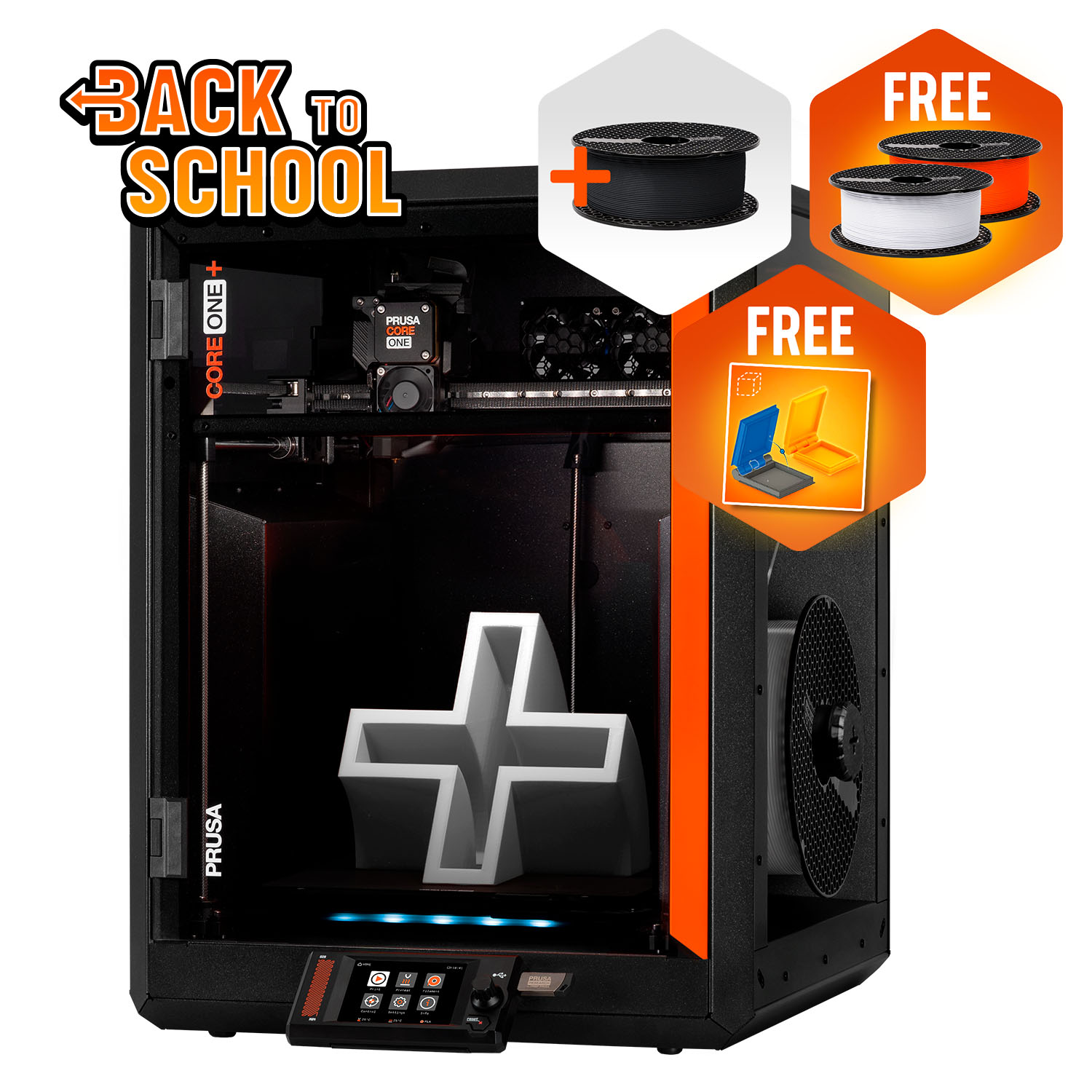
Prusa CORE One+ (Gen 2)
CORE One+ (Gen 2), assembled
Import charges at the door and a UK warranty a year shorter than the EU one, offset by a strong support reputation.
- Build volume
- 250 × 220 × 270 mm
- Technology
- FDM
- Max speed
- Not stated on manufacturer product page - Unverified
- Enclosed
- Yes (fully enclosed CoreXY; active chamber heating up to 55 °C)
- Multi-colour
- Optional (MMU3 5-filament unit or INDX tool-changer up to 8 tools, sold separately)
- Auto levelling
- Yes (fully automatic load-cell first-layer calibration)
Orders go direct from the Czech Republic, with UK VAT, duty and a courier fee collected before delivery on larger orders . The warranty is the other asymmetry: one year for UK buyers, where the two-year term applies to EU/EEA consumers only . That reads like a case against the route, and then the support record cuts the other way. Owners on UK review sites frequently describe Prusa's support as fast and knowledgeable, with the main complaints reserved for shipping-date slippage. A shorter warranty administered well can be worth more than a longer one administered badly.
Buy this if you can absorb a landed cost you will not know exactly until the courier asks, and would rather deal with a company that answers. Skip it if you need a firm total before committing, or want a UK business on the other end of the contract.
The UK-warehouse route
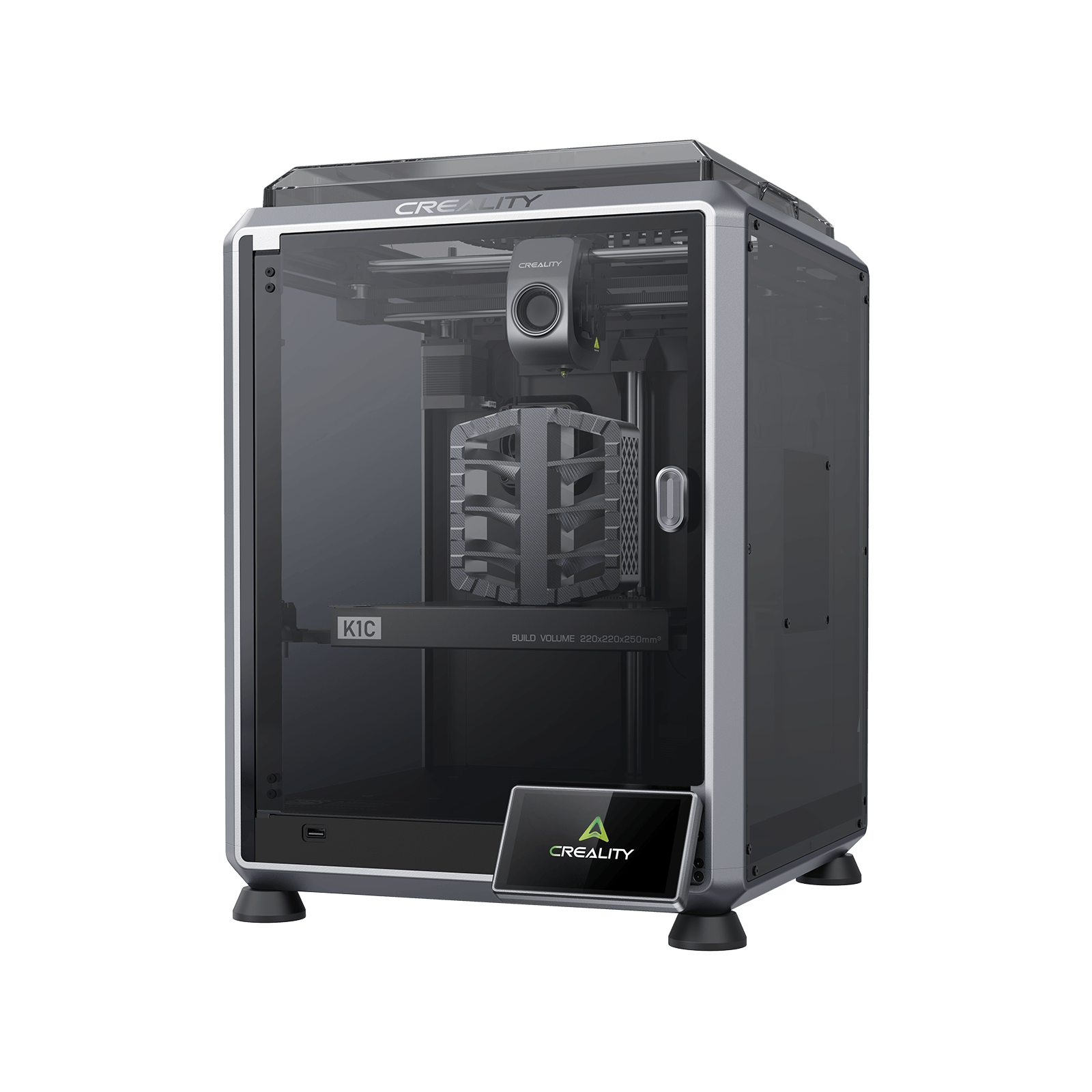
Creality K1C (2025)
K1C 3D Printer (2025 Version) - not the K1, K1 Max or K1 SE
UK stock, UK shipping and no import question — though a short delivery chain says nothing about what happens once a fault needs resolving.
- Build volume
- 220 × 220 × 250 mm
- Technology
- FDM
- Max speed
- 600 mm/s (CoreXY, 20,000 mm/s² acceleration)
- Enclosed
- Yes (die-cast aluminium unibody, tinted glass sides, acrylic lid)
- Multi-colour
- Optional (Creality CFS-C multi-colour kit sold separately)
- Auto levelling
- Yes (hands-free automatic levelling)
The K1C (2025 version) was in stock in the UK from Creality's own UK warehouse when checked, and from at least one independent UK specialist alongside it . That renders the import section irrelevant: VAT is in the price, duty does not arise, and a return goes to a UK address. And this route cuts the other way too. Creality's own support is the dominant complaint on UK review sites, described as slow to respond and slow to resolve faults, with experiences of the machines themselves sharply split. Which argues for the third route rather than the second: buy the same machine from an independent UK specialist and your contract is with a business that has a reason to keep you.
Buy this if you want delivery and returns simple and local. Skip it if after-sales responsiveness is your main worry — in which case buy the machine, but buy it from a specialist rather than from the brand.
Four things buyers get wrong about where to buy
"Buying from abroad voids your consumer rights." Repeated confidently across the web, and not what the law says. The duty to refund falls on the trader you bought from , and a trader's obligations do not evaporate because the trader is in another country. What changes is enforceability: a claim against a business outside the UK is slower, harder and sometimes not worth pursuing. That is a real reason to prefer a UK seller, but a different one from that usually given — and confusing the two convinces people they have no rights, when what they have is rights that are expensive to use.
"The manufacturer's warranty is my protection." It is additional protection. The 30-day right to reject and the six-month presumption run against the seller whatever the warranty document says. If a seller tells you your only recourse is a ticket with the brand, that is a customer-service preference, not a statement of your position.
"On a marketplace, the marketplace is the seller." Sometimes, and often not. Because the duty runs against whoever sold to you , a listing naming a third-party trader puts that trader on the other side of your contract, whatever platform protections sit above. Those protections are useful, but they are commercial policy, which can change, over a statutory floor, which cannot.
"The cheapest listing is the cheapest printer." Only if the comparison is like for like, and across routes it rarely is. Duty above £135 , VAT charged on the freight and the duty as well as the machine , a carrier handling charge, then consumables at roughly £14 to £18 a kilogram for ordinary PLA . The gap that looked decisive at the till often closes inside the first year.
Where this leaves you
Four questions, in this order, settle the route for any machine you have already chosen. Who would I be contracting with — the platform, a third-party seller, a specialist or the manufacturer? Is it in UK stock now, or is the only live listing abroad? What is the landed total once tax, duty, freight and the carrier's handling charge are in? And if it fails in month seven, where does it go back to, and who pays the postage?
Answer those and the route picks itself: usually a UK seller for a first machine, occasionally a direct order for something no UK channel carries. There is no single best shop, which is why this guide has not crowned one.
The other half of the decision is the machine. If you have not settled on a model, the ranking of the best 3d printer uk options covers filament and resin together; if budget is doing most of the deciding, start with the best budget 3d printer uk shortlist. Read either before committing to a route, because the availability of the model you land on is the thing most likely to choose the route for you.
How this article was researched
No first-hand testing, measurement or photography was involved, and no machine here has been bought through any of the routes described. Every figure cites a claim verified against a primary source — UK legislation, GOV.UK guidance, a manufacturer's own ordering or warranty page, or an authorised UK retailer listing for availability — and recorded in the site's claim ledger. Prices are bands, because live figures go stale within days. Statements about what buyers experience come from recurring patterns in manufacturer forums and UK review sites, are labelled as such, and are never presented as verified specification.
Two things were checked and left out rather than approximated. Three regulations of the Plugs and Sockets etc. (Safety) Regulations 1994 were read for a clean statement that equipment supplied here must carry a BS 1363 plug; none says so plainly enough to cite, so the plug question is not covered. And Bambu Lab's warranty page returns an error to automated requests, so this guide reports only what that policy is corroborated as stating and does not say where the UK sits within it.
Retailers and manufacturer stores are named above where naming them is the honest answer, but this article links to neither — outbound links go only to the legislation and guidance behind the claims.
Common questions
- What should UK buyers know about where to buy a 3d printer in the uk?
- That the route decides who is obliged to help you, and that this is not the same as who made the machine. Under the Consumer Rights Act 2015 the duty to refund sits with the trader you contracted with, so a third-party marketplace seller, a UK specialist and an overseas factory shop leave you in three quite different positions when a fault appears. The second thing is that an advertised price and a landed price diverge sharply once a parcel crosses the border, because duty applies above £135, VAT above that threshold is charged on the freight and the duty as well as the goods, and the carrier adds its own charge for collecting it. The third is that stock is perishable enough to make the question moot: a model can be effectively unbuyable in the UK months before anyone formally discontinues it.
- Which factors change the answer for FDM and resin users?
- Less than you might expect, and it is worth saying so rather than inventing a distinction. The statutory position, the import arithmetic and the seller-identity question are identical whichever technology you are buying, because they are properties of the transaction rather than of the machine. Two practical differences are real. Resin printers arrive with a longer tail of consumables — release film, and eventually a screen — so the question of whether your seller stocks spares in the UK carries more weight over three years than it does for a filament machine. And resin machines are more often bought from brands whose UK presence is a storefront rather than a warehouse, which makes it worth checking where a return would physically go before ordering rather than afterwards.
- What practical checklist should a buyer follow?
- Four questions, in order. Who would I be contracting with — the platform, a third-party seller, an independent specialist or the manufacturer? Is the model in UK stock right now, or is the only live listing abroad? What is the landed total once tax, duty, freight and the carrier handling charge are included, rather than the headline figure? And if it fails in month seven, where does the machine physically go back to, and who pays that postage? Answer all four before you enter a card number. For a first machine the answers usually favour a UK seller; for something no UK channel carries, a direct order is reasonable provided the first question has been answered honestly.