3D Printer Running Costs in the UK
What a 3D printer costs to run in the UK — electricity, filament, resin and the wear parts the calculators leave out, worked at current tariffs.
The short answer
Running a desktop 3D printer in the UK costs roughly 1p to 5p an hour in electricity — up to about 13p on an enclosed machine running a high-temperature material — and between about 15p and £1 an hour in material. Everything else — the parts that wear out — adds up to somewhere between a few pounds and a few tens of pounds a year, depending entirely on whether you chose filament or resin.
3D printer running costs in the UK are misnamed by the question people usually ask, which is about the electricity. Take a machine whose manufacturer rates it at 350 W and also publishes an on-mode consumption of 60 W . At the roughly 26p per kWh set by the Ofgem price cap , the second figure is about one and a half pence an hour. The first would be nearly six times that, and it is not what the machine draws.
Meanwhile the plastic going through it runs roughly £14 to £18 a kilogram . That is the bill. The cost to run a 3D printer is a materials cost wearing an electricity costume.
The three lines a running cost is made of
Every honest answer is the same three numbers added together. Electricity, charged per unit consumed. Material, charged per kilogram and consumed per gram. Wear parts, bought occasionally and therefore easy to forget, which is why they are usually the surprise rather than the largest sum.
One thing belongs to none of the three, and it is where the 3D printer electricity cost UK question most often goes wrong. A domestic bill has two halves: a unit rate for what you use, and a standing charge for being connected at all. Under the current price cap that standing charge is about 55p a day , and a 3D printer does not change it by a penny — you owe it with the machine unplugged and in its box. Only the unit rate, around 26p per kWh , responds to anything you print.
So when a guide quotes an alarming annual electricity figure, check whether a fixed cost has quietly been folded in.
What a 3D printer actually draws
The number on the back of the machine is a ceiling, not a consumption figure: it says what the power supply is built to deliver at its worst moment, every heater on and nothing settled. Treating it as a running figure inflates the answer several times over, and a 3D printer's total cost per hour is built on this one number.
The clearest proof comes from one manufacturer publishing both. The Creality Ender-3 V3 KE is rated at 350 W ; the same manual gives an on-mode consumption of 60.0 W . Same machine, same document, a factor of nearly six.
Where makers publish a printing figure, the numbers cluster low. Prusa states 80 W on PLA settings and 120 W on ABS for the MK4S, against a 240 W supply . Bambu Lab gives the P2S a 200 W steady state on PLA against a 1,200 W maximum at 220 V . QIDI publishes both halves for the Plus5: a rated 150 W plus 550 W of chamber heating and a 500 W bed, settling to 190 W on PLA at 25 °C ambient .
Two patterns fall out. An open machine printing PLA settles under 100 W. An enclosed one on a high-temperature material can genuinely sit near 500 W — that is the Plus5's own ABS figure — which makes it a materials choice, not a machine choice.
Where only a ceiling exists, resist it: Bambu Lab rates the A1 at a maximum 1,300 W at 220 V , which does not describe a printing machine.
Resin is the quiet case: Anycubic gives the Photon Mono 4 a 54 W supply , and ELEGOO's Mars 5 manual a 24 V, 3 A one . There is no heated bed to feed.
A recurring response among owners asking this question is to measure it with a plug-in energy monitor rather than work from the rating plate, because tariff, material and idle time move the answer more than the model does. A socket meter costs less than a reel of filament.
Working out your own cost per hour
Three multiplications, and you never need a calculator site again.
Electricity. Take the printing wattage — not the rating plate — and divide by a thousand to get kilowatts. Multiply by the hours the job runs. Multiply by your unit rate; the price cap average is around 26p per kWh , though your tariff is the number that counts. A machine settling at 60 W over a ten-hour print consumes 0.6 kWh, which is about 16p.
Filament. Your slicer already reports the grams. Divide the spool price by a thousand for a cost per gram, then multiply. At roughly £14 to £18 a kilogram , filament cost per print lands between about 1.4p and 1.8p for every gram on the plate. A part using 120 g is therefore somewhere near £2, and the electricity that produced it is loose change by comparison.
Resin. One extra step, and it is where people slip. Resin slicers report millilitres; UK resin is sold by the kilogram . ELEGOO's own slicer assumes a density of 1.15 g per millilitre , so a kilogram is roughly 870 ml rather than a litre. Convert first, then price — and treat that density as a working default, since it varies by resin type.
Add the three. That is the easy part; the rest is what gets forgotten.
A filament machine, costed for a year
Numbers mean more attached to a machine. This one is not a recommendation; it earns its place because Creality publishes both a rating and a real consumption figure, so the arithmetic can be checked.
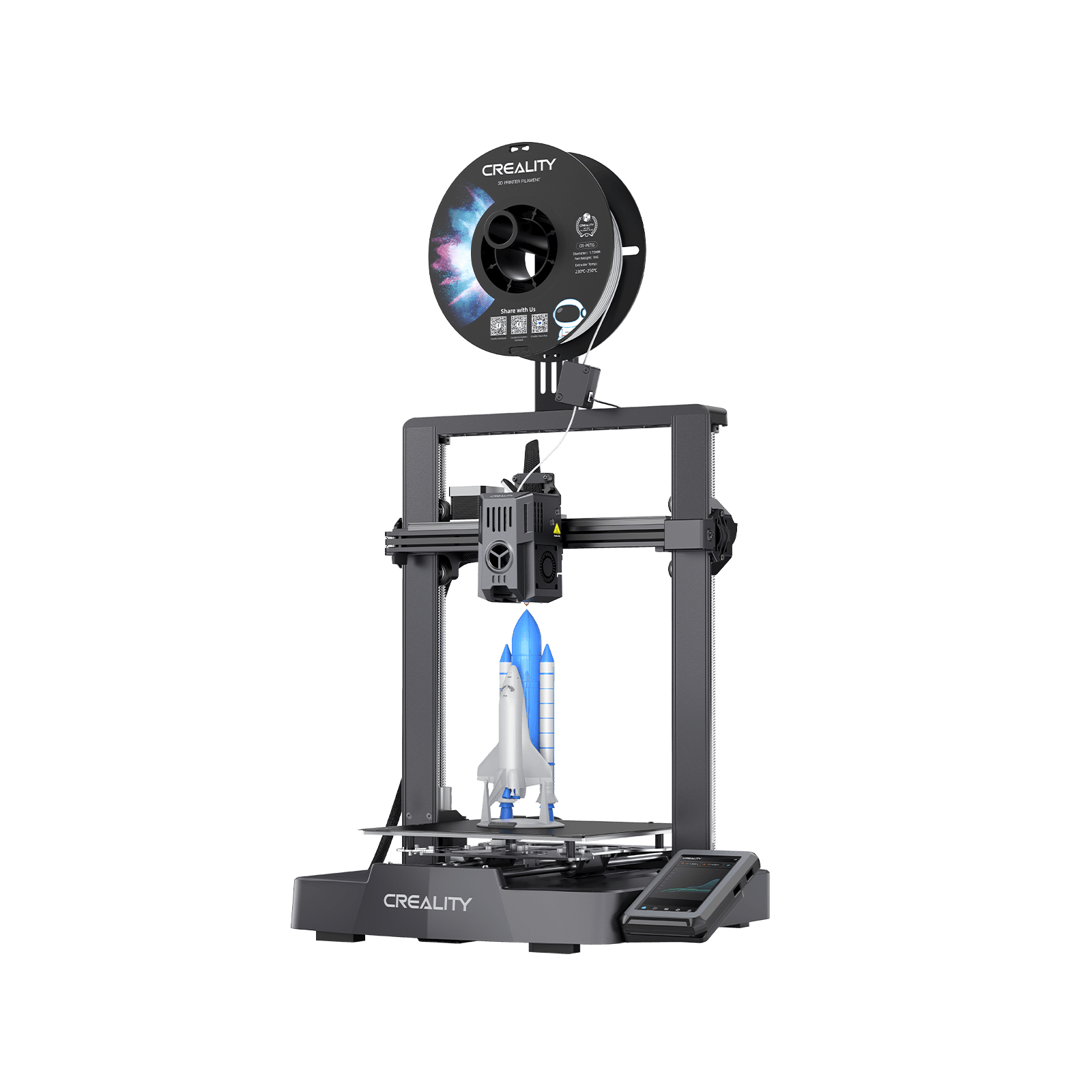
Creality Ender-3 V3 KE
Ender-3 V3 KE - not the Ender-3 V3, V3 SE, V3 Plus or V4
A worked example rather than a pick: its maker publishes an on-mode figure alongside the rating plate, which is the pair of numbers this subject turns on.
- Build volume
- 220 × 220 × 240 mm
- Technology
- FDM
- Max speed
- 500 mm/s (≤8,000 mm/s² acceleration)
- Enclosed
- No
- Multi-colour
- No
- Auto levelling
- Yes (hands-free auto levelling)
The assumptions, on the table: five hours of printing a week, so about 250 hours a year; the price cap unit rate; ordinary PLA.
Electricity: under £4 for the year. At an on-mode 60 W , 250 hours consumes 15 kWh, which at around 26p a unit is comfortably under £4. Run the same sum on the 350 W rating plate and you would budget over £22, for electricity the machine never uses.
Filament: between about £56 and £72. Four kilograms a year is an unremarkable hobby pace, and ordinary PLA runs roughly £14 to £18 a kilogram . That is well over ten times the electricity, and the only line that scales with how much you enjoy the machine.
Wear parts: probably a nozzle. The 0.4 mm brass nozzle it ships with wears slowly on PLA and quickly on anything filled with carbon or glass. A spare kit is under £10 from Creality's UK store, the whole quick-swap hot end about £33 to £40 . Most first years need neither.
Roughly £60 to £85 all in, then, of which electricity is about a twentieth. The spread comes from owner accounts on manufacturer forums rather than from this machine in particular: Owner accounts of what a printer costs to keep diverge widely — some describe more than a thousand hours with nothing bought beyond material, others a cluster of replacement parts after the warranty ran out — but a recurring point of agreement is that filament lost to failed prints costs more than the electricity does.
A resin machine, costed for a year
Resin printing running cost works out differently, and not as most people guess. The electricity is smaller, everything else larger, and one line has no published interval at all.
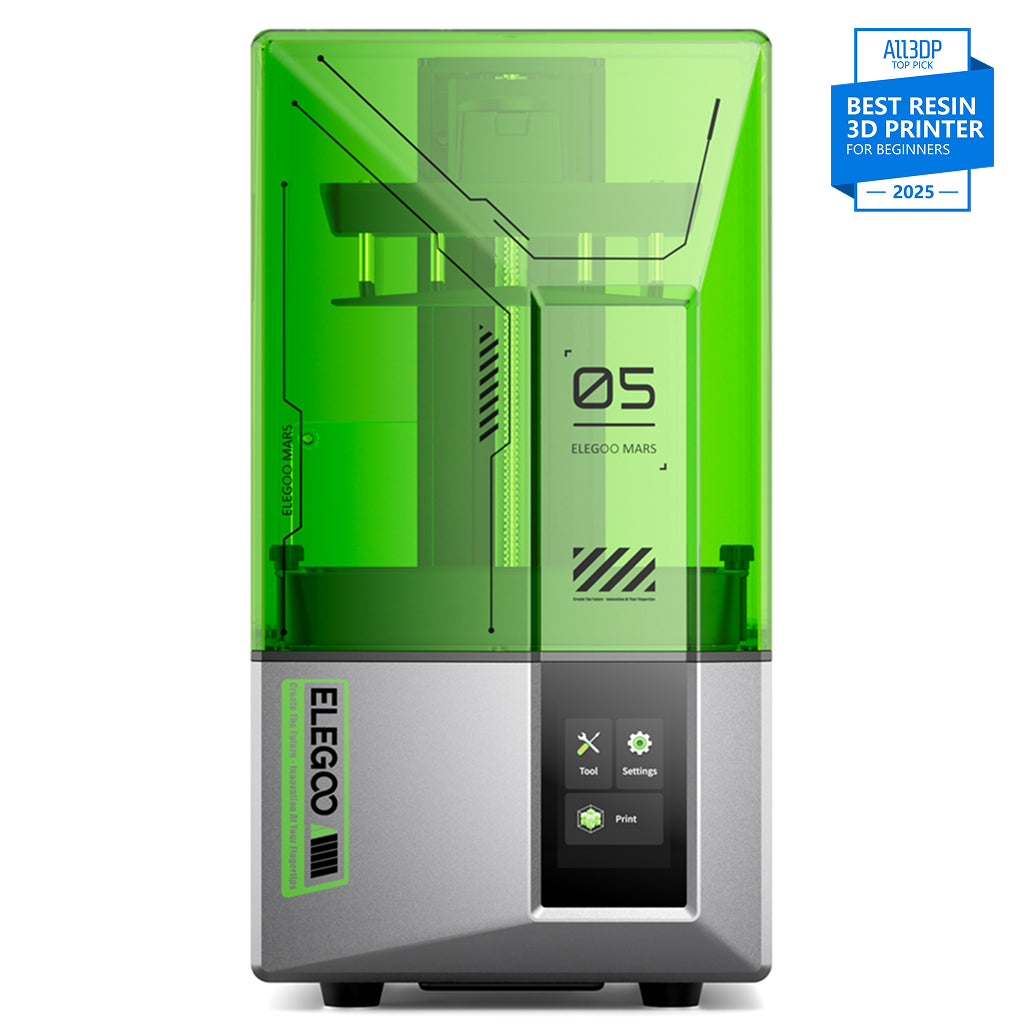
ELEGOO Mars 5
Mars 5 (4K, 6.6-inch - not the Mars 5 Ultra)
Used here because ELEGOO publishes UK prices for every part it consumes, and its own manual names the two that wear out.
- Build volume
- 143.43 × 89.6 × 150 mm
- Technology
- Resin (MSLA)
- Max speed
- Up to 70 mm/h
- Enclosed
- Hinged cover (no filtration; compatible with the Mars Mate air purifier)
- Auto levelling
- Yes (one-click automatic levelling)
Electricity is almost an irrelevance. With a 24 V, 3 A supply , 72 W is the ceiling for the whole machine — and even at that ceiling for all 250 hours, the year costs under £5 .
Resin is the middle line, between about £16 and £28 a kilogram for common types — comparable with filament by weight, and resin prints are usually small.
The wear parts are the difference. ELEGOO's own manual calls the release film a wearing part and tells owners to replace the screen once its service life starts to show in print quality . The film is minor money — a five-pack is around the £27 mark, a little over £5 a sheet . The screen is not: a replacement Mars 5 panel sits around the £55 mark , and it scales with the machine — between about £112 and £129 for the Saturn 4 Ultra 16K .
Note what is missing: nobody publishes how long the screen lasts. What ELEGOO does disclose is a warranty of twelve months on the machine, three on the screen and six on the tank and plate — a parts list with the wear order on it.
Then the alcohol line, which is a UK problem. The manual requires washing in 95% or stronger alcohol unless water-washable resin is used , and buying it here is awkward: one large UK 3D-printing retailer lists 99.9% isopropyl alcohol but states that delivery to Great Britain is not possible . No UK price could be verified, so the line is left unpriced rather than guessed.
Disposal closes the list. Uncured resin is not drain waste: the safety instructions require curing it under ultraviolet light first .
| Specification | Creality Ender-3 V3 KE | ELEGOO Mars 5 |
|---|---|---|
| What the maker publishes about power | An on-mode figure as well as a rating | A supply rating only — a ceiling, not a printing draw |
| How material is sold and measured | By the kilogram; the slicer reports grams | By the kilogram; the slicer reports millilitres |
| The scheduled wear part | None — the nozzle goes when it goes | Release film, on a schedule the maker sets |
| The expensive replacement | The hot end, and rarely | The screen, and eventually — interval not published |
| Waste handling | Offcuts and supports go in the bin | Uncured resin must be cured before disposal |
The wash-and-cure station belongs to the purchase, not to this page — around the £79 to £113 mark , bought once. Reviewers repeatedly frame resin, release film, alcohol and an eventual screen as an annual cost rather than a one-off, and warn that the printer price understates a year of printing. That is recorded against ELEGOO's Saturn range rather than the Mars 5, but the parts are the same parts.
What the calculators leave out
Every cost calculator assumes the print works. That assumption is doing a lot of quiet work.
Failed prints are the running cost owners actually talk about. A job that detaches at hour nine has consumed the electricity, the material and the time, and produced a lump. On resin the loss is explicit in the instructions: after a failure you are told to clean the cured resin out of the tank and change the resin . That is material written off by instruction, not by carelessness — which also means hardware that prevents failures pays for itself in consumables. Owners and reviewers repeatedly credit the tilting vat and automatic levelling with fewer failed prints than earlier Saturn models. That pattern is recorded against ELEGOO's larger Saturn range, not the machine above.
Multi-colour printing buys filament in order to throw it away. Every colour change purges the nozzle, and the purged material is waste by design rather than by fault. Owners repeatedly note that multicolour printing with the AMS lite generates significant purge waste, which slicer settings can reduce but not remove. On a four-colour job the purge can rival the model for weight, which at PLA prices is a real line rather than a rounding error.
Four things people still get wrong
Budgeting from the rating plate. The commonest error, and the most expensive in worry: a 350 W rating and a 60 W on-mode figure describe the same printer, and only one is a cost.
Assuming the machine is the variable. Usually it is the material: QIDI's Plus5 settles near 500 W on ABS and near 190 W on PLA . Choosing PLA saves more than choosing a different printer.
Forgetting idle time. A machine left powered for a week between prints is drawing something for all of it, and switching it off costs nothing.
Assuming a cheaper machine is cheaper to run. It can be the reverse. A budget resin printer has a screen that is a consumable, at around the £55 mark to replace , while a filament machine at a similar price may go a year on a nozzle costing under £10 . The purchase price told you nothing about either.
What this means when you are choosing a printer
Very little, which is the useful finding. Running cost is not a tie-breaker between two filament machines: they sit within a few pounds a year of each other, and the difference is swamped by how much you print. Buy the one that fails less often and you have saved more than any wattage comparison could.
Where it does change a decision is across the filament-and-resin line, in one direction only. Resin's consumables are structural — a film replaced on a schedule, a screen replaced eventually — so if the appeal of resin is that the machines look cheap, running cost is the argument against. If the appeal is detail a nozzle cannot reach, nothing here should put you off; keep a screen's worth of budget in reserve.
Three places to take this next. If budget is the constraint, the best budget 3d printer uk shortlist weighs both technologies in one bracket. If you have settled on filament, the best FDM 3D printers roundup covers the range worth looking at. If detail is what you want, the best resin printers roundup does the same on that side.
How this article was researched
This guide is research-based. No machine here was bought, tested, measured or photographed by us, and no figure on the page is offered as something we observed.
Every wattage, price and material figure comes from a manufacturer specification, an official manual, the energy regulator or an authorised UK retailer listing, each recorded with the date it was checked. Where a manufacturer publishes only a power-supply rating, the page treats it as a ceiling rather than a cost. Prices are given as bands because exact figures go stale within weeks; rates were last checked on 19 September 2026.
Three things could not be verified and are absent rather than estimated: a UK retail price for isopropyl alcohol, a published service life for any resin LCD screen, and a steady-state printing wattage for the resin machine above.
Owner-experience passages are marked and summarise recurring patterns across manufacturer forums, long-term reviews and retailer Q&A — never quotations, never a rating. Where a pattern is recorded against a sibling model, the page says so.
Common questions
- What should UK buyers know about 3d printer running costs in the uk?
- Three things, and only one of them is about electricity. First, the number on the back of the machine is a power-supply ceiling, not a consumption figure: one manufacturer publishes a 350 W rating and a 60 W on-mode figure for the same printer, and budgeting from the wrong one inflates the answer nearly sixfold. Second, the standing charge on a UK electricity bill — around 55p a day under the current price cap — is owed whether or not anything is plugged in, so it is not a running cost of the printer; only the unit rate responds to what you print. Third, the line that actually adds up is material, at roughly £14 to £18 a kilogram for ordinary PLA, which on a normal hobby year comes to fifteen or twenty times the electricity.
- Which factors change the answer for FDM and resin users?
- Which parts are consumed, and whether the manufacturer will tell you how fast. A filament machine consumes plastic and, slowly, a nozzle — a spare kit is under £10 and many first years need neither. A resin machine consumes resin, release film on a schedule its own manual describes, and eventually the LCD screen behind the film, which is around the £55 mark on a small machine and between about £112 and £129 on a larger one. No manufacturer publishes how long that screen lasts, so the cost is certain and the interval is not. Resin also carries an alcohol line the manual requires unless you use water-washable resin, and a disposal obligation: uncured resin must be cured under UV before it is thrown away rather than washed down a drain.
- What practical checklist should a buyer follow?
- Five steps. One, find the printing wattage rather than the rating — check the manual for an on-mode or steady-state figure, and if only a supply rating exists, treat it as a ceiling and measure the real draw with a plug-in energy monitor. Two, do the three multiplications: watts divided by a thousand, times hours, times your unit rate. Three, price the material from the slicer's own estimate, converting millilitres to grams first if you print resin, because UK resin is sold by the kilogram. Four, list the parts that wear and find their UK replacement prices before you buy, not after — on resin that means the film and the screen. Five, ignore running cost when choosing between two similar machines and spend the attention on which one fails less, because wasted material costs more than watts.