Bambu Lab A1 Review
A UK review of the Bambu Lab A1: what Bambu Lab says about the newer A2L, what it will not print, what it costs to run here, and where it falls short.
Independent and reader-funded. We earn a commission if you buy through our links, at no extra cost to you. How this works.
This Bambu Lab A1 review covers one exact machine: the standard A1, bought on its own without the AMS lite multi-colour unit. The A1 Combo is a different purchase at a different price, and the two get written about as one printer. What you get is an open-frame FDM design — the plate shuttles back and forth beneath a fixed gantry, with no enclosure — a 256 × 256 × 256 mm build volume, and a deliberately short materials list: PLA, PETG, TPU and PVA are the four Bambu Lab calls ideal, while ABS, ASA, polycarbonate and anything fibre-filled are not recommended. It was in stock at an authorised UK retailer at just under the £240 mark when this page was last checked.
What follows is the part a product page leaves out: whether the machine has quietly been replaced, what that build volume really gives you, and where a UK buyer stands when it fails. Still choosing between filament machines? The best FDM 3d printer uk guide ranks it against six rivals.
Has the A1 been replaced by the A2L?
No — and it is worth settling first. Bambu Lab began shipping the much larger A2L in June 2026, and the obvious reading was that the A1's turn was over. Bambu Lab's own launch post rules that out in three short sentences: the A2L is "Not a successor. Not a replacement. A new addition to the portfolio."
One specification cuts against the newer machine. The A2L's plate is rated to 80 °C, where the A1's reaches 100 °C. Bed temperature decides whether a material stays stuck down for a whole print, so on that measure the older, cheaper printer is the more capable. The A2L buys floor area, not a broader materials list — and it was listed at a UK retailer around the £350 to £360 mark, roughly £120 above the A1.
So if you need a plate bigger than 256 × 256 × 256 mm, look at the A2L. If not, the A1 is no discounted leftover: it is the current 256 mm-class A-series printer, still stocked alongside its bigger sibling. One caveat — Bambu Lab's product pages return an error to automated requests, so nothing beyond the figures above is claimed for the A2L.
The specification, and what each number changes
Start with the frame. The A1 is a bedslinger: the toolhead travels left to right and upwards while the plate carries the model back and forth beneath it, with no enclosure. The rival layout, CoreXY, bolts both motors to the frame so the only thing accelerated is the toolhead. A moving plate means a moving model, which is the A1's one structural compromise.
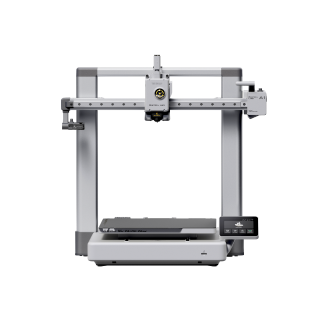
Bambu Lab A1
A1 (standard, without AMS lite)
A fast, self-calibrating open-frame printer that does PLA and PETG extremely well for the money, and does not pretend to do anything else. The compromises are the moving plate and the missing enclosure.
- Build volume
- 256 × 256 × 256 mm
- Technology
- FDM
- Max speed
- 500 mm/s toolhead (10,000 mm/s² acceleration)
- Enclosed
- No
- Multi-colour
- Optional (AMS lite sold separately; up to 4 spools)
- Auto levelling
- Yes (fully automatic)
What we like
- A full 256 mm cube and fully automatic calibration for just under the £240 mark
- Bambu Lab confirms in writing that the newer A2L is an addition to the range, not a replacement
- A 100 °C plate — hotter than both the A1 mini and the larger, dearer A2L
- Filament odometry, run-out and tangle sensing all fitted as standard
- Multi-colour can be added later, and long-term owner reports describe it as low-maintenance
What we don’t
- ABS, ASA, polycarbonate, nylon and fibre-filled filament are all outside what Bambu Lab recommends
- Default printable height is 250 mm, and an 18 × 28 mm corner of the bed is excluded
- No acoustic rating is published anywhere in the specification sheet
- A moving plate — the compromise that can show on tall, narrow models
- Spares and support route through one company, and warranty response draws recurring complaints
Build volume is where the advertised number and the useful one part company. The plate measures 256 × 256 × 256 mm. But Bambu Lab's own documentation sets the default printable height at 250 mm and excludes an 18 × 28 mm patch at the front-left corner to protect the filament cutter's stopper; reaching the full cube means modifying the machine, which Bambu Lab recommends only where the whole volume is mandatory. Six millimetres is nothing, until your model is 254 mm tall.
On speed, Bambu Lab rates the toolhead at 500 mm/s with acceleration to 10,000 mm/s². Both are ceilings, and a detailed model will never see either. The figure that predicts real pace is flow: a maximum of 28 mm³/s on Bambu Lab's own test, which sets how fast plastic goes down once the machine has stopped accelerating.
Neither the 300 °C nozzle nor the 100 °C plate is the limiting factor here, which is worth noticing: what holds the A1 back is the open frame, not the heaters. Filament run-out and tangle sensing are built in.
Setup, and what the first month asks of you
Bed levelling is fully automatic, which is most of why this machine gets recommended to people who have never printed anything: it removes the fortnight otherwise spent learning to read a first layer. Long-term owner reports on the Bambu Lab forum repeatedly describe the A1 as reliable and low-maintenance, particularly compared with older budget printers they have moved from.
It does not remove what sits above that — orientation, supports, material choice. Those are printing skills.
Bambu Lab A1 print quality, and what it will actually run
No first-hand printing was carried out for this article; what follows describes the design and reported experience, not a measurement taken here.
The useful finding on quality is comparative, and it flatters the A1. Owners who have used both families repeatedly describe the print quality as hard to tell apart on ordinary filament, with the differences they do notice usually traced to calibration or settings, although this is not consistent across all reports. The open frame is not costing you surface finish on a PLA model; it is costing you materials.
That boundary is the real decision. Bambu Lab lists PLA, PETG, TPU and PVA as ideal and does not recommend ABS, ASA, polycarbonate, nylon or fibre-filled filament. It is not a temperature problem — the nozzle reaches 300 °C. It is warping: materials that shrink as they cool need still, warm air around them, and an open frame cannot supply it.
What remains is broad enough for most people. One manufacturer's material guide puts PLA's softening point above 60 °C and rules it out for outdoor use; PETG answers most of that, rated for most exterior use below 80 °C. Household parts, toys, organisers and prototypes sit inside that line. A bracket for an engine bay does not.
Multi-colour: the AMS lite, and whether to buy the Combo
Multi-colour is not included with the standard A1. It arrives by adding the AMS lite, which feeds up to four spools, and four is the ceiling — one unit per machine, and it will not fit a P1 series printer later.
The buying decision is arithmetic, and most people get it the wrong way round. The A1 Combo bundles the printer with the four-spool AMS lite at around £340 to £430 in the UK, against just under £240 for the printer alone. Bought separately afterwards, an AMS lite runs to about £175 to £250. The bundle is much the cheaper route: if there is any chance you will want colour, buy it at the start.
What deserves scepticism is how much you will use it. Owner reports repeatedly mention that colour changes add far more time than expected, with a single change taking the better part of a minute and heavily multi-coloured models running for hours longer than their single-colour equivalents. Plate area goes too: Bambu Lab generates a prime tower on the build plate itself for multi-colour jobs, so it shares the volume with your model.
Buy the Combo if colour is part of why you want a printer at all. Buy the printer alone if you mostly make functional parts in one colour — the money goes further as filament.
What owners consistently report
The basis here is patterns that repeat across threads on Bambu Lab's own community forum and long-term written accounts, researched rather than experienced first hand. No customer review is quoted and no rating reproduced.
The 2024 recall is closed, and it was narrow. In June 2024 the US Consumer Product Safety Commission recalled about 12,800 A1 printers over a heatbed cable that could short-circuit and spark or burn through its insulation if bent or damaged, posing electric shock and fire hazards, with affected units identified by the sixth character of the serial number. The scope is what matters now: those units were sold in a window ending January 2024. Bambu Lab put the malfunction rate at under 0.1% but recalled every A1 sold to that point anyway, because it could not tell which cables had been bent, and said printers with the revised cable would follow from around May 2024. Early A1 units were recalled in 2024 for a heatbed cable issue; owner reports from that period describe slow communication, and units sold since ship with a revised bed. A machine bought new today is not in scope.
A second electrical matter is not settled, and needs describing carefully. Owner discussion on Bambu Lab's own forum returns repeatedly to a power-board component overheating and heat-damaging the plastic around it on some A1s, usually after long service, with owners who reported it describing a replacement board from Bambu Lab; the thread is disputed rather than settled, participants disagree about how widespread it is, and unlike the 2024 cable fault it has not been the subject of a published recall notice. Bambu Lab issued a statement on it in January 2026, but that statement sits only inside the forum thread and could not be retrieved from a primary source, so the figures circulating for it are not repeated here. Note two things: this is separate from the 2024 recall, and what owners document is heat damage to plastic rather than anything worse.
Support is the brand-level risk. A recurring theme among Bambu Lab buyers on UK review sites and the manufacturer's forum is slow warranty support, although delivery and packaging are frequently praised.
Noise, space and air quality in a UK home
The footprint is the constraint people discover after ordering. The machine occupies 385 × 410 × 430 mm, and the depth catches people out: a standard shelf is often shallower than that. At 8.3 kg it lifts with one hand, but a machine with a plate shuttling back and forth wants a solid, heavy surface under it.
On noise, a figure circulates and this page will not repeat it: Bambu Lab's A1 specification sheet states no acoustic rating, and the decibel number in retail listings could not be confirmed against a manufacturer page, so quoting it would dress marketing up as a measurement. What can be said is that owners disagree. Owner opinion on A1 noise is mixed: some who also own an A1 mini find the larger machine noticeably louder, while others consider it quieter than Bambu Lab's enclosed printers.
Air quality is the part most reviews skip, and the open frame cuts both ways. The Health and Safety Executive has published research on emissions from desktop filament printers, and peer-reviewed measurements show the particles are ultrafine, with ABS producing the highest peak concentration of those tested; the same work puts a plain enclosure well below ducting the exhaust outdoors. The A1 has no enclosure at all — but nor is it cleared for ABS, so the worst-behaved material there is one you would not be running. PLA and PETG in a room you can open a window in is reasonable; a sealed cupboard is not.
What a Bambu Lab A1 costs to run in the UK
Bambu Lab rates the A1 at a maximum of 1,300 W at 220 V. That is the peak while bed and hot end climb from cold, not what it draws for the next six hours, and no steady-state figure is published for the A1. For its closest comparable it publishes 200 W while printing PLA, against a 1,200 W peak. That machine is enclosed and this one is not, so 100 W to 200 W mid-print is an assumption, not a manufacturer figure — what follows is an estimate.
At around 26p per kWh under the Ofgem price cap, that is roughly 2.6p to 5.2p an hour, so thirty hours of printing a month lands around 80p to £1.60. For scale, the standing charge on a UK electricity bill is about 55p a day whether or not anything is plugged in — next to that the printer is a rounding error.
Filament is the number that moves. Ordinary PLA runs roughly £14 to £18 a kilogram from a UK retailer, and PETG and specialist materials cost more, so one spool outweighs several months of electricity. That reframes the Bambu Lab A1 price in the UK question: the machine is a one-off at just under £240, or between about £240 and £320 depending on retailer, and after that your spending is essentially plastic.
UK warranty, spare parts and availability
Buying a Bambu Lab A1 in the UK is straightforward: it is sold through Bambu Lab's own UK store and authorised UK resellers, and was listed in stock for UK delivery when this page was last checked. One cost hides in the delivery line: an authorised UK stockist adds a bulky-goods surcharge of £30 per item on top of its usual free-delivery threshold, roughly a tenth of the machine again.
Bambu Lab's UK warranty policy states two years from the warranty start date. But the UK statutory position matters more, and no manufacturer page will tell you it: your contract is with the retailer, not with Bambu Lab. The Consumer Rights Act 2015 gives a short-term right to reject faulty goods for 30 days after delivery, and for the first six months the law assumes a fault was there from the start, so it is not for you to prove it. The duty to refund falls on the trader you bought from, not the manufacturer. In practice: if a new A1 misbehaves in its first month, go to the shop rather than the support portal.
Where the A1 falls short
Three real limitations — the Bambu Lab A1 pros and cons question, answered from the cons side.
The materials list is short, and the open frame is why. ABS, ASA, polycarbonate, nylon and anything fibre-filled sit outside what Bambu Lab recommends, and with no enclosure that is a design boundary, not a tuning problem.
The plate moves, and no noise figure is published. A bedslinger accelerates the model, where CoreXY accelerates only the toolhead. The moving plate matters only on tall, narrow models; the missing figure leaves you guessing whether it can share a room.
Spares and support run through one company — a trade rather than a fault, but it means you cannot route around Bambu Lab.
Bambu Lab A1 alternatives: the mini below it, the P1S above
The A1's real competition is not another brand. Bambu Lab sells a cheaper machine that does almost the same job and a dearer one that does more.
| Specification | 1 Bambu Lab A1 The machine reviewed | 2 Bambu Lab A1 mini Spend less | 3 Bambu Lab P1S Print more materials |
|---|---|---|---|
| Best for | PLA and PETG at speed | Small parts, small desks | ABS, ASA and enclosed work |
| Build volume | 256 × 256 × 256 mm | 180 × 180 × 180 mm | 256 × 256 × 256 mm |
| Enclosed | No | No | Yes |
| Max bed temperature | 100 °C | 80 °C | 100 °C |
| ABS and ASA | Not recommended | Not recommended | Yes |
| Max hot end flow | 28 mm³/s | — | 32 mm³/s |
| Multi-colour ceiling | Four colours | Four colours | Up to sixteen colours |
| Typical UK price | £240–£320 | £170–£270 | £330–£400 |
The mini is the one to buy if your models are small. Same ecosystem and automatic calibration, on a 180 × 180 × 180 mm plate for around £170 to £270. That plate is about 30% shorter in each direction, leaving roughly a third of the volume. Its bed also stops at 80 °C rather than 100 °C, with the same short materials list.
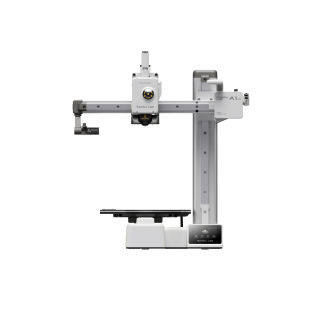
Bambu Lab A1 mini
A1 mini (standard, without AMS lite)
Nearly the same machine on a smaller plate and a cooler bed. The right call if your parts are small and your desk is smaller.
- Build volume
- 180 × 180 × 180 mm
- Technology
- FDM
- Max speed
- 500 mm/s toolhead (10 m/s² acceleration)
- Enclosed
- No
- Multi-colour
- Optional (AMS lite sold separately; up to 4 spools)
- Auto levelling
- Yes (fully automatic)
What we like
- Same ecosystem and automatic calibration for meaningfully less money
- Smaller footprint, and light enough to move off the desk between jobs
- Takes the same four-spool AMS lite for multi-colour
- The model most often suggested as a first printer
What we don’t
- A 180 mm cube leaves roughly a third of the A1's volume
- Bed stops at 80 °C rather than 100 °C
- Same short materials list — no ABS or ASA either
- Owners report the main-board fan runs constantly, including at idle
Buy the mini instead if what you make fits inside its 180 mm cube. Skip it if you can already name one thing that would not fit.
The P1S is the one to buy if the materials list is the problem. The same 256 × 256 × 256 mm cube, but enclosed in plastic and glass with a chamber temperature regulator fan, and that shell is what puts ABS and ASA on its ideal list, with nylon and polycarbonate listed as capable. Being CoreXY it also runs twice the acceleration. It asks around the £330 to £400 mark.
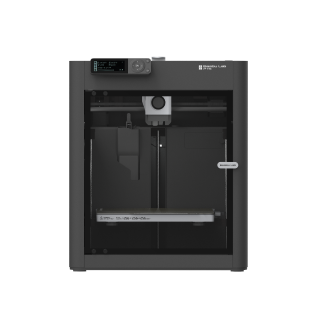
Bambu Lab P1S
P1S (standard, without AMS - not the P1P, P1S Combo or P2S)
The enclosure is the whole point: it makes ABS and ASA realistic. Louder, heavier, and it needs a room with a door you can shut.
- Build volume
- 256 × 256 × 256 mm (Bambu Studio defaults to 250 mm height)
- Technology
- FDM
- Max speed
- 500 mm/s toolhead (20 m/s² acceleration)
- Enclosed
- Yes (plastic and glass; chamber temperature regulator fan and activated-carbon filter)
- Multi-colour
- Optional (AMS or AMS 2 Pro sold separately or as a Combo)
- Auto levelling
- Yes (automatic bed levelling sensor)
What we like
- Enclosed, which is what puts ABS and ASA on the ideal materials list
- The same 256 mm cube, with twice the acceleration
- Higher hot end flow, so large parts finish sooner
- Activated-carbon filter fitted as standard
What we don’t
- Around £100 more than the A1 for a capability many buyers never use
- Noise is the most repeated owner complaint, and it comes from the fans
- The chamber is regulated rather than heated, so nylon and PC stay difficult
- Heavier, deeper, and it attracts a larger oversize delivery surcharge
Buy the P1S instead if you can name a part you want in ABS or ASA. Skip it if PLA and PETG cover your list — you would be paying for a capability you never use.
If none of the three fits, the problem is the category rather than the model: the best 3D printers UK pillar covers resin as well as filament, and the best budget 3D printers UK guide goes below the mini.
Who should buy the A1, and who should not
Whether the Bambu Lab A1 is worth it comes down to one question, and it is not about speed or price: is your materials list PLA and PETG? If it is, this is the machine, and the rest comes along free.
It is the wrong machine in four cases, each with somewhere better to go. Need ABS, ASA, polycarbonate or fibre-filled filament? Bambu Lab does not recommend them here and the P1S is the honest answer. Small parts? The mini costs less. Bigger plate? The A2L adds to the range rather than replacing this machine. And if the only place for a printer is a bedroom, buy nothing until that changes: the fix for a moving-bed machine is distance.
Nearly three years after launch the A1 is still the machine that asks least of a new owner, and Bambu Lab has confirmed in writing that the newer A2L does not replace it. The compromises are real and all knowable in advance: a short materials list, a plate that moves, no enclosure, and a usable height slightly under the advertised figure. None matters if what you print is PLA and PETG.
- Buy it if
- PLA and PETG cover what you want to make, you would rather own an appliance than a project, and you have a solid surface in a room you can ventilate.
- Skip it if
- You need ABS, ASA, polycarbonate or fibre-filled filament, your models are small enough for the mini, or the printer would have to live where someone sleeps.
How this article was researched
No first-hand testing, printing or measurement was carried out for this review. Specifications come from Bambu Lab's own A1 specification sheet and documentation, recorded claim by claim with a source URL; every figure above carries one. UK price bands and stock were checked against an authorised UK retailer on 24 September 2026 and are given as bands, never live prices. The 2024 recall comes from the US Consumer Product Safety Commission's notice and Bambu Lab's own statements. Ownership patterns are recurring themes across Bambu Lab's forum and long-term accounts — no customer review is quoted, no rating reproduced. Two things could not be verified and so are not stated: any acoustic figure for the A1, and any figure from Bambu Lab's January 2026 statement on the power-board matter. Our approach is set out in the review methodology.
Common questions
- Is the Bambu Lab A1 worth buying?
- If your materials list is PLA and PETG, yes — at just under the £240 mark it asks less of a new owner than anything else at the price, and it has not been replaced. If you need ABS, ASA, polycarbonate or fibre-filled filament, no amount of tuning gets you there and the enclosed P1S is the honest answer instead.
- Who is the Bambu Lab A1 best for?
- Someone who wants objects rather than a hobby in calibration: household parts, organisers, toys, prototypes, display pieces and tabletop terrain. It suits a first-time buyer who would rather own an appliance than a project, and anyone who has a solid surface in a room they can ventilate. It suits nobody whose only space is a bedroom.
- What are the main alternatives to the Bambu Lab A1?
- The two closest are made by the same company. The A1 mini is the step down: same ecosystem on a 180 mm cube with an 80 °C bed. The P1S is the step up: the same 256 mm cube but enclosed, which is what makes ABS and ASA realistic. The larger A2L is the option if you need more plate area rather than more materials.
- Has the Bambu Lab A1 been discontinued or replaced by the A2L?
- No. Bambu Lab's own A2L launch post says the machine is “Not a successor. Not a replacement. A new addition to the portfolio.” The A2L is a larger size class, and its plate is rated to 80 °C against the A1's 100 °C. The A1 remains stocked at UK retailers alongside it.
- Is the Bambu Lab A1 still affected by the 2024 recall?
- A machine bought new today is not in scope. The 2024 recall covered about 12,800 units sold in a window ending January 2024, identifiable by the sixth character of the serial number, over a heatbed cable that could short if bent. Bambu Lab said printers with the revised cable would follow from around May 2024.