Best Large Format 3D Printers UK
Five large-format 3D printers UK buyers can order now, from a 420 mm plate to a metre of travel — build volume, real footprint, running cost and UK stock.
Independent and reader-funded. We earn a commission if you buy through our links, at no extra cost to you. How this works.
Build volume is the one specification you cannot upgrade later. A slow machine can be sped up, a short materials list widened with a hotter nozzle, a noisy one moved to the garage — but a plate will never print a part wider than itself. So the best large format 3D printer UK buyers can order today is simply the one sized to the biggest thing they genuinely intend to make, and not a centimetre more.
The extra centimetres are not free. Each is more aluminium to heat before the first layer starts, more distance for a belt to drift across a print that runs for days, and more of the room gone. The five machines here span from 320 × 320 × 300 mm to 800 × 800 × 1000 mm — roughly twenty times the volume between them. Four melt filament and one cures resin, because "large" means something different depending on whether the object is worn or looked at.
This is research-based rather than hands-on: nothing here was bought, assembled or run, and every figure traces to a manufacturer's own documentation. Where one could not be confirmed — and on this page there were three — it was left out.
How much printer each one actually gives you
Read the build volume row against the footprint row and most of the page is decided. The two are not the same number, and on a machine whose bed slides back and forth they are not even close.
| Specification | 1 ELEGOO Neptune 4 Max Most volume per pound | 2 Creality K2 Plus Engineering plastics | 3 QIDI Plus5 Widest materials | 4 ELEGOO Jupiter 2 Surface finish | 5 ELEGOO OrangeStorm Giga Furniture scale |
|---|---|---|---|---|---|
| Best for | Props, helmets, big PLA and PETG parts | Large ABS, ASA and carbon-filled parts | Nylon, polycarbonate and TPU at size | Display pieces where the surface decides it | Parts measured in feet, not inches |
| Build volume | 420 × 420 × 480 mm | 350 × 350 × 350 mm | 320 × 320 × 300 mm | 302 × 162 × 300 mm | 800 × 800 × 1000 mm |
| Chamber | Open frame, no enclosure | Enclosed, actively heated to 60 °C | Enclosed, actively heated to 65 °C | Enclosed; heated resin vat, not a heated chamber | Open frame, no enclosure |
| Machine footprint | Not published by ELEGOO | 495 × 515 × 640 mm | 500 × 488 × 558 mm | 465 × 508 × 648 mm | Not published; 104 kg assembled, floor-standing |
| Bed ceiling | 85 °C | 120 °C | 120 °C | Not applicable | 90 °C |
| Price band | £380–£470 | £620–£780 | £650–£750 | £650–£800 | £2,100–£2,700 |
| UK supply route | ELEGOO's UK store or 3DJake UK | Creality's own UK store | 3DJake UK, free delivery to Great Britain | ELEGOO's UK store only | ELEGOO's UK store, by freight |
One row rewards a second look. The open-frame machines have the lowest bed ceilings, which is no coincidence: with no walls to hold the heat in, a hotter bed would mostly warm the room.
How these five were chosen
Our recommendations are scored on fit for the job this page describes, then the quality of the evidence behind each specification, then output quality, ease of setup, material fit, safety at home, UK value, support and spares, and current UK availability. Nothing was ranked higher for paying more commission and nothing was left out for paying less. How the sourcing works is set out at the foot of the page.
One selection is worth stating in the open, because the obvious Creality choice here is the K1 Max and it is absent. At 300 × 300 × 300 mm it was the smallest machine considered, and the K2 Plus sits above it at 350 × 350 × 350 mm with an actively heated chamber, a hotter nozzle and a hotter bed, from the same manufacturer, through the same UK route, at an overlapping price. Once the K2 Plus is on the page there is no buyer left for whom the K1 Max is the better answer, so it is not on it. A product that cannot hold a role no other product holds does not appear here.
Best large format overall: ELEGOO Neptune 4 Max
Nothing else on sale in the UK gives you this much room for this little money. The plate measures 420 × 420 mm and the gantry clears 480 mm above it, enough height for a full-size wearable helmet in a single job rather than two halves and a seam to hide. That is the whole argument, and for most people asking this question it is the right one.
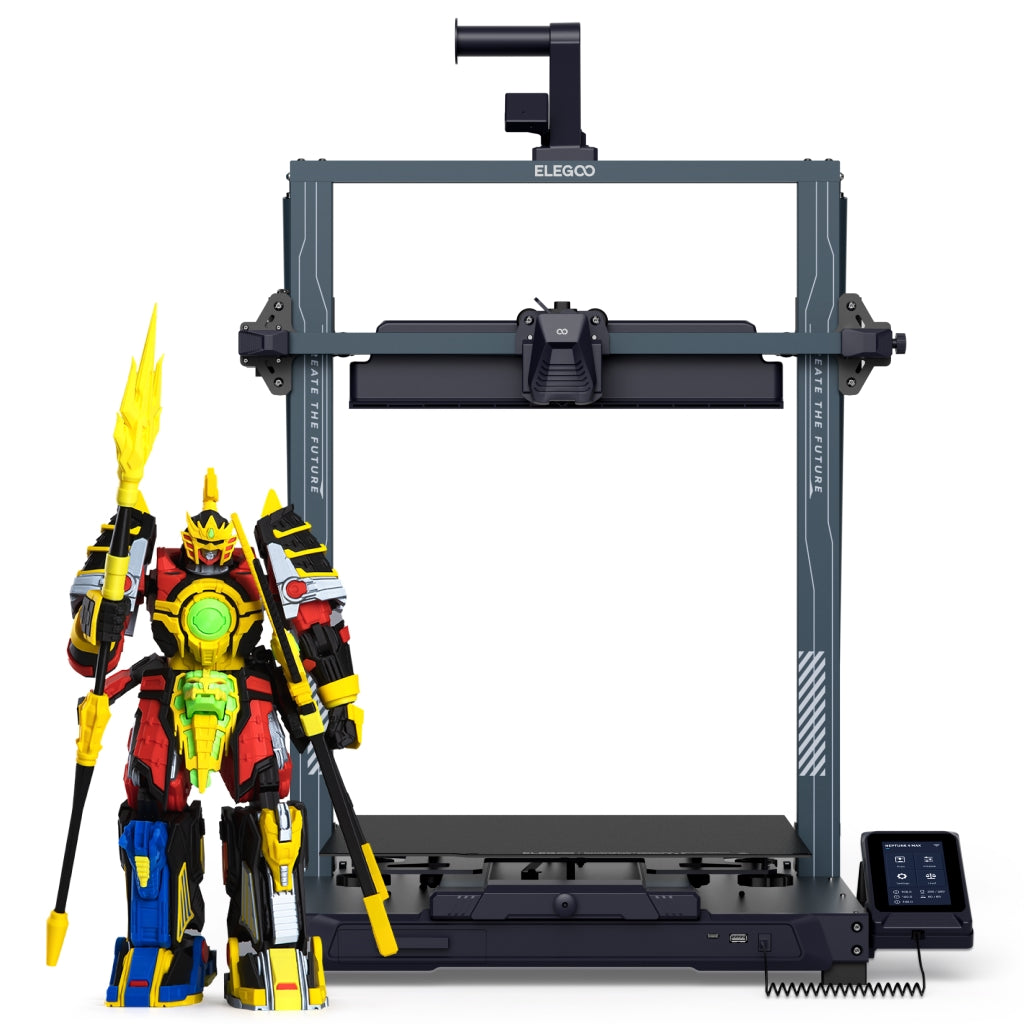
ELEGOO Neptune 4 Max
Neptune 4 Max (420 × 420 × 480 mm model — not the Neptune 4, Neptune 4 Pro, Neptune 4 Plus, Neptune 3 Max, or any refurbished/Grade B SKU)
More build volume per pound than anything else sold here. The set-up evening is the price of admission.
- Build volume
- 420 × 420 × 480 mm
- Technology
- FDM
- Max speed
- Up to 500 mm/s (250 mm/s regular; 8,000 mm/s² acceleration)
- Enclosed
- No
- Multi-colour
- No
- Auto levelling
- Yes (121-point, 11 × 11 grid) — but ELEGOO's own manual requires manual A4-paper centre-point calibration and manual auxiliary levelling of six corner points by hand-twist nuts first, and the automatic routine runs 36 points with a 36/121 toggle
What we like
- 420 × 420 × 480 mm — more usable build volume per pound than anything else on sale here
- Tall enough to finish a full-size helmet in one piece instead of two halves and a seam
- Klipper pre-installed, with 121-point automatic levelling on a plate that needs it
- Two UK supply routes and twelve months of cover
What we don’t
- Open frame with an 85 °C bed ceiling, so ABS at full size is optimistic rather than comfortable
- Owners consistently describe an evening of bed and Z-offset tuning before it settles
- Bed flatness and loosening bed screws come up repeatedly on a machine this size
- ELEGOO publishes no external dimensions, so measure the desk before it arrives
What you give up for the volume is walls. It is an open-frame machine with an 85 °C bed ceiling, so PLA, PETG and TPU are its natural territory; ELEGOO lists ABS, ASA and nylon too, but a tall ABS part in an unenclosed machine in a British room in February is asking for a split down a layer line. The 300 °C nozzle is there for flow rate, not exotic filament, and the 500 mm/s headline comes with 250 mm/s given as the regular figure — plan around the second. Levelling is automatic across 121 points, which matters far more on a bed 420 mm across than on a small one.
That is where the honest warnings live. A recurring theme among Neptune 4 Max owners is that the bed and Z-offset need a few hours of manual tuning before large prints become reliable. Spend the first evening levelling rather than printing, and the verdict owners reach is the one this page reaches. Owners who have tuned the Neptune 4 Max tend to describe it as unmatched for build volume at its price, provided they accept the set-up effort. It sells for roughly £380 to £470 with twelve months of cover and two UK routes to buy it.
Buy this if you want the largest part you can get for the money, your material list is PLA and PETG, and a first evening on bed levelling sounds like a fair trade. Skip it if you need ABS or nylon at full size — the Creality K2 Plus below is the largest machine here that holds the air at a temperature instead of borrowing warmth from the bed.
Best for large parts in engineering plastics: Creality K2 Plus
ABS does not warp because your printer is bad. It warps because the part keeps shrinking as it cools, and the bigger the part, the more shrinking there is to go wrong. Stopping that needs a chamber with a heater in it, not a box with a lid — and the K2 Plus is the largest machine here that has one: actively heated, holding up to 60 °C, inside 350 × 350 × 350 mm.
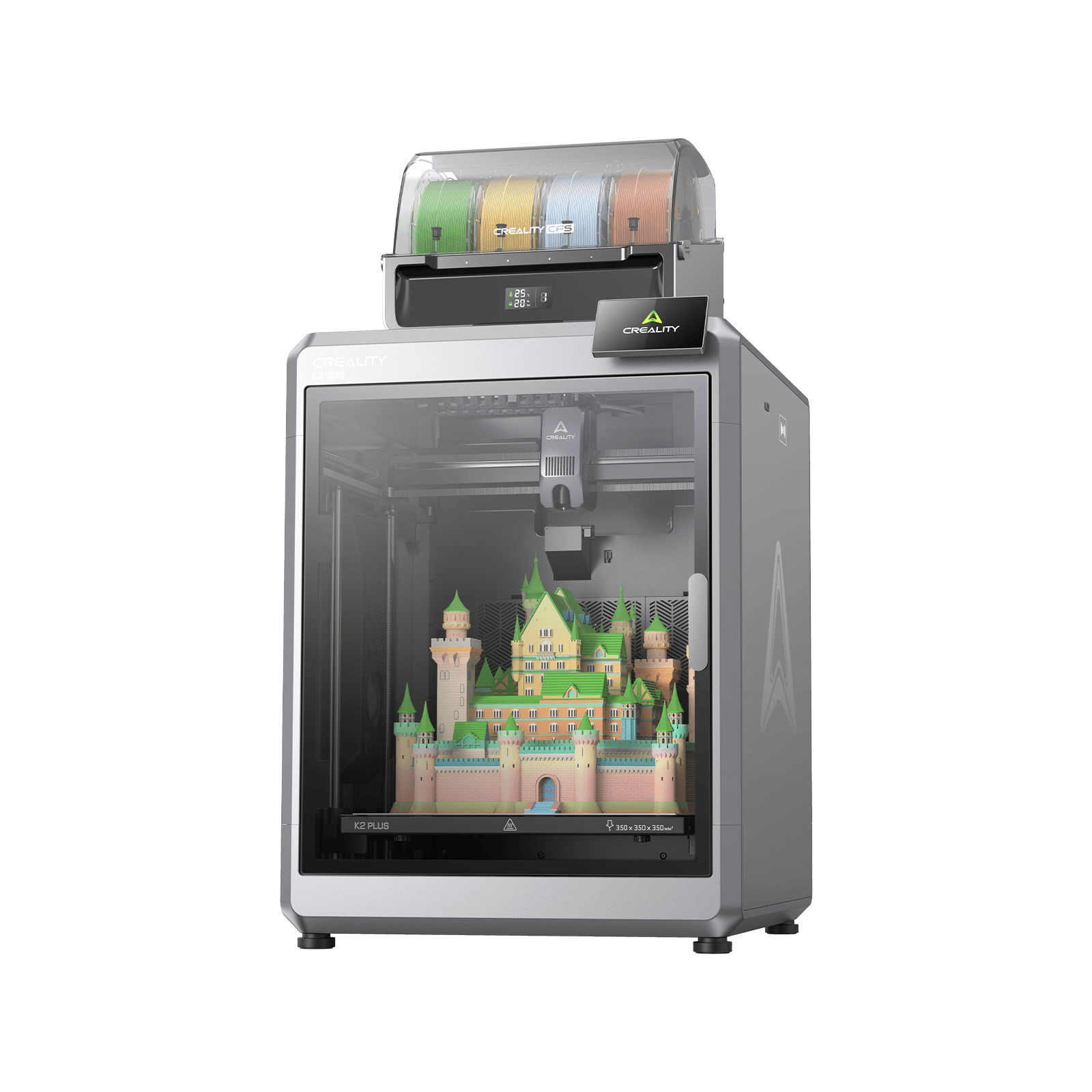
Creality K2 Plus
K2 Plus (base printer, without the CFS; not the K2, K2 Pro, K2 SE or K2 Plus Combo)
The largest heated chamber here, wrapped around a 350 mm cube. The plate is the part to watch.
- Build volume
- 350 × 350 × 350 mm
- Technology
- FDM
- Max speed
- ≤600 mm/s (≤30,000 mm/s² acceleration)
- Enclosed
- Yes — with active chamber heating to 60 °C
- Multi-colour
- Optional — up to 16 colours with four CFS units; the base machine is single-colour
- Auto levelling
- Yes — full-auto levelling, with a separate calibration AI camera
What we like
- The largest actively heated chamber on this page, holding up to 60 °C
- A 350 °C hardened steel nozzle over a 120 °C bed, inside a 350 mm cube
- Creality’s own list covers ABS, ASA and three carbon-filled composites
- Up to sixteen colours later if you add the filament units
What we don’t
- Keeping a plate this size flat once it is hot is the dominant owner complaint
- Extruder and filament-feed jams recur in Creality’s own forum
- One practical UK route — Creality’s own store
- Creality’s after-sales support is the dominant complaint on UK review sites
The toolhead matches. A hardened steel nozzle runs to 350 °C over a 120 °C bed, and Creality's list covers PLA, ABS, PETG, PET, ASA and the carbon-filled PLA-CF, PA-CF and PPA-CF; its chamber guidance goes further, naming PC, PAHT-CF, PET-CF, PPS and PPS-CF among the materials the heater exists for.
Creality is unusually straight about its own feature's limit: keep the chamber at 30–35 °C for PLA, PETG and TPU rather than run it hot, because those filaments soften in the extruder and jam it. The thing you pay for is switched off for most of what most people print — which is why an enclosure is a material decision, not an upgrade.
The plate is the weak point, and on a page about big prints it is the one that matters. A recurring theme among K2 Plus owners is that a plate this size is hard to keep flat once it is hot, and that large flat parts are where it shows; the responses they describe are a long bed soak before starting, a denser levelling mesh and re-levelling before each big print. Owner reports in Creality's own K2 Plus forum repeatedly describe filament jamming in the extruder or failing to feed through the filament system, with the PTFE tubing and its connectors the usual suspects, although this is not consistent across all reports.
Practicalities: it occupies 495 × 515 × 640 mm of bench, is rated at 1200 W, and carries twelve months of cover. Multi-colour is available later, but the base machine prints in one. Expect roughly £620 to £780.
Buy this if your large parts are ABS, ASA or carbon-filled, and you would rather spend an hour on bed mesh than an afternoon gluing a split part together. Skip it if you print PLA and PETG only — the Neptune 4 Max gives far more room for less, and you would be paying for a heater Creality will tell you to turn down.
Best for the widest material range: QIDI Plus5
This is the smallest machine on the page at 320 × 320 × 300 mm, and it is here because size is not the only thing that stops you printing something. If the part is large and has to be tough — a bracket in nylon, a housing in polycarbonate, a gasket in TPU — the question becomes what the hotend can melt, not how big the plate is.
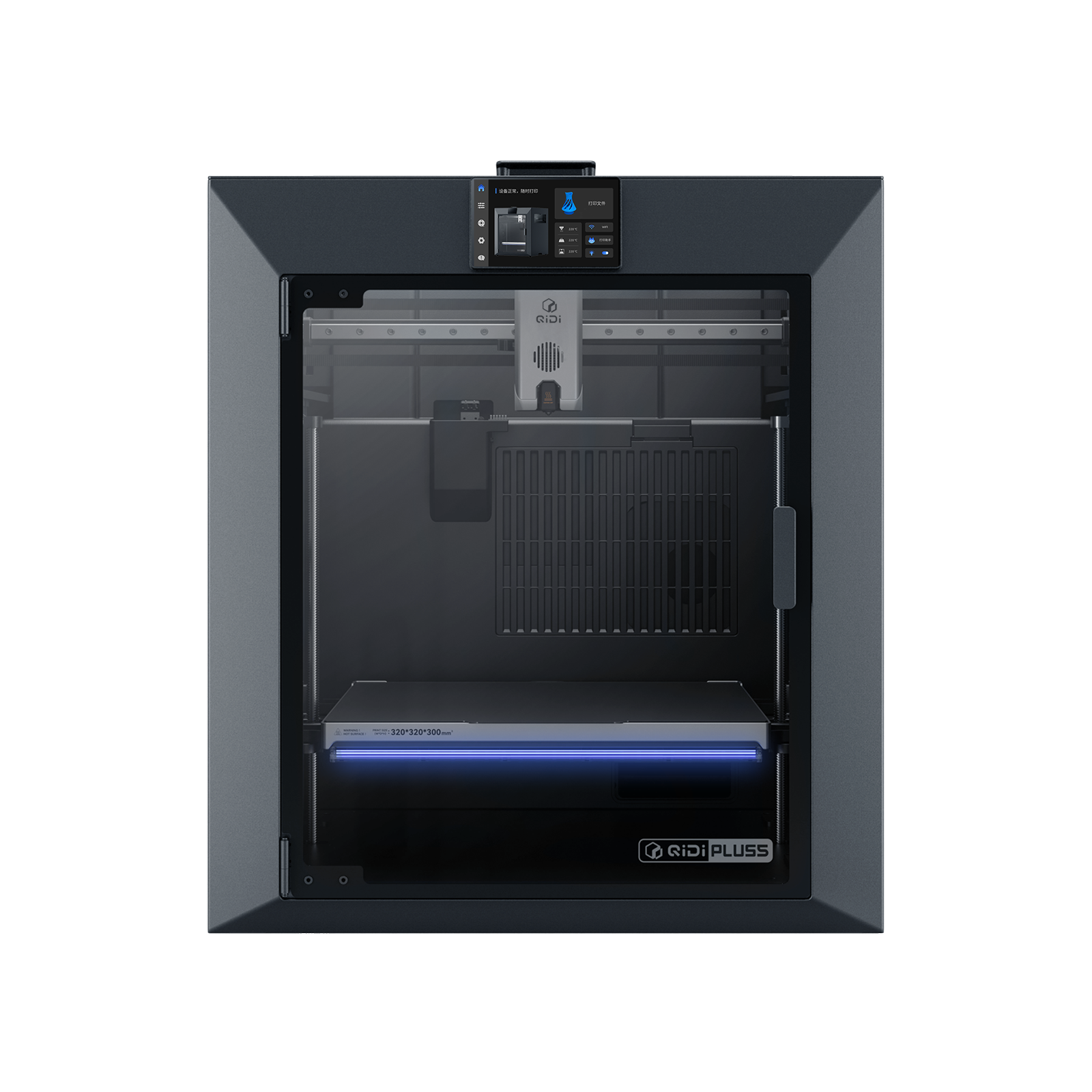
QIDI Plus5
QIDI Plus5 (standard, not the Plus5 Combo with QIDI Box, and not the Plus4)
The hottest nozzle here over an actively heated chamber. An engineering tool that expects an engineer.
- Build volume
- 320 × 320 × 300 mm
- Technology
- FDM
- Max speed
- 600 mm/s toolhead (≤20,000 mm/s² acceleration)
- Enclosed
- Yes, with independent active chamber heating up to 65 °C (3rd generation)
- Multi-colour
- Optional (compatible with QIDI Box; the Combo bundles it for 16 colours)
- Auto levelling
- Yes (hands-free, loadcell sensor integrated into the hotend)
What we like
- A 370 °C nozzle over a 120 °C bed — the hottest pairing on this page
- The only materials list here naming unfilled nylon, polycarbonate and TPU
- Three-stage filtration: pre-filter, H12 HEPA element and activated carbon
- Held in UK stock by a retailer with free delivery to Great Britain
What we don’t
- The smallest build volume on the page at 320 × 320 × 300 mm
- One year of warranty, the shortest term here
- Around 500 W steady printing ABS — the figure that shows up on a bill
- Owners describe it as an engineering tool rather than plug-and-play
The numbers back it. A bimetal nozzle runs to 370 °C — the hottest toolhead here — over a 120 °C bed, with independent chamber heating to 65 °C on a rated 550 W of its own. That is why QIDI's materials list names unfilled nylon and polycarbonate alongside PLA, ABS, ASA, PETG, TPU and the carbon- and glass-filled composites, and nothing else here lists all of them. Levelling is hands-free from a load cell inside the hotend, so the first layer is measured by the nozzle rather than a sensor beside it — a meaningful difference across 320 mm of plate. Filtration is three-stage: a G3 pre-filter, an H12 HEPA element and coconut-shell activated carbon. HEPA catches particles and carbon catches the smell; no filter removes everything, so ventilate anyway.
The costs are physical: 29 kg standing 500 × 488 × 558 mm. QIDI also publishes steady-state draw honestly — about 190 W on PLA, about 500 W on ABS — the clearest statement of what a heated chamber costs to run that any manufacturer here makes. Warranty is one year, the shortest here, but stock is the easiest: 3DJake UK holds it with free delivery to Great Britain, at roughly £650 to £750.
Owners repeatedly describe QIDI machines as engineering tools rather than plug-and-play, with a learning curve to expect. QIDI's support draws consistent praise on UK review sites for responding quickly, though reports of hardware faults on arrival sit alongside it.Buy this if your material list runs past ABS into nylon, polycarbonate or TPU, and you would trade a hundred millimetres of plate to print them properly. Skip it if the part is simply big and made of PLA: every other filament machine here has a larger plate, and you would be paying a premium for chemistry you will not use.
Best large format resin: ELEGOO Jupiter 2
Every other machine here builds a part out of extruded lines, and at this scale those lines show. Resin cures a whole layer at once through a screen instead, so surface quality does not degrade as the part grows. If you are making a bust, a display model or terrain — looked at closely rather than worn — this is the technology, and the Jupiter 2 is the large one.
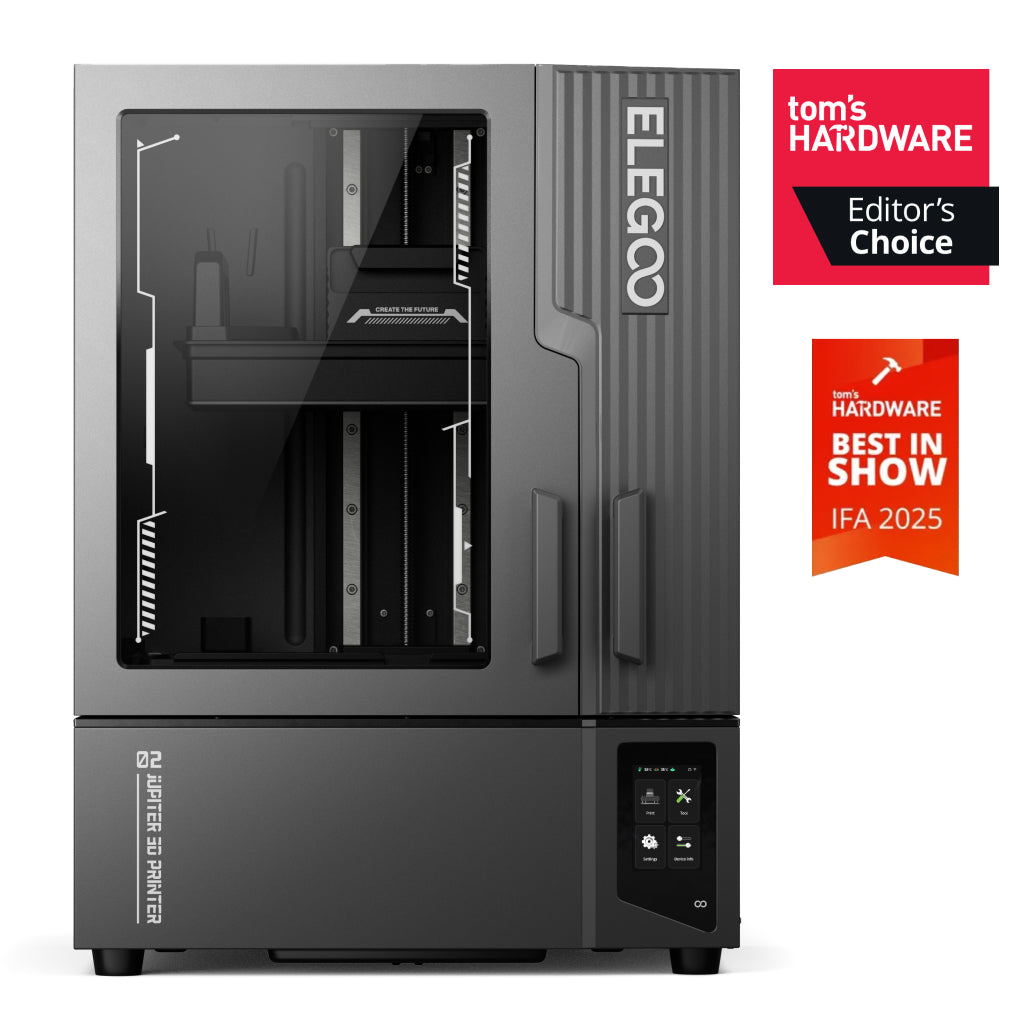
ELEGOO Jupiter 2
Jupiter 2 (16K; not the Jupiter or Jupiter SE)
Detail that does not soften as the part grows. The trade is chemistry, space and a shorter accessory list.
- Build volume
- 302 × 162 × 300 mm
- Technology
- Resin (MSLA)
- Max speed
- Up to 90 mm/h (manufacturer maximum)
- Enclosed
- Yes — double-door enclosure
- Multi-colour
- No
- Auto levelling
- Yes (auto levelling on four independent force sensors; manual levelling with real-time data feedback also available)
What we like
- 20 × 26 μm pixels — detail that does not coarsen as the part gets bigger
- Fills, drains and recycles resin automatically, behind a double door
- Levels itself on four independent force sensors
- Output sharpness is what reviewers praise most consistently
What we don’t
- Tied to the manufacturer’s own slicer, with wider support described as planned
- Gaps in the accessory range, including no matching wash-and-cure station
- Needs far more desk space than its own width suggests
- Effectively ELEGOO-direct in the UK — the main retailer cannot ship it here
It gives 302 × 162 × 300 mm through a 14-inch 16K mono screen of 15,120 × 6,230 pixels, which works out at 20 × 26 μm per pixel — about a hundredth of a millimetre, and the reason a printed rivet still looks like a rivet. The tall, narrow shape is the giveaway: resin machines grow upwards more easily than outwards, because the screen is the expensive part.
Resin's real objection is handling the liquid, and that is where the money goes. It fills, drains and recycles the vat automatically, levels itself on four independent force sensors, and sits behind a double door with a camera watching the chamber.
Reviewers who have printed on the Jupiter 2 consistently praise the sharpness of its output and the quality of its build plate, even where they criticise the rest of the experience. The criticisms are worth knowing first. Owners of this large-format machine repeatedly run into gaps in the accessory range, including release film sold only as a framed assembly and no matching wash-and-cure station. That is the sleeper: a part this size still has to be washed and cured afterwards, and you will be improvising the vessel.
Space is the other surprise. The machine is 465 × 508 × 648 mm and 28.9 kg, but reviewers repeatedly warn that this printer needs far more desk space than its own width suggests, because the doors swing wide and access is from the rear. It draws 300 W, carries twelve months on the machine with shorter terms on the screen, vat and plate, and in the UK is effectively ELEGOO-direct. Budget roughly £650 to £800.
Buy this if the finished surface is what the object is for, you know how resin behaves, and you have a ventilated corner that can stay a resin corner. Skip it if you want a large functional part, need it in a room you also sit in, or this would be your first resin machine — start smaller and come back.
Best for furniture-scale parts: ELEGOO OrangeStorm Giga
There is an extra large 3D printer, and then there is this. At 800 × 800 × 1000 mm the OrangeStorm Giga is not a bigger version of the machines above it: a metre of vertical travel takes you past helmets and props and into chairs, panels and full-size mannequin parts, printed as one thing.
ELEGOO OrangeStorm Giga
OrangeStorm Giga, single-printhead standard machine (not the Dual or Quad Extrusion upgrade kits, and not the All-in-One Family Combo)
A metre of vertical travel and a bed built from four plates. A floor machine, a freight delivery and a project in itself.
- Build volume
- 800 × 800 × 1000 mm
- Technology
- FDM
- Max speed
- 30–300 mm/s (ELEGOO default 150 mm/s)
- Enclosed
- No
- Multi-colour
- No — single printhead, expandable to four nozzles via ELEGOO's upgrade kits
- Auto levelling
- Yes — automatic, 121 levelling points
What we like
- 800 × 800 × 1000 mm — the only machine here that prints furniture whole
- Four independent 410 mm PEI plates instead of one sheet that could never stay flat
- A 0.6 mm nozzle as standard, with room for up to four printheads
- Klipper firmware, 121-point levelling and a seven-inch screen
What we don’t
- About 104 kg assembled, on a freight delivery that excludes Northern Ireland
- Seventeen minutes to bring the whole bed to 90 °C before every print starts
- Levelling is a long manual job and each of the four sections behaves differently
- ELEGOO’s own speed default is half its own headline figure
The engineering it takes to get there is visible everywhere. The platform is 820 × 820 mm built from four independent 410 × 410 mm PEI plates rather than one sheet, because nobody makes a flat, evenly heated slab that size for this money. The whole area reaches its 90 °C ceiling in 17 minutes at room temperature — a quarter of an hour before the first layer starts, every time. The standard nozzle is 0.6 mm rather than the usual 0.4, with room for up to four printheads, and layers are recommended at 0.3 mm: at this scale the limit is how fast you can lay plastic down, not how fine the lines are. Materials are the conservative part — PLA, ABS, TPU and nylon through a 300 °C nozzle on an open frame.
ELEGOO is instructive on speed: the range is quoted as 30 to 300 mm/s and its own default is 150, so the manufacturer has halved its headline figure before the machine leaves the warehouse. Owners and long-term reviewers consistently describe prints at this scale running for days rather than hours and settling well below the headline speed, while also noting that a part which would take weeks in sections finishes in one job. That is the trade in a sentence: one long print instead of a fortnight of gluing.
Then there is owning it, all 104 kg of it. Reviewers who have levelled the Giga repeatedly describe it as a long manual job across many screws, with each of the four bed sections behaving differently, and several still reaching for live Z adjustment on the first layer afterwards. It ships by freight, and ELEGOO states it will not deliver to Guernsey, Jersey or Northern Ireland. Expect roughly £2,100 to £2,700.
Buy this if the object genuinely does not fit on anything else and splitting it is not an option — cosplay armour, furniture, tooling, large enclosures — and you have the floor space and the patience for a multi-day print. Skip it if you were mainly excited by the number: for the price of one Giga you could have the Neptune 4 Max and the K2 Plus, and print two large things at once on machines that fit on a bench.
What counts as a large build volume
There is no agreed standard, so here is a usable one. A large build volume 3D printer is one that meaningfully beats the mainstream desktop cube in the axis you actually need — the axis matters more than the total, because a tall narrow part and a wide flat one fail for different reasons. That gives three tiers here: machines that turn a two-piece print into a one-piece print, machines that take a wearable prop whole, and the one that takes furniture.
The number nobody quotes is the one that decides whether it fits in your house. Build volume is the space inside; footprint is the space the machine takes, and on a bed-slinger the plate slides out past the frame, so you need roughly twice the bed depth in clear desk. The enclosed machines are easier to plan around because their beds stay inside the frame: the K2 Plus occupies 495 × 515 × 640 mm, the QIDI Plus5 500 × 488 × 558 mm and the Jupiter 2 465 × 508 × 648 mm. ELEGOO publishes none for the Neptune 4 Max or the Giga, which is why those cells in the table say so rather than guess.
Printing a helmet in one piece
This is the question behind most searches for a 3D printer for helmets, and it has an answer in millimetres. One manufacturer's own sizing guidance puts a full-size adult helmet at roughly 250–290 mm wide and 280–330 mm tall including any crest, and the threshold for printing one in a single job at roughly 350 × 350 × 330 mm; below that, a 300 mm machine gives two clean vertical halves and one seam.
That puts the Neptune 4 Max clear in every axis at 420 × 420 × 480 mm, the K2 Plus exactly on the line at 350 × 350 × 350 mm, and the QIDI Plus5 at 320 × 320 × 300 mm just under it — a halves-and-seam machine for helmets, whatever else it does well. That seam is an evening of filling and sanding, not a disaster; it is simply the thing the extra build volume buys you.
What a large scale 3D printer costs to run in the UK
Three things turn size into money: a bigger bed to heat, longer to heat it, and a print that runs for days. Here is the arithmetic — an estimate rather than a bill, with the assumptions shown so you can substitute your own tariff.
Take the Ofgem price cap for October to December 2026: 26.32 pence per unit of electricity, alongside a standing charge of 54.83 pence a day. The only manufacturer here publishing a measured steady-state figure is QIDI, which gives about 190 W printing PLA and about 500 W printing ABS at room temperature. On those numbers a twenty-hour PLA print costs almost exactly a pound in electricity, and the same twenty hours in ABS with the chamber heater working costs a little over two and a half pounds. A four-day print — routine at this size — lands between roughly five pounds and roughly thirteen. The standing charge runs whether the printer does or not, which puts a long PLA print at roughly the cost of simply having electricity that day. Rated plates tell you less: the K2 Plus is rated at 1200 W but spends most of a print nowhere near it, because the bed heater cycles rather than runs.
Two costs specific to scale are easy to miss. The first is warm-up: the OrangeStorm Giga's platform takes 17 minutes to bring its whole area to 90 °C, close to peak draw with nothing printing, every time you start. A recurring point in long-term reviews is that the Giga wants a permanent floor position and a circuit it is not sharing, with the cost of running it named as a real constraint on how often it gets used.
The second is filament, and it dwarfs the tariff. Ordinary PLA runs between about £14 and £18 a kilogram in the UK, and a furniture-sized print can use several spools. A print that fails at hour thirty costs more in plastic than a month of electricity — which is why, at this size, the money argument and the reliability argument are the same argument.
UK stock, warranty and support
UK availability is where large machines get awkward, and it is the thing a US-written roundup will never tell you. Only one of the five can be bought the ordinary way, from a UK retailer holding stock: the QIDI Plus5, which 3DJake UK carries with free delivery to Great Britain. The Neptune 4 Max has two routes, ELEGOO's own UK store and 3DJake UK. The other three are effectively manufacturer-direct. Creality's UK store is the only practical route to a K2 Plus, because 3DJake UK lists the model but states it cannot deliver it to Great Britain; the Jupiter 2 is in the same position with ELEGOO; and the OrangeStorm Giga ships by freight, with Guernsey, Jersey and Northern Ireland excluded outright. A machine with one UK supplier is a machine whose warranty claim, spare part and replacement plate all go through the same door — worth weighing before you buy.
Warranty terms are short and broadly similar. ELEGOO gives twelve months on the Neptune 4 series, and twelve on the Jupiter 2's machine with shorter terms on the screen, vat and plate. Creality gives twelve months on a fully enclosed FDM printer, with a fifteen-day window in which a confirmed fault can be a whole-unit replacement rather than a repair. QIDI gives one year. ELEGOO's UK warranty page could not be reached on the day this was checked, so no term is claimed for the Giga — the absence is deliberate.
Support is not a tiebreaker on a machine this heavy; it is the difference between a repair and a doorstop. Elegoo support is often reported as willing to send replacement parts, though owners describe the process as slow and scripted. At the other end, Creality's own support is the dominant complaint on UK review sites, described as slow to respond and slow to resolve faults, with experiences of the machines themselves sharply split.
Mistakes people make buying a big 3D printer
Buying build volume you will use twice. A big 3D printer is slower to heat, harder to level and more expensive to run, and it is no better than a small one at printing small things. Count the parts you actually plan to make that will not fit on a mainstream machine. If the answer is two, buy the mainstream machine and split those two, or pay a print bureau. If the answer is most weeks, buy the volume.
Assuming calibration scales. It does not, and as the sections above show, it is the most repeated complaint against every large machine here. A plate twice the area has far more opportunity to be out of true, and it moves as it heats. Plan the first evening as a levelling evening, and re-level before a long print rather than once when the machine was new.
Reading the headline speed as a plan. Nobody prints at the number on the box, and at this scale the gap is widest. Several owners describe layer shifts on very large or multi-day prints, commonly addressed by belt tension and slower speeds. A bigger nozzle buys far more time than a higher speed setting does, which is why the Giga ships with a 0.6 mm one.
Measuring the build volume and forgetting the machine. Check the external dimensions, then check the route into the room — something weighing 104 kg has to get through the door before it can disappoint you. Where floor space is the binding constraint, an enclosed machine that keeps its bed inside the frame uses less desk than an open one with a smaller plate.
If none of that sounds like your problem, the general picks in our best 3d printer uk guide will serve you better than anything on this page. Most people do not need a large-format machine, and it is cheaper to find that out now.
The verdict
The ELEGOO Neptune 4 Max is the right answer for most people asking this, for the unglamorous reason that it gives more room per pound than anything else on sale here and is tall enough to finish a helmet in one piece. Above it the choice stops being about size and turns on one question: does the plastic need the air held at a temperature? If it does, the K2 Plus gives you the most room while doing it, and the QIDI Plus5 is the one if the material list runs past ABS into nylon, polycarbonate or TPU. The Jupiter 2 answers a different question — surface rather than strength — and answers it well, and the OrangeStorm Giga is what you buy when the part cannot be split.
- Buy it if
- The largest thing you genuinely intend to make is a prop, a helmet or a big functional part in PLA or PETG, and you would rather put the money into build volume than into a chamber heater you will mostly be told to turn down.
- Skip it if
- Your large parts are ABS, ASA or carbon-filled, in which case the Creality K2 Plus is the largest machine here that holds the air at a temperature — or the part is bigger than a person, in which case only the OrangeStorm Giga answers the question at all.
How this article was researched
No printer here was bought, assembled or run, and nothing on this page is a measurement of our own. Every specification comes from the manufacturer's own product page, manual, support wiki or datasheet for the exact variant named, recorded against a claim ID with its source and the date it was read. UK prices are bands, checked in September 2026, not live figures; electricity figures come from the published Ofgem price cap. Owner experience is researched separately — manufacturers' own forums, long discussion threads and long-term written reviews — and used only where the same pattern appears across several independent sources.
Three things were left out because they could not be confirmed. ELEGOO publishes the OrangeStorm Giga's power consumption with its own figure marked provisional, and independent measurements disagree with it and with each other, so no wattage for that machine appears above. ELEGOO's UK warranty page could not be reached, so no warranty term is claimed for the Giga. And the K2 Plus's net weight is in no Creality document — the datasheet gives packed weights only — so it is not quoted. An article missing a specification beats one that invents it.
Common questions
- What build volume is considered large?
- There is no agreed threshold, so the useful test is whether a machine meaningfully beats the mainstream desktop cube in the axis you actually need — height for a helmet, width for a panel. On this page that produces three tiers. Around 300 to 350 mm, as on the QIDI Plus5 and the Creality K2 Plus, turns many two-piece prints into one-piece prints. The 420 mm class, as on the ELEGOO Neptune 4 Max, takes a wearable prop whole. And 800 × 800 × 1000 mm, as on the OrangeStorm Giga, is a different category again — furniture rather than cosplay. Buying a tier above the one your parts need costs you slower heat-up and a harder first layer for no benefit.
- Which printer can print a helmet in one piece?
- The ELEGOO Neptune 4 Max, comfortably, and the Creality K2 Plus at the margin. One manufacturer’s own sizing guidance puts a full-size adult helmet at roughly 250–290 mm wide and 280–330 mm tall including any crest, and puts the threshold for a single-piece print at roughly 350 × 350 × 330 mm. The Neptune 4 Max clears that in every axis at 420 × 420 × 480 mm; the K2 Plus sits exactly on the line at 350 × 350 × 350 mm; the QIDI Plus5 at 320 × 320 × 300 mm is just under it, which means two clean vertical halves and one seam to fill. That seam is an evening of work, not a disaster — it is simply the thing the extra build volume buys you.
- Are large-format printers harder to calibrate?
- Yes, and the reason is mechanical rather than a matter of firmware. A larger plate has more area to be out of true and more aluminium to distort as it heats, so a mesh taken cold no longer describes the bed by the time the nozzle reaches the far corner. It shows up as a first layer that sticks at one end of the plate and lifts at the other, and it is worst on exactly the wide flat parts a large machine is bought for. Owner reports across every machine on this page converge on the same three habits: let the bed soak at temperature for ten to fifteen minutes before starting, use a denser levelling mesh than the default, and re-run levelling before each long print rather than once when the machine was new.