Creality K1C Review
A UK review of the Creality K1C: what it will print, what it refuses to, how loud its owners say it is, what it costs to run here, and the cheaper rival.
Independent and reader-funded. We earn a commission if you buy through our links, at no extra cost to you. How this works.
The Creality K1C is the cheapest way into an enclosed CoreXY printer that was actually designed around carbon-fibre filament, and the machine assessed here is the K1C 2025 Version — not the K1, the K1 SE or the K1 Max, which are separate machines with separate specifications. It is a die-cast aluminium unibody with tinted glass sides and an acrylic lid, and it sits around the £350 to £420 mark in the UK.
What this Creality K1C review adds is what a product page leaves out: where Creality's own filament list stops, how loud it is in a room with you, what it costs to run on a British tariff, and who you are calling when it breaks. No printing or measurement was carried out for it — every figure below is traced to a source. Still choosing between filament machines in general? The best FDM 3d printer uk guide ranks it against six rivals.
Which K1C this is, and whether it is still current
Settle this first, because the K1 range is easy to buy the wrong end of. Creality has sold a K1, a K1 SE, a K1 Max and this machine, and the "C" is the only one built around abrasive filament. The current listing is the 2025 Version, which keeps the K1C hardware and adds compatibility with Creality's CFS multi-colour unit, bought separately.
The obsolescence question is fairer. Creality's storefront now leads with the newer K2 machines, and you would be forgiven for assuming the K1C had quietly been dropped. It has not: it is still listed and sold alongside the K2 series, with no successor announced. It was in stock at Creality's UK store when this page was last checked, shipping free from a UK warehouse, with an independent UK specialist holding stock as well. So this is an older design still in production rather than a run-out — which matters most for spare parts, and is good news there.
The specification, and what each figure changes
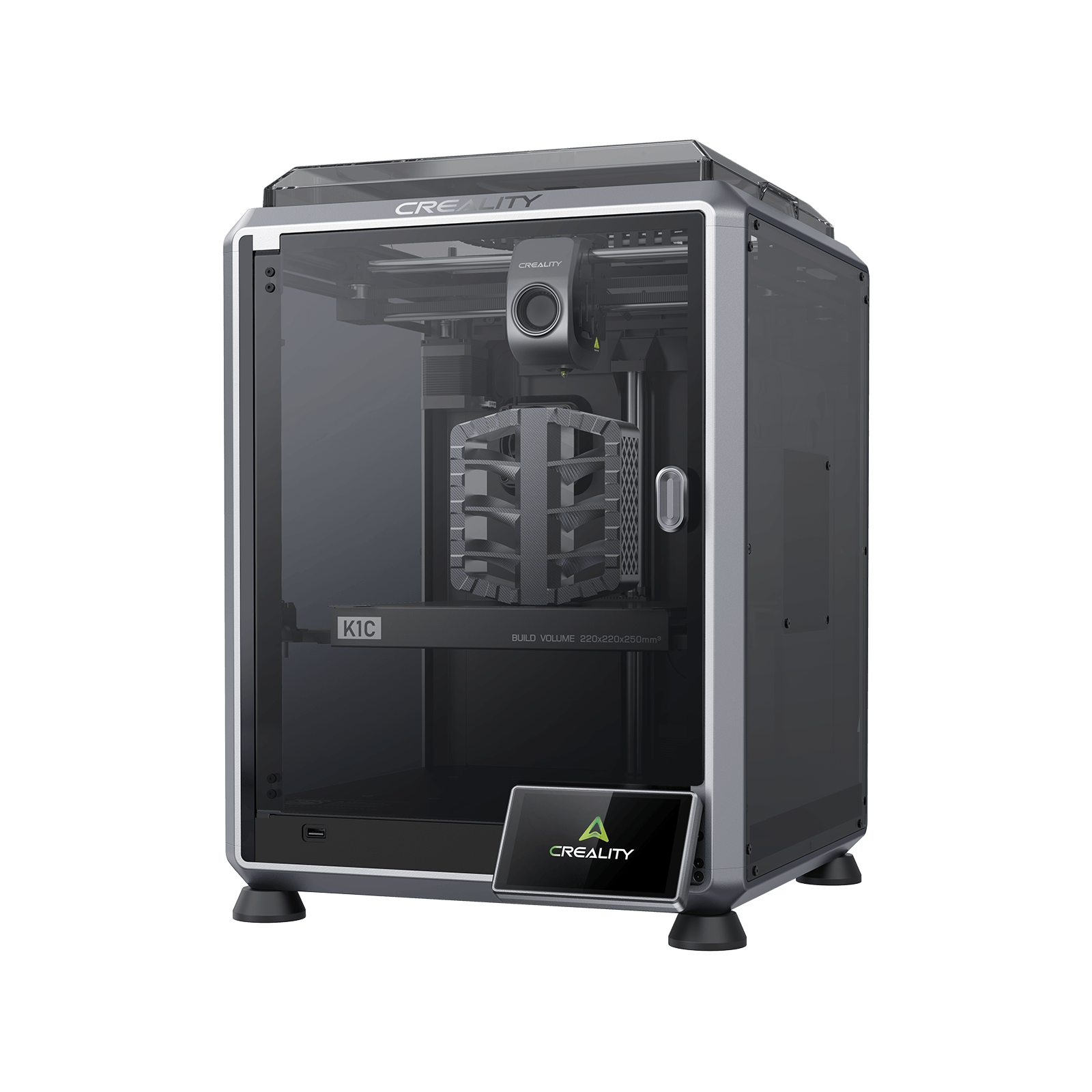
Creality K1C (2025)
K1C 3D Printer (2025 Version) - not the K1, K1 Max or K1 SE
An enclosed CoreXY printer built around abrasive filament, with a hardened nozzle fitted as standard rather than sold as an upgrade. Small plate, and a noise rating its own community argues with.
- Build volume
- 220 × 220 × 250 mm
- Technology
- FDM
- Max speed
- 600 mm/s (CoreXY, 20,000 mm/s² acceleration)
- Enclosed
- Yes (die-cast aluminium unibody, tinted glass sides, acrylic lid)
- Multi-colour
- Optional (Creality CFS-C multi-colour kit sold separately)
- Auto levelling
- Yes (hands-free automatic levelling)
What we like
- A hardened steel nozzle fitted as standard, so composites need no upgrade parts first
- Enclosed die-cast CoreXY frame quoted to 600 mm/s with 20,000 mm/s² of acceleration
- Hands-free levelling, filament run-out detection, power-loss recovery and an AI camera
- Open-source Creality OS, so the slicer and firmware are yours to change
- Still in production alongside the K2 series, with UK stock and spares from more than one route
What we don’t
- A 220 × 220 × 250 mm plate — smaller than both rivals compared here, and one costs less
- Creality's filament list omits unfilled nylon and polycarbonate; the plate stops at 100 °C
- The published 45 dB rating is not what its own community forum describes
- Owner reports describe automatic levelling losing its Z-offset after a period of use
- Creality's after-sales support is the most criticised part of buying from the brand in the UK
Start with the frame. The K1C is a CoreXY machine: the toolhead moves in two axes while the plate only travels down, so there is no heavy bed being flung about. That is why Creality can quote up to 600 mm/s with 20,000 mm/s² of acceleration — a ceiling, not a cruising speed.
The build volume is 220 × 220 × 250 mm, the figure most likely to disappoint: both machines compared later give you a 256 mm cube instead, and one costs less. For brackets, jigs and enclosures it is plenty; for anything helmet-sized it is not.
Now the part you are paying for. The hotend is all-metal with a 0.4 mm hardened steel nozzle on a direct drive extruder — a tri-metal quick-swap design with a titanium alloy heatbreak. Chopped carbon fibre eats ordinary brass, so hardened steel as standard is the difference between a printer that tolerates composites and one sold for them.
Temperature sets the boundary of what flows and what stays stuck down: 300 °C at the nozzle and 100 °C at the plate. Layers run from 0.1 mm to 0.35 mm, and Creality states ±0.1 mm over 100 mm — its own figure under its own conditions.
The conveniences are well covered: hands-free levelling, filament run-out detection and power-loss recovery, an AI camera watching for spaghetti and foreign objects, a 4.3-inch touchscreen, and printing over USB, the local network or Creality Cloud. Filament is standard 1.75 mm — no spool lock-in.
What the K1C does well
It commits to one job. Creality states the machine is specifically designed for printing carbon-fibre reinforced materials, and unusually, the hardware backs the line up rather than decorating it. The hardened steel tip and titanium alloy heatbreak in the quick-swap nozzle are there because chopped fibre is abrasive; the all-metal direct drive extruder is there because stiff filled filament is awkward to push. Nothing needs upgrading before you print PLA-CF or PA-CF. On rivals at this price, something does.
The thermal side is built for it too. Three cooling circuits sit inside the die-cast aluminium unibody with its glass sides and acrylic lid, trapping warm air around the print — which is what stops ABS and ASA lifting off the plate halfway up a tall part.
The last strength is one buyers only appreciate later: it is an open machine, shipping an open-source operating system alongside Creality Print and Creality Cloud. A recurring theme among owners is replacing Creality's own slicer with a community alternative and treating the machine as an open Klipper printer, which experienced users describe as an advantage and newer ones as extra work.
Where the K1C falls short
Four limitations are real, and each has somewhere better to go.
The materials list stops sooner than the badge suggests. Creality lists PLA, PETG, ABS, ASA, TPU95A, PLA-CF and PA-CF. Read what is missing: unfilled nylon and polycarbonate. A plate ceiling of 100 °C and no published chamber heater are why — both polymers want hot, still air, and passive warmth is not that. Some UK retailers do list polycarbonate; Creality does not, and where shop and manufacturer disagree the manufacturer wins.
The plate is small for the money. 220 × 220 × 250 mm is the tightest specification here, and the one you cannot work around with settings.
The published noise rating is optimistic. Creality quotes 45 dB or below; the next section sets out what its own community says instead.
Support is Creality's weak point, not the machine's. Cover runs to up to 24 months, but a warranty is only as good as the queue behind it, and Creality's after-sales record is the most criticised part of buying from the brand in the UK.
What owners consistently report
One caveat first. The basis here is recurring themes researched across Creality's own community forum — and a support forum is where people go when something is wrong, not when it works. Read these as the shape of the problems, not the odds of meeting one.
Noise is where the manufacturer and the machine's own community disagree outright. Creality's published figure is 45 dB or below. Owner reports on Creality's own forum repeatedly single out fan noise rather than the motion system, and a recurring response is to fit quieter fans or printed shrouds; several describe it as too loud for a shared room, although this is not consistent across all reports. No independent measurement was found either way — but a rating nobody quotes back approvingly is worth discounting.
Then the first layer. Several owners describe the automatic levelling losing its Z-offset after a period of normal use, leaving the nozzle dragging on the plate, and report that manual offset adjustment does not reliably correct it; this is not consistent across all reports. The timing matters: it arrives suddenly on a machine that had been printing correctly.
The third pattern undercuts the marketing most. Owners printing carbon-fibre filled filament frequently describe building their own slicer profiles rather than using a supplied preset, with first-layer adhesion and flow the usual sticking points, although experiences vary by material. The hardware for composites is there and verified above. The tuning is your job.
Setup and the first week
Getting to a first print is the easy part. Levelling is hands-free, so the apprenticeship older Creality machines demanded — a sheet of paper, a nozzle gap and a fortnight of test squares — is not part of this purchase. Filament run-out detection and power-loss recovery are fitted as standard, which is what turns a long overnight print from a gamble into a routine.
The learning curve arrives later, with the material you bought the machine for. PLA and PETG should print well by the end of the first evening on Creality's own profiles. Carbon-filled filament is a different week, for the reason set out above: the presets are the thin part of the package, and the profile work lands on you. Budget a few evenings of settings and a spool you are willing to waste — what you are not spending that time on is levelling, and most people would take that trade.
Creality K1C print quality and what it will actually print
Creality K1C print quality is a range you choose within rather than a single grade. Layer heights run from 0.1 mm to 0.35 mm: the fine end buys surface finish on display pieces, the coarse end buys speed on brackets nobody inspects. Creality states ±0.1 mm over 100 mm — its own figure, not one verified here.
What it will print is the more useful question. Creality's list is PLA, PETG, ABS, ASA, TPU95A, PLA-CF and PA-CF. The ordinary polymers are undemanding, and the enclosure makes ABS and ASA genuinely practical rather than merely possible. The two filled materials are the machine's reason for existing, and the hardened tip is what lets you run them without watching a brass nozzle wear open. PA-CF is what most people buy this for: stiff, heat-tolerant, suited to parts with a job rather than a shelf. The qualifier is the one from the owner patterns above — the hardware clears these materials, but the profiles do not arrive tuned.
Noise, space and fumes in a UK home
Space first, because it is what people discover after ordering. The machine is 355 × 355 × 482 mm and weighs 12.4 kg — deeper than a lot of shelving, with clearance needed above it for the lid and behind it for the spool. It lives somewhere permanently, on something solid.
Noise is the decision. Plan on the pessimistic reading of the patterns above: a room with a door you can close and nobody sleeping behind it. The enclosure is a thermal shell in die-cast aluminium, glass and acrylic, not acoustic insulation, and the fans sit outside it anyway.
Fumes deserve a straight answer. An air filter is fitted, but Creality does not document what medium it uses or what it captures, and UK retailers describe it inconsistently — so this article will not tell you it makes emissions a non-issue, because that cannot be sourced. PLA and PETG are not a concern in a normally occupied room. For ABS, ASA and filled filament, print somewhere you can ventilate and treat the filter as a consumable that reduces odour, not a licence to seal the door.
What a Creality K1C costs to run in the UK
Electricity is the cost people worry about; filament is the one that lands.
Creality rates the K1C at 350 W. That is a rated maximum — what the supply must deliver while plate and hotend heat from cold — and no steady-state figure is published. Rather than invent an average, here is the ceiling. At the Ofgem price cap of about 26p per kWh, drawing full rated power continuously costs roughly 9p an hour, so thirty hours of printing a month comes in under £2.75 — and the real figure sits well below that, because the heaters cycle. That is a worked upper bound, not a measurement. Either way, a British electricity bill will not notice this machine.
Filament is where the money goes. Ordinary PLA runs roughly £14 to £18 a kilogram from UK retailers, and the carbon-filled materials this printer exists for cost meaningfully more. One spool of PA-CF outweighs a year of electricity.
Which puts the Creality K1C price in the UK in proportion: around the £350 to £420 mark, and almost everything after that is plastic — plus the occasional nozzle, because abrasive filament wears even hardened steel.
UK warranty, spare parts and where the K1C is in stock
Buying a Creality K1C in the UK is more straightforward than it was. It is sold through Creality's own UK store from a UK warehouse, was in stock there with free shipping when this page was last checked, and at least one independent UK specialist was holding stock too.
Warranty cover runs to up to 24 months through that store. Beneath it sit rights that do not depend on goodwill: buying online in the UK gives you 14 days to cancel from the day the goods reach you, and 30 days from delivery to reject goods that are faulty. Both matter here, because of the next paragraph.
Creality's own support is the dominant complaint on UK review sites, described as slow to respond and slow to resolve faults, with experiences of the machines themselves sharply split. That is the practical risk — not a fragile machine, but a warranty only as good as the queue behind it. Buying from a UK seller with its own returns process is a hedge that costs nothing.
Spares are the bright spot. The K1 family is large and still in production, so K1-series nozzles, cameras and parts are carried by the Creality UK store, and the nozzle is quick-swap — which matters on abrasive filament.
The K1C against its two closest alternatives
The Creality K1C alternatives worth your time are the two enclosed CoreXY printers either side of it on price — and one makes uncomfortable reading for Creality.
| Specification | 1 Creality K1C (2025) The machine reviewed | 2 ELEGOO Centauri Carbon 2 Spend less | 3 Bambu Lab P1S Same money, ABS and ASA instead |
|---|---|---|---|
| Best for | Carbon fibre on a budget | Carbon fibre for less again | ABS and ASA, not composites |
| Enclosed | Yes | Yes | Yes |
| Heated chamber | No | No | No — regulated only |
| Build volume | 220 × 220 × 250 mm | 256 × 256 × 256 mm | 256 × 256 × 256 mm |
| Max speed | 600 mm/s | 500 mm/s | 500 mm/s |
| Max nozzle temperature | 300 °C | 350 °C | 300 °C |
| Max plate temperature | 100 °C | 110 °C | 100 °C |
| Fibre-reinforced filament | Yes — hardened nozzle fitted | Yes — hardened nozzle fitted | Not without an upgrade |
| Polycarbonate | Not on Creality's list | Listed by ELEGOO | Listed as capable |
| Published noise rating | ≤ 45 dB | Under 45 dB | None published |
| UK warranty | Up to 24 months | Not verified | 2 years |
| Typical UK price | £350–£420 | £280–£310 | £330–£400 |
The Centauri Carbon 2 beats the K1C on paper, for less. Enclosed CoreXY, a 256 × 256 × 256 mm plate reaching 110 °C, and a 350 °C hardened steel nozzle ELEGOO says takes PC, PET and fibre-reinforced filament — bigger, hotter at both ends, in a band of £280 to £310. It gives up speed, 500 mm/s against 600, and certainty: a far newer machine whose UK warranty term could not be verified.
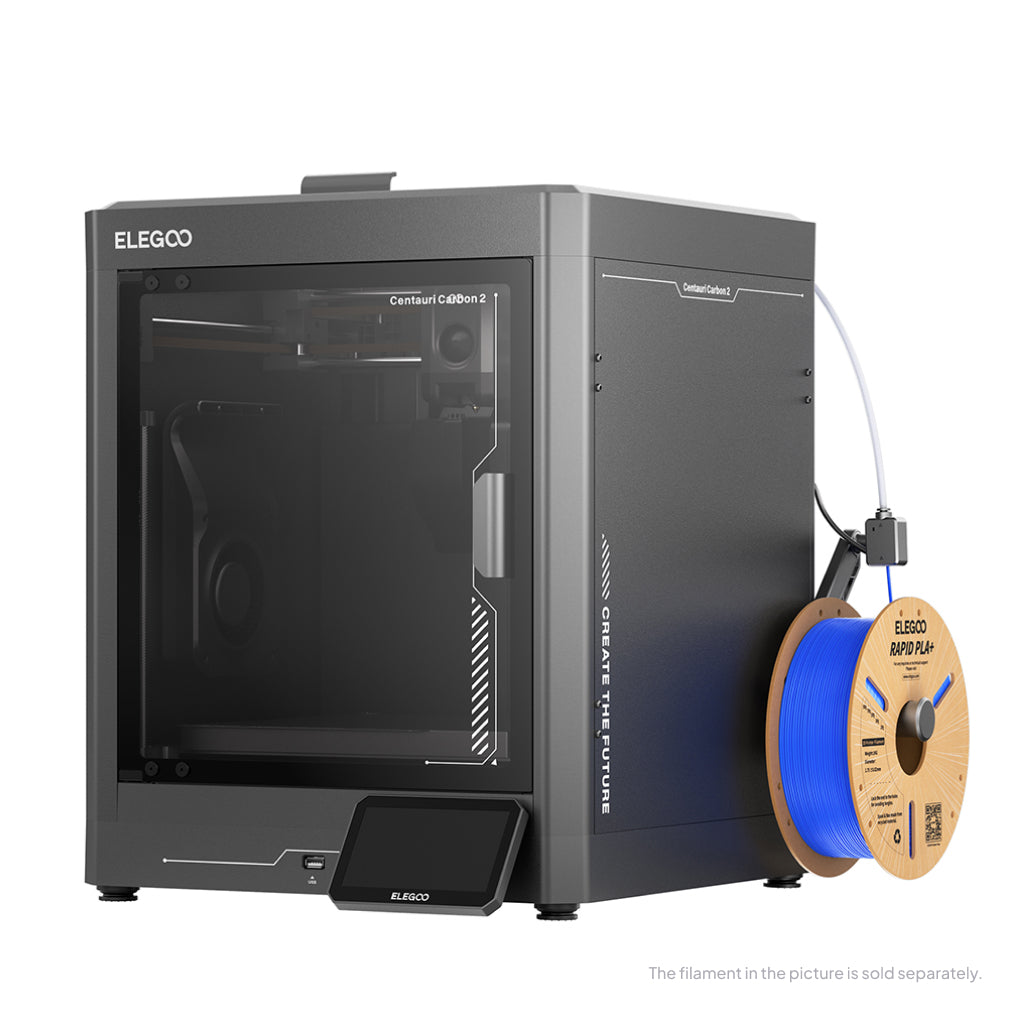
ELEGOO Centauri Carbon 2
Centauri Carbon 2 (standard, without CANVAS - not Combo)
A bigger plate and a hotter nozzle than the K1C for less. The unknown is its support record, not its specification.
- Build volume
- 256 × 256 × 256 mm
- Technology
- FDM
- Max speed
- 500 mm/s (CoreXY)
- Enclosed
- Yes (thermally regulated enclosure)
- Multi-colour
- Optional (CANVAS 4-colour system; included only in the Combo; standard unit can be upgraded)
- Auto levelling
- Yes — full-auto calibration with 121-point auto-levelling and partial bed-levelling
What we like
- A 256 × 256 × 256 mm plate against the K1C's 220 mm — more room for less money
- 350 °C hardened steel nozzle, which ELEGOO says takes PC, PET and fibre-reinforced filament
- 110 °C build plate, ten degrees past the K1C
- Enclosed CoreXY with full-auto calibration, and a published rating under 45 dB
What we don’t
- 500 mm/s against the K1C's 600 mm/s
- UK warranty term could not be verified from a primary source
- A far newer machine, so the long-term reliability record does not exist yet
- No actively heated chamber, so large nylon and PC parts remain a fight
Buy it instead if the specification is what you are buying and the price gap matters. Skip it if you want the longer track record, a verified warranty term, or the faster machine.
The P1S is the one to understand rather than to buy for composites. Enclosed, the same 256 mm cube, the same 300 °C nozzle and 100 °C plate, around the £330 to £400 mark. Bambu Lab puts ABS and ASA on its ideal list but says fibre-reinforced filament is not recommended before an extruder and hotend upgrade. That single line explains the K1C: an enclosure buys styrene plastics, a hardened nozzle buys composites, and those are separate purchases.
Bambu Lab P1S
P1S (standard, without AMS - not the P1P, P1S Combo or P2S)
The better all-rounder with smoother software, but composites need paid-for parts first. Buy it for ABS and ASA.
- Build volume
- 256 × 256 × 256 mm (Bambu Studio defaults to 250 mm height)
- Technology
- FDM
- Max speed
- 500 mm/s toolhead (20 m/s² acceleration)
- Enclosed
- Yes (plastic and glass; chamber temperature regulator fan and activated-carbon filter)
- Multi-colour
- Optional (AMS or AMS 2 Pro sold separately or as a Combo)
- Auto levelling
- Yes (automatic bed levelling sensor)
What we like
- The same 256 mm cube and a polished, well-supported software ecosystem
- ABS and ASA sit on Bambu Lab's ideal-materials list, and an activated-carbon filter is fitted
- Two years of UK warranty cover, and confirmed still in production
- Calibrates itself, and reaches a good first print quickly
What we don’t
- Bambu Lab does not recommend fibre-reinforced filament before an extruder and hotend upgrade
- Chamber is regulated rather than heated, so nylon and polycarbonate stay difficult
- Proprietary parts and a single support channel
- No acoustic rating published, and noise is the most repeated owner complaint
Buy it instead if ABS and ASA are the real target and you want the polished ecosystem. Skip it if filled filament is on your list, because the upgrade closes the price gap and then some.
If none fits, the constraint is the chamber: unfilled nylon and polycarbonate want actively heated air, which none of these three has — read about the QIDI Plus5 next, at roughly double the money. Otherwise the best 3D printers UK pillar covers resin too, and the best budget 3D printers UK guide goes below all three.
Who should buy the Creality K1C, and who should not
Whether the Creality K1C is worth it comes down to one narrow question: do you want to print filled filament, and is a 220 mm plate big enough for what you make? Two yesses and this is a well-judged machine — a hardened nozzle and an enclosure for the price of neither, with spare parts on a UK shelf. One no and something else on this page fits better.
It suits the person printing parts with a job: brackets, jigs, tool mounts, drone frames, fittings in PA-CF. It suits a small workshop wanting composites without a five-figure conversation, and anyone who would rather own an open machine than a sealed one.
It is wrong in four cases. Need unfilled nylon or polycarbonate? Creality's list does not include them, and the 100 °C plate is why. Want the most plate per pound? Both alternatives above are larger for the same money or less. Really after ABS and ASA? The P1S does that more smoothly and only stumbles on composites. And if the printer must share a room with someone, take the noise reports seriously first.
The verdict
The K1C does the thing it was built for, and does it cheaply: an enclosed CoreXY machine with a hardened nozzle fitted as standard, sold for carbon-fibre filament rather than merely tolerating it.
- Buy it if
- You want to print carbon-filled filament without buying upgrade parts first, a 220 mm plate covers what you make, and the printer has a room of its own.
- Skip it if
- You need unfilled nylon or polycarbonate, you want the largest plate for the money, or the machine would have to live where someone sleeps or works.
Around the £350 to £420 mark that is sound engineering for a specific buyer, and Creality is still making it. Two things stop it being an easy recommendation: the published rating of 45 dB or below is not what the machine's own community describes, and a cheaper rival now offers a bigger plate and a hotter nozzle. Buy it because it is built around abrasive filament — at this money, still a rare distinction.
How this article was researched
No first-hand testing, printing, measurement or photography was carried out for this review. Specifications come from Creality's own parameter page and official user manual, captured on 13 September 2026 and recorded claim by claim with a source URL; every figure above carries one. Where Creality publishes nothing — dimensions, weight, rated power and the noise rating — corroborating figures come from UK and international authorised retailers and are labelled as such. UK price bands and stock were checked against Creality's UK store and an independent UK specialist on the same date, and are quoted as bands, never live prices. The ownership patterns were researched as recurring themes across Creality's own community forum; no customer review is quoted and no rating reproduced. Three facts could not be resolved and were left out rather than estimated: the ambient temperature range, the air filter medium and polycarbonate support. Our approach is set out in the review methodology.
Common questions
- Is the Creality K1C worth buying?
- If you want to print carbon-filled filament, yes — it arrives with a hardened steel nozzle and an enclosure, so nothing needs upgrading before you start, and it sits around the £350 to £420 mark. If you do not, the case thins considerably: the plate is smaller than its rivals at the same money, and the ELEGOO Centauri Carbon 2 offers a bigger build area and a hotter nozzle for less.
- Who is the Creality K1C best for?
- Someone printing parts that have a job rather than a shelf — brackets, jigs, tool mounts, drone frames, fittings in carbon-filled nylon. It also suits a small workshop that wants composites without a five-figure machine, and anyone who would rather own an open printer they can modify than a sealed one. It suits nobody who has to put a printer where someone sleeps or works.
- What are the main alternatives to the Creality K1C?
- Two are worth real consideration. The ELEGOO Centauri Carbon 2 is the step down on price and up on paper: a larger plate, a 350 °C nozzle and a 110 °C bed for a lower band, though its UK warranty term could not be verified and it has a much shorter track record. The Bambu Lab P1S costs about the same and is the better all-rounder, but Bambu Lab does not recommend fibre-reinforced filament on it without an extruder and hotend upgrade.
- Can the Creality K1C print nylon and polycarbonate?
- Only the carbon-filled kind. Creality's own supported-filament list runs PLA, PETG, ABS, ASA, TPU95A, PLA-CF and PA-CF — unfilled nylon and polycarbonate are absent from it. The reason is thermal: the plate stops at 100 °C and Creality publishes no chamber heater, while both polymers want hot, still air to stop them warping. Some UK retailers do list polycarbonate as compatible; the manufacturer does not, and that is the list to trust.
- Is the Creality K1C loud?
- Creality's published rating is 45 dB or below, but that figure is hard to reconcile with what the machine's own community describes. Owner reports on Creality's forum repeatedly single out fan noise rather than the motion system, and quieter replacement fans and printed shrouds are a recurring response; several describe it as too loud for a shared room. No independent acoustic measurement was found either way, so plan for a room with a door you can close.