ELEGOO Mars 5 Ultra vs Anycubic Photon Mono 4 Ultra
One levels itself and prints faster, the other has the wider plate and longer LCD cover. Which compact resin printer suits you, and what each costs to run.
Independent and reader-funded. We earn a commission if you buy through our links, at no extra cost to you. How this works.
Two compact resin printers, near enough the same size and the same money. The ELEGOO Mars 5 Ultra vs Anycubic Photon Mono 4 Ultra question usually gets settled on the badge — 10K beats 9K, so the Anycubic wins — and that is the one comparison here worth almost nothing. The pixel gap is a single micrometre; the gap in how much work each asks of you is much larger.
First, the variants, because this search is a minefield. This page compares the Mars 5 Ultra 9K against the Photon Mono 4 Ultra — not the plain Mars 5, not the Photon Mono 4, not the Max. Search the pair and you will also be offered "Mars 5 vs Photon Mono 4 Ultra". Different machines, different figures. Nothing here was printed in-house.
| Specification | 1 ELEGOO Mars 5 Ultra Best for a working setup out of the box | 2 Anycubic Photon Mono 4 Ultra Best for plate width and the longer LCD cover |
|---|---|---|
| Best for | First resin printer, and anyone who prints often | Wider models, tight desks and longer screen cover |
| Panel | 7-inch 9K mono, 8,520 × 4,320 | 7-inch 10K mono |
| XY pixel size | 18 × 18 μm | 17 × 17 μm |
| Build volume | 153.36 × 77.76 × 165 mm | 153.4 × 87 × 165 mm, about 2.2 L |
| Layer range | 0.01–0.2 mm | 0.02–0.15 mm |
| Max speed (maker's maximum) | 150 mm/h | 80 mm/h standard resin, 120 mm/h high-speed resin |
| Levelling | One-click automatic | Four-point manual |
| Release mechanism | Tilt release — the tank tilts to peel | ACF release film; no tilt mechanism published |
| Failure detection | AI camera, plus resin and levelling alarms | Sensor self-checks; no camera listed |
| Slicer | ChituBox | Photon Workshop; Anycubic app not supported |
| Touchscreen | 4-inch capacitive | 4.3-inch |
| Weight | 8.8 kg | 5 kg |
| LCD warranty cover | 3 months | 6 months |
| UK price band | Around £210–£260 | Around £240–£290 |
| UK availability | ELEGOO UK store and 3DJake UK | Anycubic UK store and 3DJake UK |
How these two were compared
No printing was carried out for this page. The basis is research.
Specifications come from each manufacturer's own product page, read one variant at a time — and here that discipline does most of the work. ELEGOO sells a Mars 5 and a Mars 5 Ultra; Anycubic sells a Photon Mono 4, an Ultra and a Max. Several pages ranking for this search mix them, and one prominent write-up describes Anycubic's levelling-free system, a feature of a different and dearer model, in an article about this one.
Owner experience is separate evidence, labelled wherever it appears. Prices are bands, checked on 15 September 2026.
What the specifications actually tell you
Three figures decide this comparison, and the one on the badge is not among them.
Resolution. The K number counts pixels on the masking LCD, the screen under the tank that blocks light everywhere the model is not. It is a count, not a fineness. Both use a 7-inch panel: ELEGOO's is 9K at 8,520 × 4,320, Anycubic's is 10K. Across the same diagonal that gives 18 × 18 μm in XY against 17 × 17 μm — one micrometre apart, both square. Choosing the ELEGOO Mars 5 Ultra compared with the Anycubic Photon Mono 4 Ultra on resolution is deciding a coin toss. A recurring recommendation from reviewers is to swap the supplied fast-release film for a clearer type if maximum sharpness matters, accepting slower prints in exchange.
Speed. ELEGOO quotes up to 150 mm/h; Anycubic up to 80 mm/h on standard resin and 120 mm/h on high-speed resin, both at 0.1 mm layers. On the bottle most people have open that is roughly double, and the Anycubic's headline figure needs a dearer, narrower part of the shelf. Both are manufacturer maxima.
The gap comes from how each gets a cured layer off the film, since separation is where the time goes. The ELEGOO tilts its tank so each layer peels from one edge; Anycubic uses a low-adhesion ACF film instead, publishing no tilting mechanism. The release film is a routine consumable on this machine, and owner opinion is divided on whether the tilting vat lengthens or shortens its life, so reports vary.
Layer range. The ELEGOO spans 0.01 to 0.2 mm against 0.02 to 0.15 mm; the coarse end stops a chunky model running overnight.
Both advertise failure detection, meaning different things by it. The ELEGOO carries an AI camera with empty-plate and warp detection plus resin alarms; the Anycubic uses sensor self-checks with no camera listed. Owners and reviewers give the failure-detection camera credit for catching problems mid-print, while noting it cannot see the very early layers where failures most often begin.
Levelling, and the evening it decides
This is the difference the comparison tables leave out, and it should decide the purchase for most buyers.
Levelling means setting the build plate parallel to the film at the bottom of the tank, then fixing where it counts as zero. Get it wrong and nothing else matters: the first layer either fails to stick, or welds itself to the film hard enough to cost you an evening with a scraper.
The ELEGOO does it in one press. The Anycubic uses four-point manual levelling, with no automatic option: loosen the plate's fixings, drop it onto the screen, slide levelling paper underneath to feel for even resistance at each corner, tighten up again.
The manual route has defenders. Levelling on this model is a manual step, which some reviewers see as a good thing, though the lack of adjustable feet means an uneven surface has to be corrected before printing. It is a one-off in normal use, not a ritual before every job.
But this is a first resin printer for many people reading. Reviewers repeatedly describe the Mars 5 Ultra as one of the easiest resin printers to start with, needing very little setup before the first print.
One qualifier belongs here, not in the small print. Several reviewers caution that the auto-levelling on this class of machine does not remove the need to understand levelling, and Elegoo publishes a manual levelling guide alongside the automatic one. A shortcut past the setup, not an exemption from the concept.
ELEGOO Mars 5 Ultra: who it suits
The machine to buy if you would rather spend the evening printing than setting up.
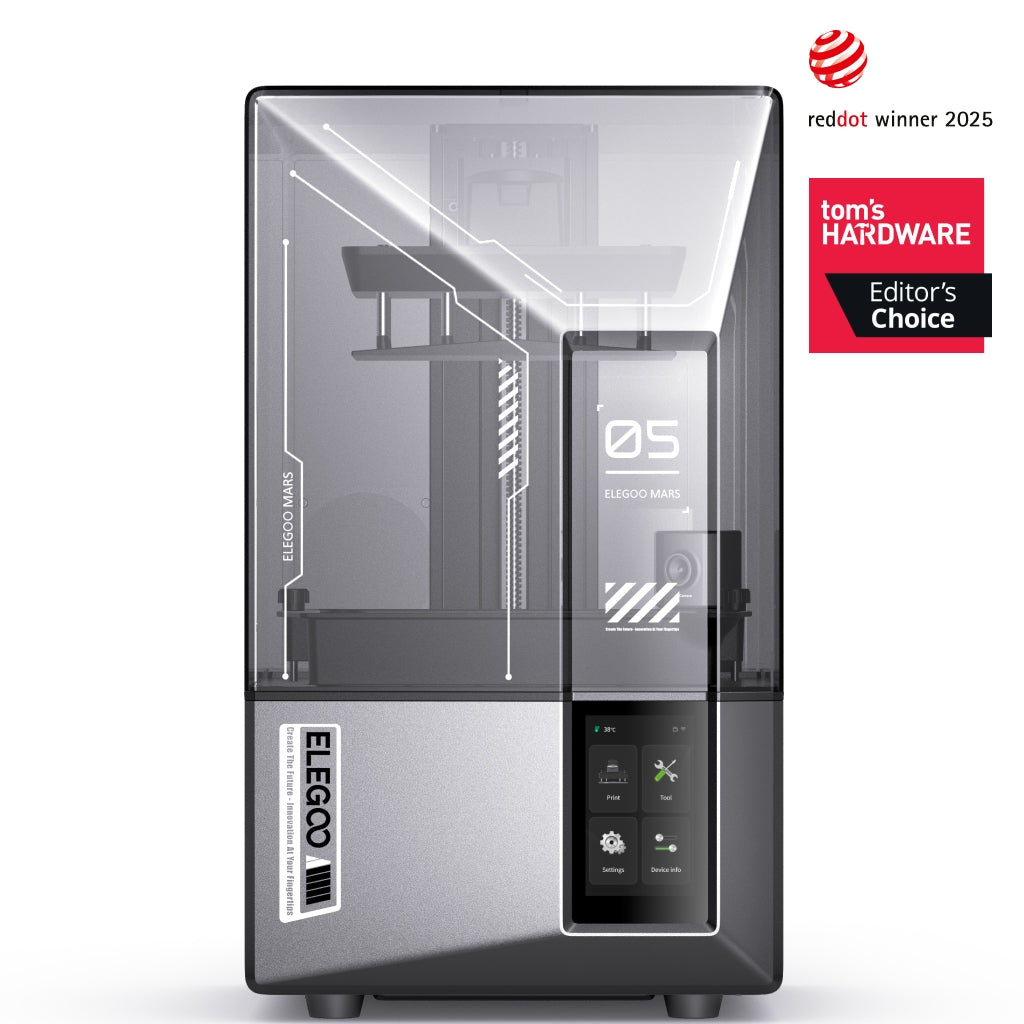
ELEGOO Mars 5 Ultra
Mars 5 Ultra 9K (not the non-Ultra Mars 5)
Levels itself, tilts its tank to release each layer, prints roughly twice as fast on ordinary resin, and sits in the lower of the two UK price bands.
- Build volume
- 153.36 × 77.76 × 165 mm
- Technology
- Resin (MSLA)
- Max speed
- Up to 150 mm/h (manufacturer maximum)
- Enclosed
- Lid (acrylic UV cover)
- Multi-colour
- No
- Auto levelling
- Yes (one-click automatic levelling)
What we like
- One-click automatic levelling removes the step most likely to defeat a beginner
- Tilt release peels each layer from an edge, which is gentler on thin supports
- Quoted at 150 mm/h against 80 mm/h for the Anycubic on standard resin
- An AI camera and resin alarms, rather than sensors alone
What we don’t
- Narrower plate — 77.76 mm against the Anycubic's 87 mm
- Heavier at 8.8 kg, with a larger footprint
- The masking LCD is covered for only three months
- No published wattage, so running cost cannot be worked out
The case is short. One-press levelling, a tilting tank and 150 mm/h compound: what makes it quicker is what makes a failed print less likely.
The envelope is 153.36 × 77.76 × 165 mm, matching the Anycubic in height and depth but giving up a little over 9 mm of width. For a bust or a rank of gaming pieces that is immaterial; for a wide terrain piece it is the one specification where the Anycubic is plainly better.
It runs ChituBox over USB or Wi-Fi — the most widely documented resin slicer there is, which matters when hunting for settings — takes most 405 nm resins, and weighs 8.8 kg.
Several reviewers report that prints grip the plate more firmly than expected at first and that reducing the bottom-layer exposure a little is the usual fix, although this varies with resin.Buy this if it is your first resin printer, you print often enough that speed compounds, or the lower price band is what makes the purchase happen.
Skip this if you need the wider plate, you want the longer warranty on the masking LCD, or weight and footprint are constrained.
Anycubic Photon Mono 4 Ultra: who it suits
The wider plate, the lighter machine, and the better warranty on the component most likely to fail.
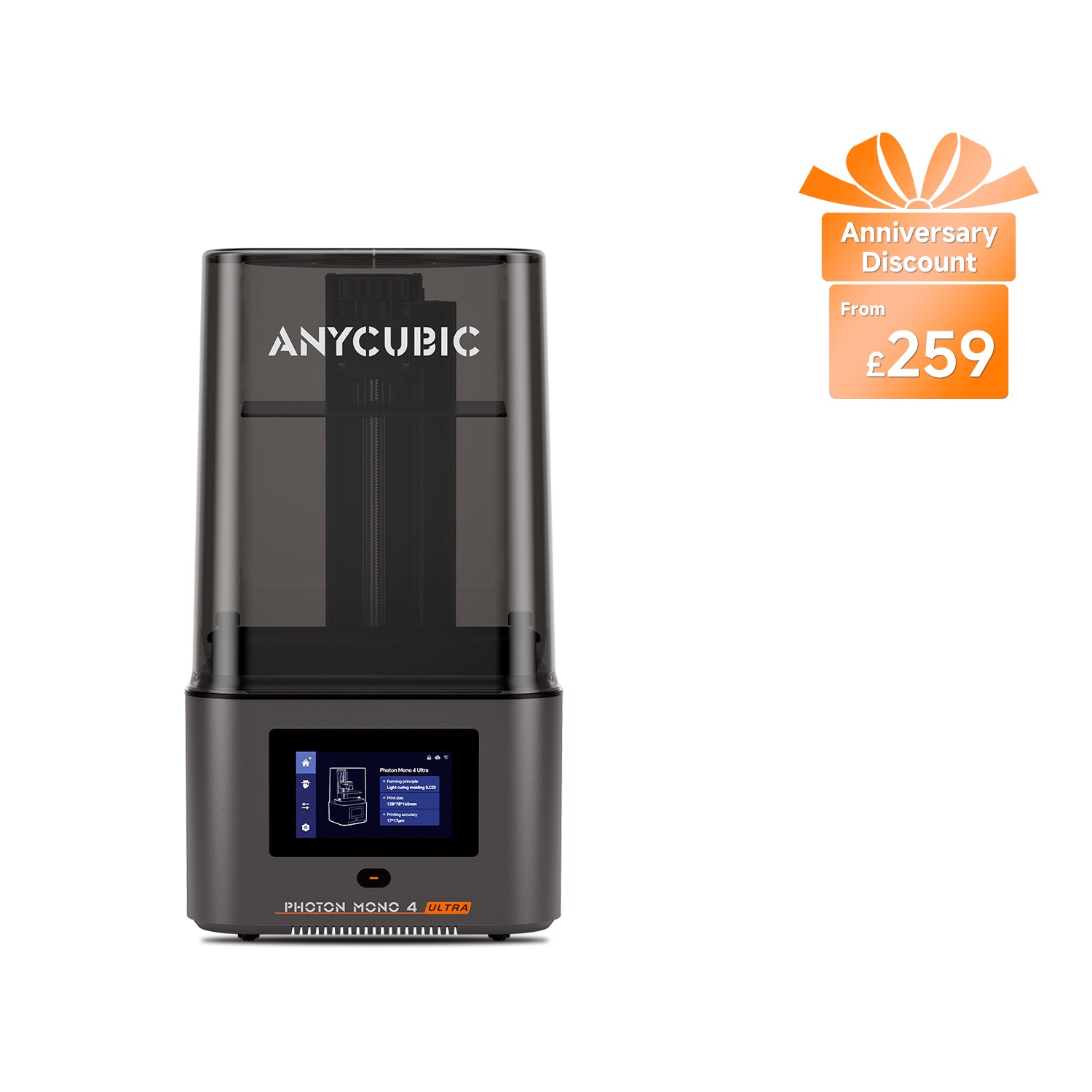
Anycubic Photon Mono 4 Ultra
Photon Mono 4 Ultra (not the Photon Mono 4 or Photon Mono 4 Max)
A capable small machine with the wider build plate and twice the ELEGOO's warranty cover on the masking LCD — asking more of you at setup, and costing more.
- Build volume
- 153.4 × 87 × 165 mm (2.2 L)
- Technology
- Resin (MSLA)
- Max speed
- Max ≤80 mm/h; standard resin at 0.1 mm ≤80 mm/h, high-speed resin at 0.1 mm ≤120 mm/h (manufacturer maxima)
- Enclosed
- Lid (removable UV cover; Anycubic lists no hinged cover)
- Multi-colour
- No
- Auto levelling
- No — 4-point manual levelling
What we like
- Wider plate at 87 mm, about 2.2 litres of build volume
- The masking LCD is covered for six months, twice the ELEGOO term
- Lightest of the two at 5 kg, in a smaller footprint
- A published 66 W supply rating, so running cost can be estimated
What we don’t
- Four-point manual levelling, with no automatic option
- Roughly half the ELEGOO's quoted speed on standard resin
- Narrower layer range, topping out at 0.15 mm
- Anycubic's own app is not supported on this model
Start with what it wins. The envelope is 153.4 × 87 × 165 mm — the ELEGOO's height and depth with roughly 9 mm more width, the difference between a wide model fitting whole and being sliced and glued. It is also much the lighter at 5 kg.
Its masking LCD is covered for six months, twice the ELEGOO term. The tank uses an ACF release film behind a replaceable screen protector, since resin spilled onto an unprotected LCD is an expensive afternoon.
Reviewers repeatedly describe this printer as dependable for small detailed models, with one multi-part hands-on test reporting no failures across its print runs.The reservations are about software. It runs Photon Workshop, and Anycubic's own app is not supported on this model. Several reviewers report that the bundled slicer needs watching, with automatic supports worth checking on each plate and no automatic orientation to speed up a full build plate. Third-party slicers are widely used with Anycubic hardware, so this is an inconvenience, not a wall.
See the best resin printers for miniatures guide for how it places among small machines.
Buy this if your models need the plate width, the machine has to be light enough to move regularly, or six months of LCD cover outweighs a slower setup.
Skip this if it is your first resin printer, you want the faster machine on ordinary resin, or you would rather not level a plate by hand.
Fumes, space and where either one can live
Neither machine filters its own air. Arriving from a filament printer, this is the most important paragraph here.
Both have a cover over the tank, and it is there to keep daylight off the resin, not to contain what comes off it. ELEGOO builds in no filtration and offers the Mars MATE purifier separately; Anycubic does the same. Siting is your decision, not the machine's.
Owner accounts of resin odour in a home vary widely: some describe printing in a bedroom and noticing little, while others treat a ventilated room and added carbon filtration as essential. Since you cannot know which camp you are in, plan for the stricter one — a room you can ventilate, ideally not one you sleep in.
Uncured resin and the alcohol used to wash it are both hazardous. Gloves and eye protection are not optional, resin should be cured before disposal rather than poured away, and contaminated alcohol does not belong down a sink — the cost of entry to resin printing, not a fault of either machine.
Neither manufacturer publishes a noise figure, so none is given here.
What each costs to run in the UK
Electricity is the part buyers ask about and nearly the least of it.
Start with the honest gap. Anycubic publishes a 66 W power supply; ELEGOO publishes no machine wattage at all, so a like-for-like comparison is not possible and is not attempted. Taking the Anycubic's figure as a ceiling rather than a draw, and a UK unit rate around 25p per kWh, an eight-hour print costs under 15p — a labelled estimate from a supply rating, not a measurement.
Resin is the real cost, and it scales with how much you print, not which machine you bought. Both take ordinary 405 nm bottles, though the Anycubic's higher speed figure depends on high-speed resin — narrower consumables.
The masking LCD is the expensive one, sitting under UV for every hour the printer runs — which is why the warranty terms below repay reading.
Reviewers consistently point out that the printer is only part of the outlay, since washing, curing, alcohol, gloves and ventilation sit outside the box.UK price, availability, warranty and support
The Anycubic Photon Mono 4 Ultra vs ELEGOO Mars 5 Ultra decision in the UK turns on a modest price gap and one warranty term that runs against everything else here.
The ELEGOO is the cheaper machine, around the £210–£260 mark against around the £240–£290 mark for the Anycubic — unusual, given it is also the faster machine with the automatic levelling. Both sell direct from their maker's UK store and through 3DJake UK, pricing in pounds and shipping domestically; the ELEGOO was in stock through a UK retailer when checked in September 2026. Spare parts are stocked in the UK for both.
Now the term that reverses the verdict, and almost nobody mentions it. Both carry twelve months on the machine. The difference is the masking LCD, the one component whose wear is a certainty. ELEGOO covers it for three months, with the tank and build plate at six; Anycubic covers it for six. That is twice the cover on the part most likely to need replacing — the strongest argument for the Anycubic here. It does not overturn the levelling, speed and price advantages together, but if you print heavily the screen is the component you will meet first.
Three ways buyers get this choice wrong
Reading a comparison of the wrong two machines. Results for this pairing routinely return the Mars 5 against the Photon Mono 4 Ultra, or the Mars 5 Ultra against the plain Photon Mono 4 — different panels, speeds and levelling. Check the page describes the Ultra on both sides.
Buying the K number. 10K sounds decisively better than 9K and is not. The panels are 17 × 17 μm and 18 × 18 μm, one micrometre apart and both square. What will change your output is the layer height and the care you take over supports. Still weighing the wider field? The best resin printers guide ranks the class properly.
Underrating the levelling difference. "Four-point manual levelling" is four words on a specification sheet and an hour of your first evening. Automatic levelling is not a luxury on a first resin printer: it removes the failure that stops most people getting a usable first print.
The verdict
This comparison is less balanced than most.
On the criteria that decide how a compact resin printer behaves — levelling, release mechanism, speed on ordinary resin, layer range, failure detection and price — the ELEGOO Mars 5 Ultra leads on all six at once. That is why it ranks first.
The Anycubic is not a bad machine, and second place is not a warning. It prints well, it is markedly lighter, it gives you the wider plate, and it covers the masking LCD for twice as long — any of which can be decisive if your models are wide, if the printer has to be portable, or if you print enough that the screen is a when rather than an if.
So whether it is the Mars 5 Ultra or Photon Mono 4 Ultra resolves cleanly: take the ELEGOO unless one of the Anycubic's three advantages describes you.
Two small MSLA machines at nearly the same money, and the badge on the front is the least informative thing about either. The ELEGOO spends its budget on the workflow; the Anycubic spends its on the panel, the plate and the warranty.
- Buy it if
- You want the machine that works soonest — automatic levelling, a tilting tank, roughly double the speed on ordinary resin, and the lower UK price band. Take the ELEGOO Mars 5 Ultra, especially if this is your first resin printer.
- Skip it if
- Your models need the wider plate, the machine has to be light enough to move for every session, or you want six months of warranty on the masking LCD rather than three. Take the Anycubic Photon Mono 4 Ultra and budget an evening for levelling.
How this article was researched
This comparison is research-based. No first-hand printing, measurement or photography was carried out, and nothing here should be read as a test result.
Every specification was researched from the manufacturer's own page for the exact variant named — the Mars 5 Ultra 9K and the Photon Mono 4 Ultra — and each figure carries a citation to its ledger entry. Where a manufacturer publishes no figure, none is given: ELEGOO publishes no machine wattage and neither maker publishes a noise rating.
Owner-reported patterns were researched from forums, documentation and long-term reviews. No customer review is quoted and no rating reproduced. No independent failure-rate data exists for either machine, so no reliability ranking is offered.
Common questions
- Which is better, ELEGOO Mars 5 Ultra or Anycubic Photon Mono 4 Ultra?
- For most buyers, the ELEGOO Mars 5 Ultra — and unusually for a comparison of this kind, it is not close. It leads on levelling, release mechanism, quoted speed on ordinary resin, layer range, failure detection and price simultaneously. The Anycubic Photon Mono 4 Ultra earns the choice in three specific situations: when your models need its extra 9 mm of plate width, when the printer has to be light enough to move for every session, or when six months of warranty on the masking LCD matters more than a quicker setup. Name which of those describes you and the question answers itself.
- Which has better print quality and reliability?
- On quality there is almost nothing between them. The panels sit one micrometre apart in XY, 17 × 17 μm on the Anycubic against 18 × 18 μm on the ELEGOO, and both are square pixels on a 7-inch screen — a gap you will not find on a finished model. Your resin, exposure settings and support work will change the result far more. On reliability, no independent failure data exists for either machine, so no honest ranking is possible and none is offered here. What can be said is that the ELEGOO carries an AI camera alongside its sensor alarms while the Anycubic relies on sensors alone, which affects what each notices when a job goes wrong rather than how often one does.
- Which offers better value for UK buyers?
- The ELEGOO, clearly. It is the cheaper of the two, around the £210–£260 mark against roughly £240–£290 for the Anycubic, and it is also the faster machine with the automatic levelling — so you are not trading features for the lower price. Both sell through UK stores and 3DJake UK in pounds with domestic shipping, so neither involves import costs. The one place the Anycubic wins on value is longer term: it covers the masking LCD for six months against ELEGOO's three, and that screen is the component most likely to need replacing if you print heavily.