ELEGOO Mars 5 Ultra Review
A UK review of the ELEGOO Mars 5 Ultra: what its automation actually removes, the one variable it does not, and what the 9K screen costs to replace here.
Independent and reader-funded. We earn a commission if you buy through our links, at no extra cost to you. How this works.
Almost every headline feature on this machine exists to take a decision away from you. It levels itself in one press, tilts its vat so each layer peels off the film from one edge rather than being dragged straight off it, and watches itself with a camera. The exact variant assessed here is the Mars 5 Ultra 9K — a 7-inch panel of 8,520 × 4,320 pixels at an 18 × 18 μm pixel — not the cheaper non-Ultra Mars 5 sold beside it.
What this ELEGOO Mars 5 Ultra review adds is the part the automation cannot reach. It sits around the £210–£260 mark in the UK and is still current, with no successor announced. No printing, measurement or photography was carried out for this page; every figure below is traced to a named source. Still choosing? The best resin printer uk guide ranks it against five rivals.
The specification, and what each figure buys you
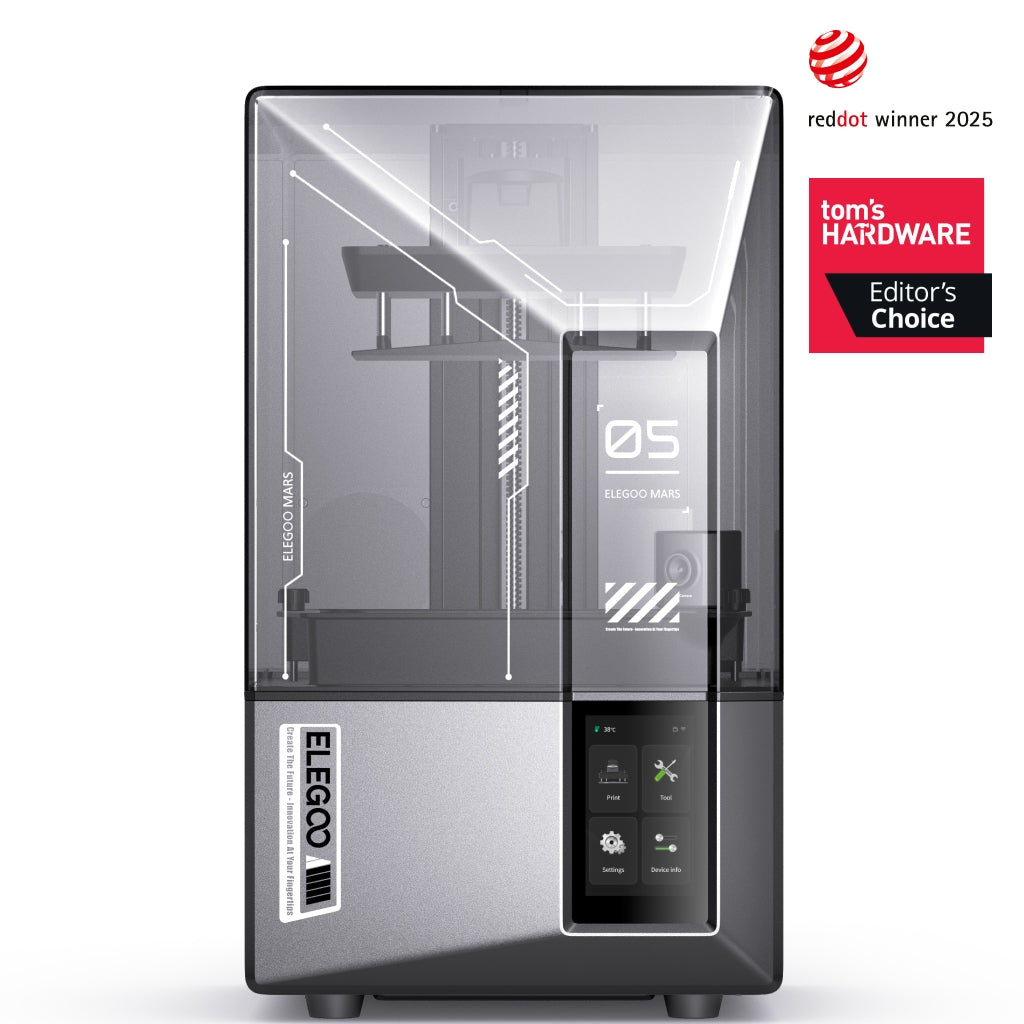
ELEGOO Mars 5 Ultra
Mars 5 Ultra 9K (not the non-Ultra Mars 5)
A compact 9K resin printer that automates almost everything a beginner gets wrong — except the one variable a cold room controls.
- Build volume
- 153.36 × 77.76 × 165 mm
- Technology
- Resin (MSLA)
- Max speed
- Up to 150 mm/h (manufacturer maximum)
- Enclosed
- Lid (acrylic UV cover)
- Multi-colour
- No
- Auto levelling
- Yes (one-click automatic levelling)
What we like
- One-click automatic levelling removes the job that puts most beginners off resin printing
- A tilting vat peels each layer off the film from one edge, which is gentler and faster than a straight lift
- Up to 150 mm/h against 70 mm/h for the plain Mars 5, from a mechanism rather than a marketing figure
- An 18 x 18 micrometre square pixel on a 7-inch 9K panel, within a micrometre of the finer rival
- Sensor alarms for low resin, vat residue and failed levelling, plus power-loss resume
- Sold by ELEGOO UK and by an independent UK specialist that stocks model-specific spares
What we don’t
- No heated resin tank, and independent reports make cold resin the main cause of first-layer failure
- The LCD is warranted for three months and costs around half the machine to replace
- No built-in air filtration; the purifier ELEGOO sells for the job is a substantial separate purchase
- The plate is narrow, and reviewers name the Z height as the machine's one real limit
- No noise rating published and no independent measurement found; no rated wattage published either
Start with the plate, because it decides most of your printing: 153.36 × 77.76 × 165 mm. That is a narrow strip rather than a square — deep enough for a tall piece, only just wide enough for a batch. The 18 × 18 μm XY pixel sets the smallest feature the machine resolves horizontally, and it is square, so it resolves equally well in both directions. Vertically you choose, with layers from 0.01 to 0.2 mm at a stated Z accuracy of 0.02 mm.
Two mechanisms change how the machine behaves rather than what it resolves. A 405 nm COB light source is the wavelength standard resins are formulated to cure at, which is why it accepts most resins on the market. Then tilt release: the vat tips so each layer peels off the film from one edge instead of being pulled straight up. Suction on a flat layer is what tears prints off a plate, and reducing it is what lets ELEGOO quote up to 150 mm/h — a maximum under the maker's own conditions, not a cruising speed.
The rest is convenience: levelling in one press from a 4-inch touchscreen, files over USB or Wi-Fi, slicing in ChiTuBox, and 8.8 kg on about 260 × 268 mm of desk.
What it does well
The strongest argument for this machine is how little it asks of you. Resin printing has historically failed people at levelling — a job done with a sheet of paper, four screws and a great deal of hope. Here it is one press.
The tilting vat is the second advantage. Every layer is cured against a transparent film and then separated from it, and on a flat layer that separation fights suction across the whole area. Tilting converts it into a peel starting at one edge — gentler on the print and quicker, hence up to 150 mm/h against 70 mm/h for the plain Mars 5. The mechanism behind the number is sound rather than cosmetic.
Third, it tries to catch its own mistakes: a camera watching for an empty plate and a warped model, alarms for low resin, vat residue and failed levelling, and power-loss resume. Residue detection is the quietly valuable one: a cured fragment left in the vat is what cracks a screen.
Buy this if you want a printer that removes the setup errors beginners make. Skip it if your printing space is cold and you are not willing to do something about that, because none of the automation above addresses it.
Where it falls short
The warranty is shortest on the part that costs the most. Cover runs twelve months on the machine, six on the vat and build plate, three on the LCD. That would be a footnote if the panel were cheap. It is not: a replacement screen for this model runs to around the £111 mark at a UK retailer, roughly half what the printer costs. The equivalent panel for the plain Mars 5 is around the £55 mark, so this is a cost the Ultra introduces rather than inherits.
Nothing filters the smell, and the thing that does is expensive and hard to get. There is no built-in filtration; ELEGOO's Mars MATE activated-carbon purifier is a separate purchase. In the UK it sits around the £148 mark including VAT, and was out of stock at the retailer checked in September 2026, with stock shown as expected in December.
The plate is the ceiling. At 153.36 × 77.76 × 165 mm the constraint is width as much as height. The most consistent criticism in independent reviews is the plate itself: reviewers repeatedly describe the Z height as the machine's one real limit, with taller pieces needing to be angled or split.
The failure detection is a monitoring aid, not a safety net. Reviewers are divided on the failure-detection camera: several find it useful for watching a job remotely, while others report that its corner mounting and its performance in low light leave it unable to see much of the print. ELEGOO's own description promises empty-plate and warp detection; the gap is worth naming.
What owners and reviewers consistently report
These are patterns recurring across independent long-form reviews, community discussion and published fault-and-fix material — not this site's own experience.
One pattern dominates. A recurring account across independent reviews is that cold, thick resin is what defeats this machine's automation — the levelling sensor triggers early and the first layer stays on the film — and that warming the resin or the room is the usual fix. The mechanism: levelling is sensor-driven, and a sensor reading resistance cannot tell a plate that has reached the film from resin too viscous to move. The automation does not fail so much as get misled. ELEGOO's Saturn 4 Ultra 16K holds its resin at 30 °C with a heated tank; this one has no such thing, which in an unheated British spare room is the difference between a variable you manage and one you have removed.
The downstream symptoms line up. Several reviewers report that prints grip the plate more firmly than expected at first and that reducing the bottom-layer exposure a little is the usual fix, although this varies with resin. Several reviewers caution that the auto-levelling on this class of machine does not remove the need to understand levelling, and Elegoo publishes a manual levelling guide alongside the automatic one. The second is the honest summary of the feature: it saves you the job, not the understanding.
Setup and the first fortnight
Getting to a first print is genuinely quick. There is no frame to assemble, levelling is a single press from the touchscreen, and files arrive over USB or Wi-Fi. Reviewers repeatedly describe the Mars 5 Ultra as one of the easiest resin printers to start with, needing very little setup before the first print.
The friction sits in the software. Slicing is done in ChiTuBox, and getting the right profile into it is the step to watch: several reviewers describe slicer profiles as the first real obstacle, reporting that the version supplied with the machine carried the correct settings when a freshly downloaded one did not.
Then the part no specification sheet prepares anyone for. The printer hands you a sticky, uncured, chemically active object, and draining, washing, clipping supports, curing and disposing of the waste is all manual — on a short job, longer than the print took. Reviewers consistently point out that the printer is only part of the outlay, since washing, curing, alcohol, gloves and ventilation sit outside the box. That is the real learning curve, not the machine.
ELEGOO Mars 5 Ultra print quality, and what it will actually make
The honest position on ELEGOO Mars 5 Ultra print quality is that the panel is no longer the limiting factor. An 18 × 18 μm square pixel on a 7-inch 9K screen sits within a micrometre of the finest compact resin panels sold — the Anycubic rival at this size reaches 17 × 17 μm. What separates good output from bad here is orientation, supports, resin and temperature, in roughly that order.
Layer height is the half you control: 0.01 to 0.2 mm at a stated Z accuracy of 0.02 mm. The fine end buys smooth curves at the cost of hours; the coarse end gets a tray of terrain done overnight, and no panel resolution rescues a visibly stepped surface. Materials are unrestrictive too — the 405 nm source takes most resins on the market, water-washable among them, which removes the need for bulk isopropyl alcohol.
Where it stops is the plate rather than the picture. 153.36 × 77.76 × 165 mm is generous vertically and tight across, so tabletop figures come in batches and a single large piece comes angled or in parts. For 28 mm and 32 mm figures painted and viewed across a table that is rarely the constraint, and the best resin printers for miniatures guide covers that case. For display busts, measure before you buy.
Noise, smell, space and safety in a UK home
Space is the easy part: about 260 × 268 mm of desk and 8.8 kg, so it fits on a shelf, though the cover lifts off rather than hinging open.
Noise deserves a straight answer and there is not one to give. ELEGOO publishes no acoustic rating and no independent measurement was found, so no decibel figure appears here, and figures circulating online for older Mars models are not this machine.
Smell is the problem it does not solve. There is no built-in filtration, and the Mars MATE purifier is a separate accessory rated by its maker at 35 dB and 6 W and stated to remove up to 95% of total volatile organic compounds — a manufacturer figure describing the purifier, not a measurement of the printer. Plan ventilation on the assumption you may not have it, given its UK stock position. Owner accounts of resin odour in a home vary widely: some describe printing in a bedroom and noticing little, while others treat a ventilated room and added carbon filtration as essential.
Then the part most reviews hurry past. ELEGOO's manual requires gloves and eye protection, a well-ventilated area, no direct skin contact with resin, and curing resin under UV before disposal. Take that literally. The Health and Safety Executive lists resins and acrylates among the agents that cause occupational skin disease, and notes that sensitisation is generally lifelong once it has happened — guidance written for workplace exposure generally, not for printing resin, but the mechanism applies. It is why a resin printer does not belong where a child or a pet can reach the vat.
What an ELEGOO Mars 5 Ultra costs to run in the UK
The ELEGOO Mars 5 Ultra price in the UK is around the £210–£260 mark, and it was in stock at a UK retailer for around the £220 mark including VAT in September 2026. That is not what it costs. The running cost of a resin printer is dominated by things that are not the printer.
Electricity is the small part, and no honest per-hour figure exists for this machine. ELEGOO publishes no rated wattage, only a supply rating, so there is nothing to average from and none is invented here. The nearest rival that does publish one rates its supply at 66 W, which at about 26p per kWh under the Ofgem price cap would be a few pence across a long evening — an illustration from a different machine, not this printer's consumption.
Resin is the cost that lands, at roughly £16 to £28 a kilogram for the common types. Add isopropyl alcohol, consumed steadily and, once resin-contaminated, hazardous waste rather than something to pour away. A wash-and-cure station is a purchase rather than an optional extra, at around the £79 to £113 mark.
Then the parts that wear. Release film is the routine one, around the £27 mark for a pack of five, and the warranty does not cover it. A replacement metal vat or build platform is about £27 each. The significant one is the screen, around the £111 mark and warranted for three months. ELEGOO publishes no service-life figure for it, so this page will not guess at one — but pricing it in is the difference between a £230-ish printer and a rather dearer one.
UK warranty, spare parts and where to buy one
Availability is the easy part of buying an ELEGOO Mars 5 Ultra in the UK. It is sold direct from ELEGOO's UK store and by 3DJake UK, it was in stock when checked in September 2026, and that retailer carries a model-specific spare-parts page listing the screen, the vat and the platform separately. That matters: the screen and the vat are consumables, and a discontinued machine is one whose parts quietly stop being stocked.
The warranty is tiered, and the tiers run the wrong way round: twelve months on the machine, six on the vat and build plate, three on the LCD, with the release film, cover and tools not covered at all. The part with the shortest cover is the one that wears and costs most to replace. The Anycubic rival covers its LCD for six months rather than three.
Beneath the warranty sit rights that do not depend on anyone's goodwill. The Consumer Rights Act 2015 gives a short-term right to reject faulty goods for 30 days after delivery, and buying online adds a 14-day cancellation right that does not depend on anything being wrong. For the first six months the law assumes a fault was there from the start. And the duty to refund falls on the trader, not the manufacturer — which should decide where you buy, not just what.
The Mars 5 Ultra against its two closest alternatives
The ELEGOO Mars 5 Ultra alternatives worth real consideration sit directly beneath it and directly beside it: the same maker's cheaper machine, and the rival Anycubic sells into this size class.
| Specification | 1 ELEGOO Mars 5 Ultra The machine reviewed | 2 ELEGOO Mars 5 Spend less, do more yourself | 3 Anycubic Photon Mono 4 Ultra Longer cover on the screen |
|---|---|---|---|
| Best for | Automation at a fair price | The cheapest sensible way in | A finer pixel and a wider plate |
| LCD | 7-inch 9K | 6.6-inch 4K | 7-inch 10K |
| XY pixel | 18 × 18 μm | 35 × 35 μm | 17 × 17 μm |
| Build volume | 153.36 × 77.76 × 165 mm | 143.43 × 89.6 × 150 mm | 153.4 × 87 × 165 mm |
| Levelling | One-click automatic | One-click automatic | Four-point manual |
| Tilt release | Yes | Not listed | Not listed |
| Max speed | 150 mm/h | 70 mm/h | 80 mm/h standard, 120 mm/h high-speed |
| Layer range | 0.01–0.2 mm | 0.01–0.2 mm | 0.02–0.15 mm |
| Monitoring camera | Yes, with warp and empty-plate detection | No — sensor alarms only | No — sensor self-checks only |
| Connectivity | USB and Wi-Fi | USB | USB and Wi-Fi |
| Rated power | Not published | Not published | 66 W |
| Weight | 8.8 kg | 6.6 kg | 5 kg |
| Built-in air filtration | No | No | No |
| UK warranty | 12 months; LCD 3 months | 12 months; LCD 3 months | 12 months; LCD 6 months |
| Replacement LCD, UK | Around £111 | Around £55 | Not published |
| Typical UK price | £210–£260 | £140–£170 | £240–£290 |
The plain Mars 5 is the one to think hardest about. It levels itself too, takes the same resins and software, carries the same warranty and sits around the £140 to £170 mark. What you give up is real: a 35 × 35 μm pixel, 70 mm/h, USB only, no camera and no tilting vat. Its replacement screen is around the £55 mark against around the £111 mark for the Ultra's. Reviewers generally describe the 4K panel as enough for most hobby printing and limiting mainly at the fine end, such as jewellery masters or display pieces examined closely.
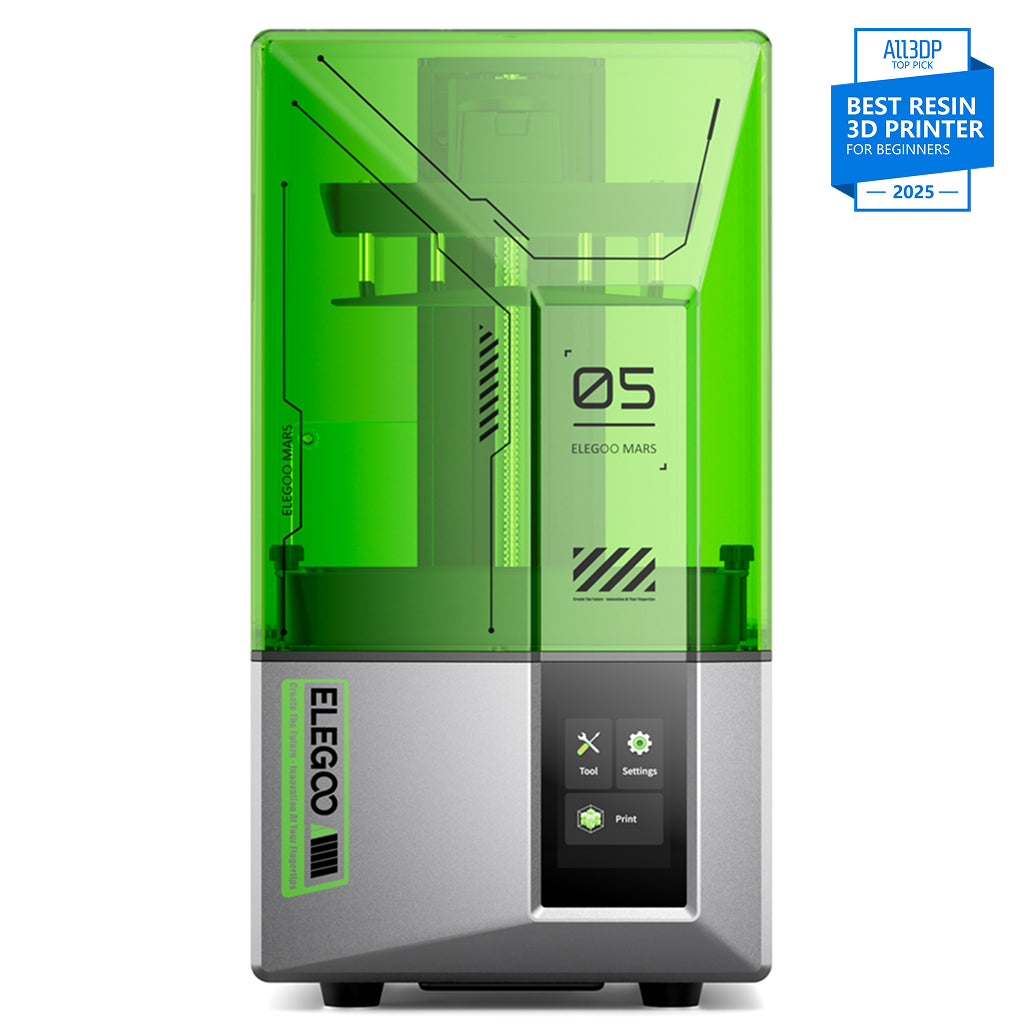
ELEGOO Mars 5
Mars 5 (4K, 6.6-inch - not the Mars 5 Ultra)
The same ecosystem and automatic levelling for roughly two-thirds of the money — slower, coarser and unconnected.
- Build volume
- 143.43 × 89.6 × 150 mm
- Technology
- Resin (MSLA)
- Max speed
- Up to 70 mm/h
- Enclosed
- Hinged cover (no filtration; compatible with the Mars Mate air purifier)
- Auto levelling
- Yes (one-click automatic levelling)
What we like
- Around two-thirds the price, with the same automatic levelling, warranty terms and spares chain
- Takes the same resins and slices in the same software, so nothing about the workflow changes
- A replacement LCD costs roughly half what the Ultra's does
- Lighter at 6.6 kg, and the plate is slightly wider even though it is shorter
What we don’t
- A 35 x 35 micrometre pixel against the Ultra's 18 x 18, which shows on close work
- Up to 70 mm/h, less than half the Ultra's quoted ceiling
- USB only, with no Wi-Fi and no monitoring camera
- No tilting vat, so layer separation is a straight lift
Buy it instead if budget is the binding constraint and you are content to wait longer for each plate. Skip it if you want Wi-Fi, remote monitoring or the speed the tilting vat buys.
The Photon Mono 4 Ultra wins on two terms the ELEGOO does not. Its pixel is marginally finer at 17 × 17 μm, its plate a little wider at 153.4 × 87 × 165 mm, and it covers its LCD for six months rather than three. Against that: levelling is a four-point manual job, the ceiling is lower at up to 80 mm/h on standard resin, monitoring is sensor-based with no camera listed, and it costs more, at around the £240–£290 mark.
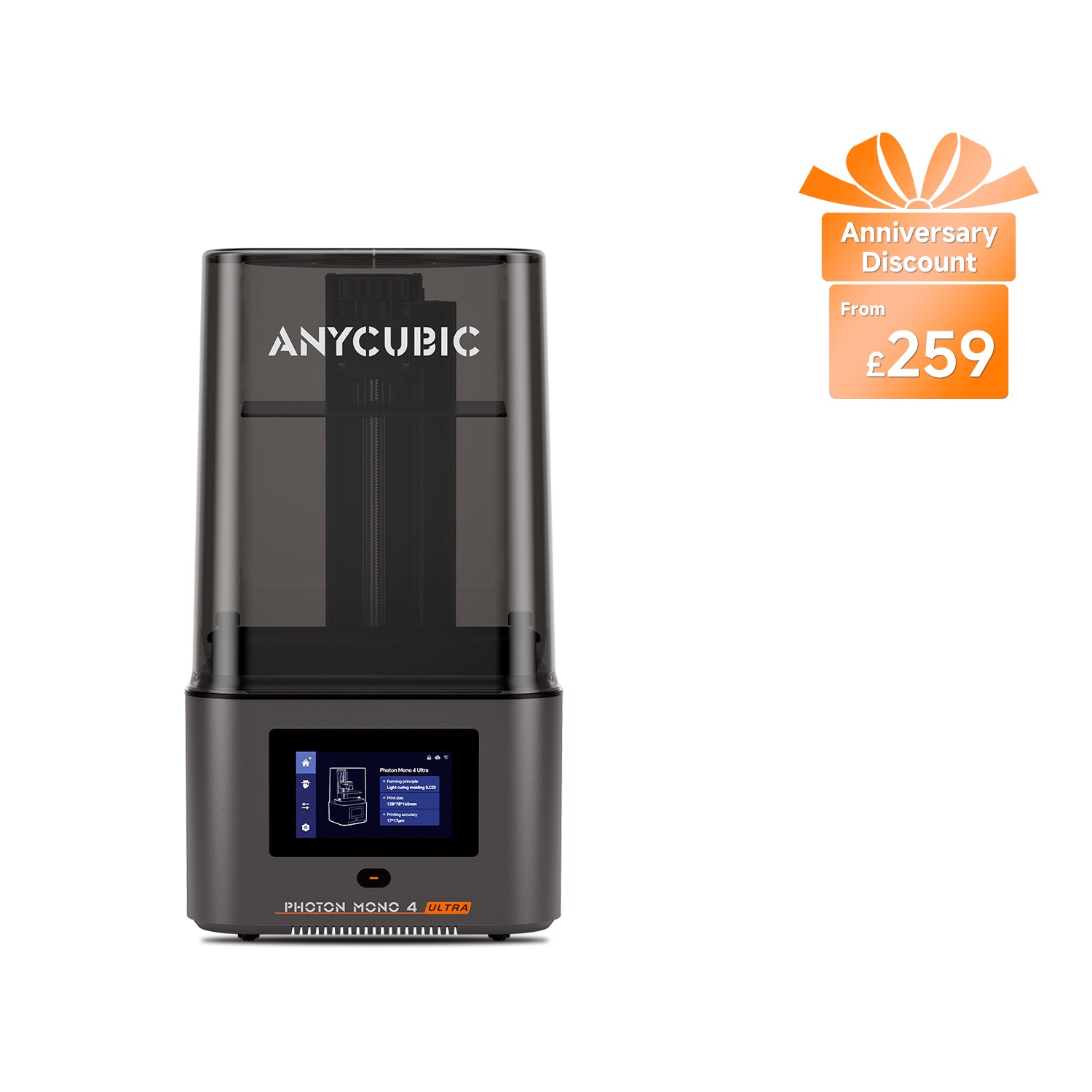
Anycubic Photon Mono 4 Ultra
Photon Mono 4 Ultra (not the Photon Mono 4 or Photon Mono 4 Max)
A finer pixel, a wider plate and twice the warranty term on the part most likely to fail — at the price of levelling it yourself.
- Build volume
- 153.4 × 87 × 165 mm (2.2 L)
- Technology
- Resin (MSLA)
- Max speed
- Max ≤80 mm/h; standard resin at 0.1 mm ≤80 mm/h, high-speed resin at 0.1 mm ≤120 mm/h (manufacturer maxima)
- Enclosed
- Lid (removable UV cover; Anycubic lists no hinged cover)
- Multi-colour
- No
- Auto levelling
- No — 4-point manual levelling
What we like
- The LCD is covered for six months rather than three
- A marginally finer 17 x 17 micrometre pixel on a 7-inch 10K panel
- A slightly wider plate at 153.4 x 87 x 165 mm
- Publishes a 66 W supply rating where ELEGOO publishes none, and weighs only 5 kg
What we don’t
- Four-point manual levelling, with no adjustable feet
- Slower, at up to 80 mm/h on standard resin
- A tighter layer range of 0.02 to 0.15 mm
- Sensor self-checks only, with no camera listed, and it costs more than the ELEGOO
Buy it instead if the three-month screen warranty is what is stopping you, or you would rather level a printer yourself than trust a sensor to do it. Skip it if you are new to resin and want the machine to remove that decision.
Who should buy it, and the verdict
Whether the ELEGOO Mars 5 Ultra is worth it comes down to a question the specification sheet never asks: how cold is the room you intend to put it in? Everything it does well removes an error a beginner makes. The one variable it leaves to you is the one a British house varies most.
It is right for you if your work fits inside 153.36 × 77.76 × 165 mm and your printing space is warm or somewhere you are willing to make warm. It is wrong for you if the printer must live in an unheated garage, and wrong again if it would share a room with people: nothing filters the air.
The automation is not marketing: levelling, tilt release and the sensor alarms genuinely remove the failures that put people off resin. Buy it knowing the screen is a wear part, and that warmth is your job.
- Buy it if
- You want the shortest honest route from a sealed box to a good resin print, and you can keep the room — or at least the resin — warm.
- Skip it if
- The printer would live somewhere cold or shared, you need a wider plate, or a three-month warranty on a screen costing half the machine is a risk too far.
At around the £210–£260 mark that is a fair deal. If neither alternative fits either, the best resin printer uk guide covers the machines either side of it, including the ones that heat their own resin.
How this article was researched
No printing, measurement, photography or first-hand use was carried out for this review. Specifications come from ELEGOO's and Anycubic's own product pages and manuals, recorded claim by claim with a source URL. UK stock, price bands and consumable prices were read from authorised UK retailer listings on 17 September 2026 and given as bands. Warranty terms come from ELEGOO's own UK policy, the consumer-law points from the legislation. Ownership patterns were gathered as patterns recurring across long-form independent reviews, community discussion and published fault-and-fix material; no customer review is quoted and no rating reproduced.
Four things could not be verified from a primary source and were left out rather than estimated: the noise level, which ELEGOO does not publish and nobody appears to have measured independently; the rated power draw, also unpublished, so no cost-per-hour is given; the service life of the LCD; and the resin temperature range it prefers, where the only figures found came from a single source. An article missing a specification beats one that invents it. Our approach is set out in the review methodology.
Common questions
- Is the ELEGOO Mars 5 Ultra worth buying?
- For a first resin printer, yes, with one condition attached. Around the £210-£260 mark it automates the three things that make resin printing hard to start: levelling, layer separation and spotting a failure. The condition is temperature. It has no heated resin tank, and independent reviewers consistently report cold, thick resin defeating the levelling sensor and leaving the first layer stuck to the film. If you can keep the room or the resin warm, it is an easy recommendation. If the printer has to live in an unheated garage, spend the money on a machine that heats its own vat instead.
- Who is the ELEGOO Mars 5 Ultra best for?
- Someone printing at tabletop scale who wants to spend their first fortnight learning to wash and cure rather than learning to level a plate. It suits miniatures, small display pieces, model parts and prototyping, all within a 153.36 x 77.76 x 165 mm plate that is generous vertically and tight across. It suits nobody who needs a wide plate for batch work, and nobody whose printer would have to share a room with people: there is no built-in filtration, and resin handling needs gloves, ventilation and UV curing before disposal.
- What are the main alternatives to the ELEGOO Mars 5 Ultra?
- Two are worth real thought. The plain ELEGOO Mars 5 sits around the £140 to £170 mark and keeps the automatic levelling, the resins, the software and the warranty terms, giving up the tilting vat, the camera, Wi-Fi, most of the speed and four-fifths of the pixels. For hobby-scale work that is a survivable trade. The Anycubic Photon Mono 4 Ultra costs more, at around the £240-£290 mark, and wins on two specific terms: a marginally finer pixel and six months of LCD cover rather than three. It asks you to level it yourself and it is slower.
- Does the ELEGOO Mars 5 Ultra need a heated room?
- It does not require one, but it is the single most useful thing you can give it. The machine has no heated resin tank, unlike ELEGOO's dearer Saturn 4 Ultra 16K, which holds its resin at 30 degrees Celsius. Cold resin thickens, and a recurring account across independent reviews is that thick resin makes the automatic levelling sensor trigger early, so the plate sits high and the first layer cures onto the release film instead. The usual fixes reported are warming the resin bottle or heating the room before a print, not buying a different printer.