Best Resin Printers for Miniatures UK 2026
The best resin printers for 28 mm miniatures in the UK, ranked on pixel size, figures per plate and what survives handling — with what 16K really buys you.
Independent and reader-funded. We earn a commission if you buy through our links, at no extra cost to you. How this works.
For most people printing tabletop figures in the UK, the best resin printer is the ELEGOO Saturn 4 Ultra 12K: a plate big enough to print a whole unit in one job, at a resolution that resolves a 28 mm face properly. If you are starting out and want the detail without the desk space, the Mars 5 Ultra is the one to look at. And if the printer will live in an unheated room, skip to the 16K — not for its screen, but for its heated vat.
This page is only about miniatures, which turns out to be a narrower question than "which resin printer". The things that decide it are pixel size measured against a figure a few centimetres tall, how many models fit on a plate, whether a printed spear survives being picked up, and whether the surface takes primer. For resin printing in general — large parts, prototypes, jewellery masters — start with our guide to the best resin printers in the UK.
How we picked these miniature printers
No first-hand laboratory testing was involved, and where a figure could not be confirmed from a primary source it was omitted. How this site reaches a recommendation in general is set out in our review methodology; what follows is what changes when every model coming off the plate is a few centimetres tall.
- XY resolution measured against 28 mm scale, not quoted as a specification. A face at heroic scale is a few millimetres across, so the pixel decides whether it is a face or a suggestion of one.
- Plate area translated into figures per job, because resin cures a whole layer at once: a full plate takes roughly as long as a single model, so plate size is really how fast you can build a force.
- What comes off the plate intact. Spears, banners and outstretched arms are what break, and support placement and resin choice decide it more than the printer does.
- The wash-and-cure routine, because a miniature that will not take primer is not a finished miniature.
- Vat heating, since the most common cause of a failed batch is cold resin rather than a bad file.
- UK stock, warranty and consumables, checked per model rather than assumed from the brand.
Every model below was confirmed as available to UK buyers on 8 September 2026. One machine from the parent page is deliberately absent: the ELEGOO Jupiter 2 has the largest plate we cover, but at 20 × 26 μm it resolves more coarsely than either Saturn, so the biggest machine is also the least detailed. It earns a role for size elsewhere; it earns none here.
The six printers compared
Read the XY resolution row first, then the plate. Those two numbers decide almost everything about printing figures, and the price roughly follows them.
| Specification | 1 ELEGOO Saturn 4 Ultra 12K Best for most tabletop printers | 2 ELEGOO Mars 5 Cheapest way in | 3 ELEGOO Mars 5 Ultra Best first printer for detail | 4 Anycubic Photon Mono 4 Ultra Finest pixel at 28 mm | 5 ELEGOO Saturn 4 Ultra 16K Best for a cold room | 6 Anycubic Photon Mono M7 Pro Best for printing an army |
|---|---|---|---|---|---|---|
| Best for | A full unit per plate | Trying resin cheaply | First detailed figures | Pure detail | An unheated room | Army batches |
| XY resolution | 19 × 24 μm | 35 × 35 μm | 18 × 18 μm | 17 × 17 μm | 14 × 19 μm | 16.8 × 24.8 μm |
| Plate | 219 × 123 mm | 143 × 90 mm | 153 × 78 mm | 153 × 87 mm | 212 × 118 mm | 223 × 126 mm |
| Screen | 10-inch 12K | 6.6-inch 4K | 7-inch 9K | 7-inch 10K | 10-inch 16K | 10.1-inch 14K |
| Heated vat | No | No | No | No | Yes | Yes |
| Auto levelling | Yes | Yes | Yes | No | Yes | Yes |
| Typical UK price | £350–£450 | £140–£170 | £210–£260 | £240–£290 | £370–£420 | £410–£470 |
| UK availability | ELEGOO UK, 3DJake | ELEGOO UK, 3DJake | ELEGOO UK, 3DJake | Anycubic UK, 3DJake | ELEGOO UK, 3DJake | Anycubic UK, 3DJake |
Best for most tabletop printers: ELEGOO Saturn 4 Ultra (12K)
The Saturn 12K is the machine most people building a tabletop force should buy, and the argument is about the plate rather than the pixel.
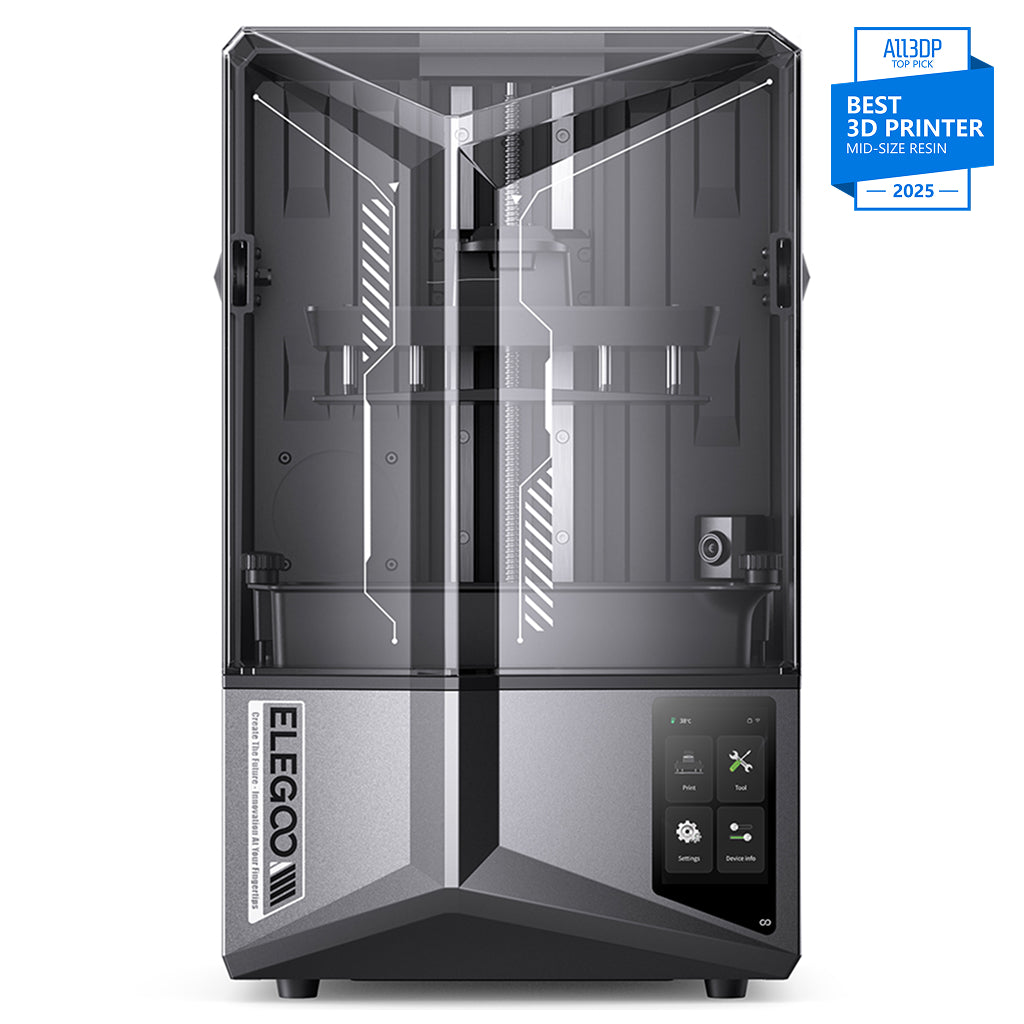
ELEGOO Saturn 4 Ultra 12K
Saturn 4 Ultra 12K (not the 16K variant)
A full unit in one job, at a resolution that resolves a 28 mm face. The printer that stops you printing figures one at a time.
- Build volume
- 218.88 × 122.88 × 220 mm
- Technology
- Resin MSLA
- Max speed
- Up to 150 mm/h (fast mode)
- Enclosed
- N/A (resin printer with hinged UV cover)
- Multi-colour
- No
- Auto levelling
- Yes (hands-free automatic levelling; tilt-release platform)
What we like
- A 219 mm plate takes a full unit in one job, not one figure at a time
- 19 × 24 μm resolves a 28 mm face and the detail on top of it
- Tilting vat and hands-free levelling, credited with fewer failures
- Two UK routes: ELEGOO's own store and 3DJake
What we don’t
- No heated vat, and cold resin is the most common cause of failed batches
- The self-levelling plate is awkward to clean between resins
- 14.5 kg and a full desk footprint
- The failure camera is a convenience, not a safety net
The plate measures 218.88 × 122.88 × 220 mm, behind a 10-inch 12K mono LCD at 11520 × 5120 giving 19 × 24 μm. That is comfortably inside what a 28 mm figure needs, and the area is the point: a resin job cures a whole layer at once, so a plate of twenty models takes roughly as long as one. It levels itself, runs a 405 nm COB source with a Fresnel collimating lens, and slices in ChiTuBox.
Owners and reviewers repeatedly credit the tilting vat and automatic levelling with fewer failed prints than earlier Saturn models, which matters more on a full plate than on a single figure — a failure costs twenty models, not one. Two caveats. Several reviewers describe the self-levelling build plate as awkward to clean thoroughly, particularly when switching resins. And several treat the camera's failure detection as a nice-to-have rather than something to rely on.
The limitation that decides between this and the 16K: no heated vat. Owners of the 12K often cite cold resin as a cause of failures, whereas 16K owners praise the built-in vat heater. It sells through ELEGOO's UK store and 3DJake UK at £350–£450.
Buy it if you are building units rather than single models and your printing room is heated. Skip it if the room is cold, or your plans are a few characters at a time — the Mars 5 Ultra costs less and resolves finer.
Cheapest way in: ELEGOO Mars 5
The Mars 5 is the cheapest resin printer on this page, and this section exists mostly to tell you what that saving costs, because most guides do not.
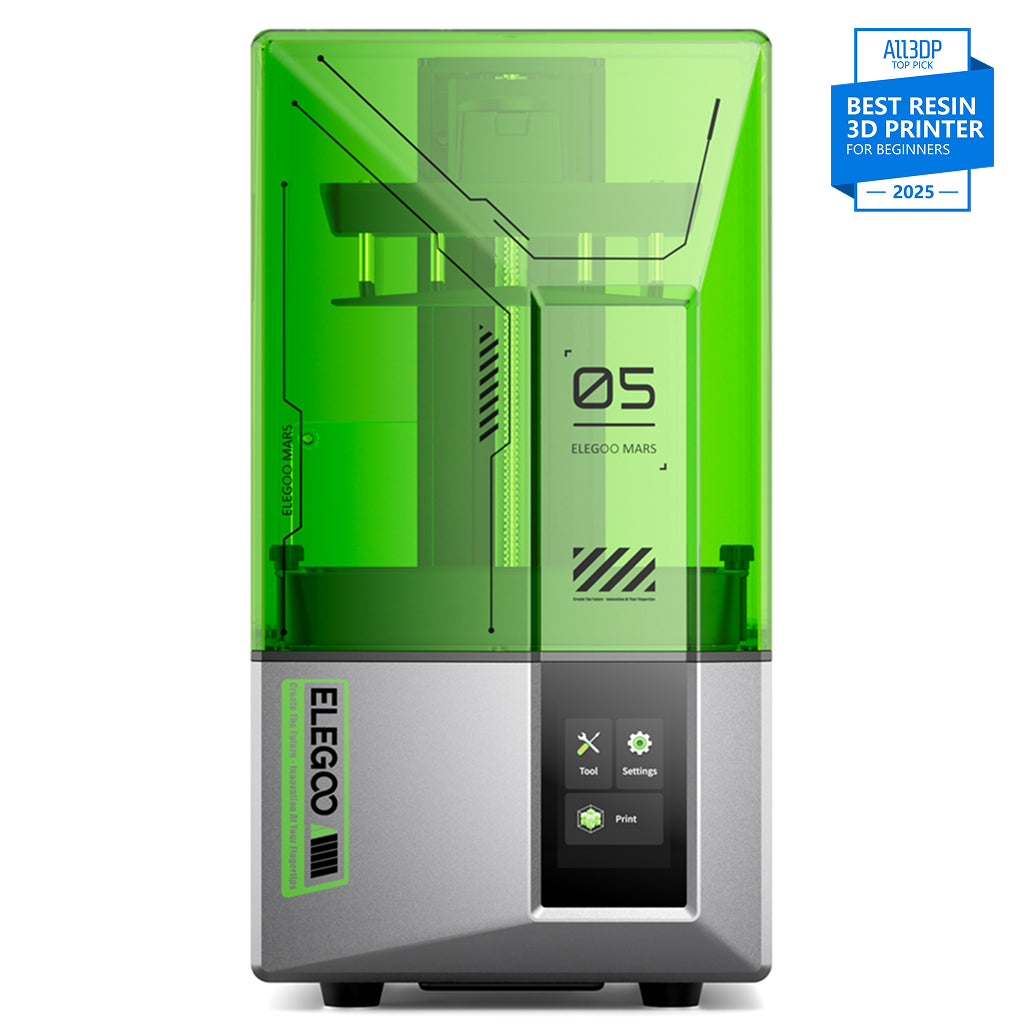
ELEGOO Mars 5
Mars 5 (4K, 6.6-inch - not the Mars 5 Ultra)
The lowest price here by a clear margin, and roughly double the pixel size of everything else. That trade is fine for terrain and rough for faces.
- Build volume
- 143.43 × 89.6 × 150 mm
- Technology
- Resin (MSLA)
- Max speed
- Up to 70 mm/h
- Enclosed
- Hinged cover (no filtration; compatible with the Mars Mate air purifier)
- Auto levelling
- Yes (one-click automatic levelling)
What we like
- The lowest price on this page by a clear margin
- One-click levelling, with resin, residue and levelling alarms
- 6.6 kg and shelf-sized
- Takes most resins on the market, including water-washable
What we don’t
- 35 × 35 μm pixels — roughly double the Mars 5 Ultra's, and it shows at 28 mm
- 143 × 90 mm plate: a handful of figures per job, not a unit
- USB only — no Wi-Fi, no app, no camera
- No filtration of its own; the purifier is a separate purchase
The specification that matters: 35 × 35 μm at 4098 × 2560 on a 6.6-inch 4K mono LCD. Set that against the Mars 5 Ultra's 18 × 18 μm and the Photon Mono 4 Ultra's 17 × 17 μm and the gap is about double, on the one axis that decides whether a 28 mm face has features. The plate is 143.43 × 89.6 × 150 mm — a handful of figures, not a squad — at up to 70 mm/h with 0.01 to 0.2 mm layers at 0.02 mm Z accuracy.
What you do get is a properly equipped entry machine. One-click levelling with resin-shortage, residue and levelling-failure alarms, a 405 nm COB source, ChiTuBox or Voxeldance Tango over USB, and support for most resins including water-washable. At 6.6 kg it lives on a shelf. It has no filtration of its own, with the Mars Mate purifier sold separately — and a purifier is not ventilation. Both ELEGOO UK and 3DJake UK stock it at £140–£170.
Buy it if you want to find out whether resin suits you before spending, or you mostly print terrain, bases and scenery where the pixel matters less. Skip it if faces and armour detail are the reason you are buying at all — that is a false economy, and the Mars 5 Ultra is the machine you actually want.
Best first printer for detail: ELEGOO Mars 5 Ultra
The Mars 5 Ultra is the honest entry point for miniatures, as opposed to the entry point for resin. It costs more than the Mars 5 and buys back exactly the thing the Mars 5 gave up.
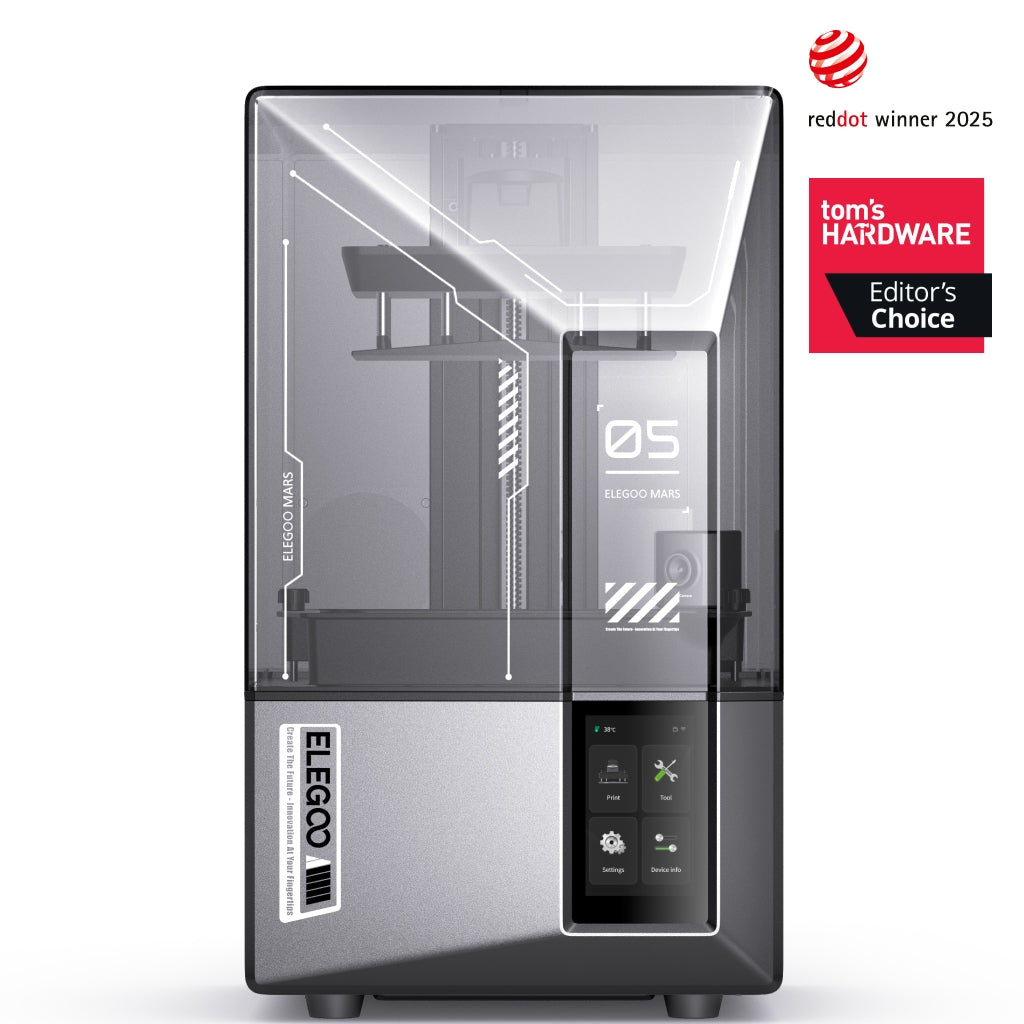
ELEGOO Mars 5 Ultra
Mars 5 Ultra 9K (not the non-Ultra Mars 5)
Square 18 μm pixels on a shelf-sized machine. The cheapest printer here that does justice to a 28 mm face.
- Build volume
- 153.36 × 77.76 × 165 mm
- Technology
- Resin (MSLA)
- Max speed
- Up to 150 mm/h (manufacturer maximum)
- Enclosed
- Lid (acrylic UV cover)
- Multi-colour
- No
- Auto levelling
- Yes (one-click automatic levelling)
What we like
- 18 × 18 μm square pixels — the resolution the Mars 5 does not have
- The easiest machine here to get a good first figure from
- 8.8 kg and shelf-sized, with Wi-Fi and a camera
- 12 months on the machine, and both UK stores hold it
What we don’t
- 153 × 78 mm plate suits skirmish forces, not armies
- Prints grip the plate hard until bottom exposure is dialled back
- No heated vat
- LCD covered for three months only
The screen is a 7-inch 9K mono at 8520 × 4320 giving 18 × 18 μm — square pixels, which means the same resolution along both axes rather than being finer one way. The plate is 153.36 × 77.76 × 165 mm: a skirmish force per job rather than a unit. It runs to 150 mm/h, manages 0.01 to 0.2 mm layers at 0.02 mm Z accuracy, levels in one click and takes most resins on the market. At 8.8 kg it is still a shelf machine.
Reviewers repeatedly describe it as one of the easiest resin printers to start with, needing very little setup before a first successful print. Several report that prints grip the plate more firmly than expected at first, and that reducing the bottom-layer exposure a little solves it. The failure-detection camera earns credit for catching problems mid-print, with the caveat that it cannot see the very early layers where most failures begin. ELEGOO gives 12 months on the machine and three on the LCD, with both UK stores holding stock at £210–£260.
Buy it if this is your first miniature printer and detail is the point. Skip it if you already know you want to print units — the Saturn's plate is worth making the jump for once rather than twice.
Finest pixel at 28 mm: Anycubic Photon Mono 4 Ultra
If the single question is "which of these resolves the finest detail on a small figure", this is the answer on the specification that matters most, and it is not the most expensive machine here.
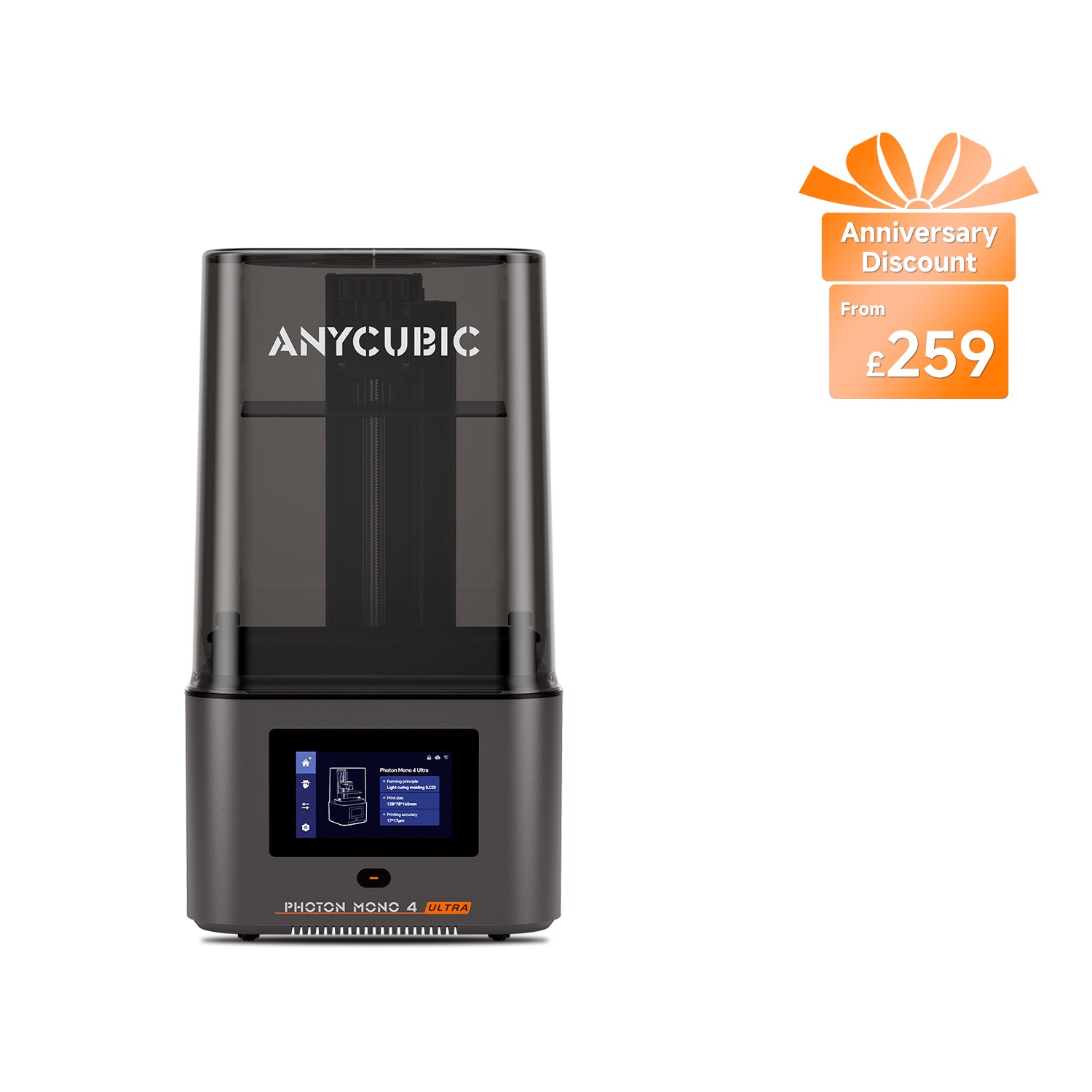
Anycubic Photon Mono 4 Ultra
Photon Mono 4 Ultra (not the Photon Mono 4 or Photon Mono 4 Max)
17 × 17 μm square pixels, the finest square pixel on this page. You level it yourself, and for detail work that is a fair trade.
- Build volume
- 153.4 × 87 × 165 mm (2.2 L)
- Technology
- Resin (MSLA)
- Max speed
- Max ≤80 mm/h; standard resin at 0.1 mm ≤80 mm/h, high-speed resin at 0.1 mm ≤120 mm/h (manufacturer maxima)
- Enclosed
- Lid (removable UV cover; Anycubic lists no hinged cover)
- Multi-colour
- No
- Auto levelling
- No — 4-point manual levelling
What we like
- 17 × 17 μm — the finest square pixel on this page
- Reviewers report it as dependable for small detailed models
- 5 kg and 66 W, the lightest and most frugal here
- Six months on the LCD, the longest screen cover of the six
What we don’t
- Four-point manual levelling, and no adjustable feet
- The bundled slicer needs watching, especially automatic supports
- Owners suggest swapping the supplied film for sharper results
- No heated vat, and a plate no bigger than the Mars 5 Ultra's
The 7-inch 10K mono LCD gives 17 × 17 μm over a 153.4 × 87 × 165 mm plate — a shade wider than the Mars 5 Ultra's. Layers run 0.02 to 0.15 mm at up to 80 mm/h with standard resin and 120 mm/h with high-speed. It draws 66 W and weighs 5 kg, the lightest and most frugal machine here.
The trade is levelling: four-point and manual. Reviewers are split on this — some see manual levelling as a good thing, though the lack of adjustable feet means an uneven surface has to be corrected another way. On output, reviewers repeatedly describe this printer as dependable for small detailed models, which is exactly the use case here. Two things to plan for: a recurring recommendation is to swap the supplied fast-release film for a clearer type if maximum sharpness matters, and several reviewers report that the bundled slicer needs watching, with automatic supports worth checking on each plate. Anycubic gives 12 months on main components and six on the LCD — the longest screen cover here — with both UK stores listing it at £240–£290.
Buy it if display-standard single figures are what you print and you are happy to level a plate. Skip it if you want to press print and walk away, or you need the plate area to batch a force.
Best for a cold room: ELEGOO Saturn 4 Ultra 16K
Read this section before you pay the premium, because the reason to buy this machine is almost certainly not the one on the box.
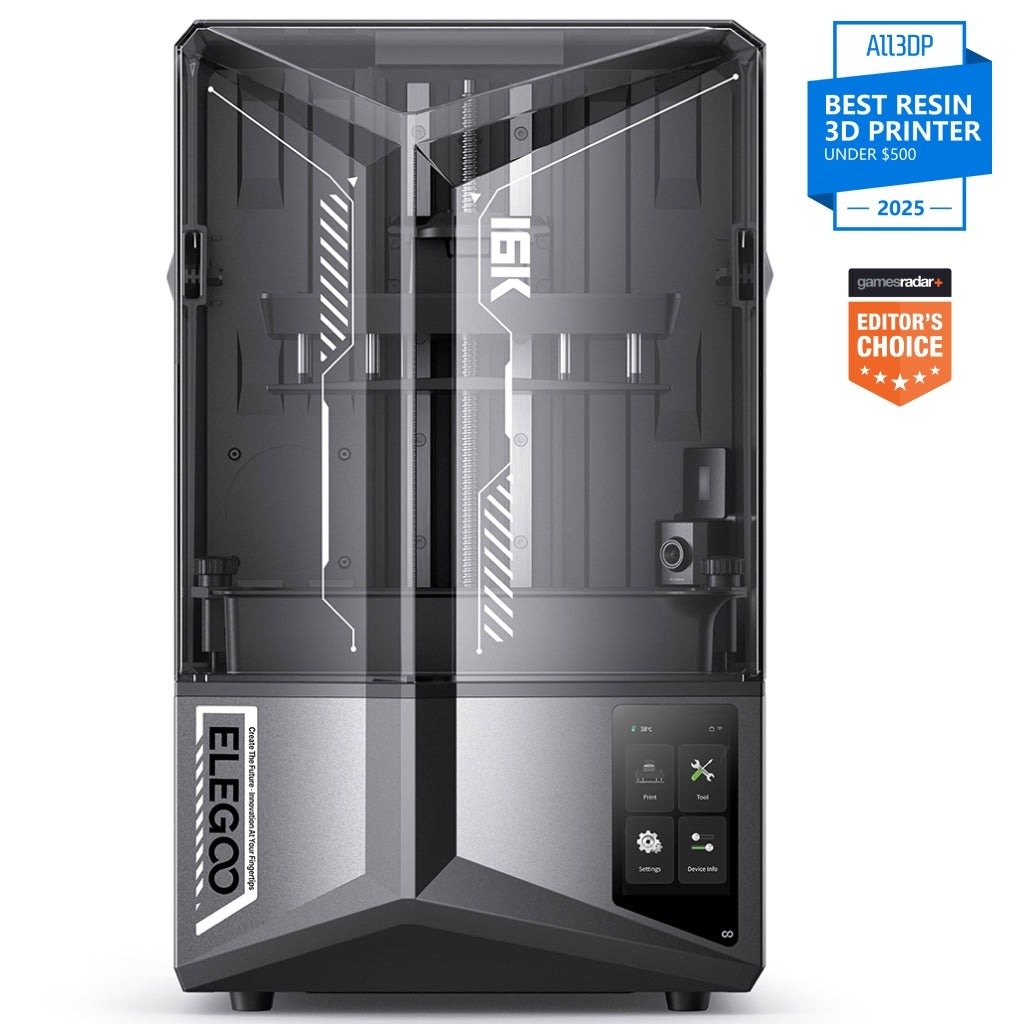
ELEGOO Saturn 4 Ultra 16K
Saturn 4 Ultra 16K (not the 12K Saturn 4 Ultra)
The 16K screen is not what you are paying for. The heated resin tank is, and in an unheated room it is the difference between a batch working and not.
- Build volume
- 211.68 × 118.37 × 220 mm
- Technology
- Resin (MSLA)
- Max speed
- Up to 150 mm/h (fast mode, manufacturer maximum)
- Enclosed
- Lid (acrylic UV cover)
- Multi-colour
- No
- Auto levelling
- Yes (one-click automatic levelling)
What we like
- Heated tank held at 30 °C — the actual reason to buy this machine
- 14 × 19 μm, the finest resolution here on paper
- Dual-band Wi-Fi and a camera reviewers rate for remote monitoring
- Barely more expensive than the 12K
What we don’t
- The 16K step over the 12K is not visible at tabletop viewing distance
- Smaller plate than the 12K: more pixels, less printable area
- ELEGOO publishes its own troubleshooting for heating and tank errors
- No filtration — it still needs a ventilated room
On paper it is the 12K with a finer screen: a 10-inch 16K mono LCD at 15120 × 6230 giving 14 × 19 μm against the 12K's 19 × 24 μm, on a smaller plate of 211.68 × 118.37 × 220 mm, because packing more pixels into the same panel shrinks the printable area.
Here is the part worth knowing. Reviewers who work in miniatures argue the 12K to 16K step is not significant at tabletop viewing distance, and that the heated tank is the real difference between the two. The reasoning is about eyesight rather than marketing: at these pixel sizes you would have to hold the model a few centimetres from your eye to see the difference. What does change outcomes is the smart heating tank held at 30 °C. Owners and reviewers repeatedly single out the heated vat as the feature that makes cold-room printing practical, though it does add a warm-up wait before a job starts.
It is not trouble-free. ELEGOO publishes its own troubleshooting for heating and resin-tank errors on this model, which several owners encounter. And reviewers are blunt that it has no filtration of its own and needs a properly ventilated room rather than a spare bedroom. It levels automatically, connects over dual-band Wi-Fi, weighs 16.1 kg and sells at £370–£420.
Buy it if your printing space is cold. Skip it if it is warm — buy the 12K, keep the larger plate and spend the difference on resin.
Best for printing an army: Anycubic Photon Mono M7 Pro
If the plan is a force rather than a few characters, throughput becomes the specification that costs you evenings, and this machine is built for it.
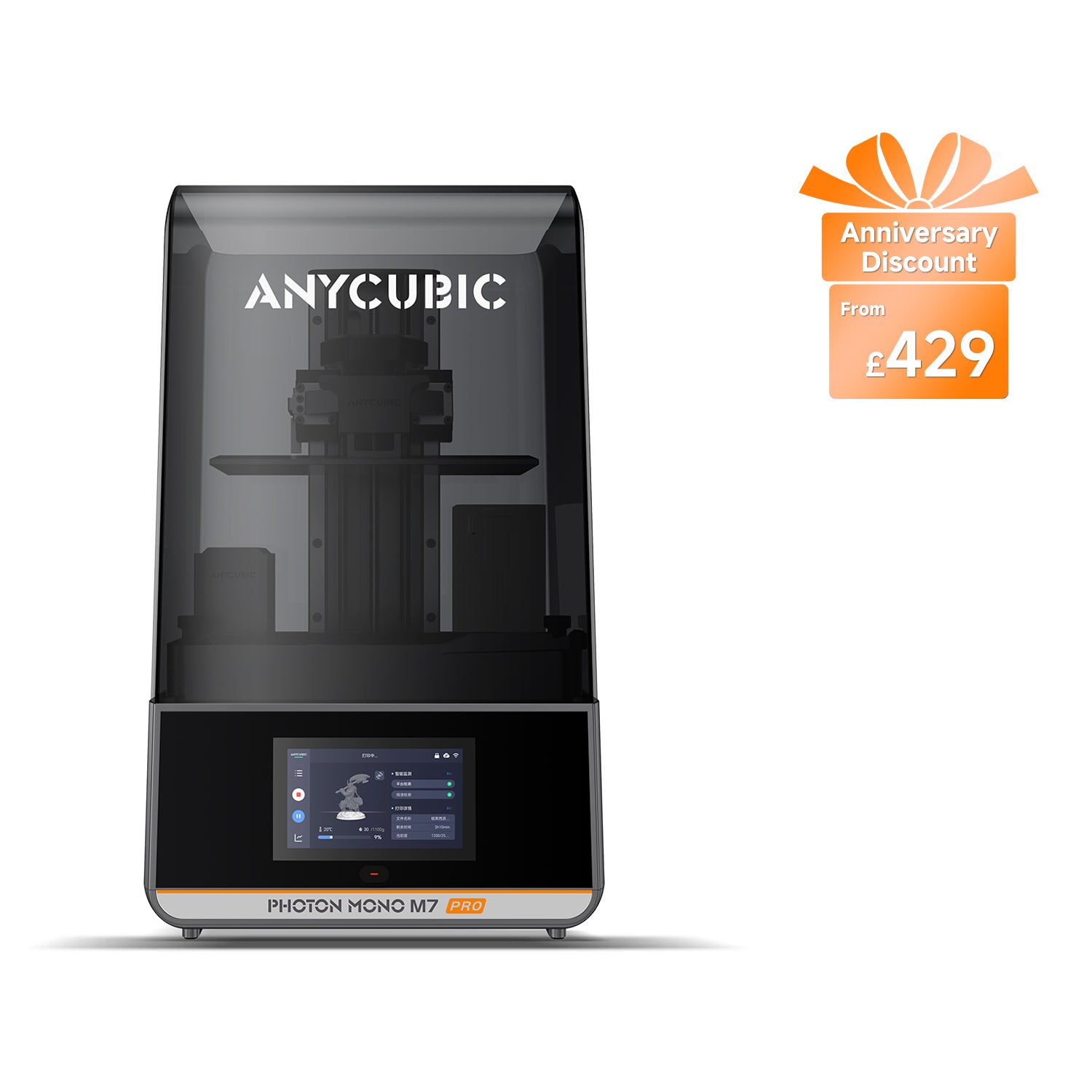
Anycubic Photon Mono M7 Pro
Photon Mono M7 Pro (not the Photon Mono M7 or M7 Max)
The fastest machine here on the largest desktop plate, with heated resin. The automation is also the part that needs the most attention.
- Build volume
- 223 × 126 × 230 mm (6.5 L)
- Technology
- Resin (MSLA)
- Max speed
- Max ≤130 mm/h; standard resin at 0.1 mm ≤130 mm/h, high-speed resin at 0.1 mm ≤170 mm/h (manufacturer maxima)
- Enclosed
- Lid (removable UV cover; Anycubic lists no hinged cover)
- Multi-colour
- No
- Auto levelling
- Yes (levelling-free)
What we like
- Up to 170 mm/h with high-speed resin, the fastest of the six
- 223 × 126 mm, the largest desktop plate here
- Integrated resin heating and automatic fill-and-drain
- Reviewers describe it as quiet in use
What we don’t
- Owners repeatedly report the automatic feed as inconsistent as the bottle empties
- The feed system and bolted tank add cleaning steps on a colour change
- Air purification is an optional accessory, not a built-in filter
- No power-loss resume, on the machine most likely to run long batches
Speed runs to 130 mm/h with standard resin and 170 mm/h with high-speed, ahead of the 150 mm/h ceiling the ELEGOO machines quote, on a 223 × 126 × 230 mm plate — the largest desktop area here. The screen is a 10.1-inch 14K at 16.8 × 24.8 μm, which is around the 12K Saturn rather than the fine end. It is levelling-free, rides dual linear rails at 10 μm precision, and fills and drains the vat automatically with dynamic temperature control.
That automation is the thing to weigh on a machine you will leave running. Owner and reviewer reports repeatedly describe the automatic resin feed as inconsistent, particularly as the bottle empties, and the manufacturer publishes its own troubleshooting and sells replacement pump tubing for it. A recurring theme is that the feed and bolted tank add cleaning steps, particularly when changing resin colours — which matters if you print different factions in different resins. Against that, the integrated resin heating is widely regarded as a genuine improvement over the previous bolt-on version, and some reviewers describe the machine as running quietly, with little more than a low hum from the fans.
Two specifications for long batches: power-loss resume is not supported, and air purification is an optional AirPure accessory rather than a built-in filter. It sells at £410–£470.
Buy it if you are printing a force and the hours are a real cost. Skip it if you print occasionally — the Saturn 12K does the same work more simply for less.
What pixel size actually means at 28 mm
This is the number that decides everything on this page, and it is routinely quoted without being explained.
The K rating is not the resolution. A "16K" figure counts pixels on the panel. Sharpness is the XY resolution — how large each pixel actually is — and that depends on spreading those pixels across the screen. A larger panel at the same pixel count gives bigger pixels, which is why the 10-inch 16K Saturn resolves 14 × 19 μm while machines with larger screens resolve more coarsely. Compare the micron figure, never the K.
Now scale it to a figure. A 28 mm heroic-scale model is roughly 32 mm to the top of the head, and a face on one is a few millimetres across. At 17 μm you have something like a hundred and fifty pixels across that face; at 35 μm you have half of it. That is the difference between an eye socket and a dimple, and it is why the Mars 5 at 35 × 35 μm and the Photon Mono 4 Ultra at 17 × 17 μm are not the same purchase with a different price.
Square pixels are worth something. A machine quoted at 19 × 24 μm is finer on one axis than the other, so a surface can resolve differently depending which way the model faces on the plate. The 18 × 18 μm Mars 5 Ultra and 17 × 17 μm Photon Mono 4 Ultra are square, and it shows most on rounded surfaces such as cloaks and shields.
And then it stops mattering. Past a certain point the limit stops being the printer and becomes the resin, the exposure and how well you supported the model. Which is the honest answer to whether 16K is worth it, and it is the next section.
How many miniatures fit on a plate
Resin cures a whole layer at once, so a plate holding one figure and a plate holding twenty take about the same time. Plate area is not really a size specification — it is how quickly you can build a force.
The spread here is wide. The Mars 5's 143.43 × 89.6 mm is a handful of 28 mm models. The Mars 5 Ultra at 153.36 × 77.76 mm and Photon Mono 4 Ultra at 153.4 × 87 mm take a small squad. The Saturn 12K's 218.88 × 122.88 mm is roughly double that footprint, and the M7 Pro's 223 × 126 mm a shade more again.
The practical consequence: if you print single characters, buy resolution. If you print units, buy area — the extra pixels on a small plate will not save you the evenings that a bigger plate does. And remember height is free. A tall thin plate of models supported at an angle uses the Z axis you paid for anyway.
Supports, breakages and getting paint to stick
The printer is about a third of whether a figure comes out well. The rest is workflow, and it is where new owners lose models.
Supports decide the surface. Every support leaves a mark where it touches, so the craft is in putting them where they will not show — under cloaks, inside bases, on the back of a shield. Several reviewers report that bundled slicers need watching, with automatic supports worth checking on each plate, which is the single most common cause of a plate that fails halfway.
Thin parts are what break. Spears, banners, outstretched arms and swords are the casualties, and standard resin is brittle once fully cured. Tough or ABS-like resins trade a little crispness for parts that survive being picked up, and most machines here take them: the Mars 5 and Mars 5 Ultra both state support for most resins on the market, water-washable and ABS-like included.
Washing and curing decide whether paint sticks. A model that comes off the plate still tacky with uncured photopolymer will reject primer. It gets washed in isopropyl alcohol, dried, then cured under UV. Under-cure and the surface stays soft; over-cure and thin parts get brittle faster.
And the safety side is real. Uncured resin is a skin and respiratory irritant, so gloves and a covered surface are not optional, and owners consistently report that the lid does not contain resin fumes, so ventilation or extraction is treated as a requirement rather than an option. Specialist reviewers also stress that uncured resin should be cured before disposal rather than washed away, and that resin-contaminated alcohol is hazardous waste. None of these machines filters as standard; where filtration exists at all it is an optional accessory, and it reduces odour rather than replacing a ventilated room.
What it costs to print a force in the UK
Resin is the number that moves. Standard grey sits in the region of £20 to £35 per litre in the UK when checked, with tough and speciality resins higher. Consumption depends on model size, hollowing, supports, failed plates and what stays in the vat — a hollowed 28 mm figure uses very little, but a full plate of solid models, printed twice because the first attempt failed, uses a surprising amount.
Consumables are the ones people forget. Release film is a routine consumable on these machines, and owner opinion is divided on whether a tilting vat lengthens or shortens its life. Owners commonly budget for release film and eventually a replacement LCD as consumables on this class of printer. The warranties tell you how the makers see it: ELEGOO covers the LCD for three months against 12 on the machine, Anycubic for six.
Then the workflow. Alcohol for washing, which gets dirty and needs replacing, gloves, paper, and a container for waste resin. Reviewers consistently point out that the printer is only part of the outlay, since washing, curing, alcohol, gloves and ventilation all sit on top.
Electricity is the small line. At 25p per kWh, the Photon Mono 4 Ultra's 66 W supply costs about 1.7p an hour and the M7 Pro's 240 W about 6p, so even a long overnight batch is well under a pound before the curing station.
Buying in the UK, and what you are allowed to print
Two routes for everything here. ELEGOO sells the Saturn 12K, the 16K, the Mars 5 and the Mars 5 Ultra through its own UK store with 3DJake UK stocking them too, and Anycubic stocks the Photon Mono 4 Ultra and M7 Pro in its UK store with 3DJake also listing them. That is unusually healthy: every machine on this page has more than one UK supplier.
Warranty terms differ more than the prices. ELEGOO gives 12 months on the machine and three on the LCD; Anycubic gives 12 months on main components and six on the screen. On a consumable part, twice the cover is worth something. Owners on UK review sites more often than not describe ELEGOO's support as quick to respond, with the recurring complaints being transit damage and postage on returns. Whichever you buy, your rights are against the retailer rather than the brand under the Consumer Rights Act 2015.
And the question nobody answers. A great deal of the search traffic for miniature printers is people wanting to print models from games they already play. Copying a copyright-protected work is an act restricted by the Copyright, Designs and Patents Act 1988, and a sculpt is protected like any other work — so printing a manufacturer's own models from files you were not licensed to use is not something this site will help you do. What is entirely legitimate, and much larger than most people realise, is the licensed STL market: independent sculptors sell tabletop-scale models under their own terms, and that is what most home printers are actually printing. This is general information rather than legal advice.
Which miniature printer should you buy?
The Saturn 4 Ultra 12K is the machine for most people printing tabletop figures, because plate area is what turns a hobby into a finished force. The Mars 5 Ultra is the sensible way in. Be careful at the very bottom: the Mars 5 is a good printer at a very good price, but at 35 μm it is not really a miniatures printer, and that is the one saving on this page likely to disappoint you. Whatever you buy, budget for the wash-and-cure routine as well — it decides whether the models get painted or stay in a drawer.
- Buy it if
- You are printing units rather than single figures — the ELEGOO Saturn 4 Ultra 12K — or, if this is your first miniature printer, the Mars 5 Ultra for its square 18 μm pixels at half the money.
- Skip it if
- Your printing room is cold (take the 16K for its heated vat), you want the finest pixel on a small plate (the Photon Mono 4 Ultra), or you are batching a whole army (the M7 Pro).
How this article was researched. Specifications come from manufacturer sheets and product pages, price ranges and stock from UK stores on 8 September 2026, and owner patterns from manufacturer documentation and miniatures-specialist and UK review sites, aggregated across many reports rather than taken from any single one. Commercial pages on this site are refreshed quarterly.
Common questions
- What pixel size is good for miniatures?
- Aim for 20 μm or finer. At 28 mm heroic scale a face is a few millimetres across, so the pixel is what decides whether an eye socket or a chainmail link resolves at all. Everything on this page except the ELEGOO Mars 5 sits between 14 and 24 μm; the Mars 5 is 35 × 35 μm, which is roughly double and is the reason it costs less. Compare the micron figure, never the K number — a bigger screen at the same pixel count means larger pixels, not smaller.
- Which resin printer produces the smoothest figures?
- On paper the ELEGOO Saturn 4 Ultra 16K, at 14 × 19 μm. In practice the Anycubic Photon Mono 4 Ultra's 17 × 17 μm square pixels are the more useful shape, because a square pixel gives the same resolution on both axes rather than being finer one way than the other. The difference between any of them is smaller than the difference a clean wash, a full cure and well-placed supports make.
- Is 16K noticeably better for miniatures?
- Not for the resolution. Reviewers who work in miniatures argue the step from the 12K's 19 × 24 μm to the 16K's 14 × 19 μm is not visible at the distance anyone looks at a tabletop figure. What the 16K adds that does matter is the heated resin tank, which keeps resin flowing in a cold room. If your printer lives somewhere unheated, that is the reason to pay the difference — not the screen.
- How many miniatures fit on one plate?
- It depends on the plate, and this is where the money goes. The Mars 5's 143 × 90 mm surface takes a handful of 28 mm figures; the Mars 5 Ultra and Photon Mono 4 Ultra at roughly 153 × 80 mm take a small squad; the Saturn 4 Ultra's 219 × 123 mm takes a full unit in a single job. Since a resin print takes about as long for one figure as for a plate full of them, plate size is really print-run size.
- Can I print Warhammer miniatures at home?
- Not lawfully, if you mean copies of a manufacturer's own models. Making a copy of a copyright-protected work is an act restricted by the Copyright, Designs and Patents Act 1988, and that covers a sculpt as much as a drawing. What is legitimate is the very large market in licensed STL files: independent sculptors sell tabletop-scale models under their own licences, and those are what most home printers actually print. This is general information, not legal advice.
- What else do I need besides the printer?
- A wash-and-cure routine, isopropyl alcohol, nitrile gloves, a covered work surface and somewhere ventilated for the machine to live. Then resin, at roughly £20 to £35 per litre for standard grey, and release film and eventually a replacement screen as consumables. Budget for the workflow as well as the machine — it is the part that decides whether the printer is still in use in six months.