ELEGOO Mars 5 vs ELEGOO Mars 5 Ultra
ELEGOO's two Mars 5 machines hold nearly the same volume, and the cheaper one has the bigger plate. What the Ultra's 9K screen and tilting vat actually buy.
Independent and reader-funded. We earn a commission if you buy through our links, at no extra cost to you. How this works.
ELEGOO Mars 5 vs ELEGOO Mars 5 Ultra is sold almost everywhere as the small one against the big one. Set ELEGOO's two parameter tables side by side and they say something else.
The Mars 5 prints a 143.43 × 89.6 × 150 mm volume; the Ultra 153.36 × 77.76 × 165 mm. Multiply those out and the capacities land within about 2% of each other — and the plate area, which decides how many pieces fit at once, is roughly 8% larger on the cheaper machine. The Ultra is wider one way and narrower the other.
So the extra money buys something, but it is not room. It buys about three and a half times as many screen pixels, a rated 150 mm/h against 70 mm/h, and a vat that tilts to peel each layer rather than hauling the plate straight up. Whether that is worth it depends on what you print.
| Specification | 1 ELEGOO Mars 5 Ultra The detail machine | 2 ELEGOO Mars 5 The value machine |
|---|---|---|
| Best for | Fine detail, speed and remote monitoring | Painting miniatures, batching, a fixed budget |
| Key strength | 3.5× the screen pixels and a tilting vat that doubles the rated speed | Nearly the same capacity with a larger plate, for appreciably less |
| Main limitation | Replacement screen costs about twice as much, on 3 months' cover | 35 µm pixel shows on close-up work; USB only |
| Screen | 7-inch 9K mono, 8520 × 4320 | 6.6-inch 4K mono, 4098 × 2560 |
| XY resolution | 18 × 18 µm | 35 × 35 µm |
| Plate area | 153.36 × 77.76 mm — about 11,900 mm² | 143.43 × 89.6 mm — about 12,850 mm² |
| Z height | 165 mm | 150 mm |
| Layer range / Z accuracy | 0.01–0.2 mm / 0.02 mm | 0.01–0.2 mm / 0.02 mm — identical |
| Rated max speed | 150 mm/h | 70 mm/h |
| Release mechanism | Tilting vat peels each layer sideways | No release row published |
| Connectivity | USB and Wi-Fi | USB only |
| Monitoring | AI camera, warp and empty-plate detection, power-loss resume | Sensor alarms only — no camera listed |
| Touchscreen | 4-inch capacitive | 3.5-inch resistive |
| Replacement screen (UK) | Around the £110 mark | Around the £55 mark |
| UK warranty | 12 months machine, 3 months screen | 12 months machine, 3 months screen |
| UK price band | £210–£260 | £140–£170 |
| UK availability | On backorder at the retailer checked | Out of stock at the retailer checked |
How this comparison was put together
No printing was done for this page. The ELEGOO Mars 5 compared with the ELEGOO Mars 5 Ultra here is desk research, and saying so matters, because the conclusion cuts against how the pair is usually sold.
Three kinds of document carry it: ELEGOO's two product pages, which supply the parameter tables; its Mars 5 series page, which sets both machines out together and lists tilt release, the AI camera, Wi-Fi and power-loss recovery under the Ultra while publishing no equivalent rows for the standard machine; and the Mars 5 manual, which carries the consumable detail no product page does. UK prices and stock come from an authorised retailer.
Where ELEGOO publishes nothing, this page gives nothing, and competitors were read only for the gaps.
The build volumes are not what the listings imply
Neither machine is meaningfully bigger, and the axis that differs most favours the cheaper one.
Axis by axis, the Ultra gains just under 10 mm in X, loses nearly 12 mm in Y, and gains 15 mm in Z. The middle one is rarely mentioned anywhere.
The consequence is that the Mars 5's plate covers roughly 8% more working area, and the shortfall falls in the short direction, where a row of figures runs out of room first. Multiply each plate by its own height and the totals differ by about 2%, which is to say not at all. Batch several models and the Mars 5 fits more; print one tall piece and the Ultra's height is its only advantage.
Height is also what owners of the dearer machine complain about. The most consistent criticism in independent reviews is the plate itself: reviewers repeatedly describe the Z height as the machine's one real limit, with taller pieces needing to be angled or split. That is said of the taller of the two: a bust needing splitting on one usually needs splitting on the other.
Desk space barely separates them; weight does, at 6.6 kg against 8.8 kg. If you need more room than either offers, the best resin printers roundup covers larger classes.
What 35 µm against 18 µm actually buys
This is the real question behind Mars 5 or Mars 5 Ultra, and the answer is narrower than either side of the argument allows.
Both are MSLA printers: a monochrome LCD masks off all but the current layer, exposed in a single flash. The screen is the lens, and its pixel size — the smallest square of resin addressable — sets horizontal detail. The Mars 5's 4K panel gives a 35 µm pixel; the Ultra's 9K panel gives 18 µm, about three and a half times as many.
A frame of reference helps more than the ratio. Take the head of a figure at 28 mm scale, about 4 mm across: the Mars 5 has roughly 114 pixels to describe it, the Ultra about 222. Both are enough for eyes, a nose and a mouth; the second is enough for an eyelid's edge.
Now the limit nobody mentions. The Ultra improves horizontal resolution only. Both publish the same layer range and Z accuracy, so vertical stepping on a shallow curve — the usual reason a resin print looks ridged — is identical. It buys sharper outlines, not smoother layers.
So the answer depends on what happens to the model next. Reviewers generally describe the 4K panel as enough for most hobby printing and limiting mainly at the fine end, such as jewellery masters or display pieces examined closely. Primer and paint sit on the surface and fill the finest detail either machine produces. For miniatures you will paint, the Mars 5's pixel is rarely the limit; for bare grey masters and moulds, the Ultra's panel is the best reason to pay more. The best resin printers for miniatures roundup sets both against the alternatives.
Speed, and the tilting vat behind it
The headline is 150 mm/h against 70 mm/h, and for once the gap has a mechanism behind it — though it is still a ceiling.
Note the unit: speed here is height per hour, not distance travelled, because the whole layer is exposed at once — so a plate of nine models takes about as long as one.
What limits layer rate is the peel, not the light. Each cured layer sticks to the film at the vat's base, and a conventional machine lifts the plate straight up and waits for the suction to break, which is slow and pulls on model and film alike. The Ultra tilts the vat instead, peeling each layer off from one side, which is what the higher figure rests on.
ELEGOO publishes tilt release for the Ultra and no release-mechanism row at all for the Mars 5 — an absence from the published tables, not the company saying the Mars 5 lacks it, and this page claims no more.
On a 100 mm piece those maxima put the Ultra at about forty minutes against nearer ninety. Both are manufacturer maxima: real times depend on the resin, the exposure and the layer height, and nothing was printed here to check either.
The mechanism is not pure gain. The release film is a routine consumable on this machine, and owner opinion is divided on whether the tilting vat lengthens or shortens its life, so reports vary. It is the same part on both.
Wi-Fi, the camera and the rest of the Ultra's case
Beyond the screen and the vat, the Ultra's remaining argument is that it watches itself — sound on paper, shakier in practice.
The difference comes from the two published lists. The Mars 5 takes files over USB from a resistive touchscreen, and its monitoring is one-click levelling, self-check and overheat protection plus a sensor watching for a resin shortage, debris in the vat or a failed levelling attempt. The Ultra adds Wi-Fi, a capacitive screen, and an AI camera that checks the plate is empty, looks for warping and resumes after a power cut.
That contrast rests on two lists ELEGOO publishes, not an assumption about the cheaper machine.
Whether it earns its keep is less settled. Several reviewers report that the Ultra's network printing and remote monitoring did not work for them first time and that they fell back to transferring files on a USB stick, though this is a software picture that may have moved since.
Software states change, so treat these features as a bonus you might get rather than a reason to pay the difference on their own — which makes the Mars 5's USB-only workflow less of a deficiency than it looks.
Living with either one, according to owners
Everything here was researched from community threads, forums and independent owner write-ups, and none of it is a test result. One asymmetry needs stating: the owner record for the Ultra is far thicker than for the Mars 5, and patterns for one are not transferred to the other.
The dominant pattern belongs to the Ultra and is the most useful thing a new owner could be told. A recurring account across independent reviews is that cold, thick resin is what defeats this machine's automation — the levelling sensor triggers early and the first layer stays on the film — and that warming the resin or the room is the usual fix. Neither machine has a heated vat, and both rely on one-click automatic levelling — a routine that assumes resin thin enough to move out of the way. In an unheated British room in February it often is not.
The Mars 5's own record says something close from the other end. Reviewers report that the levelling-failure alarm does fire in normal use, and that clearing it means draining and filtering the resin — a chore, though better than finding the problem after a failed plate. The sensor works; the inconvenience is the price of it working.
Two duties come from ELEGOO rather than owners: film and screen are wearing parts with no replacement interval published, and resin left in the vat should be poured back and filtered. Neither is a machine you switch on and forget.
What each one costs to run in the UK
Electricity is a rounding error on both, and identical. The ownership difference is the screen — and it runs opposite to the purchase price.
ELEGOO publishes no rated wattage for either machine — only the supply, the same on both, giving an arithmetic ceiling of 72 W that is a ceiling rather than a draw. Any site comparing them on consumption is estimating. From that ceiling, with the Ofgem unit rate at about 26p per kWh, a continuous 72 W costs under 2p an hour: roughly 15p for an eight-hour print, under £2 for a hundred hours in a month. The real figure is lower.
Resin is the bulk of the cost and also identical: both take most resins on the market at the same assumed density. Vat and platform cost the same, around the £27 mark each, and one film set fits both at around the £5 mark per film.
The screen is the exception, and a large one. A replacement for the Mars 5 sits around the £55 mark; for the Ultra, around the £110 mark — twice as much, on a part carrying three months' cover against twelve on the machine. ELEGOO expects it to wear out but publishes no service life, so no interval is offered here. Against the Ultra's price band, a new screen is getting on for half the machine.
Reviewers consistently point out that the printer is only part of the outlay, since washing, curing, alcohol, gloves and ventilation sit outside the box. ELEGOO's own instruction is to wash prints in strong alcohol unless the resin is water-washable, which is an argument for water-washable resin.
Smell is the last of it, and neither machine filters. Owner accounts of resin odour in a home vary widely: some describe printing in a bedroom and noticing little, while others treat a ventilated room and added carbon filtration as essential. For the second group, ELEGOO's purifier is listed above the £140 mark — more than the Mars 5's whole price band. Budget for ventilation before the finer screen.
UK price, availability, warranty and support
ELEGOO Mars 5 versus ELEGOO Mars 5 Ultra in the UK has a shape the American comparisons miss, and on the day of writing neither was readily in stock.
The bands first: the Mars 5 in the £140–£170 band, the Ultra in the £210–£260 band. Both were on promotion in September and back at list by the October check, so the gap is at its widest now.
Where to buy, and what was in stock
Here is the useful UK finding, and it inverts the usual advice. At the authorised retailer checked on 4 October 2026, the Mars 5 was sold out and the Ultra was in stock from 11 November. The cheaper, more popular machine is the harder one to buy.
Both are also listed in sterling on ELEGOO's own UK store, and neither is run-out stock: both remain current with no announced successor. One trap: ELEGOO sells bundles priced between the two bare machines, so it is possible to pay Ultra money for a Mars 5 with resin attached. Read the SKU, not the headline.
Warranty, support and spares
The warranty is the same on both and worth reading twice: twelve months on the machine, three on the screen, six on the tank and plate, and no cover for the film, the cover or the tools. The screen — the dearest replaceable part, and twice the price on the Ultra — carries the shortest term of anything.
Spares run the other way: vat, platform and film are shared or identically priced. If both land above your budget, the best resin printers roundup covers the tier below.
Which one to buy
ELEGOO Mars 5 Ultra vs ELEGOO Mars 5 comes down to one question, and it is not budget: how closely will anyone look at what you print?
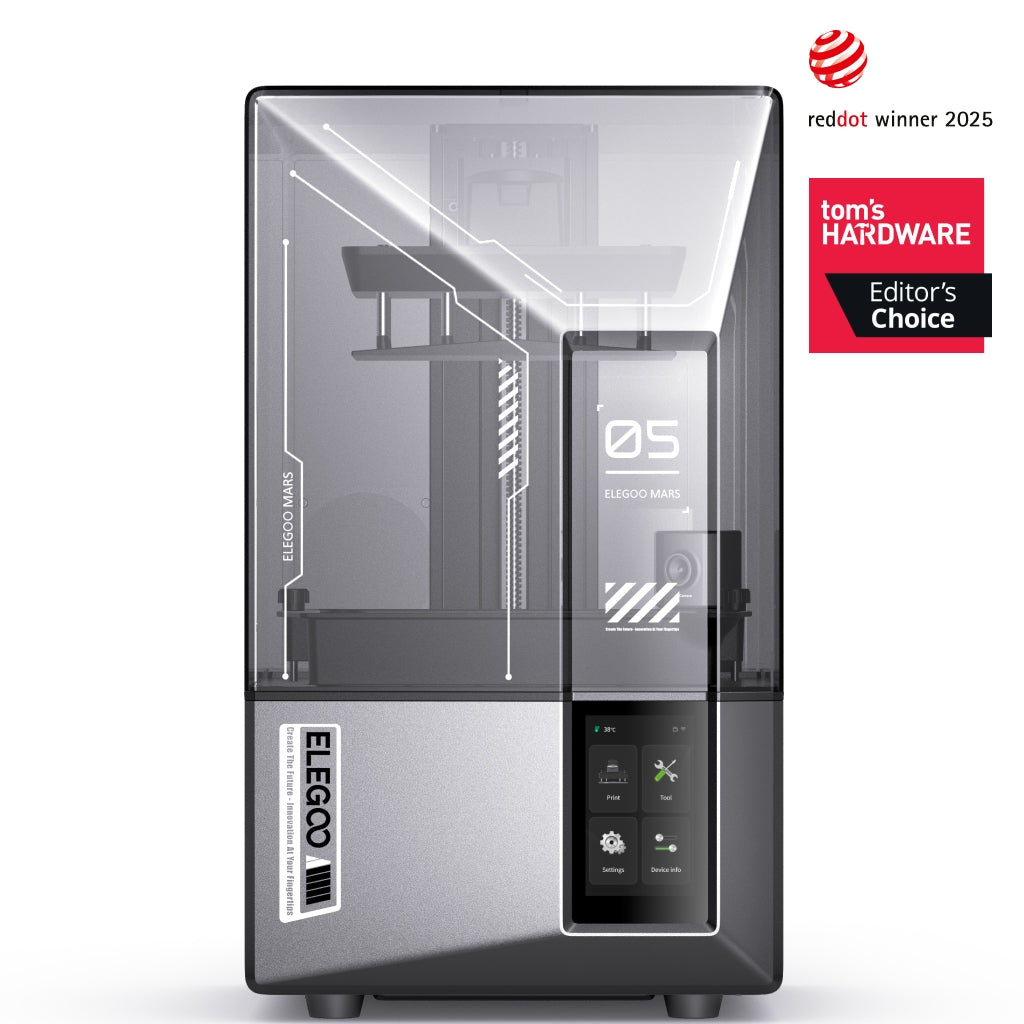
ELEGOO Mars 5 Ultra
Mars 5 Ultra 9K (not the non-Ultra Mars 5)
The one to buy when the surface matters: far more screen pixels over nearly the same plate, and a tilting vat.
- Build volume
- 153.36 × 77.76 × 165 mm
- Technology
- Resin (MSLA)
- Max speed
- Up to 150 mm/h (manufacturer maximum)
- Enclosed
- Lid (acrylic UV cover)
- Multi-colour
- No
- Auto levelling
- Yes (one-click automatic levelling)
What we like
- An 18 µm pixel against the Mars 5's 35 µm — about three and a half times the screen pixels, and the one advantage no setting on the cheaper machine can recover
- A tilting resin vat that peels each layer off sideways instead of lifting the plate away, which is what the 150 mm/h rating rests on
- 15 mm more Z height — the only capacity advantage either machine holds over the other
- Wi-Fi alongside USB, an AI camera with empty-plate and warp detection, and power-loss resume printing
What we don’t
- A replacement screen costs roughly twice the Mars 5's, on a part ELEGOO warrants for three months against twelve on the machine
- About 8% less plate area than the cheaper machine, and the shortfall falls in the short axis where a row of models runs out of room first
- Reviewers repeatedly report the network printing and remote monitoring not working first time, falling back to a USB stick
- Same 0.01–0.2 mm layer range and 0.02 mm Z accuracy as the Mars 5, so it buys horizontal detail only — not smoother layers
Buy the Ultra if bare resin is the finished article — masters, moulds, jewellery — because its finer pixel is the one advantage no setting on the cheaper machine can recover. The doubled build rate and the camera are secondary.
Skip the Ultra if your work gets primed and painted, if you batch on its smaller plate, or if a screen at double the price on three months' cover is a bill you would rather avoid.
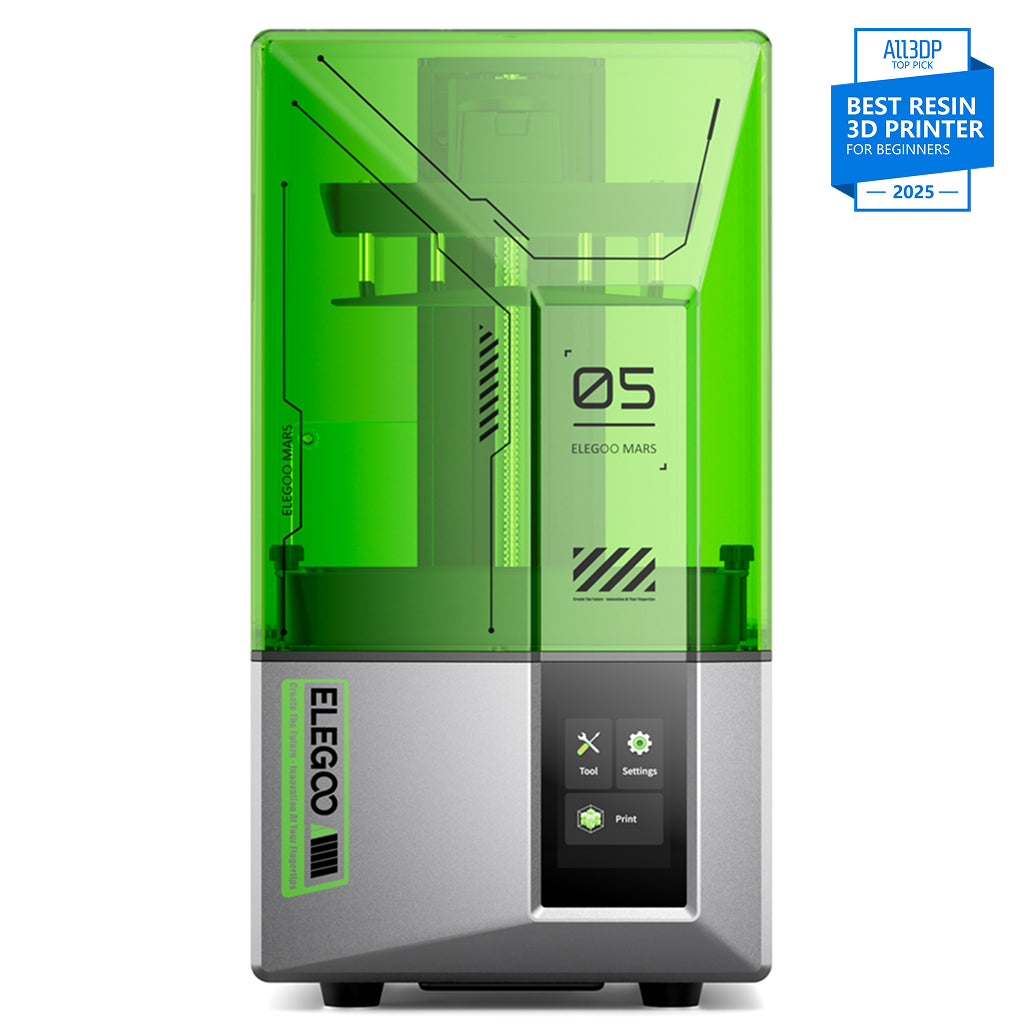
ELEGOO Mars 5
Mars 5 (4K, 6.6-inch - not the Mars 5 Ultra)
Not a cut-down Ultra but a differently shaped one: same resin range and levelling, a larger plate, and a screen at half the price.
- Build volume
- 143.43 × 89.6 × 150 mm
- Technology
- Resin (MSLA)
- Max speed
- Up to 70 mm/h
- Enclosed
- Hinged cover (no filtration; compatible with the Mars Mate air purifier)
- Auto levelling
- Yes (one-click automatic levelling)
What we like
- Roughly 8% more plate area than the Ultra, so a batch of models fits marginally better per print
- A replacement screen at about half the Ultra's price, on a machine that costs less to begin with
- The same resin range, the same one-click levelling and the same 0.01–0.2 mm layer range as the Ultra
- Its 35 µm pixel is rarely the limiting factor on anything that gets primed and painted
What we don’t
- The 35 × 35 µm pixel does show on bare resin examined closely — jewellery masters and display pieces
- USB only: no Wi-Fi, no camera, no warp detection and no power-loss resume
- Rated at 70 mm/h against the Ultra's 150 mm/h, so a tall print takes over twice as long
- A 150 mm Z height, 15 mm shorter than the Ultra, and it was the one out of stock at the UK retailer checked
Buy the Mars 5 if your models end up painted — most people's answer, and where its pixel is rarely the limit. Buy it to batch on the larger plate, or to keep for years with the wear part around the £55 mark rather than around the £110 mark. Its resin range, levelling and layer range are the Ultra's.
Skip the Mars 5 if you need the finer pixel for close-up work, or if the slower build rate would put you off printing — and note it was the one out of stock.
These are not a small printer and a big one. ELEGOO's own figures put their capacity within about 2% of each other and give the cheaper machine the larger plate, while both share the same layer range, resin list, levelling, supply and warranty.
What the Ultra buys is horizontal detail and a doubled build rate; what it costs after the sale is a screen at twice the money. Painted miniatures rarely show the difference, and a jewellery master always will. Decide on the work, not the spec sheet — and if neither fits, the best resin printers roundup is a better start.
- Buy it if
- Bare resin is the finished article, or you want speed and remote monitoring: take the Mars 5 Ultra.
- Skip it if
- Your models get painted, or you batch several per plate: take the standard Mars 5 and keep the difference.
How this article was researched
This comparison is research-based: no printing, washing, curing, measurement or photography was carried out, and nothing here is a test result. Specifications come from ELEGOO's own documents for the two named variants — the 4K Mars 5 and the 9K Mars 5 Ultra — not a bundle, a Mars 4 or a pre-owned unit. Plate areas, volumes, pixel counts and print times are arithmetic on its published figures, not measurements. Owner-reported patterns were researched from community threads, forums and independent write-ups, summarised in our own words and labelled where they appear; no review is quoted and no rating reproduced.
Five gaps are left open rather than filled. ELEGOO publishes no rated wattage, so the running-cost figures estimate from the supply ceiling. It publishes no service life for either screen, so no replacement interval is given. Its tables carry no release-mechanism row for the Mars 5, so this page records the absence rather than claiming what the machine does. The owner record is thinner for the Mars 5, and Amazon.co.uk was not checked. Prices are bands, checked on 4 October 2026.
Common questions
- Which is better, ELEGOO Mars 5 or ELEGOO Mars 5 Ultra?
- Better at what — because the two are far closer than the names suggest. ELEGOO's own parameter tables give them the same layer range, the same Z accuracy, the same resin list, the same one-click levelling, the same power supply and the same warranty terms, and put their total build capacity within roughly 2% of each other. The Ultra is not the bigger machine; it is wider in one horizontal axis, narrower in the other, and taller by 15 mm, which leaves the cheaper printer with about 8% more plate area to work on. So the question reduces to the three things that genuinely differ. The Ultra's screen addresses about three and a half times as many pixels, giving an 18 µm pixel against 35 µm. Its resin vat tilts to release each layer rather than pulling the plate straight up, which is what lets ELEGOO rate it at 150 mm/h against 70 mm/h. And it adds Wi-Fi, a monitoring camera and power-loss resume, none of which appears on the Mars 5's published list. If you need fine horizontal detail, the Ultra is better. If you do not, you are paying for resolution you will not see, and the Mars 5 is the better machine for the money. There is no universal winner here, only that criterion.
- Which has better print quality and reliability?
- On quality, the Ultra — but in one dimension only, and that distinction is usually lost. Its finer screen improves horizontal detail: crisper outlines, sharper edges, more pixels describing a given shape. It does nothing for vertical smoothness, because both machines publish an identical 0.01–0.2 mm layer range and the same 0.02 mm Z accuracy, so the layer stepping that makes a shallow curve look ridged is the same on both. Anyone implying the Ultra prints smoother layers is going beyond what ELEGOO claims. The practical catch is that primer and paint sit on top of the surface and fill the finest detail either machine resolves, which is why the advantage is clearest on bare resin and close to invisible on a painted figure at arm's length. On reliability there is nothing to separate them, and no printing was done for this page, so no first-hand judgement is offered. Both rely on the same one-click levelling routine, neither has a heated vat, and the pattern that dominates the owner record for this class is cold resin defeating the automation — the levelling sensor trips early and the first layer stays on the film. Warming the resin or the room is the fix, and it applies equally to both.
- Which offers better value for UK buyers?
- The standard Mars 5, for most people, and the reason is ownership rather than purchase. The two sit in the £140–£170 and £210–£260 bands, so the gap is roughly £90 at the top of each — and unlike most within-family gaps, this one keeps costing after the sale. The LCD is the expensive wear part on an MSLA printer, and the Ultra's replacement is about double the Mars 5's, on a panel ELEGOO warrants for only three months against twelve on the machine. Everything else is a wash: the vat and the build platform are the same price for both, one release-film set is listed as fitting either, resin costs the same per model, and the shared power supply means electricity is identical and trivial on both. Value tips to the Ultra in one clear case — work where the finer pixel is actually visible, which means bare resin, masters, moulds and jewellery rather than painted miniatures. Two UK timing points are worth knowing. Both machines were on promotion in September and both had returned to list price by early October, so the gap is currently at its widest. And at the retailer checked on 4 October 2026 the cheaper Mars 5 was sold out while the Ultra could be ordered on backorder, so availability may make the decision before the specification does.