ELEGOO Saturn 4 Ultra 16K Review
A UK review of the ELEGOO Saturn 4 Ultra 16K: what the heated tank really buys you, what it costs to own and run here, and when the 12K is the smarter buy.
Independent and reader-funded. We earn a commission if you buy through our links, at no extra cost to you. How this works.
The ELEGOO Saturn 4 Ultra 16K is sold on its screen, and the screen is the least interesting thing about it. The machine assessed here is the 16K version — 15,120 × 6,230 pixels on a ten-inch monochrome panel, a 14 × 19 μm pixel — not the 12K Saturn 4 Ultra sold alongside it, nor the non-Ultra Saturn 4 beneath both. It sits around the £370–£420 mark in the UK and is still current, with no successor announced.
What this ELEGOO Saturn 4 Ultra 16K review adds is what a product page will not: what the heated tank changes in an unheated British room, what the consumables cost here, and what the warranty quietly does not cover. No printing or measurement was carried out for it — every figure is traced to a source. Still choosing? The best resin printer uk guide ranks it against five rivals.
Which Saturn this is, and whether it is about to be replaced
Settle this first, because ELEGOO sells three machines with nearly the same name. The Saturn 4 is the entry model. The Saturn 4 Ultra adds the tilt-release platform and hands-free levelling but keeps a 10-inch 12K panel at a 19 × 24 μm pixel. This machine keeps that hardware and changes two things: the panel becomes 16K at a 14 × 19 μm pixel, and the tank gains heating that holds resin at 30 °C. ELEGOO lists no tank heating for the 12K. Hold on to that second change.
The obsolescence question is fair, and the answer is reassuring: no replacement has been announced, and it was still listed by ELEGOO and in stock at a UK retailer when this page was checked. For anyone buying an ELEGOO Saturn 4 Ultra 16K in the UK that matters more for spares than status — and it is sold by ELEGOO's UK store and at least two independent specialists.
The specification, and what each figure buys you
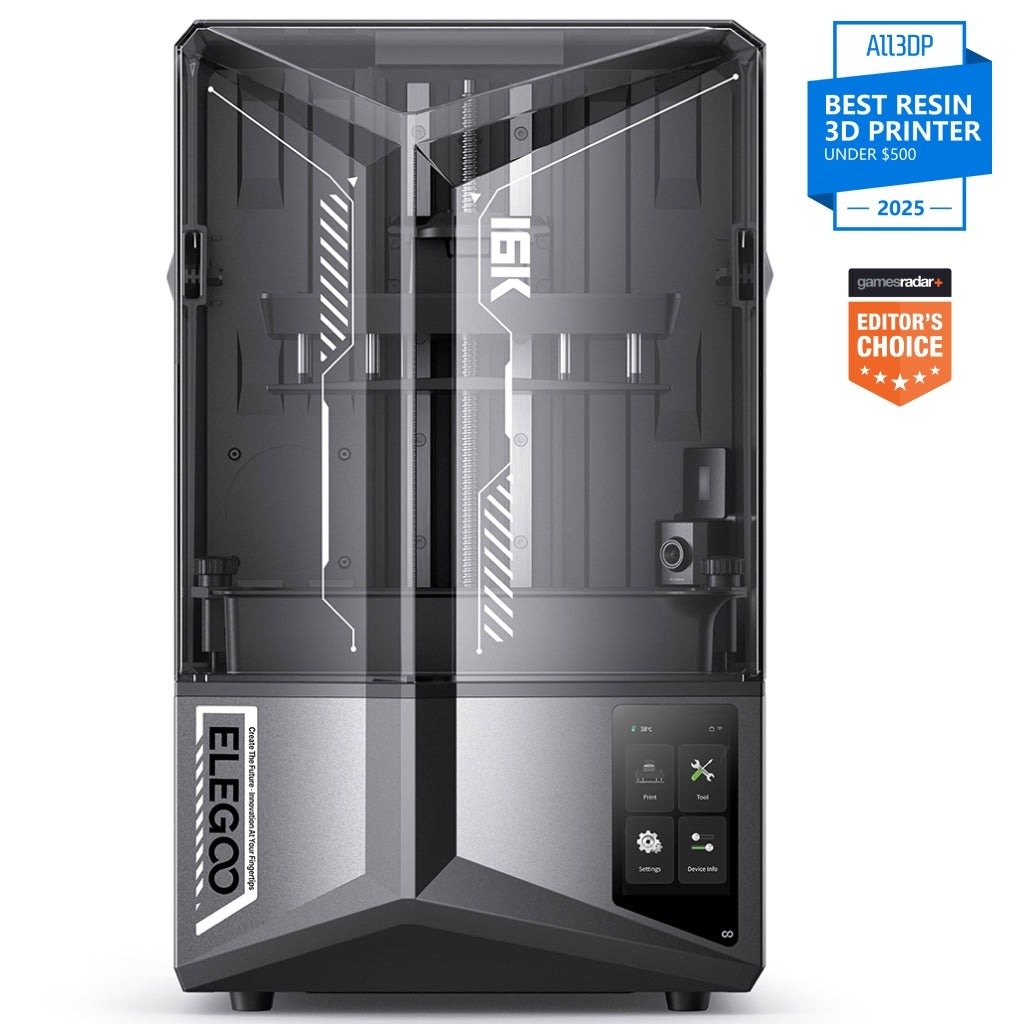
ELEGOO Saturn 4 Ultra 16K
Saturn 4 Ultra 16K (not the 12K Saturn 4 Ultra)
A ten-inch 16K resin printer whose real advantage is a heated tank and a tilting vat rather than the pixel count on the box.
- Build volume
- 211.68 × 118.37 × 220 mm
- Technology
- Resin (MSLA)
- Max speed
- Up to 150 mm/h (fast mode, manufacturer maximum)
- Enclosed
- Lid (acrylic UV cover)
- Multi-colour
- No
- Auto levelling
- Yes (one-click automatic levelling)
What we like
- A heated resin tank held at 30 °C — the feature that makes printing in a cold UK room practical
- Tilt Release peels each layer off the film sideways, which is where large-format resin printing usually fails
- A 10-inch 16K panel at a 14 × 19 μm pixel, a real step up from the 12K sibling
- One-click levelling, a lit monitoring camera, Wi-Fi, and a choice of SatelLite or ChituBox
- Sold by ELEGOO UK and two independent UK specialists, so spares have more than one route
What we don’t
- The LCD is warranted for three months against a part ELEGOO itself rates at up to 2,000 hours
- No built-in filtration — an air purifier is a separate accessory
- The resin tank fits this model only, despite sharing a chassis and a name with the 12K
- No acoustic rating published and no independent measurement found
Start with the plate: 211.68 × 118.37 × 220 mm, deep enough for a bust standing up and slightly narrower than the 12K's, because a finer pixel across the same panel buys detail rather than area. That pixel is 14 × 19 μm, which sets the smallest feature the machine can resolve horizontally; vertically you choose, with layers from 0.01 to 0.2 mm at a stated Z accuracy of 0.02 mm.
Two mechanisms change how it behaves. ELEGOO's Tilt Release tilts the resin tank to peel each layer off the film rather than pulling it straight up, which ELEGOO presents as what makes up to 150 mm/h in fast mode possible, at about 5.5 seconds a layer on its own defaults — maxima under manufacturer conditions, not a cruising speed. The second is the heated tank.
The rest is well covered: one-click levelling, and a camera with a chamber light that ELEGOO says flags an empty build plate or a warped model. A PFA release film is fitted, with a 9H tempered-glass protector over the LCD.
What it does well
The heated tank is the strongest argument for this machine, and it has nothing to do with resolution. Resin thickens as it cools, and thick resin flows back under a rising plate too slowly — hence soft detail, trapped bubbles and separated layers. Holding the vat at 30 °C removes the variable. Owners and reviewers repeatedly single out the heated vat as the feature that makes cold-room printing practical, though it does add a warm-up wait before each job. In a British garage in January that is the difference between a printer you can use in winter and one you cannot.
The tilting vat is the second advantage: peeling a layer sideways off the film takes less force than lifting it straight off, and force on a wide flat layer is where large-format resin printing goes wrong. The COB source and Fresnel collimating lens answer the other complaint large panels attract — that a part printed in a corner does not match one from the middle. It is also easy to live with from the first evening, with one-click levelling and gloves, a mask, a scraper and a tool kit in the box.
Buy this if you print detailed work and want the machine to handle the two things beginners get wrong — resin temperature and layer separation. Skip it if your room is reliably warm, you print at tabletop scale, and the cheaper sibling's panel would never be the limiting factor.
Where it falls short
The warranty runs out on the part most likely to need replacing. Cover is twelve months on the machine but only three on the LCD, against ELEGOO's own rating for that panel of up to 2,000 hours. The part with the shortest cover has the published service life; the running-cost section prices the consequence.
Spares are model-specific in a way that catches people out. The replacement resin tank sits around the £46 mark and fits this model only — not shared with the 12K, despite the near-identical name and the identical chassis.
There is no built-in filtration. An air purifier is a separate accessory. A recurring theme among reviewers is that the drip tray feels flimsy and that stray resin still finds its way onto the machine and the inside of the cover, so plan for regular wiping down.
The published figures stop short in two places. ELEGOO gives no acoustic rating and no independent measurement was found, so this review will not tell you how loud it is, and it publishes no rated wattage either. The failure detection is an aid, not a safety net: reviewers rate the lit camera highly for watching a print remotely, while consistently describing the automatic failure detection as having blind spots that make it a monitoring aid rather than a safety net.
What owners and reviewers consistently report
These are recurring themes from long-form reviews, community discussion and manufacturer troubleshooting material — and people write about a printer far more often when something has gone wrong than when it has not.
The resolution question resolves against the marketing. Reviewers who work in miniatures argue the 12K to 16K step is not significant at tabletop viewing distance, and that the heated tank is the real difference between the two.
Failures, when they come, are usually about release. A recurring account of large-format resin printing on this machine is that suction on wide flat layers, not the printer, is the usual cause of a failed print — and that angling the part and supporting it better is the fix, although experiences vary by resin.
Before you panic at an error message: Elegoo publishes its own troubleshooting for heating and resin-tank errors on this model, which several owners encounter, and most of the listed causes are contamination on the tank contacts rather than a broken part. On software, reviewers generally praise how quickly this model gets on the network and how usable the lit camera makes remote monitoring, while noting that the phone-app side of the software still lags behind.
Setup and the first fortnight
Getting to a first print is genuinely quick. Levelling is one-click, the machine joins a network over dual-band Wi-Fi from the touchscreen, and it slices in ChituBox if that is what you already know.
Reviewers consistently describe reaching a first print quickly, with the harder learning arriving afterwards in the washing, curing and resin handling rather than in the printer itself. That is worth saying plainly, because it is the part a specification sheet cannot help with. The printer produces a sticky, uncured object; draining, washing it in alcohol, removing supports, curing it and disposing of the waste is all manual, and on a short job takes longer than the print did.
ELEGOO Saturn 4 Ultra 16K print quality, and what it will actually make
The honest answer on ELEGOO Saturn 4 Ultra 16K print quality is that the panel is better than you will usually be able to see. The pixel is 14 × 19 μm against the 12K's 19 × 24 μm, an improvement of roughly a quarter in each direction — but whether it shows depends on how close the object gets to a human eye, and the patterns above say it rarely does at tabletop distance.
Which gives a clean rule. On 28 mm and 32 mm figures viewed across a table and painted, the extra pixels go where the paint will bury them. On a 75 mm bust someone picks up, on jewellery masters, on dental and scale-model work inspected under a lamp, that quarter is visible and worth paying for. If your printing is entirely the first kind, read the best resin printers for miniatures guide first.
Layer height is the half people forget: 0.01 to 0.2 mm at a stated Z accuracy of 0.02 mm. The fine end buys smooth curves at the cost of hours, the coarse end a tray of terrain overnight — and a 16K panel does nothing for a stepped 0.1 mm surface. What actually limits quality, as the patterns above describe, is release rather than resolution: a 211.68 × 118.37 × 220 mm plate leaves plenty of room to lay something flat and regret it.
Space, smell and safety in a UK home
The printer is 327.4 × 329.2 × 548 mm and weighs about 16.1 kg — over half a metre tall before you lift the lid, and heavy enough that it lives wherever you first put it. Noise deserves a straight answer, and there is not one: ELEGOO publishes no acoustic rating and no independent measurement was found, so rather than repeat an untraceable figure this review leaves it out. Smell is the predictable problem, and the machine does not solve it — no built-in filtration, with an air purifier offered as a separate accessory.
Then the part most reviews skip. ELEGOO's manual requires gloves and eye protection, a well-ventilated area, no direct skin contact with resin, and curing resin under UV before disposal; gloves and a mask are supplied. Take that literally. The Health and Safety Executive lists resins and acrylates among the agents that cause occupational skin disease — its guidance concerns workplace exposure generally rather than 3D-printing resin, and it has not assessed any particular printer resin. But the mechanism applies: HSE notes that sensitisation is generally lifelong once it has happened, and that it depends on how much contact the skin has and for how long. It is not a rash you get over. Specialist reviewers stress that uncured resin should be cured before disposal rather than washed away, and that resin-contaminated alcohol is hazardous waste.
What an ELEGOO Saturn 4 Ultra 16K costs to run in the UK
The ELEGOO Saturn 4 Ultra 16K price in the UK is around the £370–£420 mark. That is not what it costs.
Electricity is the small part. ELEGOO publishes no rated wattage, only a supply rating, so there is no honest figure to average from and this review will not invent one. The shape can be stated: a resin printer's draw is a UV panel and a small motor, with no heated bed and no hotend, and the tank heater warms a few hundred millilitres to 30 °C rather than a chamber. At about 26p per kWh under the Ofgem price cap, it is pennies an evening.
Resin is the cost that lands, at roughly £16 to £28 a kilogram, plus isopropyl alcohol, which is consumed steadily and, once resin-contaminated, is hazardous waste rather than something to pour away. A wash-and-cure station is a purchase rather than an accessory, at around the £79 to £113 mark.
Consumables are the part nobody prices. Release film works out at roughly £7 a sheet, sold in fives, and the warranty does not cover it. A spare build plate is around the £46 mark, a replacement tank the same and fitting this model only. The LCD is the significant one: rated at up to 2,000 hours and from about £112 to £129 including VAT to replace. The tempered-glass protector exists because a spill onto an unprotected panel turns a cheap accident into an expensive one.
UK warranty, spare parts and where to buy one
Availability is the easy part. It is sold direct from ELEGOO's UK store and by 3DJake UK, with a third UK specialist carrying the model-specific spares — more than one route for both stock and parts, which is not true of every resin printer here. One detail no competitor page mentions: ELEGOO UK lists Northern Ireland among its destinations, though it excludes it from delivery of pre-owned and certain oversized products, so a Northern Irish buyer should confirm before ordering.
The warranty is tiered: twelve months on the machine, the LCD three months, the tank and build plate six. The closest cross-brand rival covers its LCD for six, so ELEGOO is the weaker of the two on the part that wears.
Beneath it sit rights that do not depend on goodwill. The Consumer Rights Act 2015 gives a short-term right to reject faulty goods for 30 days after delivery; buying online carries a 14-day cancellation right regardless of fault; for the first six months the law assumes a fault was there from the start; and the duty to refund falls on the trader you bought from, not the manufacturer. That last one decides where to buy, particularly given that owners on UK review sites more often than not describe Elegoo's support as quick to respond, with the recurring complaints being transit damage and slower progress once a case needs a physical replacement.
The 16K against its two closest alternatives
The ELEGOO Saturn 4 Ultra 16K alternatives worth your time sit directly beneath and above it.
| Specification | 1 ELEGOO Saturn 4 Ultra 16K The machine reviewed | 2 ELEGOO Saturn 4 Ultra 12K Spend less, warm room | 3 Anycubic Photon Mono M7 Pro More plate, less handling |
|---|---|---|---|
| Best for | Detail work in a cold room | Tabletop scale, heated room | Volume and hands-off resin |
| LCD | 10-inch 16K | 10-inch 12K | 10.1-inch 14K |
| XY pixel | 14 × 19 μm | 19 × 24 μm | 16.8 × 24.8 μm |
| Build volume | 211.68 × 118.37 × 220 mm | 218.88 × 122.88 × 220 mm | 223 × 126 × 230 mm |
| Heated resin tank | Yes — held at 30 °C | No — not listed | Temperature-controlled vat supported |
| Automatic resin fill | No | No | Yes |
| Levelling | One-click | Hands-free | Levelling-free |
| Max speed | 150 mm/h | 150 mm/h | 130 mm/h standard resin |
| Layer range | 0.01–0.2 mm | Not published | 0.01–0.15 mm |
| Built-in air filtration | No | No | No |
| Weight | 16.1 kg | 14.5 kg | 12.8 kg |
| UK warranty | 12 months; LCD 3 months | 12 months; LCD 3 months | 12 months; LCD 6 months |
| Typical UK price | £370–£420 | £350–£450 | £410–£470 |
The 12K Saturn 4 Ultra is the one to think hardest about. It shares the chassis, the tilt-release platform and hands-free levelling, the camera, the 150 mm/h ceiling and the warranty, and gives slightly more plate at 218.88 × 122.88 × 220 mm at a coarser 19 × 24 μm pixel. What it lacks is the heated tank.
Here is where UK buyers get misled. American coverage frames the step up as a large sum, making the 12K the obvious value pick. That does not survive the crossing: at the same UK retailer the 12K sat roughly £80 below the 16K, and its UK band is wide at around £350–£450 because sellers price it differently. So the decision is about your room, not your money: warm and stable, and the 12K is plenty; cold or seasonal, and the heated tank is worth the difference on its own.
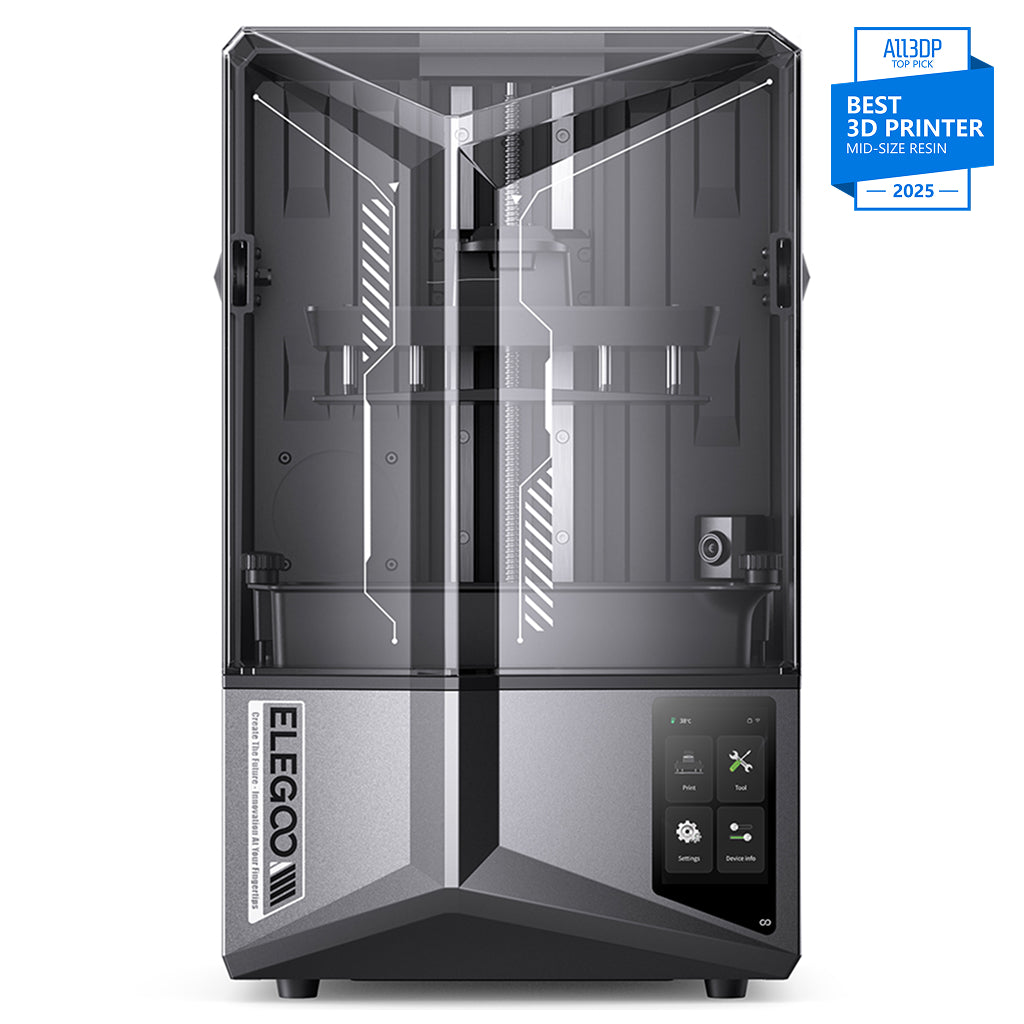
ELEGOO Saturn 4 Ultra 12K
Saturn 4 Ultra 12K (not the 16K variant)
The same machine without the heated tank and with a coarser pixel. In a heated room printing at tabletop scale, most people would never see the difference.
- Build volume
- 218.88 × 122.88 × 220 mm
- Technology
- Resin MSLA
- Max speed
- Up to 150 mm/h (fast mode)
- Enclosed
- N/A (resin printer with hinged UV cover)
- Multi-colour
- No
- Auto levelling
- Yes (hands-free automatic levelling; tilt-release platform)
What we like
- Shares the chassis, tilt-release platform, hands-free levelling, camera and 150 mm/h ceiling
- Slightly more plate at 218.88 × 122.88 × 220 mm
- Cheaper than the 16K at the same retailer, and the same warranty terms apply
- At tabletop viewing distance the coarser pixel is not the limiting factor
What we don’t
- ELEGOO lists no tank heating, which is the difference that matters in an unheated room
- A coarser 19 × 24 μm pixel, visible on work inspected close up
- UK pricing varies widely by seller, so the saving is not guaranteed
- Layer thickness range is not published by ELEGOO for this model
Buy it instead if your space stays warm year-round and your work is viewed at arm's length. Skip it if the printer is going somewhere unheated, or your parts get inspected close up.
The Photon Mono M7 Pro answers a different question. It is the larger machine — a 223 × 126 × 230 mm plate, about 6.5 litres — on a 10.1-inch 14K panel at a 16.8 × 24.8 μm pixel: more room, coarser pixel. Its distinction is handling, with an automatic resin fill-and-drain unit and a temperature-controlled vat — the answer if pouring and draining by hand has become the annoying part. It is slower on standard resin at up to 130 mm/h, has a tighter layer range, needs no levelling, and costs more, at around the £410–£470 mark.
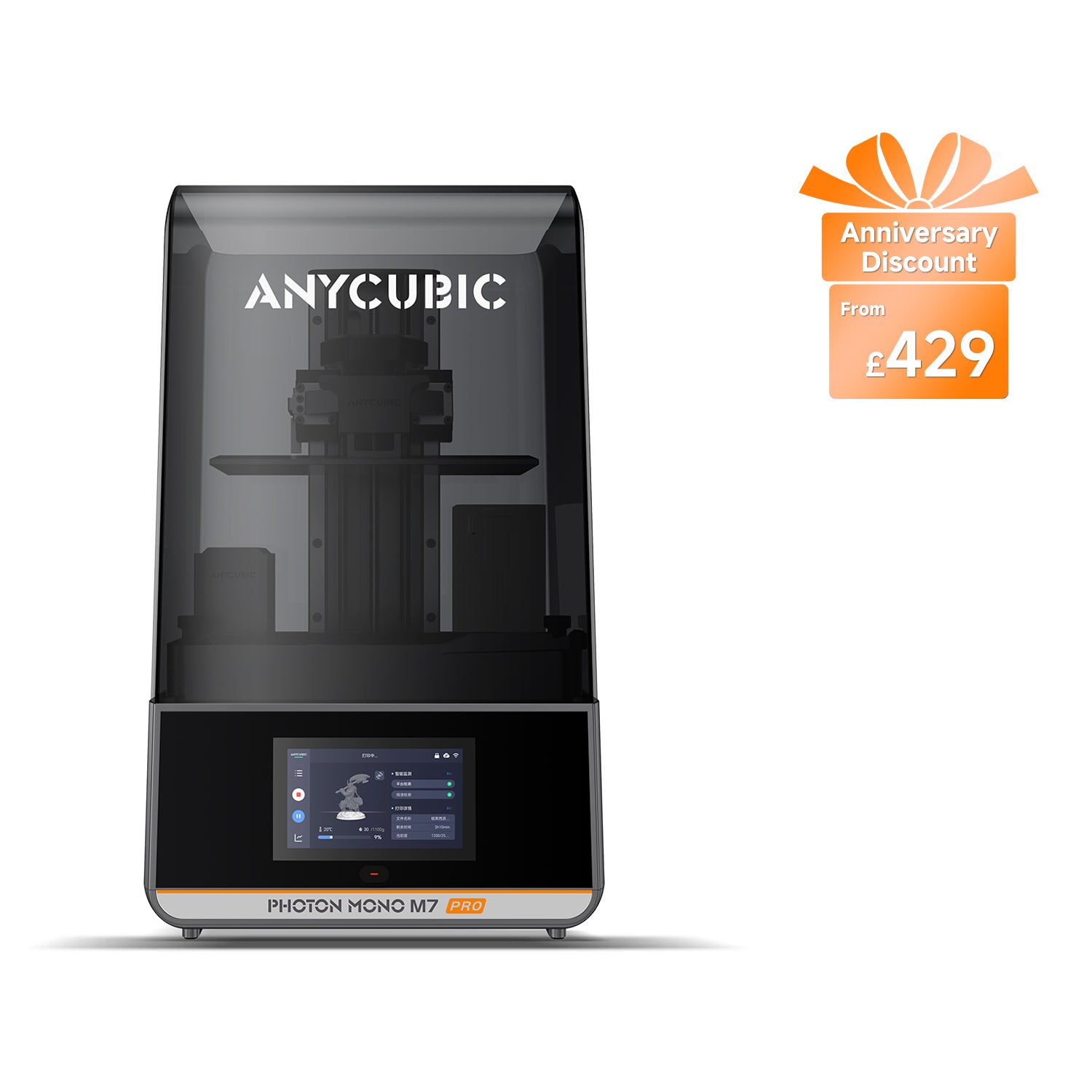
Anycubic Photon Mono M7 Pro
Photon Mono M7 Pro (not the Photon Mono M7 or M7 Max)
More build volume and automated resin handling for more money, at a coarser pixel. The choice when throughput and mess are the constraint rather than fine detail.
- Build volume
- 223 × 126 × 230 mm (6.5 L)
- Technology
- Resin (MSLA)
- Max speed
- Max ≤130 mm/h; standard resin at 0.1 mm ≤130 mm/h, high-speed resin at 0.1 mm ≤170 mm/h (manufacturer maxima)
- Enclosed
- Lid (removable UV cover; Anycubic lists no hinged cover)
- Multi-colour
- No
- Auto levelling
- Yes (levelling-free)
What we like
- A larger 223 × 126 × 230 mm plate, about 6.5 litres
- Automatic resin fill-and-drain and a temperature-controlled vat
- Levelling-free platform, so there is nothing to set at all
- LCD covered for six months rather than three
What we don’t
- A coarser 16.8 × 24.8 μm pixel than the ELEGOO
- Slower on standard resin, at up to 130 mm/h
- A tighter layer range, 0.01 to 0.15 mm
- Costs more, and air purification is still an optional accessory
Buy it instead if you print in volume and need plate more than resolution. Skip it if fine detail is the point. If none of the three fits, the best resin printer uk pillar covers the range either side.
Who should buy it, and the verdict
Whether the ELEGOO Saturn 4 Ultra 16K is worth it comes down to two questions, and neither is the one the box asks. Is your printing room reliably warm, and does anyone look at your prints from closer than arm's length? Two noes and the cheaper sibling does the same job; a yes to either and this is the better machine. It is wrong for you if you need more plate than 211.68 × 118.37 × 220 mm, if handling resin by hand is the part you dislike, or if the printer must go where people live — no built-in filtration and an unpublished noise figure make resin a bad housemate whichever model you choose.
This is a good resin printer sold on the wrong feature. The 16K panel is genuine and it is not why you should buy it; the heated tank, the tilting vat and a real UK parts supply are.
- Buy it if
- Your prints get looked at closely, your printing space is cold or unheated, and you want a machine whose spares are stocked in the UK by more than one seller.
- Skip it if
- You print tabletop miniatures in a warm room, you need a bigger plate, or the printer would have to share space with people.
At around the £370–£420 mark that is a fair deal, with one reservation worth stating rather than burying: the LCD is a consumable ELEGOO rates at up to 2,000 hours and warrants for three months. Budget for it rather than discover it.
How this article was researched
No printing, measurement, photography or first-hand use was carried out for this review. Specifications come from ELEGOO's and Anycubic's own product pages, recorded claim by claim with a source URL; every figure above carries one. External dimensions, UK stock and consumable prices were read from authorised UK retailer listings on 15 September 2026 and quoted as bands rather than live prices. Warranty terms come from ELEGOO's own UK policy, the consumer-law points from the legislation. Ownership patterns were gathered as recurring themes from long-form reviews, community discussion and manufacturer troubleshooting material; no customer review is quoted and no rating reproduced. Four things could not be verified and were left out rather than estimated: the noise level, the rated power draw, the ambient temperature range, and a third close rival whose UK availability could not be confirmed. Our approach is set out in the review methodology.
Common questions
- Is the ELEGOO Saturn 4 Ultra 16K worth buying?
- For detailed work, or for a printer that has to live somewhere cold, yes. The heated tank holding resin at 30 °C removes the most common cause of winter print failures, and around the £370 to £420 mark it is fairly priced against its rivals. For tabletop miniatures printed in a heated room the case is much weaker: the 12K Saturn 4 Ultra shares the chassis, the tilt release and the warranty, and the finer pixel would rarely be the limiting factor.
- Who is the ELEGOO Saturn 4 Ultra 16K best for?
- Someone printing objects that get examined rather than glanced at — busts, display pieces, jewellery masters, scale models, dental and prototype work. It also suits anyone whose printer has to go in a garage, shed or unheated spare room, because the heated tank is what makes that workable. It suits nobody who needs the printer to share a living space: there is no built-in filtration, no published noise figure, and the post-processing involves alcohol.
- What are the main alternatives to the ELEGOO Saturn 4 Ultra 16K?
- Two are worth real consideration. The 12K Saturn 4 Ultra is the same machine without the heated tank and with a coarser pixel, and in the UK it costs meaningfully less at the same seller — the better buy for tabletop-scale work in a warm room. The Anycubic Photon Mono M7 Pro goes the other way: a bigger plate, automatic resin fill-and-drain and a temperature-controlled vat for more money, at a coarser pixel than the ELEGOO. Choose it if volume and handling, not detail, are your constraint.
- How much does an ELEGOO Saturn 4 Ultra 16K cost to run in the UK?
- Electricity is negligible — a resin printer has no heated bed or hotend, and at about 26p per kWh under the Ofgem price cap it is pennies an evening. ELEGOO publishes no rated wattage, so no exact figure is given here. The real costs are consumables: resin at roughly £16 to £28 a kilogram, isopropyl alcohol, release film at around £7 a sheet, and the LCD, which ELEGOO rates at up to 2,000 hours and which runs from about £112 to £129 to replace. Budget for a wash-and-cure station too, at around the £79 to £113 mark.
- Is the 16K screen worth it over the 12K Saturn 4 Ultra?
- On its own, usually not. The step from a 19 × 24 μm pixel to 14 × 19 μm is real, but reviewers who work in miniatures argue it is not significant at tabletop viewing distance. What is worth paying for is the other difference: ELEGOO lists no tank heating for the 12K, and resin that is too cold is a far more common cause of a ruined print than a pixel that is too large. Judge the two on your room temperature and how closely your prints get inspected, not on the screen.