Anycubic Photon Mono M7 Pro vs ELEGOO Saturn 4 Ultra 16K
One refills its own resin, the other has the finer panel and costs less. Which of these two resin printers suits your work, and what each costs to run.
Independent and reader-funded. We earn a commission if you buy through our links, at no extra cost to you. How this works.
These two land in the same place on a UK shelf by opposite routes. The Anycubic Photon Mono M7 Pro vs ELEGOO Saturn 4 Ultra 16K question is usually settled by whichever panel has the bigger number in front of the K, which is the least useful way to decide it.
One refills and drains its own vat and gives you a taller, wider envelope. The other has the finer panel and costs less.
These are the exact variants — the Photon Mono M7 Pro, not the M7 or M7 Max, and the Saturn 4 Ultra 16K, not the 12K most comparisons quietly substitute. Nothing here was printed in-house.
| Specification | 1 ELEGOO Saturn 4 Ultra 16K Best for fine detail and a simpler workflow | 2 Anycubic Photon Mono M7 Pro Best for speed, capacity and hands-off resin |
|---|---|---|
| Best for | Miniatures, busts and detail work | Tall models, batches and long unattended jobs |
| Panel | 10-inch 16K mono, 15,120 × 6,230 | 10.1-inch 14K mono, 13,320 × 5,120 |
| XY pixel size | 14 × 19 μm | 16.8 × 24.8 μm |
| Build volume | 211.68 × 118.37 × 220 mm | 223 × 126 × 230 mm |
| Max speed (maker's maximum) | 150 mm/h | 130 mm/h standard, 170 mm/h high-speed resin |
| Resin heating | Yes — tank held at 30 °C | Yes — temperature-controlled vat |
| Resin handling | Manual pour and drain | Yes — automatic fill and drain |
| Release mechanism | Tilt release — the tank tilts to peel | Straight lift |
| Power-loss resume | — | No — listed as not supported |
| UK price band | Around £370–£420 | Around £410–£470 |
| UK availability | ELEGOO UK store and 3DJake UK | Anycubic UK store and 3DJake UK |
How these two were compared
No printing was carried out for this page; the basis is research, and it matters for how you read the rest.
Specifications come from each manufacturer's own page, read variant by variant. That caution is not academic: Anycubic sells an M7, an M7 Pro and an M7 Max, ELEGOO sells the Saturn 4 Ultra with two different panels, and several comparisons quote 12K figures under a 16K heading.
The basis for owner experience is different again, and labelled wherever it appears — recurring patterns across forums, manufacturer documentation and long-term reviews, never an individual quoted. Prices are bands, checked with stock routes on 8 September 2026.
What 16K actually buys you over 14K
Less than the badge implies, because the badge measures the wrong thing.
"16K" and "14K" count pixels on the masking LCD, not how fine those pixels land on your model. The Saturn's panel holds 15,120 × 6,230, the M7 Pro's 13,320 × 5,120. Because the Anycubic panel is larger and spreads fewer pixels across it, the figure that decides detail separates them further than the badge suggests: 14 × 19 μm in XY against 16.8 × 24.8 μm.
A micrometre is a thousandth of a millimetre, so the ELEGOO lays a smaller, squarer dot. That shows on chainmail, lettering and the eyes of a face, where one pixel decides whether the detail survives — and retreats to almost nothing on smooth curves or anything primed and painted. The comparison below is between ELEGOO's own 12K and 16K panels, but the arithmetic carries. Reviewers who work in miniatures argue the 12K to 16K step is not significant at tabletop viewing distance, and that the heated tank is the real difference between the two.
The ELEGOO also has the wider layer range, 0.01 to 0.2 mm against 0.01 to 0.15 mm — and a thicker layer is how you stop a bulk model taking two days.
Speed, and what each machine does to get it
On paper the M7 Pro wins, but the number has a condition attached.
Anycubic quotes up to 130 mm/h on standard resin and up to 170 mm/h on high-speed resin, both at 0.1 mm layers. ELEGOO quotes up to 150 mm/h in fast mode. So the M7 Pro is slower on ordinary resin and only overtakes on high-speed resin. Both are manufacturer maxima anyway — travel under ideal conditions, not throughput on a full plate.
A real job exposes a layer, separates it from the film, and exposes again, hundreds of times an hour. That separation is where the two differ. The Saturn uses what ELEGOO calls Tilt Release, tipping the tank so each layer peels from one edge instead of being pulled straight up, which puts less stress on thin supports. The M7 Pro separates by lifting, leaning on dual linear rails quoted at 10 μm precision.
Several reports note that prints from high-speed resin are best washed and de-supported soon after the job finishes, since supports become much harder to remove once fully cured. A printer that finishes at two in the morning saves nothing if the supports have gone glassy by breakfast.
Resin handling is the real difference
If one section decides this for you, it is this one. Panels and speed figures are close; how each machine handles liquid resin is not.
Both keep the resin warm, which matters more in a British house than it sounds: resin thickens as it cools, and a cold vat gives soft, under-cured layers that look like exposure problems. The Saturn holds its tank at 30 °C; the M7 Pro uses a temperature-controlled vat. Both also take the levelling ritual off your hands. Owners and reviewers repeatedly single out the heated vat as the feature that makes cold-room printing practical, though it does add a warm-up wait before each job.
Now the split. The M7 Pro fills and drains its own vat — connect a bottle, and it pumps resin in at the start and back out at the end. It is the most appealing feature on either machine, because pouring is the part everyone dislikes. It is not free at the other end. A recurring theme in reviews is that the automatic feed system and bolted tank add cleaning steps, particularly when changing resin colour. A pump and its tubing must be flushed when you switch from grey to clear.
So the M7 Pro removes the pouring and adds the flushing. Run one resin for months and that is a gain; change colour often and you may have swapped a job you disliked for one you dislike more.
ELEGOO Saturn 4 Ultra 16K: who it suits
Detail work at the lower price band, with the fewest moving parts between you and a finished print.
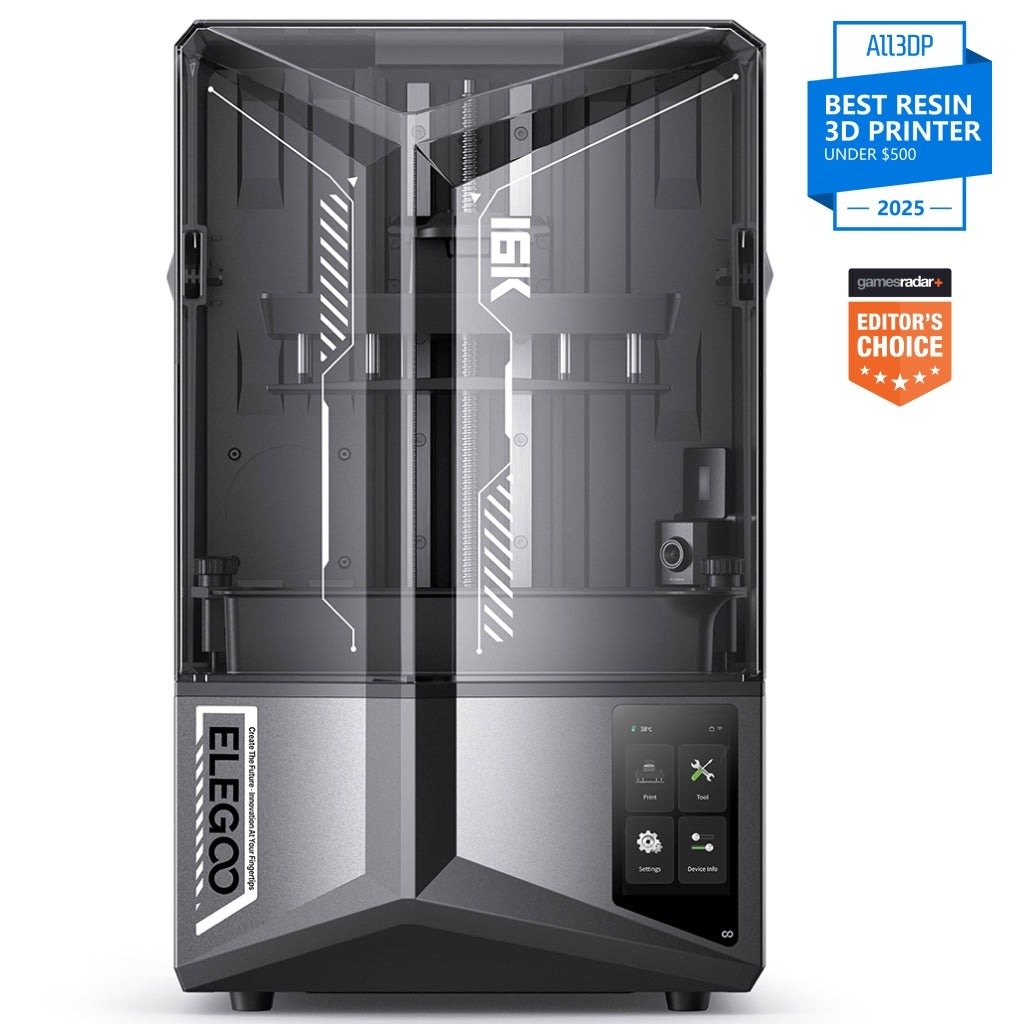
ELEGOO Saturn 4 Ultra 16K
Saturn 4 Ultra 16K (not the 12K Saturn 4 Ultra)
The finer panel of the two, a tilt-release vat that is gentle on delicate supports, and the lower UK price band.
- Build volume
- 211.68 × 118.37 × 220 mm
- Technology
- Resin (MSLA)
- Max speed
- Up to 150 mm/h (fast mode, manufacturer maximum)
- Enclosed
- Lid (acrylic UV cover)
- Multi-colour
- No
- Auto levelling
- Yes (one-click automatic levelling)
What we like
- Finer XY pixel at 14 × 19 μm, where chainmail and facial detail live
- Tilt release peels each layer from an edge, sparing thin supports
- Wider layer range to 0.2 mm, so bulk models need not run overnight
- Plain lift-out vat, with no pump to flush between resin colours
What we don’t
- Heavier at 16.1 kg, and awkward to move once sited
- Smaller envelope in all three axes than the Anycubic
- The LCD is covered for only three months under the UK warranty
- No published wattage, so running cost cannot be worked out
The case is narrow and strong: the finer pixel, a vat that peels rather than pulls, and a lower price. For gaming pieces, busts or anything destined for a paintbrush, all three point the same way — see also the best resin printers for miniatures.
The envelope is 211.68 × 118.37 × 220 mm, smaller than the Anycubic in every direction, though height bites first and 220 mm takes a substantial bust. It levels itself in one press, connects over USB or Wi-Fi, and carries a camera with a chamber light that ELEGOO says flags an empty plate or a warped model — a capability claim with no published detection rate. At 16.1 kg siting it is a decision.
A recurring theme among reviewers is that the drip tray feels flimsy and that stray resin still finds its way onto the machine and the inside of the cover, so plan for regular wiping down.Buy this if you print detail work for painting, you change resin colours often, or the lower price band is what makes the purchase happen.
Skip this if you need models taller or wider than its envelope allows, you run one resin continuously, or you want the longer LCD cover.
Anycubic Photon Mono M7 Pro: who it suits
More room in every direction, a machine that handles its own resin, and the higher speed figure on the right resin.
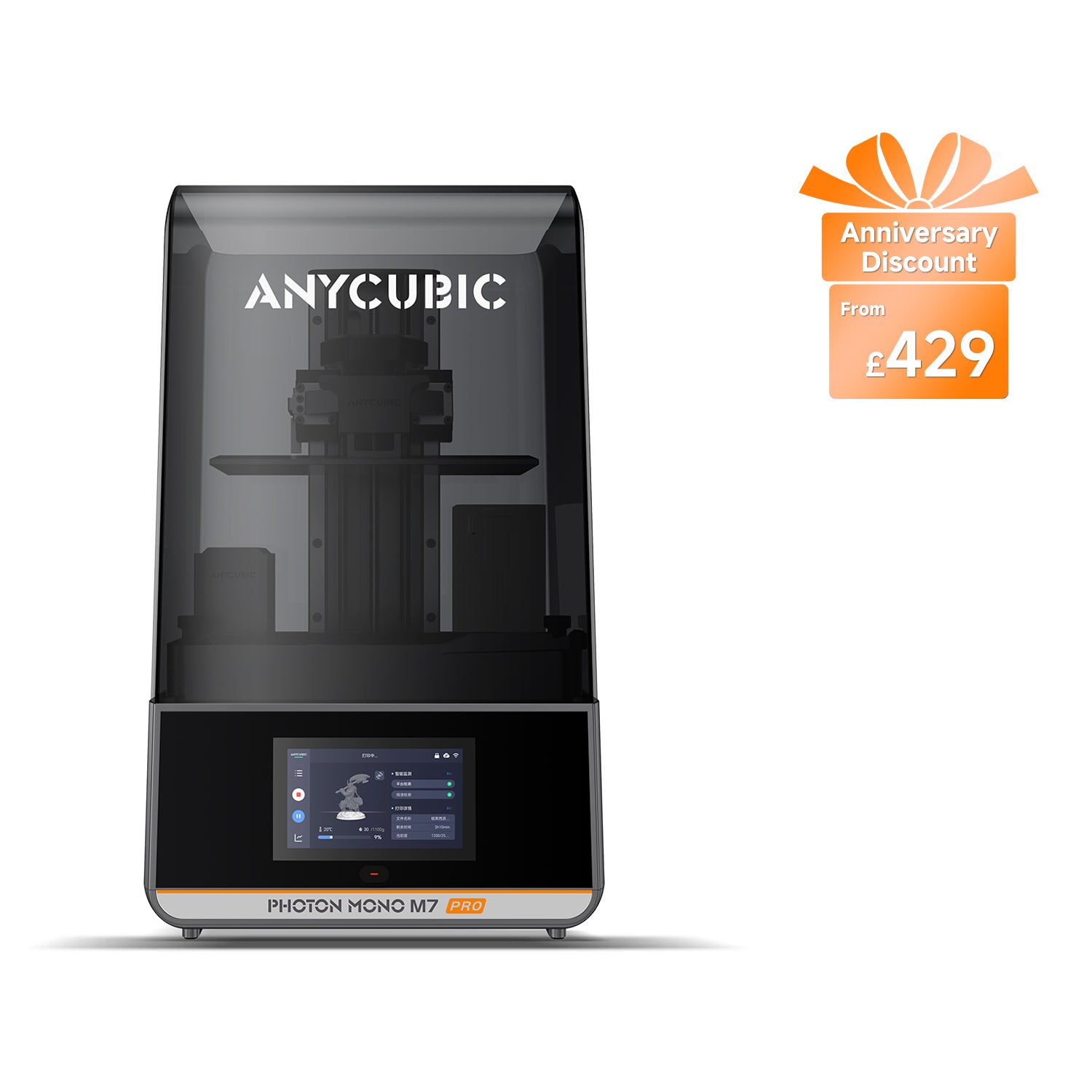
Anycubic Photon Mono M7 Pro
Photon Mono M7 Pro (not the Photon Mono M7 or M7 Max)
The bigger envelope of the two, automatic fill and drain, and the higher quoted speed on high-speed resin — at the higher price band.
- Build volume
- 223 × 126 × 230 mm (6.5 L)
- Technology
- Resin (MSLA)
- Max speed
- Max ≤130 mm/h; standard resin at 0.1 mm ≤130 mm/h, high-speed resin at 0.1 mm ≤170 mm/h (manufacturer maxima)
- Enclosed
- Lid (removable UV cover; Anycubic lists no hinged cover)
- Multi-colour
- No
- Auto levelling
- Yes (levelling-free)
What we like
- Larger envelope at 223 × 126 × 230 mm, about 6.5 litres
- Automatic fill and drain takes the pouring out of a job
- Dual linear rails quoted at 10 μm precision
- The LCD is covered for six months, twice the ELEGOO term
What we don’t
- Power-loss resume is listed by Anycubic as not supported
- Coarser XY pixel at 16.8 × 24.8 μm than the ELEGOO panel
- The resin pump needs flushing when changing resin colour
- Slower than the ELEGOO on standard resin
- The higher of the two UK price bands
The envelope is the clearest advantage: 223 × 126 × 230 mm, about 6.5 litres — roughly 11 mm more width, 10 mm more height and 7 mm more depth. That reads as marginal and is not: it is the difference between a tall model fitting whole and being cut in two and glued.
Elsewhere: a 10.1-inch 14K monochrome LCD, layers from 0.01 to 0.15 mm, a COB source with a Fresnel lens rated at 5,500 μW/cm² ±10%, Photon Workshop and ChituBox over USB, Wi-Fi or LAN, and 12.8 kg.
One limitation deserves more attention than it gets: Anycubic's own specification lists power-loss resume as not supported. This is the printer you buy for long unattended jobs, and a brief cut in the small hours ends one outright rather than pausing it. Budget for a small UPS.
Owner and reviewer reports repeatedly describe the automatic resin feed as inconsistent, particularly as the bottle empties, and the manufacturer publishes its own troubleshooting for it. Against that, the integrated resin heating is widely regarded as a genuine improvement over the previous bolt-on version, though it is not intended for the thickest resins.
Buy this if you need the extra height or width, you run one resin for long stretches and want the filling handled, or you value the longer LCD cover.
Skip this if your work is fine detail viewed close up, you switch resin colours often, or a power cut ending a job outright is unacceptable.
Fumes, space and where either one can live
Neither machine filters its own air — the most important fact here for anyone coming from a filament printer.
Both have a cover over the vat, but a cover keeps daylight off the resin — it does not contain what comes off it. ELEGOO lists an air purifier as a separate accessory rather than building filtration in, and Anycubic does the same.
This is a siting decision, not a product decision. Reviewers consistently advise siting this printer in a well-ventilated room or pairing it with a separate air purifier, since it has no built-in charcoal filtration. In a British house that usually means a garage, a utility room or a spare room with a window that opens — not a bedroom.
Specialist reviewers stress that uncured resin should be cured before disposal rather than washed away, and that resin-contaminated alcohol is hazardous waste. Gloves and eye protection are not optional. Neither manufacturer publishes a noise figure, so none is offered here.
What each costs to run in the UK
The running cost of a resin printer is not electricity. It is resin, consumables and the parts that wear out — and on that scale these two are close.
Anycubic gives the M7 Pro a 240 W power supply, a ceiling rather than a draw. At a UK unit rate around 25p per kWh, a ten-hour print costs roughly 60p at most — a labelled estimate from the supply rating, not a measurement. The same sum cannot be done for the ELEGOO, which publishes no machine wattage, so treat electricity as a rounding error for both.
Resin dominates, and scales with how much you print, not which machine you bought. Both take ordinary 405 nm bottles — but the Anycubic's higher speed figure depends on high-speed resin, at the dearer end of the shelf.
Release film is replaced every few hundred hours, or the first time a failed print welds itself to it — a regular purchase, not a repair.
The masking LCD is the expensive one. Panels degrade under UV and are the part most likely to need replacing in the first couple of years — which is why the warranty terms below repay reading.
UK price, availability, warranty and support
The Anycubic Photon Mono M7 Pro versus ELEGOO Saturn 4 Ultra 16K question in the UK comes down to a modest price gap and one easily missed warranty term.
The ELEGOO sits lower, around the £370–£420 mark against around the £410–£470 mark. Both are discounted frequently, and the gap is roughly a couple of litres of resin.
Availability is straightforward: the ELEGOO direct from ELEGOO's UK store and 3DJake UK, the Anycubic from Anycubic's UK store and 3DJake UK. Both price in pounds and ship domestically, though ELEGOO's shipping notes exclude Northern Ireland at present.
Warranty is where they genuinely part company, and most comparisons leave it out. Both give twelve months on the machine. The difference is the masking LCD — the part most likely to fail and the dearest to replace. ELEGOO covers it for three months, with the resin tank and build plate at six; Anycubic covers it for six. On the one component whose wear is a certainty, that is a meaningful advantage to the Anycubic.
Owners on UK review sites more often than not describe ELEGOO's support as quick to respond, with the recurring complaints being transit damage and slower progress once a case needs a physical replacement. Spare parts are stocked in the UK for both machines.
Three ways buyers get this choice wrong
Treating "Saturn 4 Ultra" as one machine. It is two. ELEGOO sells it with a 12K panel and with a 16K panel, and much of the writing about them quotes 12K figures under a 16K heading. The panel here is 15,120 × 6,230; the 12K machine's is not. The same trap catches the M7 Pro, routinely confused with the plain M7 and the M7 Max.
Buying the pixel count for work that will never show it. The ELEGOO's panel is genuinely finer, and on a bust viewed at arm's length that is money well spent. On terrain or a large prop, it is not. If you are still deciding, the best resin printers guide sets out the wider field.
Assuming automation means less work. The M7 Pro's automatic fill and drain is the most attractive feature on either machine, and it adds a flushing job at every colour change. It moves work around, rather than removing it.
The verdict
Whether it is the Photon Mono M7 Pro or Saturn 4 Ultra 16K turns on one question, and it is not which is better. It is whether your constraint is detail or capacity.
If it is detail — miniatures, busts, anything that goes under a brush — the ELEGOO takes it. The finer pixel is real, the tilt-release vat is kinder to thin supports, and it costs less. That is why it ranks first, not because it wins outright.
If it is capacity — tall models, full plates, long unattended runs on one resin — the Anycubic takes it, and its six-month LCD cover is the better warranty on the part most likely to need it.
There is no universal winner here, and any comparison that hands you one has skipped the real question. Two well-made MSLA machines with opposite priorities: the ELEGOO spends its budget on the panel, the Anycubic on volume and automation.
- Buy it if
- You print fine detail for painting, you change resin colours regularly, and you would rather clean a plain vat than flush a pump — take the ELEGOO Saturn 4 Ultra 16K, the cheaper of the two.
- Skip it if
- You need the extra height or width, you run one resin for long stretches, or you want the longer LCD cover — take the Anycubic Photon Mono M7 Pro and accept the cleaning its automation brings.
How this article was researched
This comparison is research-based. No first-hand printing, measurement or photography was carried out, and nothing here should be read as a test result.
Every specification was researched from the manufacturer's own page for the exact variant named, and each figure carries a citation to the ledger entry holding its source and date. Where a manufacturer publishes no figure, none is given. Owner-reported patterns were researched from forums, manufacturer documentation and long-term reviews; no customer review is quoted and no rating reproduced. Price bands and warranty terms were checked on 8 September 2026.
Common questions
- Which is better, Anycubic Photon Mono M7 Pro or ELEGOO Saturn 4 Ultra 16K?
- Neither wins outright, and the question only resolves once you name a criterion. For fine detail work destined for a paintbrush, the ELEGOO Saturn 4 Ultra 16K — it has the finer pixel, a gentler tilt-release vat and the lower UK price band. For tall models, full plates and long unattended runs on a single resin, the Anycubic Photon Mono M7 Pro, which gives you a larger envelope, automatic fill and drain and a longer warranty on the LCD. Which is better between the Anycubic Photon Mono M7 Pro or ELEGOO Saturn 4 Ultra 16K is decided by the size of what you print and how often you change resin, not by the panel badge.
- Which has better print quality and reliability?
- On quality the ELEGOO has the measurable edge: 14 × 19 μm in XY against 16.8 × 24.8 μm, which shows on features a few pixels wide such as chainmail, lettering and faces. On anything primed and painted, or viewed at arm's length, the two are hard to separate. On reliability there is no independent failure data for either machine, so no honest ranking is possible. Both attract owner-reported niggles instead: the Anycubic's automatic resin feed is reported as inconsistent as the bottle empties, and ELEGOO publishes its own troubleshooting for heating and resin-tank errors. Neither pattern points to a machine that fails.
- Which offers better value for UK buyers?
- The ELEGOO Saturn 4 Ultra 16K is the cheaper of the two, sitting around the £370–£420 mark against roughly £410–£470 for the Anycubic, and it gives you the finer panel for the lower price. That makes it the better value for most buyers arriving at this comparison. The Anycubic earns its premium only if you need the larger build envelope or the automatic resin handling — and it carries one advantage worth weighing: six months of warranty cover on the masking LCD against ELEGOO's three, on the part most likely to need replacing.