Bambu Lab A1 vs Creality Ender-3 V3
One is a 256 mm cube you can still buy in the UK; the other is faster on paper and nearly gone from UK shelves. Specs, warranty, running costs and spares.
Independent and reader-funded. We earn a commission if you buy through our links, at no extra cost to you. How this works.
Two open frames, aimed at the same buyer, at close to the same money — and a specification sheet that flatters the cheaper one. The Bambu Lab A1 vs Creality Ender-3 V3 question looks like it turns on speed and price. For a UK buyer it turns on which of the two you can still put in a basket.
The A1 builds to 256 × 256 × 256 mm against 220 × 220 × 250 mm, and Creality quotes 600 mm/s to Bambu Lab's 500 mm/s.
Variants first: the standard A1 without the AMS lite, against the base Ender-3 V3 CoreXZ — not the V3 SE, V3 KE, V3 Plus or Ender-3 V4. Nothing here was printed in-house.
| Specification | 1 Bambu Lab A1 Best for most UK buyers | 2 Creality Ender-3 V3 Best for open-firmware tinkerers, if one can be found |
|---|---|---|
| Best for | Buyers who want the machine to work and to stay supportable | Tinkerers who want root access and abrasive-ready hardware |
| Key strength | A 256 mm cube that is in stock, in warranty and in pounds | Hardened steel nozzle and the hotter plate, both as standard |
| Main limitation | ABS, ASA and fibre-filled filament are all not recommended | Largely delisted in the UK, and the nozzle is proprietary |
| Motion system | Open-frame moving bed | CoreXZ gantry |
| Build volume | 256 × 256 × 256 mm | 220 × 220 × 250 mm |
| Max speed / acceleration | 500 mm/s, 10,000 mm/s² | 600 mm/s, 20,000 mm/s² |
| Max hot end flow | 28 mm³/s | Not published by Creality |
| Max hot end temperature | 300 °C | 300 °C |
| Max plate temperature | 100 °C | 110 °C |
| Nozzle and hotend | Not separately published | Hardened steel, 0.4 mm, metal hotend |
| Filaments on the maker's list | PLA, PETG, TPU, PVA | PLA, PETG, TPU 90A, ABS, PLA-CF, PETG-CF |
| Named as not recommended | ABS, ASA, PC, PA, PET, carbon and glass fibre | ASA, PC and PA are simply absent from the list |
| Screen | 3.5-inch 320 × 240 IPS touchscreen | 4.3-inch colour touchscreen |
| Filament sensing | Odometry, run-out and tangle sensors | Run-out sensor |
| Multi-colour | Up to four colours with one AMS lite | Creality lists no system for this model |
| Net weight | 8.3 kg | Not published by Creality |
| Machine dimensions | 385 × 410 × 430 mm | Not published by Creality |
| Power rating | 1300 W maximum at 220 V | 350 W rated |
| Noise rating | None published | None published |
| UK warranty | 2 years | Up to 12 months |
| UK price band | Around the £240 to £320 mark | None could be verified |
| UK availability | Official UK store plus UK resellers | Largely delisted; one Creality UK route showed stock |
How these two were compared
No printing was carried out for this page. Every specification was researched from each manufacturer's own material for the exact variant named — Bambu Lab's A1 specification sheet, and Creality's parameter page and user manual. Owner-reported patterns are separate evidence, taken from each maker's forum.
Creality publishes no flow rate, dimensions, weight or acoustic rating for this model, and no UK price could be verified, so those rows carry an absence rather than a guess. Prices are bands.
The variant trap, and the machine this page compares
More comparisons of these two describe the wrong Creality than describe the right one.
Ender-3 V3 is a family whose members do not share a specification. The base V3 is the CoreXZ machine: the bed moves only forward and back while two belts drive the toolhead in X and Z together. It builds to 220 × 220 × 250 mm on that gantry, fed by a direct drive extruder carried on the head — the arrangement that makes flexible filament practical.
The SE, the KE and the Plus are different machines with different beds, motion and prices. If your listing carries a suffix, these are not its figures.
What the headline speed numbers are worth
Creality wins the speed row, and the speed row is close to meaningless.
The ceilings are 600 mm/s with 20,000 mm/s² of acceleration against 500 mm/s and 10,000 mm/s². Both describe how fast a toolhead crosses an empty bed, which is not what limits a real print.
Melt rate is. Push the head faster than the hot end can feed it and the extruder skips, so on any part with walls and infill the flow figure sets the ceiling. Bambu Lab publishes one: 28 mm³/s on a single-wall test model. Creality publishes no equivalent, so the Bambu Lab A1 compared with the Creality Ender-3 V3 on the measure that governs throughput means holding one number against a blank.
A recurring theme among owners is that the usable speed sits far below the quoted ceiling, with contributors converging on roughly a quarter above a normal profile as the point where quality still holds and reporting skipped axis movement on some machines beyond that; several also describe the machine's quiet mode as roughly halving speed while reducing fan noise, so the two are traded against each other.Build volume, and how much of it you get
The A1 has the bigger bed, and the advantage is real but smaller than the numbers suggest. It gains 36 mm in each horizontal direction — 256 × 256 × 256 mm against 220 × 220 × 250 mm — about a third more floor area.
Height is the surprise. Bambu Lab's own documentation notes that Bambu Studio limits toolhead travel, so printable height defaults to 250 mm rather than 256 mm, and an 18 × 28 mm patch at the front-left corner is excluded to protect the filament cutter's stopper; the full cube needs a printed part, a raised limit and no AMS fitted. Out of the box the two machines are the same height.
Materials: the list that favours the Ender-3 V3
Here the ranking on this page inverts, and this is the strongest argument for the Creality.
Its list for the base V3 is PLA, PETG, TPU 90A, ABS, PLA-CF and PETG-CF. The last three matter. ABS is the tough, heat-tolerant plastic for workshop fittings; the CF suffixes are PLA and PETG loaded with chopped carbon fibre, abrasive enough to ruin a brass nozzle in a few spools. The V3 arrives ready for both, with a hardened steel nozzle in a metal hotend as standard and a plate reaching 110 °C where the A1 stops at 100 °C.
Bambu Lab's list runs the other way: PLA, PETG, TPU and PVA are ideal, while ABS, ASA, PC, PA, PET and both carbon and glass fibre are not recommended. Temperature is not the obstacle — both hot ends reach 300 °C — the open frame is.
The V3 is an open frame too, so ABS cooling in a draughty room still splits at the layer lines: being on the list means the hardware survives it, not that the print succeeds.
Bambu Lab A1: who it suits
The machine to buy if you would rather spend your evenings printing than maintaining a printer.
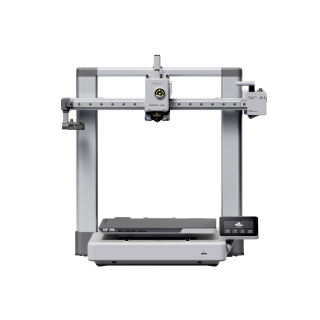
Bambu Lab A1
A1 (standard, without AMS lite)
The larger, better-equipped and better-supported of the two, with twice the warranty term and a UK store behind it. Gives up ABS and carbon fibre — for most home printing, nothing given up at all.
- Build volume
- 256 × 256 × 256 mm
- Technology
- FDM
- Max speed
- 500 mm/s toolhead (10,000 mm/s² acceleration)
- Enclosed
- No
- Multi-colour
- Optional (AMS lite sold separately; up to 4 spools)
- Auto levelling
- Yes (fully automatic)
What we like
- A 256 mm cube — roughly a third more bed area than the Ender
- Filament odometry, run-out and tangle sensing all built in
- Two years of UK warranty against up to twelve months
- In stock in pounds from a UK store, with UK spare-parts listings
What we don’t
- ABS, ASA, PC, PA, PET and fibre-filled filament are not recommended
- The plate stops short of the temperature ABS wants
- The advertised cube needs a hardware modification to reach in full
- A moving bed, which tall and narrow models can object to
The case rests on three things, none of them print quality. It is the bigger machine. It is the better one to live with: fully automatic levelling with no first-layer ritual to learn, a 3.5-inch 320 × 240 IPS touchscreen driven from panel, phone or PC, and filament odometry alongside run-out and tangle sensors, so it knows whether the spool will see the job out. And it has somewhere to go: one AMS lite takes it to four colours. At 385 × 410 × 430 mm and 8.3 kg one person can move it, and UK pricing sits around the £240 to £320 mark.
Long-term owner reports on the Bambu Lab forum repeatedly describe the A1 as reliable and low-maintenance, particularly compared with older budget printers they have moved from. It is not faultless. Several A1 owners describe an X-axis belt tension warning appearing after a period of use, which is often cleared by re-tensioning the belt, although for some it recurs.
For the wider field, see the best FDM printers guide.
Buy this if your filament shelf is PLA, PETG and TPU, or you want to buy a spare part in a year's time.
Skip this if ABS or carbon-filled filament is the job, or you want to get underneath the firmware.
Creality Ender-3 V3: who it suits
There is a real case here, and it is narrower than it once was: this is the machine for somebody who wants to open it up.
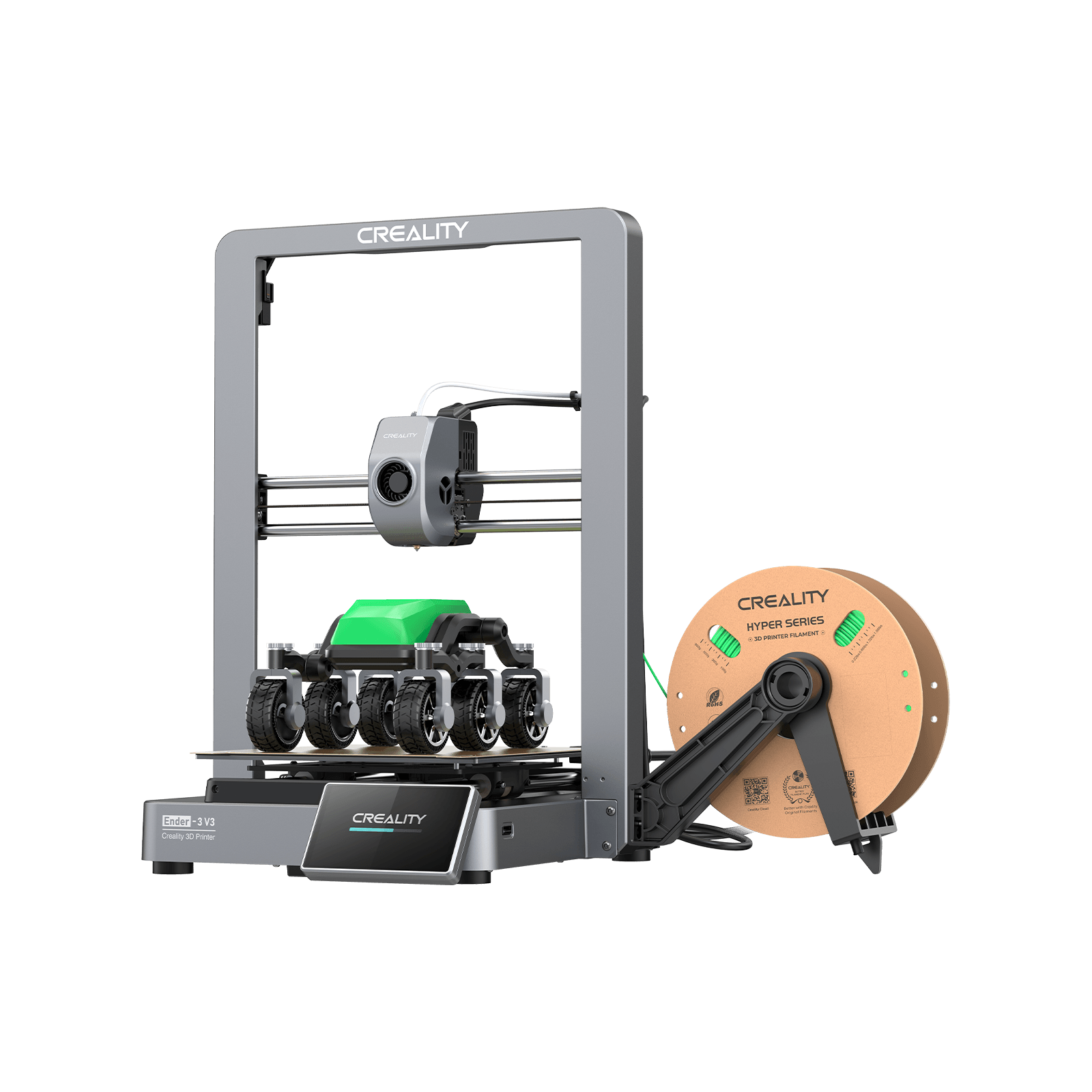
Creality Ender-3 V3
Ender-3 V3 (base CoreXZ model) — not the V3 SE, V3 KE, V3 Plus or Ender-3 V4
A capable CoreXZ frame with a hardened nozzle and the hotter plate as standard, over a firmware layer owners can reach into. Undermined by UK availability that has all but gone.
- Build volume
- 220 × 220 × 250 mm
- Technology
- FDM
- Max speed
- 600 mm/s (20,000 mm/s² acceleration)
- Enclosed
- No
- Multi-colour
- No
- Auto levelling
- Yes (auto-levelling with one-tap calibration and automatic Z offset)
What we like
- Hardened steel nozzle and metal hotend as standard, so abrasives are fair game
- A plate that reaches the temperature ABS actually wants
- Input shaping, run-out sensing and power-loss recovery all included
- Assembles in about ten minutes, as pre-built modules
What we don’t
- Largely delisted in the UK — no current UK price could be verified
- Up to twelve months of warranty, half the A1's term
- A proprietary quick-swap nozzle, not a generic V6 or MK8
- No published flow rate, weight, dimensions or noise figure
The hardware is better than the Ender name suggests. A CoreXZ gantry driving a direct drive extruder through a hardened steel nozzle in a metal hotend sits in a die-cast aluminium frame with part-cooling fans front and back. Creality quotes a 0.1 to 0.35 mm layer range and ±0.2 mm of accuracy over 100 mm, the 4.3-inch colour touchscreen is the larger of the two, and files arrive over USB or Wi-Fi into 8 GB of storage. Creality Print is the expected route, with no third-party slicer named.
The differentiator is underneath. Owner reports describe the machine running Klipper underneath, with root access documented on its own screen and its configuration editable through the web interface it already serves, and that is how owners describe applying most of the fixes they share; the limit they also describe is a custom build they cannot version, with attempts to add adaptive mesh levelling on top of it going unrecognised, although this is not consistent across all reports. That openness is what the A1 cannot offer at any price.
It also has a failure mode worth knowing first. Owner reports in Creality's own forum for this model repeatedly describe prints starting cleanly and then losing extrusion to a clog partway through, with contributors tracing it to heat creeping up past the heatbreak and pointing at the hotend cooling fan first; the remedies they settle on are a cold pull, replacing the softened filament tube and easing the extruder tension, although outcomes are not consistent across all reports and one owner described the failure going as far as damaging the board.
Buy this if you want into the firmware, you print abrasive filament, and you have found one in stock at a price you like.
Skip this if you want a printer rather than a project, or would rather not own a machine whose UK retail presence has largely gone.
Setup, first print and the learning curve
Both machines level themselves, and neither is quite the no-assembly box it is sold as. Bambu Lab's own packing list ships the non-combo A1 as a base housing, a frame and screws to join them, and its unboxing guide runs to eighteen steps. Creality's figure for the V3 is about ten minutes from pre-assembled modules.
Calibration separates them — on paper, the same feature twice. The A1 levels fully automatically, with no first-layer routine to learn; the V3 auto-levels with one-tap calibration and an automatic Z offset.
A recurring theme among owners of this model is that automatic calibration sets a first-layer height that needs correcting, and that the correction does not survive the next calibration; what contributors settle on is writing the offset into the printer's configuration file through its own web interface, setting it in the slicer, or turning automatic calibration off before a print, though the figures owners land on differ from machine to machine.What each costs to run in the UK
Anyone weighing Bambu Lab A1 versus Creality Ender-3 V3 UK running costs meets one figure that looks alarming and is not.
Bambu Lab rates the A1 at a maximum 1300 W at 220 V; Creality gives the V3 a rated 350 W. That is nearly four times the number and not four times the electricity: the A1's is a maximum, what it pulls with a large exposed bed heating from cold, while Creality's is a rated power. Neither publishes a steady-state draw.
Take both as ceilings. At a unit rate around 25p per kWh, an hour at the A1's maximum costs about 33p and the Ender's rated figure about 9p, and real jobs sit well below both — a labelled estimate from rating plates, not a measurement.
Electricity is the small number either way. Ordinary PLA runs between £14 and £18 a kilogram in the UK, so a 50 g model costs roughly 70p to 90p in plastic against a few pence in power.
UK availability, warranty, support and spares
Put as Creality Ender-3 V3 vs Bambu Lab A1, this is the section that settles the page.
The Ender-3 V3 has largely left UK retail. Checked on 1 October 2026: Creality's global store showed it sold out; its UK Ender-3 collection listed the V3 SE instead; 3DJake UK showed it sold out and no longer stocked. One route remained — Creality's own UK product page, showing stock and UK shipping — but it rendered its price as an unfilled template. That is why no price band for this machine appears anywhere on this page.
The A1 has no such problem. It sells through Bambu Lab's UK store and UK resellers around the £240 to £320 mark, and was in stock when last checked, with a bulky-goods surcharge of about £30 per item. Warranty is two-to-one: two years against up to twelve months.
Spares invert the usual story. The Ender's nozzle is Creality's own Unicorn quick-swap tri-metal design, shared with the K1C and the V3 Plus but not interchangeable with a V6 or MK8. They are well stocked in the UK, singly under the £15 mark and as a four-nozzle kit under £60 — easier to buy than the printer.
Support narrows the A1's advantage. A recurring theme among Bambu Lab buyers on UK review sites and the manufacturer's forum is slow warranty support, although delivery and packaging are frequently praised. No independent failure-rate data exists for either machine, so no reliability ranking is offered here.
Three ways buyers get this choice wrong
Buying on the 600 mm/s headline. It is the biggest number on either sheet and the least useful: throughput is governed by how fast the hot end melts plastic, and only Bambu Lab publishes that figure.
Assuming an Ender takes generic spares. A reasonable inference from a decade of the name, and wrong here: the nozzle is Creality's own quick-swap part, so a drawer of V6 or MK8 spares is no use.
Buying the wrong V3. The SE, the KE and the Plus sit alongside the base CoreXZ model under names a search engine treats as near-identical, and none shares its 220 × 220 × 250 mm envelope.
If neither convinces, the best 3D printers and best budget 3D printers guides cover the wider field.
The verdict
Whether it should be the A1 or Ender-3 V3 turns on one question, and it is not which prints better.
For almost everyone it is the A1 — not because the Creality is a poor machine, since the CoreXZ frame, the hardened nozzle and the hotter plate are all real, but because a printer you cannot reliably buy, carrying half the warranty term and taking a nozzle only its maker sells, is harder to live with than a faster headline suggests. Creality's own channels showed the V3 sold out or delisted on the last check, and the warranty gap is two years against up to twelve months.
The Ender-3 V3 keeps a genuine claim on two buyers: the one who wants root access to the firmware, and the one printing abrasives who wants a hardened nozzle as standard.
The specification sheet flatters the cheaper machine; the buying experience flatters the dearer one. The question is not which prints better, but which you can still feed, fix and claim against in two years.
- Buy it if
- You want a printer that works out of the box and will still have parts and warranty behind it in two years. Take the Bambu Lab A1 — the larger, better-equipped machine, and the only one a UK shop will reliably sell you.
- Skip it if
- You want to get underneath the firmware, or you print carbon-filled filament and want a hardened nozzle as standard. Those are the Creality Ender-3 V3's — but check UK stock first, and expect to buy nozzles from Creality alone.
How this article was researched
This comparison is research-based: no first-hand printing, measurement or photography was carried out, and nothing here is a test result. Every specification was researched from each manufacturer's own material for the exact variant named and carries a citation to its ledger entry. Owner-reported patterns come from each maker's forum and are marked where they appear; no customer review is quoted and no rating reproduced.
Common questions
- Which is better, Bambu Lab A1 or Creality Ender-3 V3?
- For most UK buyers, the A1 — but the reason is ownership rather than output. On the specification sheet the Creality is competitive and in places ahead: a CoreXZ gantry, a hardened steel nozzle as standard, a plate that goes ten degrees hotter, and ABS and carbon-filled filament on the manufacturer's own list where the A1 names them as not recommended. What decides it is everything after the purchase. The base Ender-3 V3 has largely gone from UK retail; Creality's own global store showed it sold out on the last check and the UK collection page lists the V3 SE in its place. Its warranty runs to up to twelve months against the A1's two years, and its nozzle is a proprietary quick-swap part rather than a generic V6 or MK8. The A1 is bigger, in stock, in pounds, and supportable. The Ender-3 V3 is the better answer only for a buyer who wants root access to the firmware or who needs the hardened nozzle for abrasives — and who can still find one.
- Which has better print quality and reliability?
- Neither can be separated on print quality from the evidence available, and no honest ranking on reliability is possible. Both are open-frame direct drive machines running input shaping, both reach 300 °C at the nozzle, and the Creality publishes a dimensional accuracy figure of ±0.2 mm over 100 mm where Bambu Lab publishes none — which is a difference in disclosure, not a demonstrated difference in output. On throughput the headline figures mislead in Creality's favour: 600 mm/s against 500 mm/s describes how fast each toolhead can cross an empty bed, while the melt rate that actually caps a real print is published only by Bambu Lab, at 28 mm³/s. Creality discloses no equivalent, so the comparison cannot be made. On reliability, no independent failure-rate data exists for either machine. What owner reporting shows is two different failure modes rather than one worse machine: recurring reports of heat-creep clogs and a first-layer offset that does not survive recalibration on the Creality, and recurring reports of a belt tension warning and slow warranty support on the Bambu Lab.
- Which offers better value for UK buyers?
- The A1, and the gap is wider than it looks, because only one of the two can currently be priced. The A1 sits around the £240 to £320 mark through Bambu Lab's UK store and UK resellers, with a bulky-goods delivery surcharge of about £30 per item to allow for. No UK price could be verified for the base Ender-3 V3 at all: the one Creality UK route still showing stock rendered its price as an unfilled template, and the other channels showed it sold out or delisted. A machine you cannot reliably price or buy has no value proposition to assess. Warranty widens it further — two years against up to twelve months — and running costs do not narrow it, since filament rather than electricity dominates the annual spend on either machine and both take the same spools. The one place the Creality genuinely wins on value is abrasive printing: its hardened steel nozzle and 110 °C plate come as standard, where the A1 does not recommend fibre-filled filament at all.