Best 3D Printers for Cosplay UK
Six 3D printers UK cosplayers can order now, ranked on what actually finishes a costume: seams, the material ceiling, speed, and what a full build costs.
Independent and reader-funded. We earn a commission if you buy through our links, at no extra cost to you. How this works.
A costume is never one print. It is thirty or forty of them, queued back to back for weeks, finishing on a date somebody else chose. So the best 3D printer for cosplay UK buyers can order today is not the one with the biggest plate. It is the one that gets to the end of that queue, in a material the finished piece can survive being worn in.
Two questions decide most of the rest. The first is how many seams you are signing up for: a helmet printed whole needs roughly 350 × 350 × 330 mm of room, and every machine below that turns it into halves you will fill and sand by hand. The second is the material. PLA is the easy default, and one manufacturer's material guide puts its softening point above 60 °C and says plainly that it is not suitable for outdoor use — a problem for something that spends August in a car boot.
Six machines are here, from a 256 mm cube to a plate you could lay a chest piece on whole. Nothing here was bought, assembled or run: this is research-based, built from manufacturers' own documentation, UK supply checks and patterns in what owners report.
What each machine gives a costume
Read two rows against each other and most of the decision is made. Build volume tells you how many pieces the helmet arrives in; materials tell you whether it can sit in a hot car without sagging.
| Specification | 1 Bambu Lab P1S Whole costume | 2 ELEGOO Neptune 4 Max One-piece helmets | 3 Creality K2 Plus Heat-resistant parts | 4 Bambu Lab A1 First machine | 5 ELEGOO Mars 5 Ultra Fine detail | 6 ELEGOO OrangeStorm Giga Full-scale armour |
|---|---|---|---|---|---|---|
| Best for | Armour sets, props and a deadline | Helmets and large panels in one piece | Parts that must survive heat | A first costume on the smallest outlay | Insignia, jewellery and face detail | Chest pieces and pauldrons, whole |
| Build volume | 256 × 256 × 256 mm | 420 × 420 × 480 mm | 350 × 350 × 350 mm | 256 × 256 × 256 mm | 153 × 78 × 165 mm | 800 × 800 × 1000 mm |
| Helmet in one piece | No — two halves | Yes, with room over | Yes, on the line | No — two halves | No | Yes, several at once |
| Chamber | Enclosed, filtered, not actively heated | Open frame | Enclosed, actively heated to 60 °C | Open frame | Acrylic UV cover, no filtration | Open frame |
| Bed ceiling | 100 °C | 85 °C | 120 °C | 100 °C | Not applicable | 90 °C |
| Materials that matter here | PLA, PETG, TPU, ABS, ASA | PLA, PETG, TPU (ABS and ASA listed, but see below) | PLA, PETG, ABS, ASA, PET, carbon-filled | PLA, PETG, TPU (ABS and ASA not recommended) | Standard, ABS-like and water-washable resin | PLA, ABS, TPU, nylon |
| Price band | £330–£400 | £380–£470 | £800–£900 | £240–£320 | £210–£260 | £2,100–£2,700 |
| UK supply route | Bambu Lab UK store; 3DJake UK | ELEGOO UK store; 3DJake UK | Creality's UK store, Leicester warehouse | Bambu Lab UK store and UK resellers | ELEGOO UK store; 3DJake UK | ELEGOO UK store, by freight |
How these six were chosen
Our recommendations are scored on fit for the job this page describes first, then evidence quality, output quality, ease of setup, material fit, safety in a British home, UK value, support and spares, and whether you can buy the machine here this month. Specifications come from manufacturers' own documentation for the exact variant named; owner experience comes from manufacturer forums and long-term reviews, gathered as patterns and always labelled. Nothing was ranked higher for paying more commission.
One decision needs defending in the open. A cosplay 3D printer is usually judged on plate size alone, and the machine at the top of this page has the fourth largest plate of the six. It is there because a costume is a queue, not a part: the machines above it in volume either cannot hold the materials that keep a worn prop rigid, or cost twice as much, and a seam you fill once is a smaller problem than a part that fails four days before a convention. Where the extra volume genuinely settles it — a helmet you want off the plate whole, at roughly 350 × 350 × 330 mm and up — the machine that does it is second, and says so.
Every product here holds a role no other holds. The Creality K1C and the QIDI Plus5 are good machines that were cut for failing that test.
Best overall for a costume: Bambu Lab P1S
Reliability is an unglamorous thing to put first, until a twenty-hour pauldron fails at four in the morning with the convention on Saturday. The machine that wins a costume is the one that reaches the end of the queue in a material the finished piece can live in.
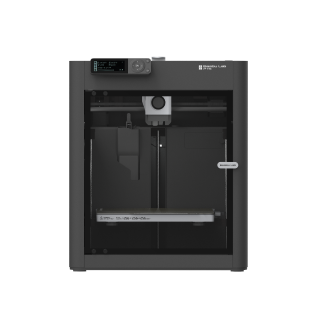
Bambu Lab P1S
P1S (standard, without AMS - not the P1P, P1S Combo or P2S)
Enclosed, quick and consistent, so ABS and ASA are genuinely available. You will be splitting the helmet.
- Build volume
- 256 × 256 × 256 mm (Bambu Studio defaults to 250 mm height)
- Technology
- FDM
- Max speed
- 500 mm/s toolhead (20 m/s² acceleration)
- Enclosed
- Yes (plastic and glass; chamber temperature regulator fan and activated-carbon filter)
- Multi-colour
- Optional (AMS or AMS 2 Pro sold separately or as a Combo)
- Auto levelling
- Yes (automatic bed levelling sensor)
What we like
- The only machine here that lists PLA, PETG, TPU, ABS and ASA as ideal materials
- An enclosure with a chamber fan — what stops a big ABS part curling as it cools
- 32 mm³/s of flow and optional 0.6 and 0.8 mm nozzles for armour-sized parts
- Two years of cover, two UK supply routes, and still in production
What we don’t
- 256 × 256 × 256 mm means a full-size helmet arrives as two halves
- Fibre-filled filament needs an extruder and hot end upgrade first
- Owners name fan noise as the thing they live with, not the motion system
- An oversize delivery surcharge applies at one UK stockist
The enclosure is the whole argument. It is a shell of plastic and glass with a chamber temperature regulator fan, and warm air around a part is what stops a big ABS or ASA piece curling off the plate as it cools. Bambu Lab lists PLA, PETG, TPU, PVA, PET, ABS and ASA as ideal materials, which no other machine here can say. The guidance for ASA asks for a bed of at least 100 °C and an enclosure to hold the ambient temperature up; this plate tops out at exactly 100 °C inside exactly that enclosure.
Speed is the second reason, though not as the marketing puts it. No armour panel is printed at the headline 500 mm/s. What predicts how long a costume takes is flow — 32 mm³/s here — and fitting the optional 0.6 or 0.8 mm nozzle is how a slab-sided chest plate stops being a three-day job.
Three honest limitations. The plate is 256 × 256 × 256 mm, so a full-size helmet arrives as two halves and one seam to fill. An enclosed machine is not automatically a carbon-fibre machine: Bambu Lab says filled filaments need an extruder and hot end upgrade first. And then there is the noise. Owners repeatedly trace the noise to the fans rather than the motion system, and a recurring theme is that the chamber fan is the loudest part of the machine when it is running PLA; several describe swapping the fans for quieter ones, and some say they would not run it overnight in a room next to a bedroom.
It sells for roughly £330 to £400 through Bambu Lab UK and 3DJake UK, and Bambu Lab said in February 2026 that it has no plans to phase the model out.
Buy this if you want one machine to make a whole costume, you would rather split a helmet than nurse a big printer, and ABS or ASA for the parts that live in a car boot appeals. Skip it if a seamless helmet is the entire point, or the machine has to live next to where somebody sleeps.
Best for one-piece helmets: ELEGOO Neptune 4 Max
Every seam you do not print is an evening you do not spend filling, sanding and then finding the join again under the paint. That is the case for a large printer for cosplay, and this is the cheapest machine sold here that makes it properly: 420 × 420 mm of plate with 480 mm above it, against the roughly 350 × 350 × 330 mm at which most helmets stop needing to be cut in half.
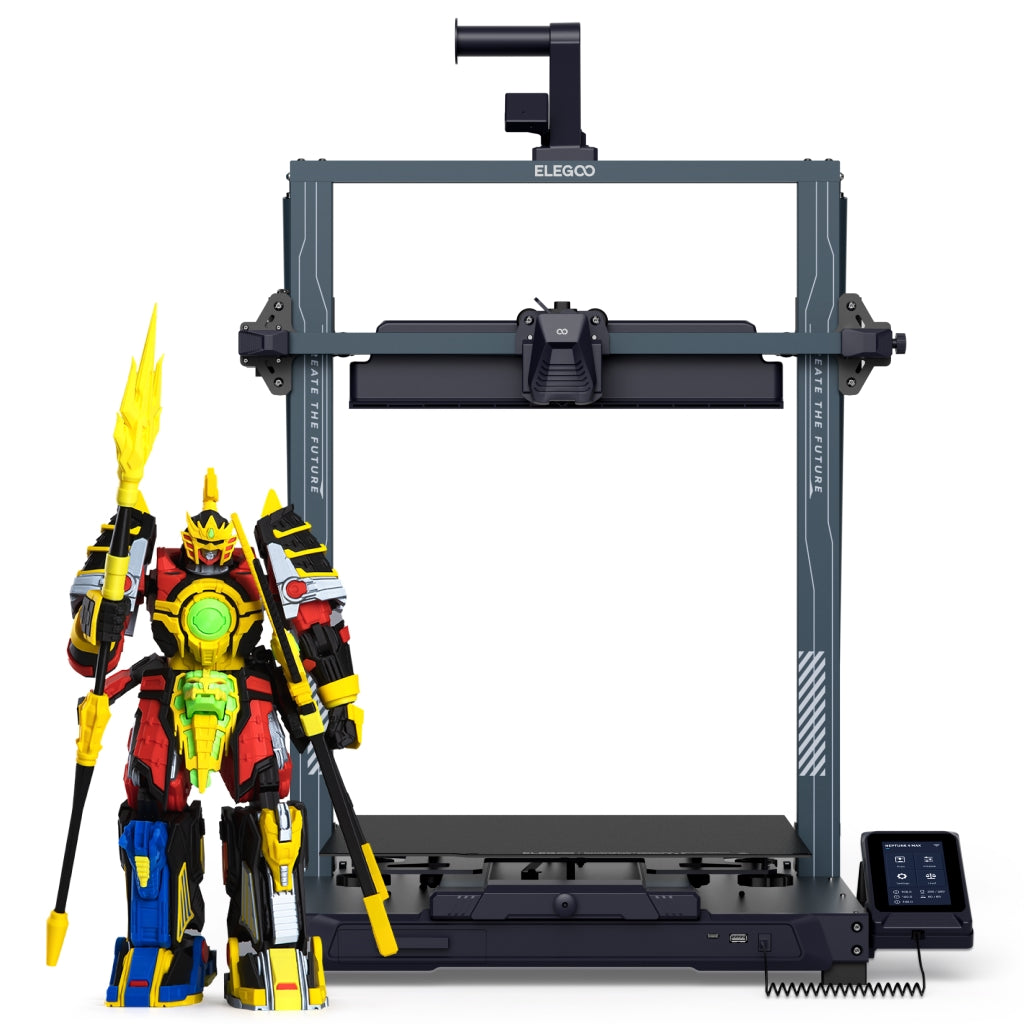
ELEGOO Neptune 4 Max
Neptune 4 Max (420 × 420 × 480 mm model — not the Neptune 4, Neptune 4 Pro, Neptune 4 Plus, Neptune 3 Max, or any refurbished/Grade B SKU)
The cheapest way to stop splitting helmets. The trade is an open frame and an evening of tuning.
- Build volume
- 420 × 420 × 480 mm
- Technology
- FDM
- Max speed
- Up to 500 mm/s (250 mm/s regular; 8,000 mm/s² acceleration)
- Enclosed
- No
- Multi-colour
- No
- Auto levelling
- Yes (121-point, 11 × 11 grid) — but ELEGOO's own manual requires manual A4-paper centre-point calibration and manual auxiliary levelling of six corner points by hand-twist nuts first, and the automatic routine runs 36 points with a 36/121 toggle
What we like
- 420 × 420 × 480 mm clears the one-piece helmet threshold with room to spare
- Cheaper than every machine here that matches it for volume
- 121-point automatic levelling on a plate that genuinely needs it
- Two UK routes and twelve months of cover
What we don’t
- Open frame with an 85 °C bed, so ASA is off the table whatever the materials list says
- Owners describe hours of bed and Z-offset tuning before large prints settle
- Layer shifts on multi-day prints come up repeatedly at this size
- 18.1 kg of machine that wants a surface which does not flex
What you give up for the room is walls. It is an open-frame machine with an 85 °C bed ceiling, and although ELEGOO's list includes ABS, ASA and nylon, the guidance for ASA asks for a bed of at least 100 °C and an enclosure around it. The honest position is that this is a PLA and PETG machine — which for most cosplay is what you want: both sand well, both take filler primer, and PETG holds its shape to about 80 °C where PLA gives up above 60 °C.
The rest is built for size rather than speed: a 500 mm/s headline with 250 mm/s given as the regular working figure, levelling across 121 points that matters far more on a plate 420 mm across than on a small one, and 18.1 kg of machine that wants a table which does not flex.
This is also the machine that asks most of its owner. A recurring theme among Neptune 4 Max owners is that the bed and Z-offset need a few hours of manual tuning before large prints become reliable.
Buy this if helmets and large curved panels are most of what you intend to make, you print in PLA and PETG, and a first evening spent levelling instead of printing is an acceptable price. Skip it if you need ABS or ASA at size — the Creality K2 Plus below holds the air warm — or if you want to switch it on and walk away from the first print.
Best for parts that must survive heat: Creality K2 Plus
A prop rarely fails while it is being printed. It fails in the back of a car in July, and what fails is the material rather than the machine. If the answer is ABS or ASA, the part has to be printed in warm air — and this is the only machine here that heats the air deliberately, inside a plate big enough for a whole helmet.
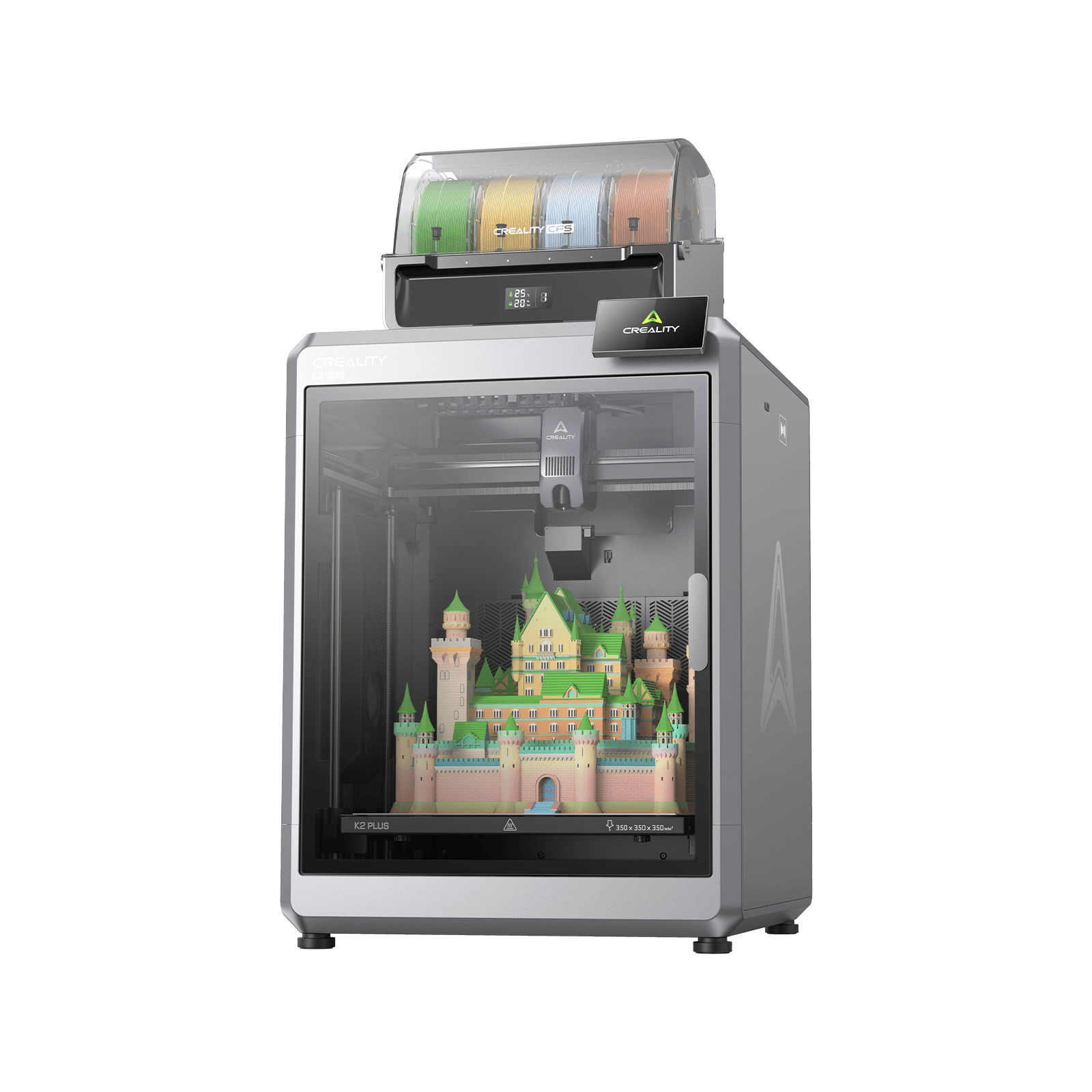
Creality K2 Plus
K2 Plus (base printer, without the CFS; not the K2, K2 Pro, K2 SE or K2 Plus Combo)
A heated chamber wrapped around a 350 mm cube — a one-piece helmet in ABS. Watch the plate, and the price.
- Build volume
- 350 × 350 × 350 mm
- Technology
- FDM
- Max speed
- ≤600 mm/s (≤30,000 mm/s² acceleration)
- Enclosed
- Yes — with active chamber heating to 60 °C
- Multi-colour
- Optional — up to 16 colours with four CFS units; the base machine is single-colour
- Auto levelling
- Yes — full-auto levelling, with a separate calibration AI camera
What we like
- The only actively heated chamber here, holding up to 60 °C
- 350 × 350 × 350 mm sits exactly on the one-piece helmet threshold
- A 350 °C hardened nozzle over a 120 °C bed clears the ASA requirement comfortably
- In UK stock and shipping from a Leicester warehouse
What we don’t
- Keeping a plate this size flat once hot is the dominant owner complaint
- Creality itself says to turn the chamber down for PLA, PETG and TPU
- Running the chamber heater long-term may affect service life, by its own warning
- Roughly twice the price of the machine above it
The chamber is actively heated and holds up to 60 °C, around a build volume of 350 × 350 × 350 mm — directly on the line where helmets stop being cut in half. The toolhead matches: a hardened steel nozzle to 350 °C over a bed that reaches 120 °C, comfortably past the 100 °C the ASA guidance asks for, with a materials list running from PLA and PETG to ABS, ASA and the carbon-filled composites.
Creality is unusually straight about the limit of its own feature. For PLA, PETG and TPU it recommends 30–35 °C rather than a hot chamber, because those filaments soften in the extruder and jam it, and it warns that running the heater for long periods may affect service life. What you are paying for is switched off for most of what most people print. Buy it for the material, not the feature.
The plate is the weak point, which on a page about large curved parts is the one that matters. A recurring theme among K2 Plus owners is that a plate this size is hard to keep flat once it is hot, and that large flat parts are where it shows; the responses they describe are a long bed soak before starting, a denser levelling mesh and re-levelling before each big print.
It takes 495 × 515 × 640 mm of bench and weighs 35 kg, and the catch is the price: roughly £800 to £900, which is two Neptune 4 Maxes.
Buy this if your props live outdoors or in a car, you want a helmet in one piece and in ABS or ASA, and the budget stretches. Skip it if you print PLA and PETG only — you would be paying for a heater Creality will tell you to turn down.
Best first machine, and best for soft parts: Bambu Lab A1
Most people making a first costume do not need the best printer on this page. They need one that works while they learn to sand, fill, prime and paint, which is where the craft actually lives. This is the cheapest way into that on a plate the same size as the top pick — 256 × 256 × 256 mm — for roughly £240 to £320.
Bambu Lab A1
A1 (standard, without AMS lite)
Costume-sized plate, lowest outlay, and the direct-drive extruder that straps and padding need.
- Build volume
- 256 × 256 × 256 mm
- Technology
- FDM
- Max speed
- 500 mm/s toolhead (10,000 mm/s² acceleration)
- Enclosed
- No
- Multi-colour
- Optional (AMS lite sold separately; up to 4 spools)
- Auto levelling
- Yes (fully automatic)
What we like
- The same 256 mm plate as the top pick for a good deal less money
- TPU is listed as an ideal material — straps, padding and soft edges
- Two years of cover and a UK store with resellers behind it
- Owner reports describe it as reliable and low-maintenance over long service
What we don’t
- No enclosure, and ABS and ASA are not recommended on it at all
- A moving bed, so tall narrow parts are where owners see trouble
- Default printable height is 250 mm, not the advertised 256 mm
- Needs roughly its own depth again in clear desk space
It has a second job the dearer machines do less well. Bambu Lab lists TPU among the filaments it prints ideally, and flexible filament is what a costume needs for the parts that touch you: straps, padding, the soft lip inside a gauntlet. Expect it to be slow whatever the box says — the guidance is 20 mm/s typical and 30–40 mm/s maximum, against a 500 mm/s headline.
The limits are worth stating plainly. There is no enclosure, and although the plate reaches 100 °C, Bambu Lab does not recommend ABS or ASA on it at all — so what you make here is PLA or PETG, and PLA gives up above 60 °C. It is also a bed slinger: the machine itself measures 385 × 410 × 430 mm, and the plate travels out of that frame as it prints, so allow roughly its own depth again in clear desk. Owner opinion on the A1 moving bed is divided: several point to tall, narrow models as the case where it shows, while others report tall prints completing without trouble and put failures down to bed adhesion instead.
One specification deserves a warning on a page about parts that only just fit: Bambu Lab's own documentation says the default printable height is 250 mm rather than the advertised 256 mm, with a corner of the bed excluded to protect the filament cutter. If a helmet half is sized to the last millimetre, that is where it will fail to slice.
Two years of cover make it an easy first machine to live with; if price is the binding constraint, the best budget 3d printers guide covers the tier below.
Buy this if it is your first costume, or you want a second machine running straps and padding in TPU while the big one works. Skip it if your props need to survive summer heat, or the projects you have in mind are helmets you would rather not cut in half.
Best for fine detail: ELEGOO Mars 5 Ultra
There is a category of cosplay part filament cannot do: a clan sigil the size of a matchbox, a ring, the raised detail on a face plate. The nozzle fitted as standard above — 0.4 mm on the P1S and the K2 Plus — draws a line that wide, and slowing it down does not make it finer. Resin does not draw lines at all.
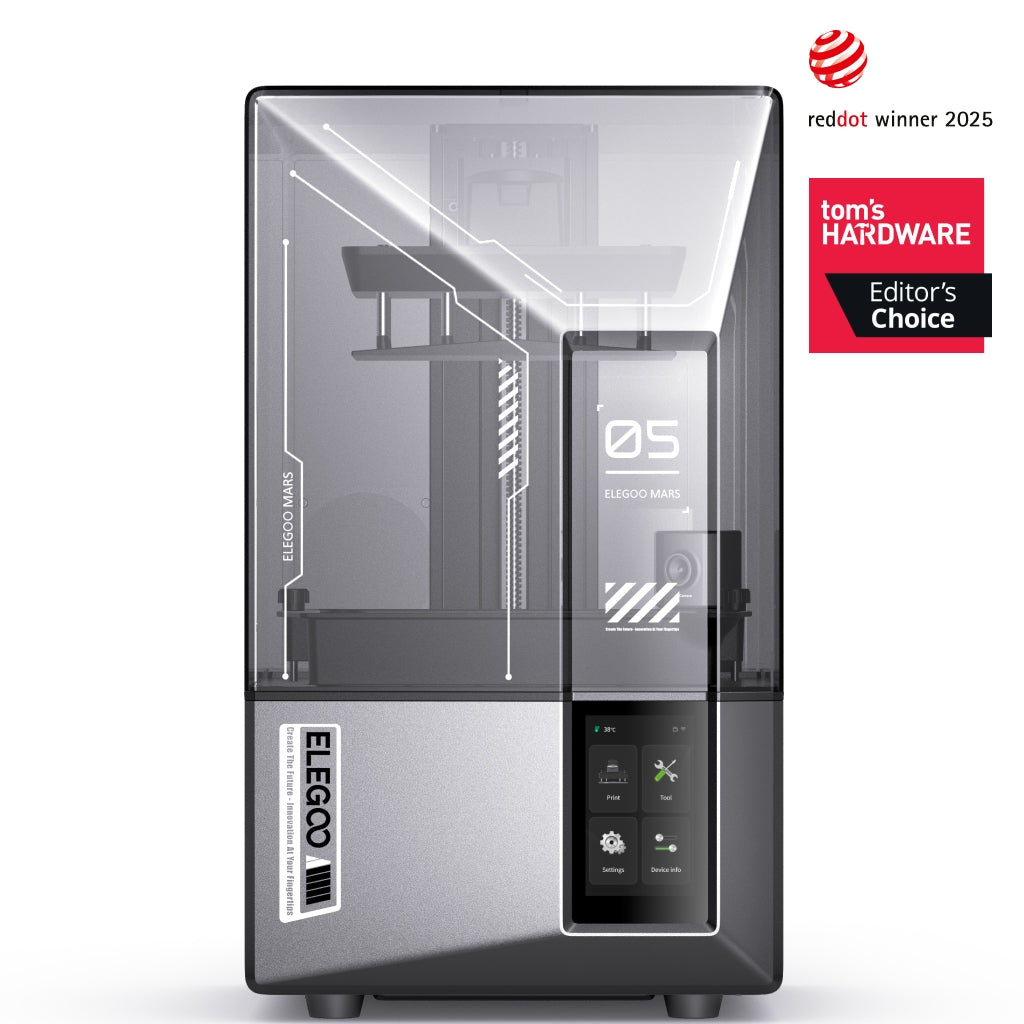
ELEGOO Mars 5 Ultra
Mars 5 Ultra 9K (not the non-Ultra Mars 5)
The detail a nozzle cannot reach, for accessory-sized pieces. It is a second machine, never the only one.
- Build volume
- 153.36 × 77.76 × 165 mm
- Technology
- Resin (MSLA)
- Max speed
- Up to 150 mm/h (manufacturer maximum)
- Enclosed
- Lid (acrylic UV cover)
- Multi-colour
- No
- Auto levelling
- Yes (one-click automatic levelling)
What we like
- 18 × 18 μm pixels — insignia, jewellery and face detail a 0.4 mm nozzle cannot draw
- A whole layer is cured in one exposure, so a full plate costs no more time
- One of the easiest resin machines to get a first print out of
- Sold direct and through a UK retailer, both in stock
What we don’t
- 153 × 78 × 165 mm — a pauldron detail, not a pauldron
- Gloves, eye protection and ventilation are requirements, not suggestions
- No filtration built in; the matching air purifier is a separate purchase
- Three months of cover on the screen and six on the tank and platform
ELEGOO lists it as MSLA, where a mono LCD masks a single light source so a whole layer is cured in one exposure rather than traced, at 18 × 18 μm per pixel — about two hundredths of a millimetre, which is why a printed rivet still looks like a rivet. Because the layer is exposed in one step, print time follows the height of the part rather than how full the plate is, and the speed is published as a height: up to 150 mm per hour.
The catch is the size of what you can make. The plate measures 153 × 78 × 165 mm, which is a pauldron detail, not a pauldron. The most consistent criticism in independent reviews is the plate itself: reviewers repeatedly describe the Z height as the machine's one real limit, with taller pieces needing to be angled or split.
Resin also brings a workflow the filament machines do not have. ELEGOO's manual asks for gloves and eye protection, a ventilated space, no skin contact, and curing waste resin under UV before disposal. The Health and Safety Executive lists resins and acrylates among the agents that cause occupational skin disease and says that once sensitised a person is likely to remain so for life. Gloves are not optional, and this machine has no filtration built in.
Around £210 to £260 buys it, with twelve months on the machine but three on the screen and six on the tank and platform. If resin turns out to be the bulk of what you want, the best resin printers guide goes deeper.
Buy this if you already have a filament machine and the detail parts are letting the costume down. Skip it if this would be your only printer: you cannot build armour on it.
Best for full-scale armour: ELEGOO OrangeStorm Giga
Everything above prints a costume in pieces. This prints it in parts. A 3D printer for armour at this scale stops being a desktop appliance and becomes workshop equipment — both the appeal and the warning.
ELEGOO OrangeStorm Giga
OrangeStorm Giga, single-printhead standard machine (not the Dual or Quad Extrusion upgrade kits, and not the All-in-One Family Combo)
A chest piece whole, or a helmet and both pauldrons in one job. A club or commission machine, not a first one.
- Build volume
- 800 × 800 × 1000 mm
- Technology
- FDM
- Max speed
- 30–300 mm/s (ELEGOO default 150 mm/s)
- Enclosed
- No
- Multi-colour
- No — single printhead, expandable to four nozzles via ELEGOO's upgrade kits
- Auto levelling
- Yes — automatic, 121 levelling points
What we like
- 800 × 800 × 1000 mm — a chest piece lies on the plate whole
- A 0.6 mm nozzle as standard, with 0.8 and 1.0 mm available for armour-scale lines
- 121-point levelling and Klipper firmware on a machine this size
- Dispatched from a UK warehouse, by freight
What we don’t
- About 104 kg assembled, and it wants a circuit it is not sharing
- A bed built from four separate plates, each behaving differently at levelling
- ELEGOO's own speed default is half its headline figure — prints run for days
- Costs more than the other five machines on this page combined
The plate is 800 × 800 × 1000 mm, less a build volume than a small wardrobe: a chest piece lies on it whole, or a helmet and both pauldrons go on together. The extrusion is scaled to match, with a 0.6 mm nozzle as standard and 0.8 and 1.0 mm available at the 0.3 mm layer height ELEGOO recommends — which sands out under filler primer anyway.
Three facts decide whether this is your machine. The bed is four separate 410 × 410 mm plates under an open frame, so the flatness problem is multiplied by four. It weighs about 104 kg and travels by freight, with Guernsey, Jersey and Northern Ireland excluded. And the real speed is 30–300 mm/s against ELEGOO's own default of 150 mm/s, which at this scale means days. Owners and long-term reviewers consistently describe prints at this scale running for days rather than hours and settling well below the headline speed, while also noting that a part which would take weeks in sections finishes in one job.
At roughly £2,100 to £2,700 it costs more than the other five combined, and ELEGOO publishes no settled figure for what it draws, so this page does not print one.
Buy this if you build full armour sets repeatedly — for commissions, a group or a club — and have the floor, the circuit and the patience for a four-section bed. Skip it if this is a costume a year: splitting parts across the machines above costs a few evenings and several thousand pounds less.
What to look for before you buy
Three things separate a machine that finishes costumes from one that merely prints, and none is the number on the front of the box.
How much room a helmet actually needs
A full-size adult helmet runs roughly 250–290 mm wide and 280–330 mm tall including any crest or fin, which lands it just above the standard 256 mm class. Manufacturer guidance puts the one-piece threshold at roughly 350 × 350 × 330 mm: a 350 mm cube sits exactly on the line, and 420 × 420 × 480 mm clears it with the gauntlets beside it.
Below the line the helmet becomes two vertical halves and one seam — a smaller disaster than the specification pages imply. Slicers cut an oversized model on a plane or a dovetail and generate plug, dowel or snap connectors so the pieces line themselves back up. Builders who split large models describe software-generated alignment pins and numbered sections, and report that filling and sanding the joins — not the printing — is where the finish is won.
What the prop is made of matters more than what printed it
Every part of a costume gets warm: in a car, in a queue outside in August, under a stage light. One manufacturer's material guide puts PLA's softening point above 60 °C, says it degrades under UV and states it is not suitable for outdoor use. The same guide puts PETG at good temperature resistance and suitable for most exterior use below 80 °C, and ASA at UV and temperature resistance up to 93 °C — while asking for a bed of at least 100 °C, an enclosure and good ventilation to print it.
Line those requirements against the machines and the shortlist writes itself. An 85 °C bed cannot meet the ASA guidance whatever the materials list says, and a machine whose maker does not recommend ABS or ASA at all is a PLA and PETG machine however hot its plate runs. The two that clear it are the enclosed ones, and anything worn is printed in filament rather than resin — the best fdm 3d printers guide covers that market broadly.
What the speed figure does not tell you
Headline speeds are toolhead speeds. What predicts how long a chest plate takes is how much plastic the hot end can melt in a second: 32 mm³/s on the quickest machine here, 28 mm³/s on the cheapest. Makers often publish the honest number beside the loud one — 500 mm/s headline, 250 mm/s regular.
Helmets are tall, hollow and narrow at the top, which is the shape that fails most. Owners printing tall parts consistently describe slowing the machine down, adding a brim and switching to tree supports, and several note that a finer layer height makes a tall print more likely to fail rather than less. Plan a slower profile for the big parts.
UK running costs — what a whole costume costs to print
The electricity is not the expensive part, and saying so up front saves a lot of worry. Under the current Ofgem price cap a domestic unit of electricity is about 26p per kWh, with a daily standing charge of about 55p you pay whether the printer is on or not. Rated power is a ceiling rather than a running figure — 1000 W on the top pick, 1200 W on the K2 Plus, 1300 W on the A1 — and a machine only approaches it while the bed and chamber heat. Even if one held a full kilowatt for a solid day, that is 24 kWh, or roughly £6 of electricity. Treat it as the worst case it cannot exceed.
Filament is where the money goes. Ordinary PLA runs roughly £14 to £18 a kilogram from a UK retailer, and a costume eats it. Builders who have posted full-scale costume builds describe tens of kilograms of filament and hundreds of printer hours spread over weeks or months, although the two detailed accounts found differ widely in how they were printed. Work on the assumption that a full suit of armour costs more in plastic than a budget printer costs to buy. Resin, if you add a machine for detail parts, sits between about £16 and £28 a kilogram depending on type, and brings consumables with it: a replacement screen is around the £111 mark, a metal vat or build platform about £27 each.
The costs nobody budgets for are the finishing ones — filler primer, sandpaper in four grits, plastic filler, paint — and the filament lost to prints that fail at hour nineteen, which over a build costs more than the electricity ever does. These figures are estimates from published rates and current UK prices, not measurements of any machine.
Buying one in the UK: stock, warranty and support
All six were in stock through a UK route when this page was checked: Bambu Lab through its own UK store and authorised resellers, ELEGOO direct and through 3DJake UK, Creality from its Leicester warehouse, and the Giga by freight, with Guernsey, Jersey and Northern Ireland excluded. UK consumer prices include VAT at the standard 20% rate, so the band you see is the band you pay.
Cover varies more than the prices do. Bambu Lab's warranty policy states two years, with some parts and consumables carrying a shorter period. ELEGOO lists twelve months on the Neptune 4 series and twelve on the Mars 5 Ultra, but three months on the LCD — the part that wears — and six on the tank and platform. Creality gives twelve months with a fifteen-day whole-unit replacement window.
Underneath all of that sits UK law, which is better than any of these policies: a faulty machine can be rejected outright within 30 days of delivery, and anything bought online can be cancelled within 14 days of it arriving, for any reason at all. A recurring theme among buyers is slow warranty support, with owners describing tickets that sit open for weeks, although this is not consistent across all reports. If a convention date depends on the machine, buy early.
The mistakes that cost cosplayers the most
Forgetting the machine has to live somewhere. A CoreXY machine keeps its footprint — 389 × 389 × 458 mm on the P1S, 495 × 515 × 640 mm on the K2 Plus — while a bed slinger's plate travels out of its 385 × 410 × 430 mm frame and wants that depth again in clear space. The Giga at about 104 kg is furniture.
Treating an enclosure as a filter. The materials that make a prop survive summer are also the ones worth ventilating for: peer-reviewed measurements show the particles emitted are ultrafine, with ABS producing the highest peak concentration of the filaments tested. A carbon filter helps, but the same work puts a plain enclosure well below ducting the exhaust outdoors. A recurring theme among owners printing ABS and ASA indoors is that the built-in carbon filter is treated as a partial measure rather than a complete one, with several describing ducting the exhaust outside or adding filtration, although this is not consistent across all reports. Print those materials in a room you can ventilate, not a bedroom.
Buying the biggest machine first. A first costume made of clean 256 mm sections beats a second costume abandoned on a 420 mm plate. If the machine is really for the household and the costumes a sideline, the best 3d printer uk roundup is the wider list.
The verdict
For most people making costumes in the UK, the Bambu Lab P1S is the machine that finishes them: enclosed, quick, consistent enough to leave running, and the only one here that puts PLA, PETG, TPU, ABS and ASA on the same plate. You will split a helmet and fill one seam, and the slicer will hand you the pins to line it up with. If that seam is unacceptable, the Neptune 4 Max is the cheapest way to make it disappear; if the props live outdoors, the K2 Plus is the only machine here that heats the air around them; and if this is a first costume, start with the A1 and spend the difference on sandpaper, filler primer and paint. The printer is a third of the work.
- Buy it if
- You want one machine that will get a whole costume made — armour, props and the odd helmet half — in materials that survive a car boot in July.
- Skip it if
- A seamless full-size helmet is the entire project, in which case the ELEGOO Neptune 4 Max is worth the evening of tuning it asks for.
How this article was researched
No machine here was bought, assembled or run. Every specification comes from the manufacturer's own product page, manual, wiki or material guide for the exact variant named, recorded against a claim ID with its source and the date it was read. Prices are bands checked in September 2026. Owner experience comes from manufacturer forums and long-term reviews, used only where a pattern recurs. Figures that could not be confirmed — the power draw of two machines here — were left out.
Common questions
- What build volume is needed for cosplay helmets?
- Roughly 350 × 350 × 330 mm if you want the helmet off the plate in one piece — that is the threshold manufacturer guidance gives, and it exists because a full-size adult helmet runs about 250–290 mm wide and 280–330 mm tall once you include a crest or fin. Two of the machines here clear it: the Creality K2 Plus sits exactly on the line at 350 mm in every axis, and the ELEGOO Neptune 4 Max clears it comfortably at 420 × 420 × 480 mm. Below the threshold the helmet becomes two vertical halves and one seam, and under about 250 mm it becomes four pieces or more. Being below the line is not a disqualification: it costs you an evening of filling and sanding per helmet, which is worth weighing against the price difference rather than treated as a reason to spend more.
- Is FDM best for cosplay props?
- For anything worn or handled, yes. Filament machines print hollow, light, large parts in materials chosen for how they behave in use, and they scale to helmet and armour sizes that resin machines do not reach — the resin printer on this page tops out at 153 × 78 × 165 mm. Filament also sands and takes filler primer predictably, which is most of what cosplay finishing consists of. Resin earns its place for the small parts where a 0.4 mm nozzle is simply too coarse: insignia, jewellery, buckles, the raised detail on a face plate. The practical answer for most people is one filament machine first and a resin machine later if the detail parts are letting the costume down, not one or the other.
- Which printer is fast enough for large armour parts?
- Speed on a large part is set by how much plastic the hot end can melt per second and by the width of the line it lays down, not by the headline figure on the box. Of the machines here the Bambu Lab P1S has the highest rated flow at 32 mm³/s, and fitting a 0.6 or 0.8 mm nozzle to it does more for a slab-sided chest plate than any speed setting will. The larger machines are slower per part but print more of it at once, which is usually the better trade: the OrangeStorm Giga runs at ELEGOO's own default of 150 mm/s and takes days, but finishes parts that would otherwise be printed as six pieces and glued. And no machine is fast with flexible filament — the guidance is 20 mm/s typical, 30 to 40 mm/s maximum, whatever the printer claims.