3D Printer Ventilation Requirements Explained
What ventilation a 3D printer really needs in a UK home: the Building Regulations figure, what the measurements show for FDM and resin, and what a filter does.
The short answer
Yes, and the useful answer is a number rather than an adjective. 3D printer ventilation requirements are written down almost everywhere as "a well-ventilated area" — and not one manufacturer source reached for this page puts a figure on that phrase, in litres per second, air changes an hour or room size .
The UK does have a figure. It was not written with printers in mind, but the Building Regulations guidance for homes in England expects any habitable room to be capable of at least four air changes an hour, direct to outside .
What changes between machines is how hard that is to earn. A filament printer's demands are set mostly by the material and how hot the nozzle runs. A resin printer's are firmer: the manual requires gloves, eye protection and a well-ventilated area as instructions rather than advice .
What the air actually contains
"3D printer fumes" is one phrase covering two unrelated problems, which is why so much ventilation advice quietly contradicts itself.
The first is particles. Peer-reviewed measurements of desktop filament printers put the mean emitted diameter at 50 to 60 nanometres — ultrafine, invisible, and inhalable deep into the lung . The second is gas: the volatile organic compounds you can smell. They do not respond to the same control. In the study that measured how well enclosures hold particles in, the researchers measured the gases too and calculated no control efficiency for them at all .
That split runs through everything below. A particle filter is weakest between about 0.1 and 0.3 µm and gets better below that, because the smallest particles are caught by diffusion rather than strained out — and it does nothing at all about gases or odour . Hence two stages for two jobs in the UK schools guidance: HEPA-class for the particles, carbon for the compounds .
What the UK actually requires of a room
So does a 3D printer need ventilation as a matter of law? Not as a printer — but the room it stands in is covered by a document far more specific than anything a manufacturer publishes. Approved Document F is the ventilation part of the Building Regulations for homes in England, and it works through three mechanisms: extract ventilation at the source, a background rate for the dwelling, and purge ventilation to clear one room quickly .
Purge ventilation sounds written for this. It asks that every habitable room be capable of at least four air changes an hour, direct to outside , then turns that into something you can check with a tape measure: a window opening 30 degrees or more needs an opening of a twentieth of the room's floor area, a tenth if it opens between 15 and 30 degrees, and nothing counts below 15 degrees. Those areas assume a single-sided urban room, a 2.1 metres per second breeze and 3 °C between inside and out — a still, warm day gives you less.
Read the definition before adopting the number, though. It calls purge ventilation intermittent, and "required only for pollutants produced by occasional activities"; its own example is fumes from painting . A print runs for eight hours.
Nor does the rest of the document cover you. Extract ventilation to outside is required in kitchens, utility rooms, bathrooms and lavatories — not in bedrooms, studies or spare rooms, which is where printers go . And the whole-home background rate of 0.3 litres per second per square metre is a trickle, not something that clears a room.
Where the "six air changes an hour" figure comes from
Search this subject and a number arrives fast: at least six air changes an hour. It is real and it is traceable. It is Washington State Department of Health guidance for schools in Washington State, and in its own wording it describes a room holding several printers under negative pressure relative to the spaces around it . Sound for a school workshop in Washington; not a requirement in a British bedroom.
The UK rules that do define adequate extraction are workplace rules — under COSHH an employer must prevent or adequately control exposure, with a written risk assessment to show it . None of that binds a householder.
FDM printer ventilation in practice
Two things move a filament printer's emissions far more than any accessory does.
Material and temperature, first. The UK schools guidance, written with the Health and Safety Executive, asks that PLA be the main filament, that more hazardous materials be avoided, and that the nozzle run at the low end of the supplier's range, because hotter nozzles emit more . One manufacturer's material guide states that ASA releases potentially dangerous fumes and needs a well-ventilated area .
Containment, second, and here the measurements are good. Peer-reviewed work comparing particle controls put a rigid enclosure alone at a minimum control efficiency in the high sixties to low eighties per cent, a flexible one higher, HEPA-filtered controls higher again, and ducting the exhaust outdoors most effective at over 98 per cent . HSE's own research measured a 97 per cent fall in particle emission rates with a printer inside an enclosing hood with filtered ventilation . Where there is no extraction at all, the guidance prefers a cabinet to an open frame .
One owner-side habit undoes the second point entirely. A recurring theme among owners printing PLA in an enclosed machine is running it with the door open and the top lifted to keep the chamber from softening the filament before it reaches the nozzle, although this is not consistent across all reports. An enclosure held open is not an enclosure.
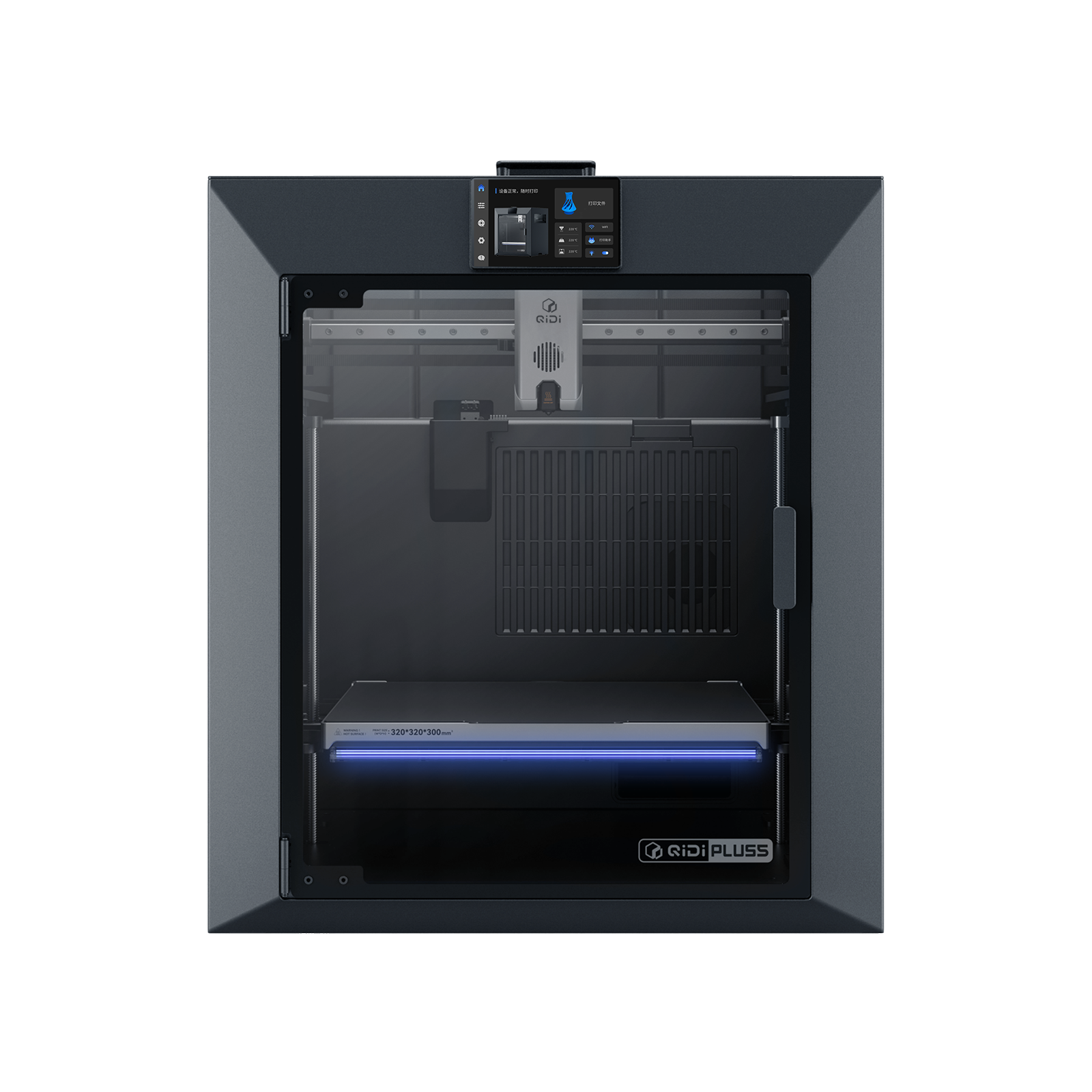
QIDI Plus5
QIDI Plus5 (standard, not the Plus5 Combo with QIDI Box, and not the Plus4)
A worked example, not a pick: one of the few consumer machines carrying a particle stage and a gas stage at once.
- Build volume
- 320 × 320 × 300 mm
- Technology
- FDM
- Max speed
- 600 mm/s toolhead (≤20,000 mm/s² acceleration)
- Enclosed
- Yes, with independent active chamber heating up to 65 °C (3rd generation)
- Multi-colour
- Optional (compatible with QIDI Box; the Combo bundles it for 16 colours)
- Auto levelling
- Yes (hands-free, loadcell sensor integrated into the hotend)
Its filter is a three-stage set — a G3 pre-filter, an H12 HEPA element and coconut-shell activated carbon — so both halves of the requirement sit in one machine. What that label means is less obvious than it looks.
Resin printer ventilation in practice
Resin is where the advice gets loudest and, as it happens, where the evidence is best. A 2025 peer-reviewed study co-authored by the HSE's science division measured the air around a running resin printer at the distances people sit at.
In a ventilated test room, total VOCs from the printer they tested reached roughly 116 µg/m³ half a metre away and roughly 34 µg/m³ at two metres . Both sat two to three orders of magnitude below the UK workplace exposure limits — while the same printer sealed into a small chamber went above them, peaking beyond 128,000 µg/m³ . The room is doing more of the work than the machine.
Then the part worth remembering. Moving from half a metre to two metres cut the measured VOCs by 71 per cent; putting the printer in a hood drawing air through a HEPA filter and an activated carbon filter cut them by 84 per cent — and that hood returned its filtered air to the room rather than ducting outside . The familiar instruction that nothing but a duct through a window will do is firmer than the measurement supports. The authors' caution belongs with their figures: the air returned to baseline within two hours, and many of the compounds they found have no published safety guideline at all, which is why they argue for precaution .
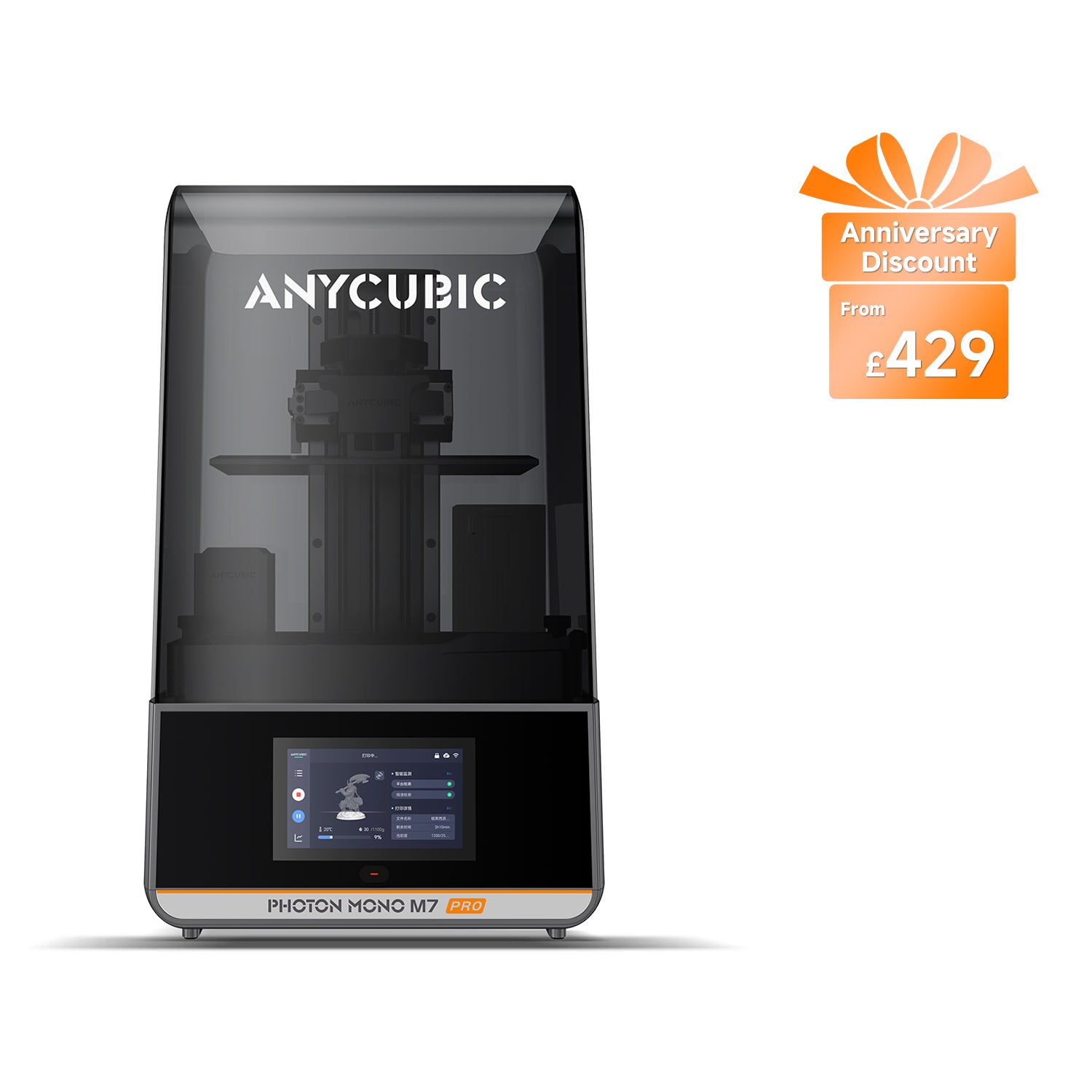
Anycubic Photon Mono M7 Pro
Photon Mono M7 Pro (not the Photon Mono M7 or M7 Max)
A worked example, not a pick: nothing is built in and both routes out of the problem are sold separately.
- Build volume
- 223 × 126 × 230 mm (6.5 L)
- Technology
- Resin (MSLA)
- Max speed
- Max ≤130 mm/h; standard resin at 0.1 mm ≤130 mm/h, high-speed resin at 0.1 mm ≤170 mm/h (manufacturer maxima)
- Enclosed
- Lid (removable UV cover; Anycubic lists no hinged cover)
- Multi-colour
- No
- Auto levelling
- Yes (levelling-free)
No built-in filter here — the activated-carbon purifier is an optional accessory around the £25 mark and a ventilation hose attachment is offered separately . Reviewers consistently treat the optional carbon purifier as something that helps rather than something that settles the question, and several report that it and the automatic resin-fill system share a single port, so fitting both is not an option.
3D printer air filtration: what a grade tells you
Machines are sold with an "H12 HEPA" filter, and under the current European standard H12 is not a HEPA grade. The 2009 revision renamed the old H10 to H12 classes as E10 to E12 and put them in a separate EPA category, because unlike the grades above them they need not meet a local value. HEPA now begins at H13, at 99.95 per cent efficiency at the most penetrating particle size, against E12's 99.5 per cent .
That is a labelling point, not an indictment. An element stopping 99.5 per cent of particles at the size filters find hardest is a capable filter, and what a printer emits is far smaller than that worst case, in the range where capture improves . A grade also describes the medium on a test rig, not a machine with air paths around it.
Maintenance deserves more attention than the label does. Once a filter is the control measure, the schools guidance treats it as local exhaust ventilation that must be checked and changed . HSE has reviewed recirculating extraction specifically and found that a filter of the wrong type, or in poor condition, returns contaminants to the room — and that industry does not agree on what efficiency counts as adequate . At work the interval is at least every 14 months . At home there is none, and often none published: one manufacturer states no schedule anywhere on its own pages while selling the replacement as a two-pack around the £20 mark .
Four things people get wrong
That an enclosure deals with the smell. It deals with particles; the study that measured enclosure performance calculated no control efficiency for gases . If you can still smell the print, the box is working on something other than what you noticed.
That the print finishing means the air is clear. The schools guidance asks for a clearance time and sets no figure . The nearest measured number is the resin study's two hours to baseline — one machine, one material, but better than guessing.
That a HEPA filter cannot catch ultrafine particles. The reverse is true: filters are weakest in the middle of the size range and improve below it, because the smallest particles are caught by diffusion .
That a resin printer's cover is a seal. The researchers who measured one recorded it as neither airtight nor ventilated; its job is keeping daylight off the resin .
What to do, in the order that matters
Ordered by how far each step moves the answer, not by what it costs.
1. Decide the material before the machine. PLA as the default, ABS and ASA a separate decision needing real extraction, and the nozzle run at the low end of its range . Nothing else here moves as much.
2. Measure the window in the room you have in mind — a twentieth of the floor area if it opens 30 degrees or more, a tenth if it opens between 15 and 30 . Try not to make it the room you sit in all day: proximity and duration both raise exposure . If you rent and fitting a duct is not yours to decide, that window is the control you have, and the two steps below matter more because of it.
3. Add distance, because it is free. Two metres instead of half a metre cut measured resin VOCs by 71 per cent .
4. If you buy containment, buy both stages — a particle filter and a carbon filter answer different problems , and a machine with one needs the other added, or the exhaust ducted out.
5. Put the outlet high and let the room clear. Where the regulations do ask for an extract fan they want it as high as practicable, within 400 mm of the ceiling ; the schools guidance wants a clearance time before an enclosure is opened, and warns against crowding machines into one small or poorly ventilated room .
What this means when you are choosing a printer
Treat containment as a specification rather than a brand. The UK schools guidance states its purchasing preference plainly — a printer that is fully enclosed and filtered — and names the two stages that make the second word mean something . On a filament machine you are asking whether both are already there. On a resin machine you are asking which room it goes in and how far from your chair, because the air handling is bought separately whatever you choose.
| Specification | QIDI Plus5 | Anycubic Photon Mono M7 Pro |
|---|---|---|
| What the air carries | Ultrafine particles and gases, in amounts set by material and temperature | Gases from a liquid; nothing is heated |
| Fitted as standard | An enclosure with a particle stage and a carbon stage | A cover that blocks daylight, and no filter |
| What you add | Extraction or ducting if you print ABS or ASA regularly | A carbon purifier or a hose to the outside, plus gloves and eye protection |
| What moves the result most | Choosing PLA and running the nozzle cool | Putting two metres between you and the vat |
Where to go next
If this has turned "well ventilated" into a specification you can shop against, the shortlists take it from there. The best 3d printer uk roundup ranks on everything else once containment is settled, the best FDM 3D printers guide is the filament-only version, and the best budget 3D printers page is where an enclosure is traded against price.
If the resin numbers did not put you off — they were meant to make the room part of the purchase — the best resin printers roundup covers the machines and the best resin printers for miniatures guide covers what most people buy one for.
How this article was researched
This guide is research-based. No printer named here was bought, run, measured or photographed by us, no air sample was taken, and nothing here is offered as something we observed.
Every figure traces to a primary source recorded with the date it was read: Approved Document F on GOV.UK, HSE guidance and research, the CLEAPSS schools guide written with the HSE, two peer-reviewed emissions studies, a filter standards reference, manufacturers' manuals, and one US state health department whose much-quoted figure is attributed rather than borrowed.
Four limits. The resin measurements come from one study, one printer, one brand of resin. The particle study did not test PLA, so no PLA-against-ABS comparison is drawn from it. The filter classes rest on two secondary sources that agree, the standard itself being paywalled. And the finding that no manufacturer quantifies "well ventilated" covers the sources reached: two could not be read, and are recorded as unread rather than as silent.
Owner-experience passages are marked, summarise recurring patterns across long-term reviews and manufacturers' forums, and quote no review and no rating.
Common questions
- What should UK buyers know about 3D printer ventilation requirements?
- That the phrase doing all the work in every manual — "a well-ventilated area" — is never defined by the people who print it. Across the manufacturer manuals and material guides reached for this page, not one gives a rate, an air change figure or a minimum room size. The UK does have numbers, just not written for printers: Approved Document F, the ventilation part of the Building Regulations for homes in England, asks that every habitable room be capable of at least four air changes an hour direct to outside, and turns that into an openable window area of one twentieth of the room's floor area where the window swings 30 degrees or more. Two things about that document matter more than the figure. It defines purge ventilation as being for pollutants from occasional activities and offers painting fumes as its example, which an eight-hour print plainly is not; and it requires extract ventilation to outside in kitchens, utility rooms, bathrooms and lavatories, but not in bedrooms, studies or spare rooms — the rooms printers actually live in. The figure most often quoted online, six air changes an hour, is Washington State health department guidance for Washington schools describing a room of several printers under negative pressure. It is not a British requirement and was never meant to be one.
- Which factors change the answer for FDM and resin users?
- They are close to opposite problems. A filament printer melts plastic, so what it emits is set mainly by the material and the nozzle temperature: the UK schools guidance written with the HSE asks for PLA as the main filament and a nozzle at the low end of its range, because hotter nozzles emit more, and one manufacturer's own material guide says ASA releases potentially dangerous fumes and needs a well-ventilated area. Its particles are ultrafine — peer-reviewed work puts the mean emitted diameter at 50 to 60 nanometres — and containment works on them in a measured order: a plain rigid enclosure lowest, filtered controls higher, ducting the exhaust outdoors highest at over 98 per cent. A resin printer heats nothing, so all of that falls away and distance takes over. In a 2025 study co-authored by the HSE's science division, total VOCs measured about 116 µg/m3 half a metre from a running machine and about 34 µg/m3 at two metres — a 71 per cent reduction for moving the printer rather than buying anything. A hood drawing air through HEPA and activated carbon achieved 84 per cent, and notably it returned its filtered air to the room rather than ducting outdoors, which is gentler advice than the internet's. The resin printer's own cover is not part of the answer: the researchers recorded it as neither airtight nor ventilated, because its job is keeping daylight off the vat.
- What practical checklist should a buyer follow?
- Material first, because it moves the answer further than anything purchasable: PLA as the default, ABS and ASA treated as a separate decision that needs real extraction, and the nozzle run cool. Room second — take a tape measure to the window, since a twentieth of the floor area is the opening the Building Regulations expect of a window that swings 30 degrees or more, a tenth if it only opens between 15 and 30, and nothing below that counts. Try not to choose the room you sit in all day, because proximity and duration both raise exposure. Distance third, because it is free and it is measured: two metres instead of half a metre cut resin VOCs by 71 per cent in the study above. Filters fourth, and in pairs — a particle stage and a carbon stage answer different problems, so a machine with one of them needs the other added or the exhaust ducted out. Treat the filter as a consumable with consequences: HSE's own review of recirculating extraction found that a filter of the wrong type or in poor condition returns contaminants to the room, and several manufacturers publish no replacement interval at all. Then give the air time. The schools guidance asks for a clearance period before an enclosure is opened without setting one; the nearest measured figure is the resin study's two hours back to baseline. And if you rent, where fitting a duct is not your decision, the window and the distance are the two controls you actually hold.