Best Large-Format Resin Printers UK
The best large-format resin printers in the UK, ranked by build volume in litres rather than screen size — and what a bigger vat really costs to run.
Independent and reader-funded. We earn a commission if you buy through our links, at no extra cost to you. How this works.
If you are shopping for the best large format resin printer in the UK, the number you want is one almost nobody prints. Manufacturers quote three dimensions: the ELEGOO Jupiter 2 builds inside 302 × 162 × 300 mm, the Anycubic Photon Mono M7 Max inside 298 × 164 × 300 mm. Those triples look different. Multiply each out and they are the same hole: 14.7 litres apiece.
So this page ranks by litres, and that ordering exposes the trade size-first shopping hides. The two biggest machines here are also the two coarsest — the Jupiter 2 resolves at 20 × 26 μm and the M7 Max at a square 46 × 46 μm — while the smallest, the ELEGOO Saturn 4 Ultra, resolves at 19 × 24 μm inside 5.9 litres. Buy volume and you spend detail to get it.
The five printers ranked by build volume
Read the litres row first. Everything below it is either where that volume comes from or a limit on how much of it you can safely fill.
| Specification | 1 ELEGOO Jupiter 2 Most volume, detail intact | 2 Anycubic Photon Mono M7 Max Cheapest route to 15 litres | 3 ELEGOO Jupiter SE Lowest price per litre | 4 Anycubic Photon Mono M7 Pro Largest desktop-class plate | 5 ELEGOO Saturn 4 Ultra 12K Best peel handling per pound |
|---|---|---|---|---|---|
| Build volume | 14.7 L | 14.7 L | 13.0 L | 6.5 L | 5.9 L |
| Plate | 302 × 162 × 300 mm | 298 × 164 × 300 mm | 278 × 156 × 300 mm | 223 × 126 × 230 mm | 219 × 123 × 220 mm |
| Pixel size | 20 × 26 μm | 46 × 46 μm | 51 × 51 μm | 16.8 × 24.8 μm | 19 × 24 μm |
| Levelling | Automatic, four force sensors | Four-point manual | Manual, paper method | Levelling-free | Automatic, one-click |
| Heated vat | Yes | Yes, 20–40 °C | No | Yes | No |
| Power-loss recovery | Yes | Yes | No | No | Not published |
| Price band | £650–£800 | £650–£750 | £450–£520 | £410–£470 | £350–£450 |
| UK availability | ELEGOO UK direct only | Anycubic UK only | ELEGOO UK direct | Anycubic UK, 3DJake | ELEGOO UK, 3DJake |
Why litres is the only honest way to compare
A build volume is a product of three numbers, and the eye is bad at multiplying. Set the Jupiter 2's 302 × 162 × 300 mm beside the Photon Mono M7 Pro's 223 × 126 × 230 mm and the first looks perhaps a third bigger. It is 14.7 litres against 6.5 litres — the difference between printing a helmet in halves and printing it whole.
A large resin printer is an MSLA machine: a monochrome LCD masks one ultraviolet source, so the panel is the printing element and its size sets the plate. Searching for a large build volume SLA printer therefore returns LCD machines almost exclusively, because scaling a sheet of glass is cheap. The catch is the pixels on it.
| Specification | Saturn 4 Ultra | Saturn 4 Ultra 16K | Photon Mono M7 Pro | Jupiter 2 | Photon Mono M7 Max | Jupiter SE |
|---|---|---|---|---|---|---|
| Panel | 10-inch 12K | 10-inch 16K | 10.1-inch 14K | 14-inch 16K | 13.6-inch 7K | 12.8-inch 6K |
| Build volume | 5.9 L | 5.5 L | 6.5 L | 14.7 L | 14.7 L | 13.0 L |
| Pixel size | 19 × 24 μm | 14 × 19 μm | 16.8 × 24.8 μm | 20 × 26 μm | 46 × 46 μm | 51 × 51 μm |
Every machine under seven litres holds a pixel under 25 μm, while the M7 Max's square 46 × 46 μm covers roughly five times the area of the M7 Pro's 16.8 × 24.8 μm, and the Jupiter SE is coarser still at 51 μm. The reason is arithmetic: a panel carries a fixed pixel count, so spreading 15,120 × 6,230 pixels across fourteen inches of glass instead of ten makes every pixel bigger. That is no reason to avoid a coarse pixel — at this scale nobody inspects pixel edges — only a reason to know which you buy.
One product line makes the point sharply. The Saturn 4 Ultra 16K costs more than the 12K beside it and resolves far finer, at 14 × 19 μm — but builds inside 211.68 × 118.37 × 220 mm against the 12K's 218.88 × 122.88 × 220 mm: roughly seven per cent less.
How we chose these five
No machine here was bought, opened or printed with. This ranking is built from manufacturer specification tables and manuals, UK brand-store listings checked for price band and stock, and published reviews and forum threads read for patterns that repeat rather than for individual opinions. Where a figure could not be confirmed from a primary source it has been left out and said so. The approach is set out in our review methodology.
Candidates were ordered on published build volume, then separated on whether the rest of the machine can fill that volume reliably. Price never promoted a machine: the cheapest pick ranks third and the dearest first, both on litres alone.
Two larger machines were cut. The Phrozen Sonic Mega 8K S is physically the biggest resin printer we found on sale to UK buyers, but Phrozen's own website returned an error to every request, the brand runs no UK store, and its only UK route was one retailer whose two listings for the same machine disagreed on price and stock. The UniFormation GK3 Ultra fails the same way, with a manufacturer page that no longer resolves. Neither is unbuyable; both are unverifiable, and a specification we cannot source is one we will not print.
Most volume with the detail intact: ELEGOO Jupiter 2
Volume and pitch usually pull against each other, and on this page they mostly do. One machine escapes it: a 14-inch 16K panel puts a 20 × 26 μm pixel across a 302 × 162 × 300 mm plate — nearly fifteen litres at a pitch finer than most 7-inch machines managed two generations back.
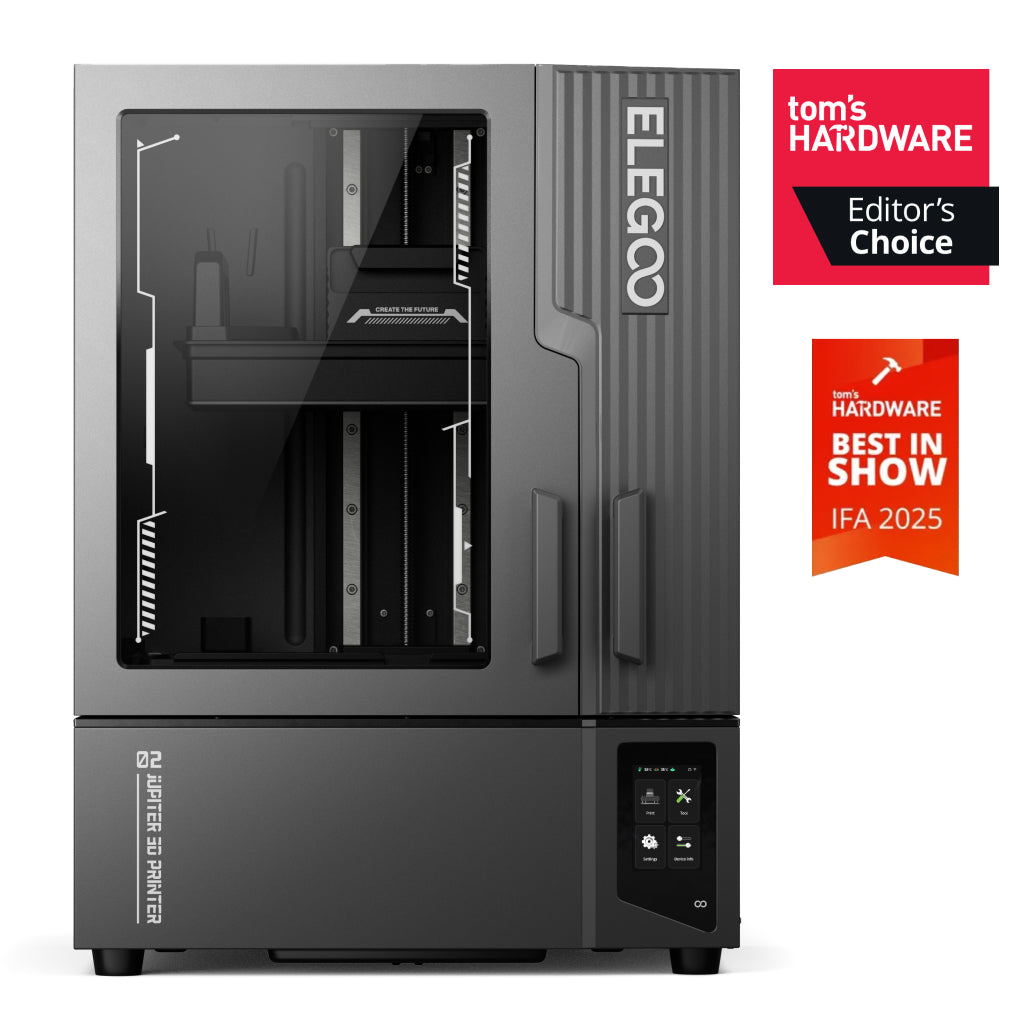
ELEGOO Jupiter 2
Jupiter 2 (16K; not the Jupiter or Jupiter SE)
The only machine here that pairs a fifteen-litre plate with a pitch under 30 μm, and the best-equipped large format on sale in the UK. You pay for it twice: once at the till and again every time the screen or film needs replacing.
- Build volume
- 302 × 162 × 300 mm
- Technology
- Resin (MSLA)
- Max speed
- Up to 90 mm/h (manufacturer maximum)
- Enclosed
- Yes — double-door enclosure
- Multi-colour
- No
- Auto levelling
- Yes (auto levelling on four independent force sensors; manual levelling with real-time data feedback also available)
What we like
- 302 × 162 × 300 mm — nearly 15 litres, the most on sale in the UK from a verifiable source
- 20 × 26 μm from a 14-inch 16K panel: the only fine pitch anywhere near this size
- Automatic levelling on four force sensors, which matters more the wider the plate gets
- Power-loss recovery, resin temperature sensing and a tool-free quick-swap release film
What we don’t
- ELEGOO UK direct only — 3DJake states it cannot deliver this model to Great Britain
- 28.9 kg and 465 × 508 × 648 mm, with doors that swing wide and access from the rear
- The most expensive consumables here: a panel around the £198 mark, film around £21 a sheet
- 300 W at the wall, and reviewers describe it as less forgiving than current rivals
What makes a plate this size survivable is everything around the panel. Levelling runs on four independent force sensors, which matters more as a plate grows: a tilt of a tenth of a millimetre across 300 mm is a first-layer failure you discover only at the end. Resin feeds and recycles into a heated quick-lock tank, layers reach 0.01 mm at 0.02 mm Z accuracy, and a double door and chamber camera make it a genuine enclosure. Power-loss recovery is fitted, and the release film swaps without tools — which counts, because it is the dearest consumable here.
Accounts of the automatic resin system split consistently: it takes genuine handling out of a vat this tall, while the pump and tubing add mess and slow a resin change enough that several describe going back to pouring by hand.At 28.9 kg and 465 × 508.1 × 648.1 mm this is furniture rather than a desk appliance, and it draws 300 W. Reviewers repeatedly warn that it needs far more desk space than its own width suggests, because the doors swing wide and access is from the rear.
Buy this if you want the largest plate available without a coarse pixel. Skip it if this is your first resin printer.
The cheapest route to fifteen litres: Anycubic Photon Mono M7 Max
Here is the page's closest call. Anycubic publishes 298 × 164 × 300 mm, stated as 14.7 litres; ELEGOO publishes 302 × 162 × 300 mm. Multiply both out and the gap is two hundredths of a litre: same space, different money.
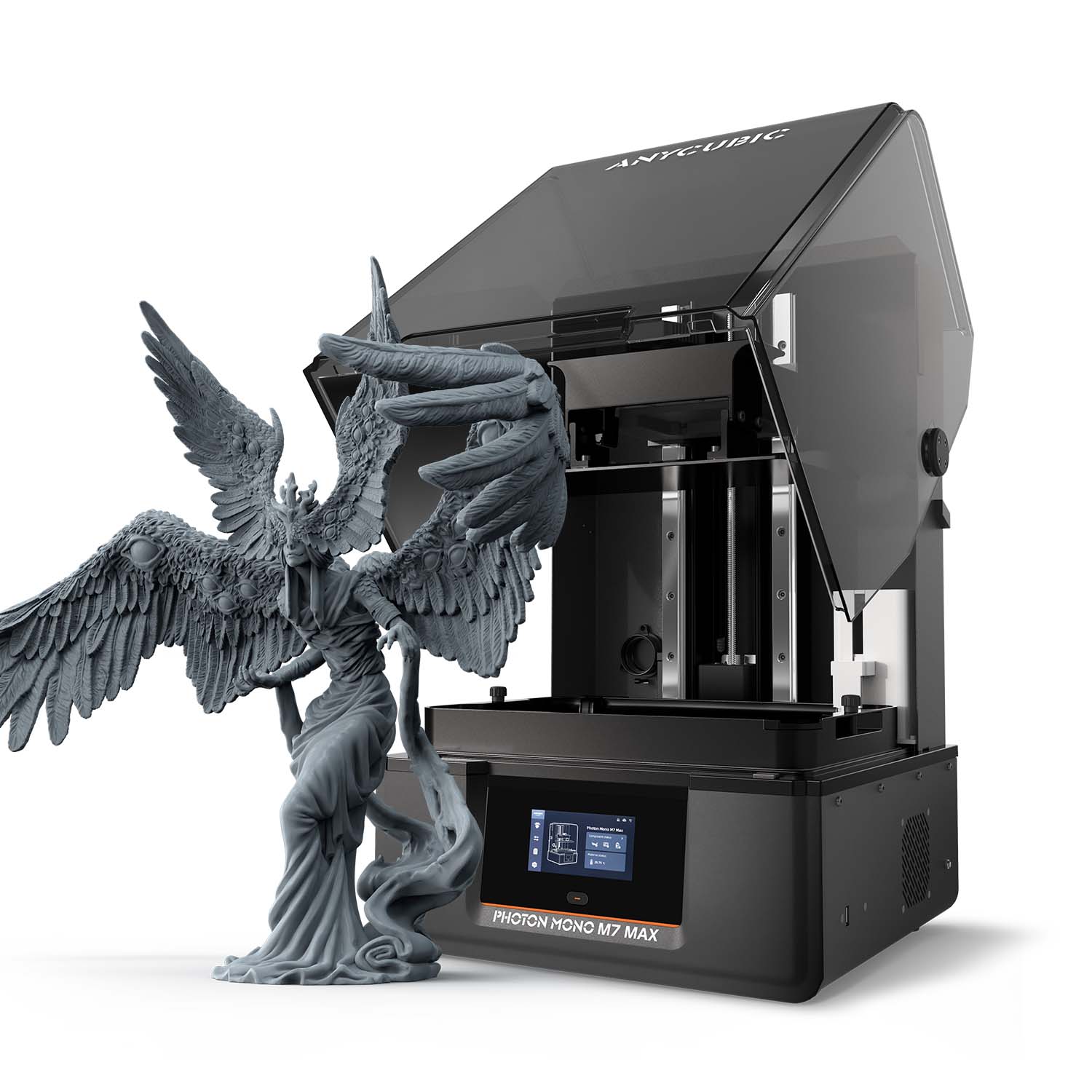
Anycubic Photon Mono M7 Max
Photon Mono M7 Max (not the Photon Mono M7 or M7 Pro)
Matches the Jupiter 2's build volume for less money, with equal detail in both plate axes and power-loss resume fitted. The pixel is more than twice as wide, and you level it yourself.
- Build volume
- 298 × 164 × 300 mm (14.7 L, manufacturer's own figure)
- Technology
- Resin (MSLA)
- Max speed
- Max ≤63 mm/h; standard resin at 0.05 mm ≤31 mm/h, standard resin at 0.1 mm ≤63 mm/h, high-speed resin at 0.1 mm ≤86 mm/h (manufacturer maxima)
- Enclosed
- Hinged UV-blocking cover; supports one-handed operation and hovers at angles over 45°
- Multi-colour
- No
- Auto levelling
- No — 4-point manual levelling
What we like
- 298 × 164 × 300 mm, which Anycubic states as 14.7 L — the Jupiter 2's volume for less
- Square 46 × 46 μm pixels, so edge quality is the same whichever way a part faces
- Power-loss resume fitted, which Anycubic lists as absent on both smaller M7 machines
- Temperature-controlled vat from 20 to 40 °C, automatic resin fill, and only 180 W
What we don’t
- 46 × 46 μm covers roughly five times the area of the M7 Pro's pixel
- Four-point manual levelling — the smaller M7 Pro is levelling-free
- No UK seller found other than Anycubic's own store, so there is no fallback route
- Light source rated at 4,500 μW/cm² against the M7 Pro's 5,500, spread over more glass
What Anycubic kept is worth more than it sounds. The pixel is square at 46 × 46 μm, so edge quality is the same whichever way a part faces — which frees orientation to be chosen for drainage and support contact rather than for which axis looks better. The vat is temperature-controlled from 20 °C to 40 °C with automatic filling, holding up to 1.3 litres. Two details beat everything else here: power-loss resume is supported, which Anycubic lists as absent on both smaller M7 machines, and the UV cover is hinged and holds position past 45°.
Four-point manual levelling reads badly against a levelling-free M7 Pro. The reports do not support that fear. Reviewers who have set this machine up consistently report that the manual levelling is a one-off rather than a routine: one notes it arrives levelled from the factory and another did not need to repeat it across a set of test prints, although both are single setups rather than long-term accounts.
It is single-source in Britain, and its light is rated at 4,500 μW/cm² within ten per cent against the M7 Pro's 5,500 — the same budget over more glass.
Buy this if you want fifteen litres for the least money and a square pixel suits work with detail running in more than one direction. Skip it if the pitch would show on anything you make.
Lowest price per litre: ELEGOO Jupiter SE
There is a version of this purchase where you want the space and almost nothing else. A 12.8-inch 6K panel across a 278 × 156 × 300 mm plate works out at thirteen litres — roughly 88 per cent of the Jupiter 2's volume — in a £450–£520 band. Nothing else here comes close on pounds per litre.
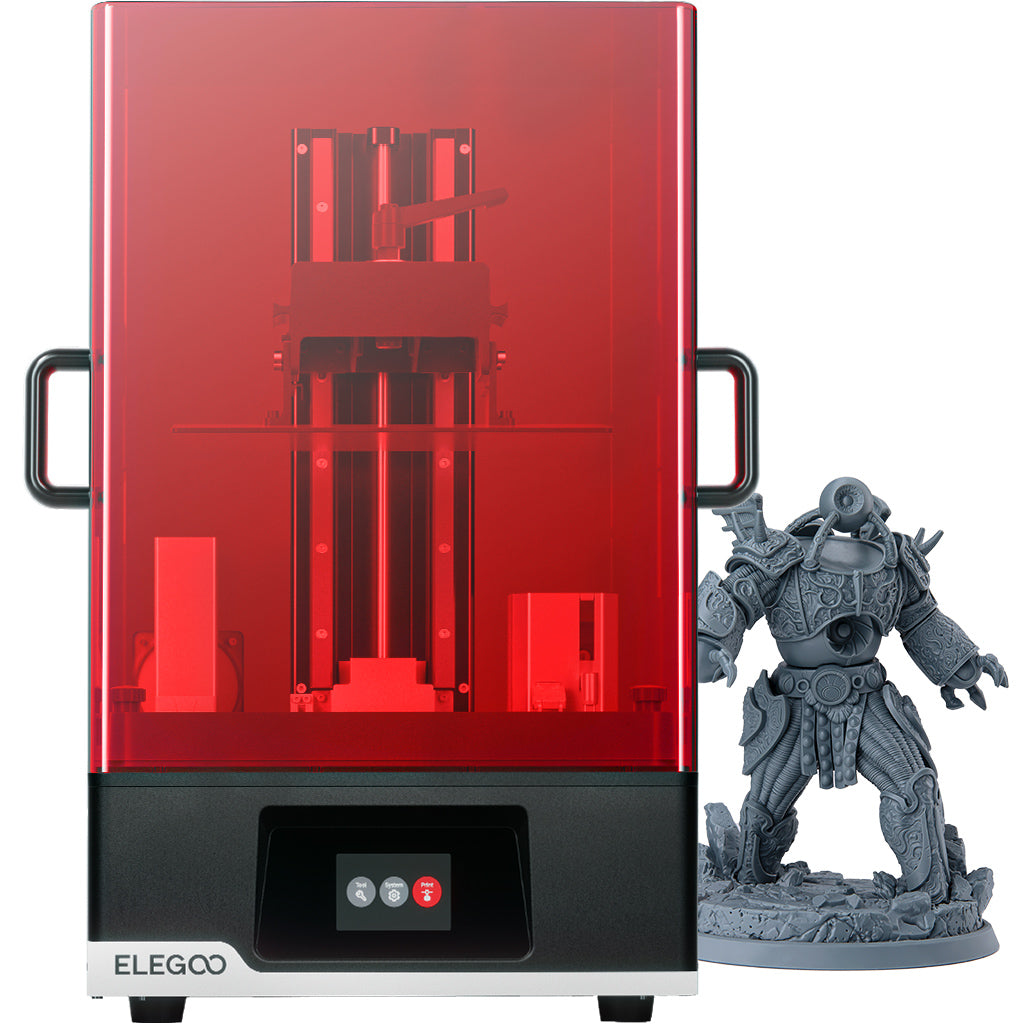
ELEGOO Jupiter SE
Jupiter SE (not the Jupiter or the Jupiter 2)
Thirteen litres and automatic resin handling for appreciably less than either fifteen-litre machine. The savings come out of pixel size, levelling, vat heating and everything networked.
- Build volume
- 278 × 156 × 300 mm (ELEGOO's comparison table); 277.848 × 156.264 × 300 mm in the long-form listing
- Technology
- Resin (MSLA)
- Max speed
- Up to 70 mm/h (manufacturer maximum)
- Enclosed
- Flip-up cover
- Multi-colour
- No
- Auto levelling
- No — manual levelling by the paper method
What we like
- 278 × 156 × 300 mm — 13 litres, and the lowest price per litre on this page by a distance
- Automatic resin feeding and recycling kept, with shortage and bottle monitoring
- 0.01–0.2 mm layers at 0.02 mm Z accuracy, identical to the Jupiter 2
- Reviewers describe the printer itself as dependable across their print runs
What we don’t
- 51 μm pixels — the coarsest pitch here by a wide margin
- Manual paper-method levelling, an unheated tank, and no resin temperature sensing
- No power-loss recovery and no OTA updates: a lost 13-litre plate is not recoverable
- USB only on a 3.5-inch resistive screen, and a release film without the quick-swap fitting
The surprise is what ELEGOO did not remove: automatic resin feeding and recycling, with shortage detection and bottle monitoring, plus 0.01–0.2 mm layers at 0.02 mm Z accuracy identical to the Jupiter 2. Where it saves is everywhere else. The pixel is 51 μm, the coarsest here; levelling is manual by the paper method; the tank is unheated and resin temperature unmeasured; there is no power-loss recovery and no over-the-air updating; connectivity is USB only; and the film lacks the Jupiter 2's quick-swap fitting, making a change a screws-and-tools job. It tops out at 70 mm/h.
Reviewers of this machine repeatedly describe the automatic resin feeder as the part that disappoints: resin stays behind in the pump and tubing, so changing colour or material means clearing a system that was not designed for it, and several describe going back to pouring the vat by hand.Buy this if your limit is budget rather than ambition and you are happy to level by hand in a room you keep warm. Skip it if the room is cold, your parts carry fine raised detail, or you would be upset to lose a thirteen-litre plate to a power cut.
The largest plate that still behaves like a desktop machine: Anycubic Photon Mono M7 Pro
Not everyone who wants a bigger resin printer wants workshop furniture. This is the largest machine here that does not become one: 223 × 126 × 230 mm, stated as 6.5 litres, from a 10.1-inch 14K panel at 16.8 × 24.8 μm — the finest pitch of the five picks.
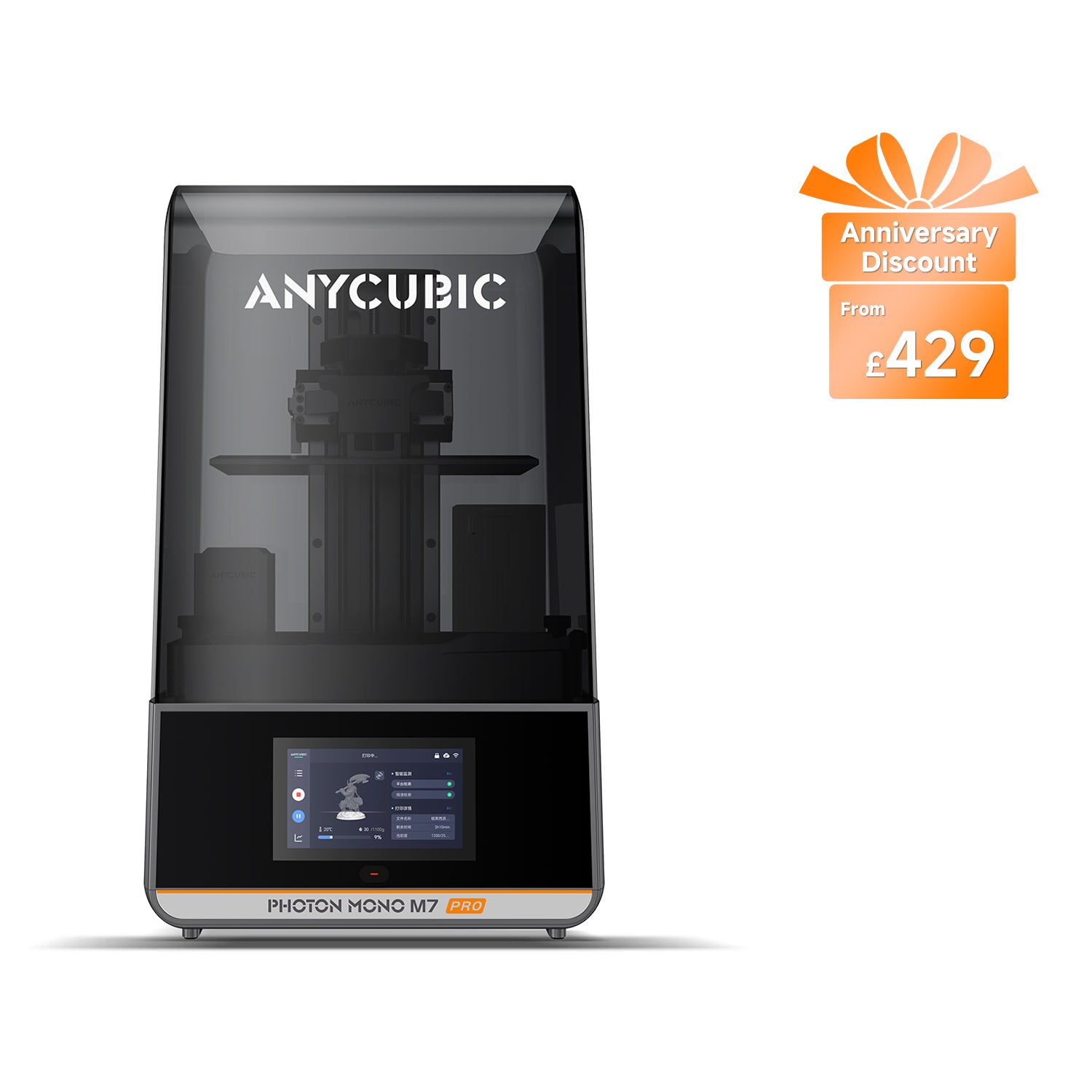
Anycubic Photon Mono M7 Pro
Photon Mono M7 Pro (not the Photon Mono M7 or M7 Max)
The biggest machine here that still sets itself up, heats its own resin and fills its own vat. Less than half the volume of the Jupiter 2, and the only pick with a pitch under 17 μm across the plate.
- Build volume
- 223 × 126 × 230 mm (6.5 L)
- Technology
- Resin (MSLA)
- Max speed
- Max ≤130 mm/h; standard resin at 0.1 mm ≤130 mm/h, high-speed resin at 0.1 mm ≤170 mm/h (manufacturer maxima)
- Enclosed
- Lid (removable UV cover; Anycubic lists no hinged cover)
- Multi-colour
- No
- Auto levelling
- Yes (levelling-free)
What we like
- 6.5 litres — the largest plate here that still sits on an ordinary desk
- 16.8 × 24.8 μm: the finest pitch on this page, across the plate
- Levelling-free, with a dynamically heated vat and automatic resin fill-and-drain
- The strongest light source here at 5,500 μW/cm², and up to 170 mm/h on high-speed resin
What we don’t
- Less than half the volume of the two fifteen-litre machines
- Anycubic lists power-loss resume as not supported, unlike the larger M7 Max
- Owner reports describe the automatic resin feed as inconsistent as the bottle empties
- The heated, pump-fed vat cannot be left to soak and is awkward to pour out
The case for stopping here rather than going large is that this machine automates the three jobs that get harder as a plate grows. It is levelling-free, the vat heats dynamically while resin fills and drains automatically, and dual linear rails are rated to 10 μm with layers to 0.01 mm. The light source is the strongest here at 5,500 μW/cm², and it is quick for its class at up to 170 mm/h on high-speed resin.
The resin path is what owners rate least. Owner and reviewer reports repeatedly describe the automatic resin feed as inconsistent, particularly as the bottle empties, and the manufacturer publishes its own troubleshooting for it. The pixel is also not square, so edge quality differs between plate axes. Anycubic lists power-loss resume as not supported, the one place the far larger M7 Max is better equipped, and the purifier is an optional accessory. It draws 240 W and weighs 12.8 kg.
Buy this if you want more plate than a 7-inch machine without a dedicated bench or a levelling ritual. Skip it if you are here because your models do not fit.
Best handling of peel force per pound: ELEGOO Saturn 4 Ultra
The smallest machine here earns its place on mechanism rather than size. Its plate is 218.88 × 122.88 × 220 mm — 5.9 litres, the least here — but it is the cheapest pick that tilts its vat to peel each layer off the film rather than lifting straight up, and peel force is what defeats large flat prints.
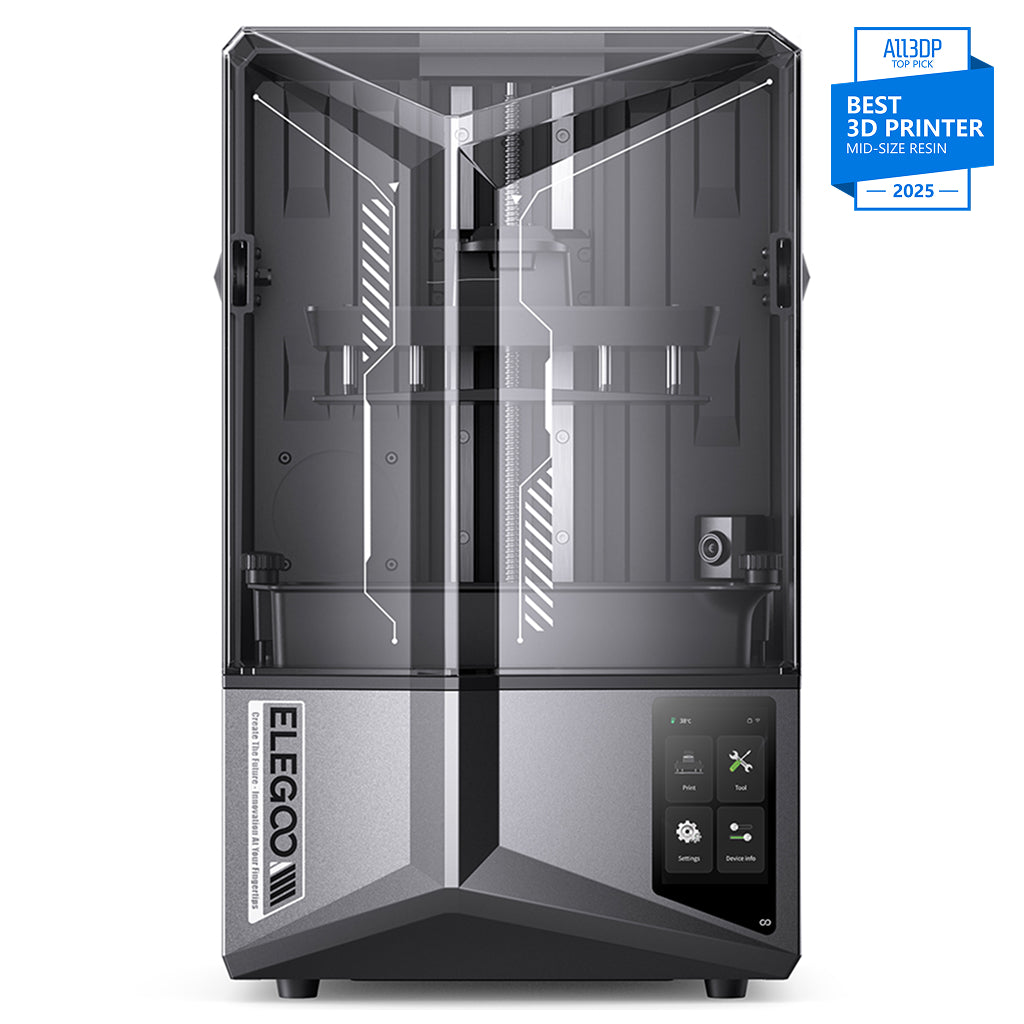
ELEGOO Saturn 4 Ultra 12K
Saturn 4 Ultra 12K (not the 16K variant)
The least volume here and the best answer to the failure mode that volume causes. Buy it if your parts have wide flat cross-sections and will fit six litres; it is the wrong page's product otherwise.
- Build volume
- 218.88 × 122.88 × 220 mm
- Technology
- Resin MSLA
- Max speed
- Up to 150 mm/h (fast mode)
- Enclosed
- N/A (resin printer with hinged UV cover)
- Multi-colour
- No
- Auto levelling
- Yes (hands-free automatic levelling; tilt-release platform)
What we like
- Tilt release peels each layer off the film — the direct answer to peel force, at the lowest price here
- Up to 150 mm/h, the fastest quoted figure on this page
- 19 × 24 μm, finer in both axes than either fifteen-litre machine
- The cheapest consumables here: a panel around £112 and film at under £5 a sheet
What we don’t
- 5.9 litres — the least build volume on the page
- No tank heating and no resin temperature control, which a cold British room punishes
- ELEGOO publishes no rated wattage, so no electricity estimate can be given
- No built-in filtration; ventilation and a purifier are a separate purchase
ELEGOO states that tilting the tank peels the model off the film quickly, which is what lets it quote up to 150 mm/h — the fastest figure of the five picks, from the smallest machine, because getting a layer off the film is the slow part of a resin print. A 10-inch 12K panel gives 19 × 24 μm, finer in both axes than either fifteen-litre machine, and levelling is hands-free.
Owners and reviewers repeatedly credit the tilting vat and automatic levelling with fewer failed prints than earlier Saturn models.The gap is temperature. ELEGOO lists no tank heating or resin temperature control anywhere in its specification for this machine, the most consequential omission in a British room. Owners of the 12K version often cite cold resin as a cause of failures, whereas 16K owners praise the built-in vat heater but note it must be switched on each session. Both fifteen-litre machines heat their vats; this one expects you to heat the room. It is 14.5 kg on a 327.4 × 329.2 × 548 mm footprint, in a £350–£450 band.
Buy this if your largest part fits six litres and its cross-sections are wide and flat. Skip it if you came here because things do not fit.
What a big vat actually changes
Four things get harder when a plate gets bigger, and none appears on a specification sheet.
Peel force scales with the layer, not the machine. The suction holding a cured layer to the release film acts over the cross-section being peeled, and the biggest plate here presents about 489 cm² against the smallest's 269 cm² — roughly 1.8 times the area. That is why the release mechanism matters more as plates grow: tilting the tank to peel a layer away attacks the problem directly, and two of these five do not do it.
A recurring point in technical guides and production write-ups is that the suction holding a layer to the film acts over the area being peeled, so the usual advice is to angle parts off the plate and limit how much cross-section any one layer exposes — though the recommended angle varies between sources.A resin printer for large models needs the model prepared differently. A solid part at this scale is a worse print than a hollowed one, because it fights every layer release with its full cross-section.
Guides to printing large resin models consistently make the same points: hollow the part, put drain holes at its lowest point as it will be printed, and use more than one so air can get in as resin leaves — a sealed cavity is widely described as a suction cup and a common cause of failure. Recommended hole sizes vary between sources, roughly in the 2 mm to 5 mm range.More resin stands in the machine. The M7 Max's vat holds up to 1.3 litres against the M7 Pro's one litre, and with standard resin from around the £17 mark per kilogram that is real money sitting in the printer — and the money you risk on every job, since a failed plate can contaminate the lot with cured fragments. That, rather than the price of the machine, is what makes a large vat raise failure costs.
The job does not end at the plate. ELEGOO's manual directs owners to wash models in alcohol unless the resin is water-washable, and the hardware sold for that job is sized for small parts: Anycubic's own wash-and-cure station sits around the £79 mark and is built for what a 7-inch machine makes. Plan for a vessel big enough to take a full plate.
UK running costs: electricity, resin and the screen
Electricity is the part people worry about and the part that barely matters. At the capped unit rate of 26.32p per kWh applying from October to December 2026, and using each maker's rated power, an eight-hour job costs roughly 63p on the 300 W Jupiter 2, around 51p on the 240 W M7 Pro and about 38p on the 180 W M7 Max or Jupiter SE. Treat those as estimated ceilings: a rated figure is what the supply can deliver, not what a machine averages while the panel is dark between exposures. ELEGOO publishes no printing wattage for the Saturn 4 Ultra, so no figure is given for it.
The real cost of size is the panel, which sits in the ultraviolet path for every second of every print. Independent technical sources and forum threads consistently treat the mono panel as a consumable rated in the low thousands of hours rather than a permanent part, which is why a replacement screen belongs in the running-cost sum, although reported working lives vary with how hard the machine is used. None of the three large panels here publishes a service life; the only rating we could verify is ELEGOO's "up to 2,000 hours" for a 10-inch screen. The replacement price, though, is verifiable.
| Specification | M7 Pro, 10.1in | Saturn 4 Ultra, 10in | Jupiter SE, 12.8in | M7 Max, 13.6in | Jupiter 2, 14in |
|---|---|---|---|---|---|
| Replacement panel | around £110 | around £112 | around £127 | around £180 | around £198 |
| Release film, per sheet | around £9 | under £5 | around £10 | around £12 | around £21 |
| Resin vat | around £46 | around £42 | around £56 | around £83 | around £81 |
| Build plate | around £46 | around £43 | around £42 | around £80 | around £83 |
Replacing the largest panel costs roughly 77 per cent more than the smallest. Film is where the scaling turns unkind: ELEGOO sells Saturn 4 film ten to a pack, under £5 a sheet, while Jupiter 2 film comes three to a pack at around £21 a sheet — roughly four and a half times as much for a consumable replaced on the same schedule.
So the annual picture is a few pounds of electricity, resin from around the £17 mark per kilogram, film at two to four times small-format prices, and eventually a panel at around the £180 to £200 mark. Budget for all four before the machine.
Buying in the UK: stock, warranty and spares
Large machines have thinner supply chains than small ones. Three of the five can only be bought from the manufacturer's own UK store: 3DJake lists the Jupiter 2 but states that delivery to Great Britain is not possible, and we found no third-party UK seller for the M7 Max or the Jupiter SE either. Only the M7 Pro and the Saturn 4 Ultra have two UK routes — a real argument for the smaller machines. ELEGOO UK itself ships to the UK and the Crown Dependencies in three to seven business days, free over £40.
Now the part that matters most on a page about large panels: the component you pay most to replace has the least cover. ELEGOO gives twelve months on the machine but three on the LCD, with the resin tank and build plate at six — the same split on the Jupiter SE. Anycubic gives twelve months on the machine and six on the screen, naming the M7 Max explicitly, and covers the M7 Pro the same way. So the dearest panel here carries three months of cover and the second-dearest six. Anycubic also lists the peristaltic pump tube as a consumable with no warranty — relevant on machines whose selling feature is a pump. ELEGOO's UK store also sells pre-owned units of most of this range, which its own warranty table states carry no warranty at all.
Spares are otherwise well stocked and model-specific on both stores. Owners of the largest machine here repeatedly run into gaps in the accessory range, including release film sold only as a framed assembly and no matching wash-and-cure station. Anyone buying a professional resin printer for production should price a spare panel and film set alongside the machine: a screen failure on a single-route product is a stopped line. For the same pool on all-round merit, see our best resin printer uk guide; for tabletop figures, resin printers for miniatures.
Mistakes buyers make when shopping on size
Buying volume you will never fill. The common version of this purchase is a buyer who needs one dimension and pays for three. If a model is only too tall, check the Z height on its own: the Jupiter 2, the M7 Max and the much cheaper Jupiter SE all reach 300 mm, so height alone does not justify the step up.
Assuming the bigger machine is the better machine. Pixel size runs backwards to volume across this page, and automation does not scale with price either: the M7 Max levels by hand while the smaller M7 Pro is levelling-free, and the Jupiter SE has neither heating nor power-loss recovery. Read the feature rows, not the price.
Forgetting what the room has to absorb. None of these filters its own air — on the M7 Max and the M7 Pro the purifier is an optional accessory — and a large machine holds more resin with more surface open to the room. Owner accounts of resin odour in a home vary widely: some describe printing in a bedroom and noticing little, while others treat a ventilated room and added carbon filtration as essential. You cannot know which group you are in beforehand, so plan for ventilation. Manufacturer guidance asks for gloves and eye protection, a well-ventilated area, no skin contact, and resin cured under UV before disposal; the risk is cumulative, since the Health and Safety Executive lists resins and acrylates among the causative agents of occupational skin disease and says that once sensitised a person is likely to remain so for life.
Buying resin when the job wants filament. If you need a large, tough, functional part — a bracket, an enclosure, a cosplay piece that must survive being worn — resin is the wrong technology however many litres you buy, because the parts are brittle. Manufacturer guidance on printing a helmet in one piece asks for roughly 350 × 350 × 330 mm or larger, which no resin machine here approaches in width. Our best 3d printers uk guide covers the machines that do.
Which large-format resin printer should you buy?
For most people who genuinely need the space, the ELEGOO Jupiter 2 is the answer, and volume is only half of why. Nearly fifteen litres at 20 × 26 μm is the only combination here that does not force a choice between size and pitch, and the force-sensor levelling, heated tank and power-loss recovery turn a plate that large into finished parts rather than expensive failures.
If pitch is irrelevant to what you make, the Photon Mono M7 Max gives the same volume for less. If budget binds, the Jupiter SE is thirteen litres in the £450–£520 band. If six and a half litres is enough, the M7 Pro is the easiest to live with. For wide flat parts that fit six litres, the Saturn 4 Ultra's tilt release handles them best.
The ELEGOO Jupiter 2 is the pick: the most build volume available in the UK from a verifiable source, at the only fine pitch anywhere near that size. The Jupiter SE is the value choice if you can accept a coarse pixel and manual levelling, and the Photon Mono M7 Max is the one to take if you want that volume with equal detail in both plate axes.
- Buy it if
- You have measured the part that does not fit, you will fill the plate often enough to justify it, and you have a dedicated bench, a ventilated room and a plan for washing and curing output a standard station will not hold.
- Skip it if
- You are buying litres because more sounds better, your parts would fit a 7-inch machine, or you need large parts that must survive mechanical use — in which case a filament printer is the right tool.
How this article was researched
This guide is research-based. No machine here was purchased, operated or photographed by us, and no number on this page is a measurement we took. Every specification comes from the manufacturer's own product page or specification table and carries a citation; price bands, stock positions and spare-part prices come from the brands' own UK stores, checked between 8 September and 8 October 2026. Volumes in litres and plate areas in square centimetres are arithmetic on the published dimensions.
Four gaps are worth stating. No manufacturer publishes a peel force, so the discussion of release forces reasons from exposure area and names each machine's mechanism. No LCD service life is published for the three large panels, which is unfortunate given that the panel is the main running cost. ELEGOO publishes no rated wattage for the Saturn 4 Ultra, so it has no electricity estimate, and no acoustic rating is published for any machine here, so the page makes no noise comparison.
Common questions
- Which resin printer has the largest practical build volume?
- Two machines tie, and the tie is real rather than a rounding. The ELEGOO Jupiter 2 builds inside 302 × 162 × 300 mm and the Anycubic Photon Mono M7 Max inside 298 × 164 × 300 mm, which work out at 14.68 and 14.66 litres — a difference of two hundredths of a litre. "Practical" is the operative word, though: the hardest job either can be given is a plate full of wide flat layers, because the suction holding each layer to the release film acts over the area being peeled. A larger machine does exist on sale to UK buyers, at roughly 18 litres, but its manufacturer's website would not serve us a specification and the brand runs no UK store, so it is not a pick here.
- Do large vats increase failure costs?
- Yes, measurably, in three ways. The consumables cost more: a replacement panel for the 14-inch Jupiter 2 is around the £198 mark against around £112 for a 10-inch Saturn screen, and its release film works out at roughly four and a half times the per-sheet price. More resin stands in the machine — up to 1.3 litres in the M7 Max's vat — and a failed plate can contaminate the lot with cured fragments. And a failure wastes more of what you put in, since a full large plate is kilograms of resin and hours of printing. The counterweight is that a layer exposes in one pass however much of the plate it covers, so a plate you actually fill spreads the fixed costs of the job across everything on it.
- What workshop space is needed?
- More than the footprint suggests. The Jupiter 2 is 465 × 508 × 648 mm and 28.9 kg, the M7 Max is 425 × 362 × 652 mm and 24 kg, and the Jupiter SE is 480 × 377 × 658 mm — all of them taller than a kitchen wall cupboard and heavy enough to want a solid bench rather than a shelf. Then add clearance: the Jupiter 2's doors swing wide and it is accessed from the rear, so it cannot go in an alcove. The part buyers forget is downstream. None of these machines filters its own air, so the room needs ventilation, and no consumer wash-and-cure station is sized for what a fifteen-litre plate produces, so you also need space for a draining tray and a washing vessel large enough for the output.