Fastest Resin Printers UK
The fastest resin printers in the UK, ranked on throughput at a realistic layer height rather than the headline mm/h figure on the box. Bands, not prices.
Independent and reader-funded. We earn a commission if you buy through our links, at no extra cost to you. How this works.
Three numbers decide which is the fastest resin printer uk buyers can order today, and all three are measured differently. Anycubic quotes the Photon Mono M7 Pro at 130 mm/h on standard resin and 170 mm/h on high-speed resin. ELEGOO quotes the Saturn 4 Ultra at 150 mm/h flat, no resin named. The ELEGOO Jupiter 2 is quoted at 90 mm/h and will still finish a batch of thirty models before either of them.
None of those figures is wrong, and all three are close to useless alone. A millimetre-per-hour rating is a vertical build rate: it describes how fast the plate climbs, so it scales directly with layer height. Set a finer layer and the same machine takes several times longer.
So these five are ranked on throughput using layer-cycle arithmetic from the makers' own published figures rather than the number on the box — and the machine that clears a full plate soonest is the slowest of the five on paper.
The five, ranked by what they finish in an hour
Read the second row twice. Every machine publishes a maximum, and the conditions attached differ by brand — which makes the first row uncomparable until you have read the second.
| Specification | 1 Anycubic Photon Mono M7 Pro Fastest overall | 2 ELEGOO Saturn 4 Ultra 16K Fastest at the finest pixel | 3 ELEGOO Saturn 4 Ultra 12K Most plate per hour for the money | 4 ELEGOO Mars 5 Ultra Fastest compact | 5 ELEGOO Jupiter 2 Fastest by batch |
|---|---|---|---|---|---|
| Quoted maximum | 170 mm/h | 150 mm/h | 150 mm/h | 150 mm/h | 90 mm/h |
| Conditions on it | High-speed resin at 0.1 mm; 130 mm/h on standard | Fast mode | Fast mode | Manufacturer maximum | Manufacturer maximum |
| Release mechanism | Not published | Tilt release | Tilt release | Tilt release | Not published |
| Plate | 223 × 126 × 230 mm | 212 × 118 × 220 mm | 219 × 123 × 220 mm | 153 × 78 × 165 mm | 302 × 162 × 300 mm |
| Finest layer | 0.01 mm | 0.01 mm | Not published | 0.01 mm | 0.01 mm |
| Heated vat | Yes | Yes | No | No | Yes |
| Price band | £410–£470 | £370–£420 | £350–£450 | £210–£260 | £650–£800 |
| UK availability | Anycubic UK, 3DJake | ELEGOO UK, 3DJake | ELEGOO UK, 3DJake | ELEGOO UK, 3DJake | ELEGOO UK direct only |
Two things stand out. The 170 mm/h at the top is the only figure here that depends on what you pour in. And three of the five reach 150 mm/h across a span from the £210–£260 band upwards — so past a point, money stops buying speed and starts buying plate.
What a mm/h figure actually measures
A resin printer does not trace a layer, it prints one. A monochrome LCD masks a single ultraviolet source, so the whole cross-section cures in one exposure, and the maker publishes speed as a height per hour rather than a travel speed. So the useful thing to know about a fast MSLA printer is that mm/h is layer height divided by layer time — and only one of those belongs to the printer.
ELEGOO publishes both halves of one layer for the Saturn 4 Ultra: 5.5 seconds on its general parameter settings, of which 2.5 seconds is the slicer's default exposure. Roughly three seconds a layer is therefore mechanical — tilting the tank, peeling the layer off the film, repositioning. That subtraction is ours, but it is the useful half: exposure belongs to the resin, the three seconds to the machine.
Hold the 5.5 seconds steady and vary only the layer height, which is what a slicer does:
| Specification | 0.05 mm layers | 0.10 mm layers | 0.15 mm layers |
|---|---|---|---|
| Layers per 10 mm of height | 200 | 100 | 67 |
| Implied build rate | about 33 mm/h | about 65 mm/h | about 98 mm/h |
The published maximum for that machine is 150 mm/h. At 5.5 seconds a layer that needs a layer height near 0.23 mm, past the coarse end of the class — ELEGOO publishes a 0.01 to 0.2 mm range for the 16K sibling. The two figures do not reconcile, which tells you what the headline is: a ceiling measured under conditions chosen to produce the largest number.
In model terms, a 60 mm figure at 0.05 mm is 1,200 layers, and at 5.5 seconds each that is about an hour and fifty minutes. The headline implies twenty-four. So a listing advertising a 150 mm per hour resin printer is quoting a best case at a coarse layer — not dishonest, since every brand does the same, but not a finishing time.
Independent reviewers who publish their own timings consistently work at finer layer heights than the headline figure assumes, and report print times well short of it as a matter of course rather than as a fault. Reviewers repeatedly note that the slicer's predicted time runs short of the time a job actually takes, so the estimate is worth treating as a floor.Which release systems print fastest
Those three mechanical seconds are where the engineering competition sits, and the two brands have answered it differently — one with hardware, one with chemistry.
The older way to free a cured layer is to lift the plate straight up until the part lets go of the film, slowly enough not to tear it off its supports. Tilt release peels instead of pulling. ELEGOO describes the Saturn 4 Ultra as adopting tilt release technology, in which the tank tilts so the model peels off the film — stated in the same sentence as the 150 mm/h maximum, which makes the mechanism the manufacturer's own explanation for the figure. Peeling from one edge needs a fraction of the force of lifting a whole face, so the motion can be quicker and gentler together. The same mechanism appears on the Saturn 4 Ultra 16K and the Mars 5 Ultra, which is why all three reach the same number. It is a change to the machine: it applies to every job and costs nothing per print.
Anycubic quotes two figures instead of one. The Photon Mono M7 Pro is rated 130 mm/h on standard resin and 170 mm/h on high-speed resin, both at 0.1 mm layers; the Photon Mono 4 Ultra splits the same way at 80 and 120 mm/h. This is the comparison most listings get wrong. The 170 figure is not a faster machine than the 150 figure — it is a machine plus a consumable. High-speed resin cures in less ultraviolet, shortening the exposure half of the cycle; switch back to standard resin and the same printer drops below all three ELEGOO machines. Weighing a high speed resin printer against a tilt-release one means weighing a recurring cost against a fixed one.
The film is a variable too: the Photon Mono 4 Ultra uses an ACF release film, and films trade clarity for release force.
A recurring recommendation from reviewers is to swap the supplied fast-release film for a clearer type if maximum sharpness matters, accepting slower prints in exchange. Several reports note that prints from high-speed resin are best washed and de-supported soon after the job finishes, since supports become much harder to remove once fully cured.How we picked these five
Nothing here was bought, opened or printed with. The ranking is built from manufacturer specification pages and manuals, UK retailer listings read for price band and stock, and published reviews and forum threads read for recurring patterns. Our approach is set out in our review methodology.
Candidates were ranked on manufacturer-stated throughput against the layer arithmetic above, with evidence quality as the cut. The Anycubic Photon Mono 4 Ultra is a good printer and a poor fit here: 80 mm/h on standard resin and 120 on high-speed, in the £240–£290 band — slower than the Mars 5 Ultra and dearer than its £210–£260 band. The Photon Mono M7 would have ranked, but no UK price band or availability could be confirmed from a primary source.
Four of the five picks are ELEGOO. No commercial factor was applied anywhere in this ranking; that is what happens when you sort by a mechanism one brand has fitted across its range and the other has not.
Fastest overall: Anycubic Photon Mono M7 Pro
If the brief is "finish sooner, whatever it costs", this is the machine — with one condition the brief must accept. The 170 mm/h rating is the highest here and applies only with high-speed resin at 0.1 mm layers; on standard resin the same printer is rated 130 mm/h. Both figures are honest. Only one is free.
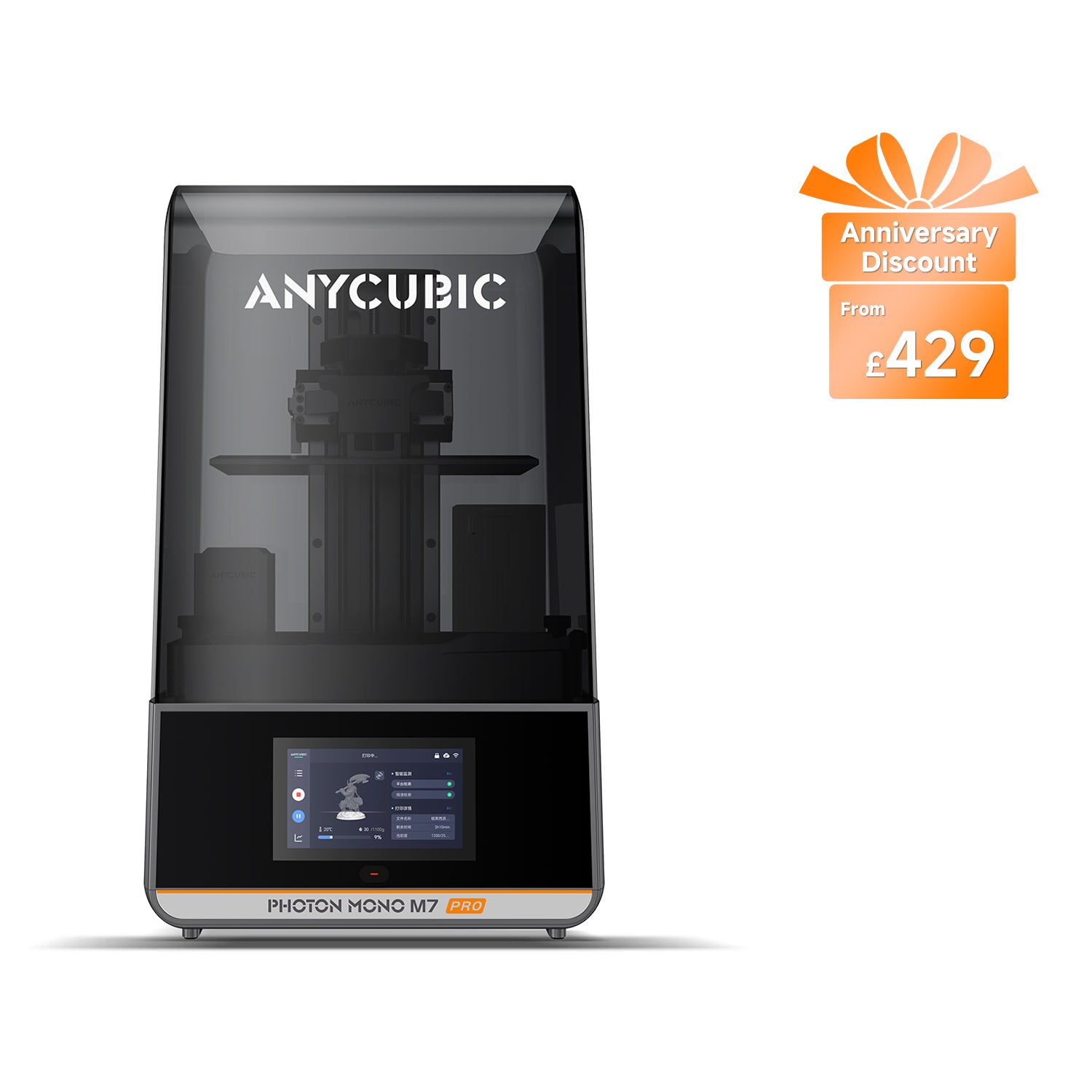
Anycubic Photon Mono M7 Pro
Photon Mono M7 Pro (not the Photon Mono M7 or M7 Max)
The highest quoted rate here and the largest desktop plate. The top figure is rented rather than owned.
- Build volume
- 223 × 126 × 230 mm (6.5 L)
- Technology
- Resin (MSLA)
- Max speed
- Max ≤130 mm/h; standard resin at 0.1 mm ≤130 mm/h, high-speed resin at 0.1 mm ≤170 mm/h (manufacturer maxima)
- Enclosed
- Lid (removable UV cover; Anycubic lists no hinged cover)
- Multi-colour
- No
- Auto levelling
- Yes (levelling-free)
What we like
- 170 mm/h quoted — the highest rate on this page, at 0.1 mm layers
- 223 × 126 × 230 mm: the largest desktop plate here, so a fast cycle covers more models
- Levelling-free, with dual linear rails quoted at 10 μm
- Heated vat, which protects the layer time the rating depends on
What we don’t
- The 170 figure needs high-speed resin; on standard resin it is 130 mm/h
- Power-loss resume is listed as not supported — a real risk on a long job
- The automatic resin feed is reported as inconsistent as the bottle empties
- 240 W, and 312 × 315 × 520 mm of bench before clearance
The rest of the specification makes that rate usable. The plate measures 223 × 126 × 230 mm, biggest of the four desktop machines, so a fast cycle covers more models per job. Layers reach 0.01 mm on dual linear rails quoted at 10 μm, the platform is levelling-free, and the vat has dynamic temperature control — the quiet speed feature, since cold resin wants a longer exposure.
Owner and reviewer reports repeatedly describe the automatic resin feed as inconsistent, particularly as the bottle empties, and the manufacturer publishes its own troubleshooting for it.Anycubic's own table lists power-loss resume as not supported, a real exposure on a six-hour job. It draws 240 W and wants 312 × 315 × 520 mm of bench, and the pixel is strongly non-square at 16.8 × 24.8 μm, so edge quality depends which way a part faces. Against that, the screen carries six months of cover rather than ELEGOO's three.
Buy this if you will keep high-speed resin in the cupboard and would rather spend money than time.
Skip this if you print occasionally with whatever resin is to hand, or if losing a long job to a power cut would be unacceptable.
Fastest at the finest pixel: ELEGOO Saturn 4 Ultra 16K
Speed and detail usually pull against each other, because detail means finer layers and more of them. This is the best answer here to wanting both: the same 150 mm/h in fast mode as its cheaper siblings, exposing at 14 × 19 μm, the finest pitch of the five.
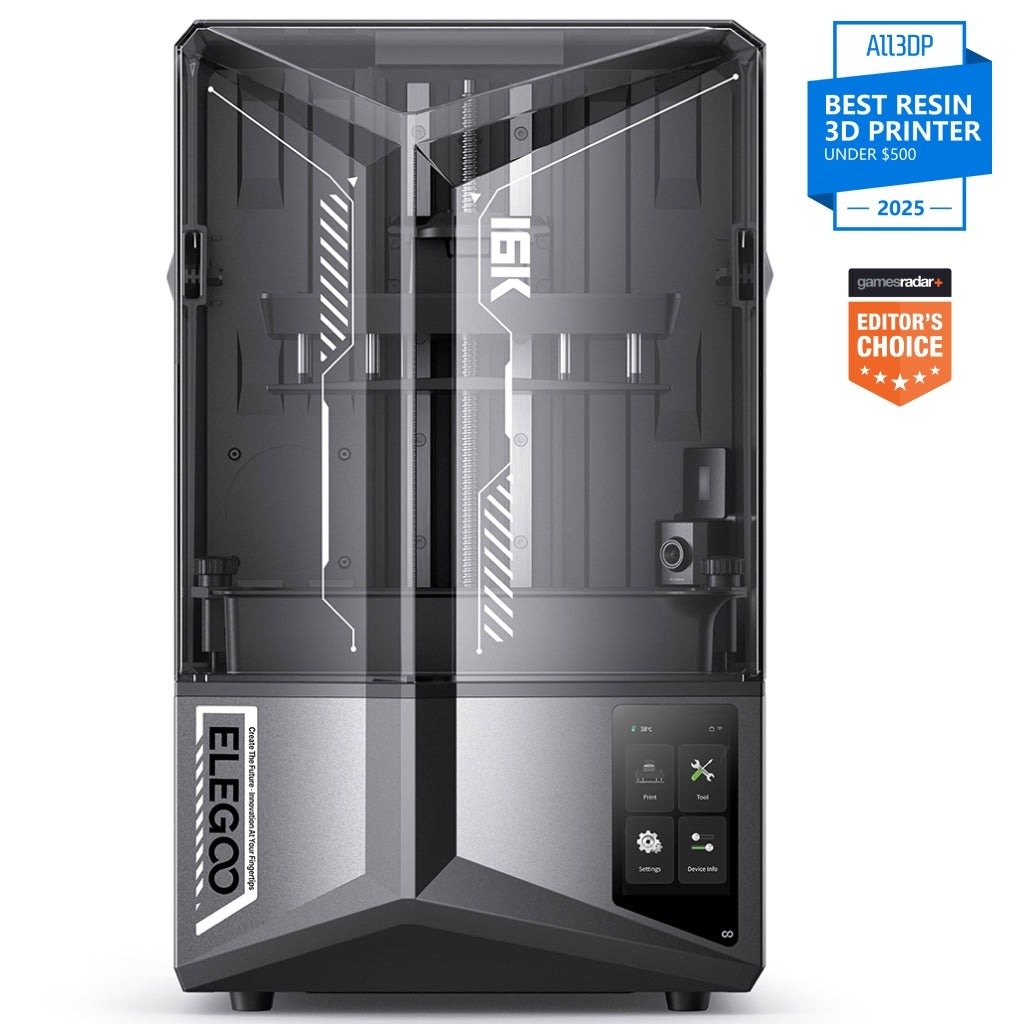
ELEGOO Saturn 4 Ultra 16K
Saturn 4 Ultra 16K (not the 12K Saturn 4 Ultra)
The finest pixel here on a plate worth filling, at the same headline rate as the 12K models.
- Build volume
- 211.68 × 118.37 × 220 mm
- Technology
- Resin (MSLA)
- Max speed
- Up to 150 mm/h (fast mode, manufacturer maximum)
- Enclosed
- Lid (acrylic UV cover)
- Multi-colour
- No
- Auto levelling
- Yes (one-click automatic levelling)
What we like
- 150 mm/h in fast mode at 14 × 19 μm — the finest pixel on this page
- ELEGOO publishes the layer time: 5.5 s on its own default parameters
- Resin tank held at 30 °C, which keeps the layer time honest in a cold room
- Tilt release and 0.01–0.2 mm layers, so fast-and-coarse and slow-and-fine are both available
What we don’t
- Suction under wide flat layers, not the printer, is the usual cause of a failure
- No filtration of its own — a ventilated room or a purifier is part of the buy
- Three months of warranty on the screen against twelve on the machine
- The panel is rated to 2,000 hours, and running hard spends them faster
ELEGOO publishes a layer time of 5.5 seconds in fast mode on its own defaults. Layers run 0.01 to 0.2 mm, so coarse-and-fast and fine-and-slow are both available on one machine; the tank tilts to peel each layer off the film rather than lifting it, across a 212 × 118 × 220 mm plate. The specification that matters most for consistent speed sounds least exciting: the tank is held at 30 °C.
Owners and reviewers repeatedly single out the heated vat as the feature that makes cold-room printing practical, though it does add a warm-up wait before each job.In an unheated room over winter, that heater is the difference between the quoted layer time and a much longer one. What slows this machine in practice, though, is not the machine.
A recurring account of large-format resin printing on this machine is that suction on wide flat layers, not the printer, is the usual cause of a failed print — and that angling the part and supporting it better is the fix, although the right angle depends on the model.A failure at hour four is the slowest outcome available.
Buy this if you print detailed work and refuse a slow machine for it, or the printer will live somewhere cold.
Skip this if your parts are large and simple, where the finer pixel earns nothing, or you need the biggest plate here — the Jupiter 2.
Most plate per hour for the money: ELEGOO Saturn 4 Ultra
Throughput is rate multiplied by area, and this is where the two meet at the lowest price. It matches the 150 mm/h of the rest of the tilt-release group across 218.88 × 122.88 × 220 mm — fractionally more plate than its own 16K sibling, for a band that starts lower.
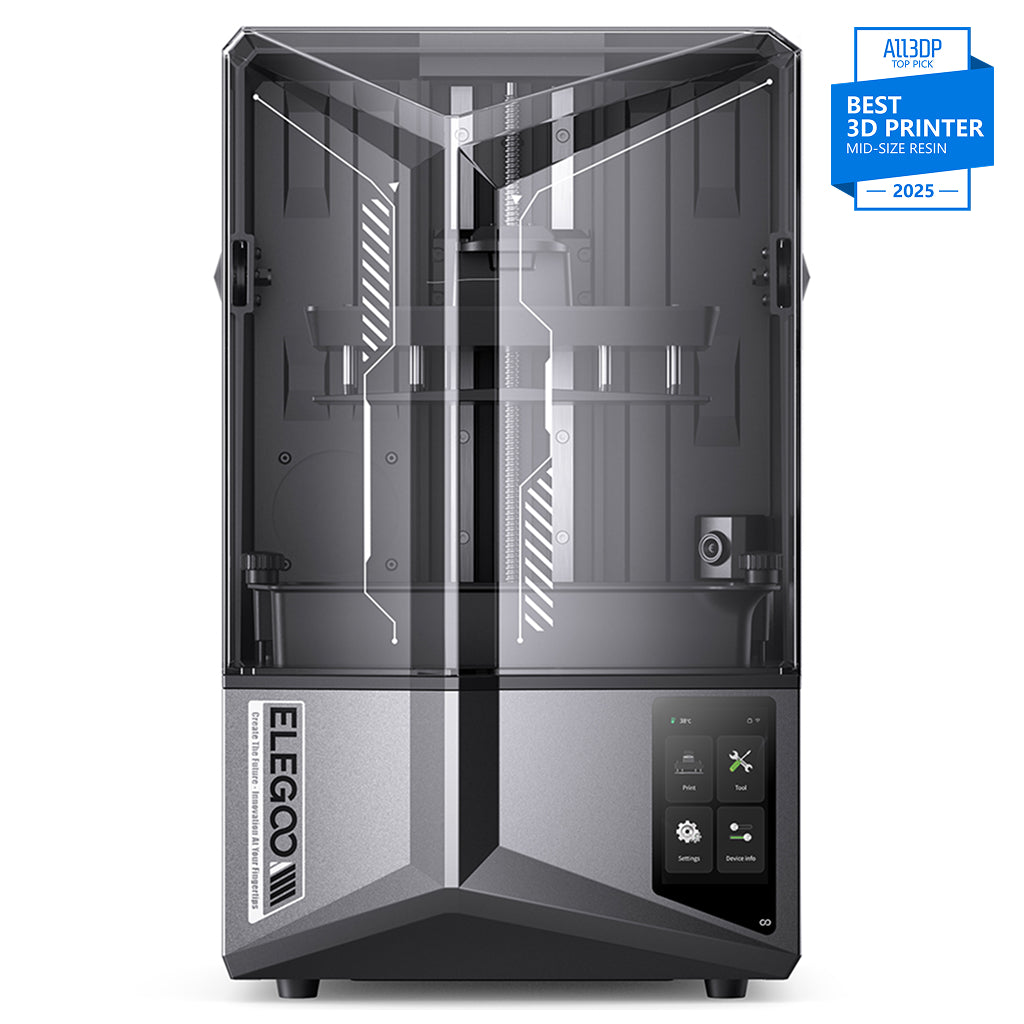
ELEGOO Saturn 4 Ultra 12K
Saturn 4 Ultra 12K (not the 16K variant)
The same tilt release and headline rate as the 16K, on a slightly larger plate for less. What you give up is the heated tank.
- Build volume
- 218.88 × 122.88 × 220 mm
- Technology
- Resin MSLA
- Max speed
- Up to 150 mm/h (fast mode)
- Enclosed
- N/A (resin printer with hinged UV cover)
- Multi-colour
- No
- Auto levelling
- Yes (hands-free automatic levelling; tilt-release platform)
What we like
- The same 150 mm/h and the same tilt release as the 16K, for less
- 218.88 × 122.88 × 220 mm — fractionally more plate than its own 16K sibling
- ELEGOO publishes both halves of the layer: 5.5 s total, 2.5 s of it exposure
- 405 nm COB source through a Fresnel lens at 92% uniformity, and hands-free levelling
What we don’t
- No tank heating or resin temperature control is listed on this model
- Owners of the 12K often cite cold resin as a cause of failures
- No layer-thickness range is published on ELEGOO's page for this variant
- Needs the same 327 × 329 × 548 mm of bench as the 16K
This is the machine the guide reasons from, because ELEGOO states both halves of its layer: 5.5 seconds on general parameter settings, of which 2.5 seconds is the default exposure. The mechanism is tilt release, tied directly to the 150 mm/h figure. Light comes from a 405 nm COB source through a Fresnel lens, levelling is hands-free, and the pitch is 19 × 24 μm — coarser than the 16K, invisible on anything primed and painted.
The omission to think hardest about: no tank heating or resin temperature control is listed on this model.
Owners of the 12K version often cite cold resin as a cause of failures, whereas 16K owners praise the built-in vat heater but note it must be switched on each session.In a heated room the saving costs nothing; in a garage it is a false economy. Plan the bench either way — the chassis is 327.4 × 329.2 × 548 mm, the same body as the 16K.
Buy this if you want maximum finished models per pound and the printer will live somewhere heated.
Skip this if the room is cold, or you need the finest detail on offer — both point to the 16K.
Fastest compact: ELEGOO Mars 5 Ultra
The most surprising line in the comparison is this one. The cheapest machine here, in the £210–£260 band, carries the same 150 mm/h rating as models at twice the money — because it has the same tilt release, tipping the tank so each layer peels from one edge rather than being pulled off the film.
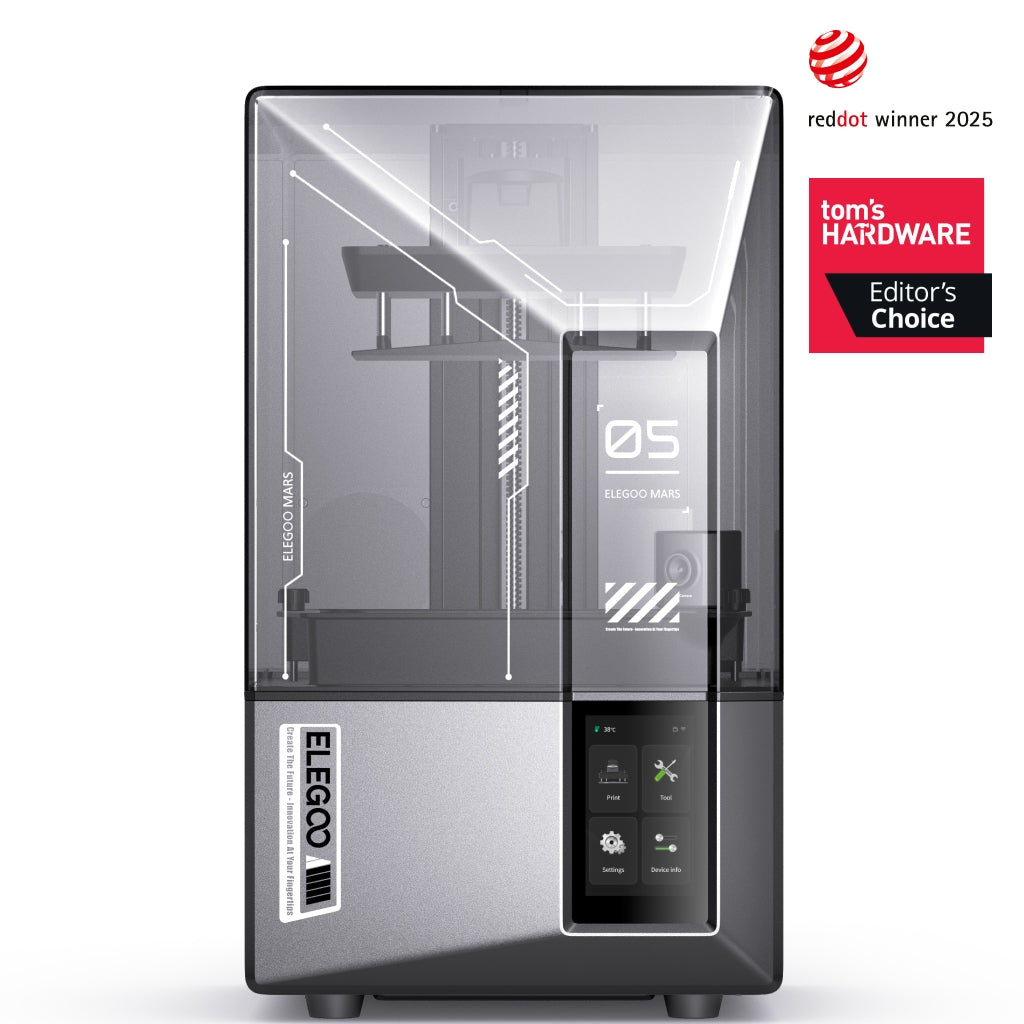
ELEGOO Mars 5 Ultra
Mars 5 Ultra 9K (not the non-Ultra Mars 5)
Full tilt-release speed in a desk-sized machine at the lowest price here. The plate is the compromise.
- Build volume
- 153.36 × 77.76 × 165 mm
- Technology
- Resin (MSLA)
- Max speed
- Up to 150 mm/h (manufacturer maximum)
- Enclosed
- Lid (acrylic UV cover)
- Multi-colour
- No
- Auto levelling
- Yes (one-click automatic levelling)
What we like
- 150 mm/h in the £210–£260 band — the same tier as machines at twice the money
- Tilt release, one-click levelling and 0.01 mm layers at the lowest entry price
- 18 × 18 μm square pixels, finer in both axes than either 12K machine here
- 8.8 kg on a 260 × 268 × 451.5 mm footprint: a shelf, not a bench
What we don’t
- Cold resin is the dominant cause of failure and there is no heated vat
- 153 × 78 × 165 mm — the smallest plate here, which is a direct tax on throughput
- Reviewers describe the Z height as the machine's one real limit
- No built-in filtration; the air purifier is a separate purchase
The rest holds up: 18 × 18 μm square pixels, finer in both axes than either 12K machine above, layers from 0.01 to 0.2 mm, one-click levelling, and 8.8 kg on a 260 × 268 × 451.5 mm footprint — a shelf, not a bench.
A recurring account across independent reviews is that cold, thick resin is what defeats this machine's automation — the levelling sensor triggers early and the first layer stays on the film — and that warming the resin or the room is what fixes it.With no heated vat, the automation works against you in a cold room: it is quick to start a job that was never going to stick. The second limit is geometry. At 153.36 × 77.76 × 165 mm this plate is roughly a third of the Saturn's area, and since a layer costs the same however many models it holds, a small plate is a direct tax on throughput.
The most consistent criticism in independent reviews is the plate itself: reviewers repeatedly describe the Z height as the machine's one real limit, with taller pieces needing to be angled or split.Buy this if you want the top speed tier for the least money, print small parts, and have a warm corner for it.
Skip this if you print in batches, where the plate costs more time than the tilt release saves.
Fastest by batch: ELEGOO Jupiter 2
Last on paper, first in practice for one specific job. The quoted maximum is 90 mm/h, the lowest here — on a plate of 302 × 162 × 300 mm, roughly four times the area of the Mars 5 Ultra's. If the work is a batch rather than a model, that trade is not close.

ELEGOO Jupiter 2
Jupiter 2 (16K; not the Jupiter or Jupiter SE)
The slowest rate and by far the most finished parts per job. Buy it for the plate, not the number.
- Build volume
- 302 × 162 × 300 mm
- Technology
- Resin (MSLA)
- Max speed
- Up to 90 mm/h (manufacturer maximum)
- Enclosed
- Yes — double-door enclosure
- Multi-colour
- No
- Auto levelling
- Yes (auto levelling on four independent force sensors; manual levelling with real-time data feedback also available)
What we like
- 302 × 162 × 300 mm — roughly four times the plate area of the Mars 5 Ultra
- Automatic resin feeding and recycling through a heated quick-lock tank
- Properly enclosed behind a double door, with a chamber camera for overnight runs
- Auto levelling on four independent force sensors
What we don’t
- 90 mm/h — the lowest quoted rate of the five
- ELEGOO UK direct only; 3DJake cannot deliver this model to Great Britain
- 28.9 kg and 465 × 508 × 648 mm, needing a dedicated bench with rear access
- 300 W at the wall, and reviewers call it less forgiving than current rivals
Run that comparison and the ranking inverts. Three jobs on a small plate at 150 mm/h finish later than one job on this plate at 90 mm/h, because two of the three repeat the same layers — and somebody has to clear the plate between them.
The supporting hardware matches the intent: levelling on four force sensors, resin fed and recycled automatically through a heated quick-lock tank, enclosed behind a double door with a chamber camera. The costs are mostly physical: 28.9 kg in a 465 × 508.1 × 648.1 mm body, drawing 300 W.
Reviewers repeatedly warn that this printer needs far more desk space than its own width suggests, because the doors swing wide and access is from the rear.ELEGOO's UK store is effectively the only route, as 3DJake cannot deliver this model to Great Britain, in the £650–£800 band.
Buy this if you print batches and have a dedicated bench with rear access.
Skip this if you print one model at a time, or this would be a first resin printer — the Mars 5 Ultra is where to start.
What actually decides when a print finishes
Once the machine is on the desk, four things move the clock, and only one is the number you bought it for. Layer height has the longest travel: doubling it from 0.05 mm to 0.1 mm, both inside the 16K's published range, roughly halves the layer count. Plate area is throughput, because a whole cross-section cures in one exposure. Temperature decides whether the quoted layer time is real — two machines here hold the tank warm, the Saturn 4 Ultra 16K at 30 °C and the M7 Pro through dynamic vat control, and on the other three the job is yours. Orientation decides how often you print twice.
Then there is the half no rating covers. Every model comes off the plate wet, and the wash, support removal and UV cure take the same time on the cheapest machine here as the dearest.
Reviewers consistently describe reaching a first print quickly, with the harder learning arriving afterwards in the washing, curing and resin handling rather than in the printer itself.If detail rather than speed is the real priority, our guide to resin printers for miniatures ranks much the same pool against a tabletop figure instead.
UK running costs at speed
Electricity is the small number. At the capped unit rate of 26.32p per kWh applying from October to December 2026, a six-hour job costs roughly 38p on the 240 W M7 Pro and around 47p on the 300 W Jupiter 2. Treat both as estimated ceilings: a rated figure is what the supply can deliver, not what a machine averages while the LED sits dark between exposures. The three ELEGOO desktop machines publish no printing wattage, so no figure is offered for them.
The part specific to buying on speed runs against intuition. Printing faster barely changes the electricity, since the energy goes into the same number of exposures. What it changes is how quickly you consume the panel — a wearing part in the ultraviolet path for every second of every print, which ELEGOO rates at up to 2,000 hours on the 16K.
Independent technical sources and forum threads consistently treat the mono panel as a consumable rated in the low thousands of hours rather than a permanent part, which is why a replacement screen belongs in the running-cost sum, although reported working lives vary with how hard the machine is used.Those hours are the real budget. A machine finishing twice as many models per hour reaches its replacement screen in half the calendar time. UK panels run around the £110 to £130 mark for the 16K, about £111 for the Mars 5 Ultra and about £120 for the M7 Pro; films come five to a set for around £37. On a machine in the £210–£260 band that screen is a meaningful fraction of the purchase price — the line most speed comparisons leave out.
Buying in the UK: stock, warranty and spares
Four of the five have two UK routes — the brand's own store and 3DJake UK, which ships to Great Britain from a European warehouse. The Mars 5 Ultra was in stock at 3DJake when checked in September 2026, while warehouse stock on the M7 Pro stood at zero with more inbound — so for the fastest machine here, the timing of the order may matter more than the speed of the printer.
The Jupiter 2 is the exception to plan around. ELEGOO's UK store is effectively the only route, because 3DJake cannot deliver that model to Great Britain, and ELEGOO UK excludes Northern Ireland, the Scottish Highlands and Islands, Jersey, Guernsey and the Isle of Man for certain oversized products — worth checking against your postcode first.
Warranty is not in the buyer's favour on the part that wears. ELEGOO covers the machine for twelve months but the LCD for three, tank and plate at six — the same split on the Saturn 4 Ultra 16K, the Saturn 4 Ultra, the Mars 5 Ultra and the Jupiter 2. Anycubic covers main components for twelve months and the LCD for six. On a machine bought to run hard that difference is worth more than it looks, because the screen is the component your throughput consumes.
Owners on UK review sites more often than not describe Elegoo's support as quick to respond, with the recurring complaints being transit damage and slower progress once a case needs a physical replacement.Spares are well covered at the ELEGOO end: screens, tanks, plates and film for the Saturn 4 Ultra 16K are listed individually by the ELEGOO UK store, 3DJake UK and Neill's Materials in Bury St Edmunds. If speed is one requirement among several, our wider guide to the best resin printer uk ranks this pool on overall merit instead.
Mistakes buyers make when shopping on speed
Comparing headline figures across brands. A 170 mm/h rating that needs high-speed resin and a 150 mm/h rating that needs nothing are not fifteen per cent apart; they are different kinds of claim.
Assuming a quick resin 3d printer shortens the evening. It shortens the print. On a full plate of small models, a wash-and-cure station does more for the clock than another notch of rated speed.
Underestimating the room. None of these machines filters its own air: the Saturn 4 Ultra 16K has no built-in filtration, nor does the Mars 5 Ultra, and the M7 Pro's purifier is an optional accessory.
Reviewers consistently advise siting this printer in a well-ventilated room or pairing it with a separate air purifier, since it has no built-in charcoal filtration.If the only space available is a bedroom with a closed window, the honest answer is that a resin machine of any speed is the wrong purchase, and an FDM printer is the one to look at instead.
Specialist reviewers stress that uncured resin should be cured before disposal rather than washed away, and that resin-contaminated alcohol is hazardous waste.Buying large before buying competent. The biggest plate here is also the least forgiving.
Several reviewers describe the Jupiter 2 as less forgiving than current rivals and suggest it suits owners who already have resin printing experience.The verdict
The fastest machine here depends on what you mean by fast. On rate alone the M7 Pro wins, and the condition on its best figure is a resin you buy separately. On rate per pound the Mars 5 Ultra is untouchable, because tilt release has reached the bottom of ELEGOO's range and brought the top speed tier with it. On finished parts per evening the Jupiter 2 wins while being the slowest of the five on paper — the clearest sign that the headline figure is the wrong thing to shop on.
- Buy it if
- You want the highest quoted rate here and will keep high-speed resin in the cupboard — the Anycubic Photon Mono M7 Pro, in the £410–£470 band.
- Skip it if
- You print occasionally or with whatever resin is to hand. The ELEGOO Mars 5 Ultra reaches the same 150 mm/h tier as machines at twice the money, in the £210–£260 band.
One number to take away: at a fine layer height the 5.5-second layer ELEGOO publishes for its own machine works out nearer 33 mm/h than the 150 mm/h on the box. Choose on plate size, resin temperature and release mechanism; the speed follows.
How this article was researched
This is a research-based comparison. No machine here was bought, opened, printed with or measured by us, and nothing is presented as a first-hand result. Every specification figure carries a citation to a manufacturer page or manual; price bands and UK stock were checked on UK retailer listings between 8 September and 3 October 2026 and are given as bands rather than live prices.
Throughput figures are manufacturer maxima, labelled as such; where this guide converts them into build rates, the arithmetic is ours and is shown so you can check it. Owner-experience passages summarise recurring patterns in our own words, with no review quoted and no rating reproduced. Figures that could not be confirmed from a primary source were left out — including printing wattage for the three ELEGOO desktop machines, and any independent timing of these machines on a common test file.
Common questions
- How is resin print speed measured?
- As a vertical build rate in millimetres per hour — a height per hour, not a travel speed. An MSLA machine cures a whole layer in one exposure, so nothing traverses the part and the only thing moving is the plate. That makes the figure layer height divided by layer time, which is why it is close to meaningless on its own: the same printer at 0.05 mm layers builds at roughly half the rate it manages at 0.1 mm, with nothing changed on the machine. Ask what layer height a quoted figure assumes before comparing it with anything.
- Does high-speed resin reduce detail?
- Probably less than you would expect, but the evidence is weaker than either side claims. Detail across a layer is set by the pixel size of the panel and the layer height you slice at — neither of which the resin changes. What a high-speed resin changes is how much ultraviolet a layer needs, which shortens the exposure half of the cycle. Worth knowing: the sources arguing it costs nothing are mostly resin sellers, and the owner accounts arguing it costs something are scattered rather than a pattern. The better-documented trade is handling — prints from high-speed resin are reported to be best washed and de-supported soon after the job finishes, because supports get much harder to remove once fully cured.
- Which release systems print fastest?
- Tilt release, on the manufacturers' own account. Instead of lifting the build plate straight up until the part lets go of the film, the tank tilts so the layer peels from one edge — which needs a fraction of the force, so the motion can be quicker and gentler at once. ELEGOO states the mechanism in the same sentence as its 150 mm/h maximum on the Saturn 4 Ultra, and fits it across the Mars 5 Ultra and Saturn 4 Ultra 16K too. The distinction worth holding on to is that this is a change to the machine, so it applies to every print and costs nothing extra, whereas Anycubic's higher figure is conditional on a resin you buy separately.