Are 3D Printers Safe to Use at Home?
A straight answer on 3D printer safety at home: what the UK evidence says about fumes, fire, burns and resin, and which controls are actually worth buying.
The short answer
Mostly yes, and the conditions are specific enough to list. The question are 3D printers safe at home has two answers, because two machines hide behind the one word: a filament printer melts plastic, a resin printer handles a liquid chemical.
For filament, the UK guidance the Health and Safety Executive helped write asks one thing above all: make PLA the main material, avoid ABS, and run the nozzle at the low end of the supplier's melt range, because hotter nozzles emit more . Do that in a room you can ventilate and the ordinary case is reasonable.
For resin the answer is conditional. The maker's own manual requires gloves, eye protection, ventilation and curing before disposal . Instructions, not suggestions.
And on what people really want to know — could it start a fire — nobody can give you a probability, because no UK statistic counts fires started by 3D printers .
Four risks, not one
This gets answered as though there were a single hazard, usually fumes. There are four, and a control that deals with one can leave the others where they were.
Filament gives you the first, third and fourth. Resin gives you the first, the second and a disposal problem.
FDM printer fumes safety: what gets into the room
A filament printer emits two different things, and treating them as one is where most advice goes wrong. First, particles: peer-reviewed measurements put the mean emitted diameter at 50 to 60 nanometres — ultrafine, invisible, small enough to reach deep into the lung. Second, gas: the volatile organic compounds you can smell. Two different things, two different controls — and that decides what is worth buying.
Material and temperature set how much of either you get. The UK reference point is CLEAPSS guide G276, written with the Health and Safety Executive and endorsed by it — aimed at schools, but the only document of its kind written for this country. Read the direction of its advice carefully: PLA is named as the way to reduce the risk, not remove it , and the measurements found ultrafine particles from every filament tested . Several guides ranking for this question call PLA emissions negligible. The guidance a UK regulator helped write declines to, and so does this page.
ABS and ASA are where the answer changes: ABS gave the highest peak particle concentration of the materials in that study , and one manufacturer's own material guide says ASA releases potentially dangerous fumes and needs a well-ventilated area .
The guidance also names who carries the risk — people with asthma or breathing difficulties, or a predisposition to it — and notes that proximity and time near a running printer both increase exposure .
3D printer fire safety: the honest version
Start with what is not known. England publishes a dataset of dwelling fires started by domestic appliances, built on twenty-nine named categories, from cookers to deep fat fryers. A 3D printer is not one of them . Anyone quoting you a UK rate is not reporting a measurement. Nor is the absence reassuring: an uncounted thing is not a safe thing.
The failure mode is documented, and duller than people expect. A filament printer holds its heaters on by software, working from what a small sensor tells it. The firmware most consumer machines derive from states the problem in its own source: if a thermistor falls out it reports the much lower temperature of the room, so the heater is never told to stop. The guard is thermal runaway protection, described there as protection from damage and fire and enabled by default .
So is a real fault in a real product: in June 2024 a regulator recalled around twelve thousand eight hundred units of one popular printer over a heatbed cable that could short and spark if bent. Those machines sold in a window ending January 2024, and nobody was hurt . Faults happen; that one was found and remedied.
A recurring theme on both manufacturers' own forums is that experienced owners advise against running a machine overnight or while the house is empty, and describe layering precautions instead — a smoke alarm covering the room, a non-flammable surface, periodic checks of cables and connectors, and watching through the printer's camera — although the lengths individual owners go to vary widely.One manufacturer's handbook simply tells the owner not to leave the printer unattended while it is on . Nobody who prints regularly manages that, so the workable version is to choose which jobs you supervise and make the rest cheap to be wrong about. A UK university's safety office set its own standard in that spirit in November 2025: monitor for overheating, run overnight jobs only in fully enclosed machines, fire detection in the room . That binds its staff, not your house — but in rented homes in England a smoke alarm on every storey with a living room on it is already a duty on the landlord , so copying it is close to free.
One check costs nothing and no guide reached for this page mentions it. Regulations from 1994 make it an offence to supply a mains appliance here unless it is correctly fitted with a BS 1363 plug carrying a BS 1362 fuse . A foreign plug and a travel adaptor mean the machine was not placed on this market properly.
Burns and moving parts, the risk nobody writes about
If a 3D printer hurts somebody in a house, this is overwhelmingly how. The schools guidance is plain about it: the nozzle reaches between 200 and 300 °C, a heated bed runs between 50 and 100 °C, skin can be severely burnt on contact with either, a part lifted off the plate can still be hot enough to burn, and hair, clothing and fingers can catch in the moving parts or pinch between belts and drive wheels . The top of that bed range is the temperature of boiling water, on a plate at toddler height on most desks.
Containment is the control, not vigilance, and here the fume and burn arguments agree: the same guidance recommends a cabinet over an open-frame printer where no other extraction exists . If an enclosed machine is out of budget, the substitute is height and a closed door.
Resin printer safety at home is a different question
A resin printer is quieter, smaller and far better at detail. It is also the one that needs you to change how you work. Nothing in it is heated, so two of the four risks disappear; what replaces them is a vat of reactive liquid you handle, wash off and throw away. One maker's own manual requires gloves and safety glasses, a well-ventilated area, no skin contact, and curing under UV light before disposal .
The reason is sensitisation rather than irritation. The Health and Safety Executive lists resins and acrylates among the agents that cause occupational skin disease , and notes that once sensitised a person is likely to remain so for life . That table covers construction and healthcare, not printing resin, so it is not a finding about any particular bottle. It is the mechanism, and it is why gloves are the point rather than a precaution. A burn heals.
The lid is where people go wrong next. It exists because the machine cures resin with light — on the one below, a 405 nm source under the vat — so it keeps daylight out rather than anything in. A recurring theme among owners is that the lid does not contain resin fumes, so ventilation or an extraction setup is treated as a requirement rather than an option. One widely bought machine has no built-in filtration at all .

ELEGOO Mars 5 Ultra
Mars 5 Ultra 9K (not the non-Ultra Mars 5)
The worked example a first-time resin buyer is most likely to be looking at, not a pick. Its acrylic cover blocks light, and ELEGOO states there is no filtration behind it.
- Build volume
- 153.36 × 77.76 × 165 mm
- Technology
- Resin (MSLA)
- Max speed
- Up to 150 mm/h (manufacturer maximum)
- Enclosed
- Lid (acrylic UV cover)
- Multi-colour
- No
- Auto levelling
- Yes (one-click automatic levelling)
Owner accounts of resin odour in a home vary widely: some describe printing in a bedroom and noticing little, while others treat a ventilated room and added carbon filtration as essential. Assume you are in the second group until you know otherwise.
Disposal is the part no competing guide reached for this page handled properly. A maker's own instruction is that neither liquid resin nor used solvent with resin dissolved in it may go into drains or household waste , while fully cured parts, gloves and towels can . Curing changes the route. For what cannot be cured away, GOV.UK runs a postcode checker for council hazardous-waste services, England and Wales only .
Safe 3D printing indoors: what each control achieves
Here the evidence is unusually good, and most advice stops at "get an enclosure". Peer-reviewed measurements compared several controls for particles: a rigid enclosure alone managed a minimum control efficiency in the high sixties to low eighties per cent, a flexible one did better, HEPA-filtered controls better again, and ducting the exhaust outdoors was the most effective thing tested at over 98% . HSE research separately measured a 97% fall in particle emission rates with a printer inside an enclosing hood with filtered ventilation .
So: vent outside if you can, filter properly if you cannot, bare box last. But the same researchers measured gases and calculated no control efficiency for them . Every figure above is about particles; none of it says an enclosure deals with smell. Hence two filter stages for two problems in the guidance — HEPA-class for ultrafine particles, carbon for volatile organic compounds — and a purchasing recommendation of a printer fully enclosed and filtered . Hold that against what a popular enclosed machine ships with.
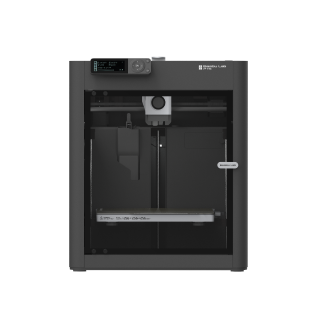
Bambu Lab P1S
P1S (standard, without AMS - not the P1P, P1S Combo or P2S)
A worked example, not a recommendation. It is genuinely enclosed and it genuinely filters — but with activated carbon, one of the two stages the UK guidance names.
- Build volume
- 256 × 256 × 256 mm (Bambu Studio defaults to 250 mm height)
- Technology
- FDM
- Max speed
- 500 mm/s toolhead (20 m/s² acceleration)
- Enclosed
- Yes (plastic and glass; chamber temperature regulator fan and activated-carbon filter)
- Multi-colour
- Optional (AMS or AMS 2 Pro sold separately or as a Combo)
- Auto levelling
- Yes (automatic bed levelling sensor)
Its chamber is enclosed in plastic and glass and its filtration is activated carbon — the gas stage: right for odour, wrong for ultrafine particles. That does not make it a poor choice; it is far safer than an open frame at half the price. It means the box and the filter are doing two jobs and only one is finished. A recurring theme among owners printing ABS and ASA indoors is that the built-in carbon filter is treated as a partial measure rather than a complete one, with several describing ducting the exhaust outside or adding filtration, although this is not consistent across all reports.
| Specification | Bambu Lab P1S | ELEGOO Mars 5 Ultra |
|---|---|---|
| Main hazard | What it heats, and what that puts in the air | What sits in the vat |
| Containment it ships with | Sealed chamber and a carbon filter | A cover that blocks light, nothing behind it |
| What you must add | Extraction, for ABS or ASA | Gloves, eye protection, ventilation, disposal route |
| Burn and trap risk | Real — hot nozzle, hot bed, moving gantry | None; nothing is heated |
Three things people get wrong
That PLA is harmless. It is the least hazardous common filament, which is why the guidance makes it the default . Least hazardous is a ranking, not a clean bill of health.
That an enclosure deals with fumes. It deals with particles ; the same study calculated no control efficiency for gases . If you can still smell the print, the box is working on something other than what you notice.
That a resin printer's lid is a seal. It is a light shield, and one widely sold machine has no filtration behind it .
The home safety checklist
Five things, in the order they stop mattering.
1. Choose the material before the machine. PLA by default, ABS and ASA a separate decision needing real extraction . This moves the answer further than any accessory.
2. Pick a room you can ventilate, and not the one you sit in all day .
3. Prefer enclosed, and know what it is for. A strong particle control , a burn and entrapment control at once , not an odour control without a carbon stage . Leave the door shut a while after the print finishes; the guidance asks for a clearance time and sets no figure .
4. Hard non-flammable surface, clearance, smoke alarm in the room . Decide in advance which jobs run unsupervised , and check the box carries UKCA or CE .
5. For resin, buy the gloves, the eye protection and the disposal route with the machine . Liquid resin and resin-contaminated alcohol go neither down a drain nor in the bin .
Where to go next
If this pushed you towards a closed box, that is a specification to shop on rather than a brand. The best 3d printer uk shortlist ranks on everything else once containment is settled, the best FDM 3D printers roundup is the filament-only version, and the best budget 3D printers guide is where price is traded against an enclosure.
If the resin section did not put you off, good — it was meant to make running one a decision rather than a surprise. The best resin printers roundup covers the machines, and the best resin printers for miniatures guide covers what most people buy one for.
How this article was researched
This guide is research-based. No printer named here was bought, tested, measured or photographed by us, no air sample was taken, and nothing on the page is offered as something we observed.
Every figure traces to a primary source recorded with the date it was read: UK legislation, GOV.UK guidance and statistics, CLEAPSS guide G276 and the HSE research behind it, two peer-reviewed emissions studies, manufacturers' manuals and material guides, a regulator's recall notice, and an open-source firmware project's configuration file.
Four things are absent because no primary source could be found: a UK figure for how often 3D printers start fires; a safe exposure duration or air-quality threshold for a home; a published clearance time for opening an enclosure; and any regulator assessment of a particular printing resin, the sensitisation evidence here concerning resins and acrylates at work generally. Two scope limits: the firmware documentation describes the configuration most machines derive from rather than every machine, and the university standard quoted binds its own staff. Owner-experience passages are marked, summarise recurring patterns across manufacturers' forums and specialist long-term reviews, and quote no review and no rating.
Common questions
- What should UK buyers know about whether 3D printers are safe at home?
- That the answer turns on the material and the room far more than on the machine, and that the UK has its own guidance rather than needing American rules borrowed for it. CLEAPSS guide G276, written with the Health and Safety Executive and endorsed by it, asks that PLA be the main filament, that ABS be avoided, and that the nozzle run at the low end of the supplier's melt range because hotter nozzles emit more. Do that in a room you can ventilate, keep the machine off the desk you sit at all day, and the ordinary case is a reasonable one. The two UK-specific checks nobody mentions are both on the box: a mains appliance supplied here must arrive correctly fitted with a BS 1363 plug and a BS 1362 fuse, and it should carry UKCA or CE, either of which Great Britain still recognises. On fire, the honest position is that no UK statistic counts fires started by 3D printers — the official England dataset on appliance fires lists twenty-nine appliance categories and a 3D printer is not one of them — so anyone quoting you a rate has made it up.
- Which factors change the answer for FDM and resin users?
- They are almost opposite machines from a safety point of view. A filament printer heats plastic, so it carries the hazards that come with heat: ultrafine particles and gases from the melt, a nozzle the guidance puts between 200 and 300 °C, a bed between 50 and 100 °C, a moving gantry that can catch hair or fingers, and heaters held on by software with thermal runaway protection as the backstop. A resin printer heats nothing, so all of that falls away — and is replaced by a liquid you have to handle. The Health and Safety Executive lists resins and acrylates among the agents that cause occupational skin disease and notes that sensitisation, once it happens, is generally lifelong, which is why gloves and eye protection are the manufacturers' own requirement rather than editorial caution. The resin decision also continues after the print: models need washing in strong alcohol unless the resin is water-washable, and neither liquid resin nor resin-contaminated alcohol may go down a drain or into household waste. In short, filament asks you to think about the room; resin asks you to change how you work.
- What practical checklist should a buyer follow?
- Material first: PLA as the default, ABS and ASA treated as a separate decision needing real extraction, and the nozzle run cool. Room second: one you can ventilate, and not the one you sit in all day, because proximity and time near a running printer both raise exposure. Containment third, understanding what it buys — measurements put a plain enclosure well behind a filtered one, and ducting the exhaust outdoors ahead of both, but that evidence is about particles only; the same study calculated no control efficiency for gases, which is why the guidance names a HEPA-class stage and a carbon stage for two different problems. Then the cheap checks: a BS 1363 plug and a conformity mark on arrival, a hard non-flammable surface with clearance, and a smoke alarm in the room — already a legal requirement in rented homes in England, and a sensible floor for anybody. Decide in advance which jobs you will leave unsupervised; the manufacturer instruction is not to leave the machine running alone at all. And for resin, buy the gloves, the eye protection and the disposal route at the same time as the printer, not afterwards.